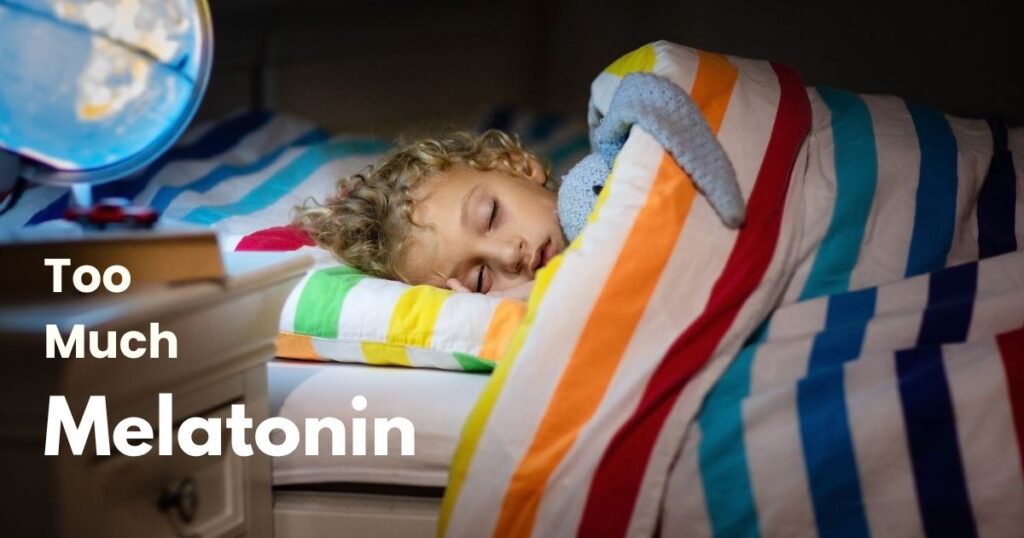
Melatonin may help some children, but it should not be treated like a routine sleep medicine.
Gummies can pose an accidental-ingestion risk, product strength can vary, and long-term safety in children remains uncertain.
Parents should discuss melatonin with a pediatric healthcare professional before giving it to a child.
What Is Melatonin?
Melatonin is a hormone naturally produced by the brain. It helps regulate the body’s circadian rhythm, or internal body clock, and signals that it is time for biological night.
Melatonin is not simply a hormone that “knocks you out.” Its main role is to help coordinate sleep timing.
This distinction matters when talking about children.
A child who struggles to fall asleep does not necessarily have a melatonin problem. Sleep difficulties can be related to an inconsistent bedtime, evening screen use, anxiety, an irregular schedule, an uncomfortable sleep environment, an underlying medical condition or a circadian rhythm disorder.
Melatonin supplements may have a role in some of these situations, but they should not automatically be the first answer to every childhood sleep problem.
The American Academy of Sleep Medicine (AASM) recommends that parents discuss melatonin with a healthcare professional and notes that many sleep problems can be better managed through changes in schedules, habits and behaviors rather than supplements.
Why Are Parents Giving Melatonin to Children?
There are several reasons parents may consider melatonin.
A child may:
- Have difficulty falling asleep
- Have an irregular sleep schedule
- Struggle to adjust to a new sleep schedule
- Have a circadian rhythm sleep problem
- Have certain neurodevelopmental conditions associated with sleep difficulties
- Continue having sleep problems despite healthy sleep routines
Melatonin may help some children with autism spectrum disorder or ADHD, and it may be useful for certain circadian sleep-wake problems. In these situations, its use should be discussed with and monitored by a pediatric healthcare professional.
But there is another reason melatonin has become popular.
It is widely available as a supplement and comes in forms that are easy for children to take, including gummies, chewable tablets, liquids, capsules and tablets.
That convenience also creates a safety concern.
A product that looks and tastes like candy can be particularly attractive to a young child.
Are Melatonin Gummies Safe for Kids?
They can be used safely in some circumstances, but “safe” does not mean risk-free.
Current evidence suggests that melatonin appears to be relatively safe for many children when used at normal doses for the short term. However, there are relatively few studies in children, and long-term safety has not been established.
This is an important distinction.
We should not tell parents that melatonin gummies are inherently dangerous.
At the same time, melatonin should not be treated like an ordinary vitamin or snack.
Melatonin is a hormone, and children are still growing and developing. Researchers have questions about whether prolonged supplementation could affect hormonal development, including puberty, but current evidence does not allow us to say that long-term melatonin definitely causes these problems.
Take-Home Message
Melatonin may be appropriate for some children, but short-term safety is better understood than long-term safety. It should be used thoughtfully rather than routinely.
Why Are Melatonin Gummies a Special Concern?
Gummies create two important safety issues.
They can look like candy
Gummies are flavored, chewable and often colorful.
That makes them more appealing to children and easier to consume accidentally.
CDC surveillance found that gummy formulations were the most commonly documented specific dosage form, accounting for 47.3% of estimated emergency-department visits involving unsupervised melatonin ingestion among children aged 5 years and younger during 2019–2022.
The amount may not always match the label
This is another concern parents may not realize.
NCCIH reports that a 2023 study tested 25 over-the-counter melatonin gummy products. Twenty-two of the 25 products were inaccurately labeled.
One product contained no detectable melatonin. Among the products that did contain melatonin, measured amounts ranged from 74% to 347% of the amount stated on the label.
That means a product labeled “1 mg” should not automatically be assumed to contain exactly 1 mg.
This is particularly important when a supplement is being given to a child.
Take-Home Message
Gummies can be attractive to children, and some products may not contain exactly the amount stated on the label. Treat melatonin like medicine, not candy.
How Common Is Accidental Melatonin Ingestion?
The concern becomes clearer when we look at U.S. surveillance data.
A 2024 CDC report estimated 10,930 emergency-department visits among U.S. children aged 5 years and younger for unsupervised melatonin ingestion during 2019–2022. These represented about 7.1% of all emergency-department visits for unsupervised medication exposures in this age group.
Most of these visits did not result in hospitalization. In the CDC analysis, 93.5% did not result in hospitalization.
That is reassuring, but accidental ingestion should still be taken seriously.
The CDC specifically emphasized keeping all medications and supplements, including melatonin gummies, out of children’s reach and sight.
Take-Home Message
Most reported accidental ingestions in young children did not require hospitalization, but the number of emergency visits shows why safe storage is essential.
Also Read: Our Melatonin Guide | Circadian Rhythm and Melatonin | Your Body's Natural Melatonin Production
Can a Child Take Too Much Melatonin?
Yes.
A child can consume more melatonin than intended, especially after finding a bottle of gummies or chewable tablets.
However, “too much” does not automatically mean severe poisoning.
CDC data found that most young children presenting after unsupervised ingestion did not require hospitalization. Earlier poison-center surveillance also found that most pediatric exposures resulted in minimal or no effects, although some children developed symptoms and some required hospital care.
Possible symptoms can include:
- Drowsiness
- Headache
- Dizziness
- Agitation
- Increased urination or bedwetting
- Gastrointestinal symptoms
The situation can be more complicated if the amount taken is unknown, a large amount was consumed, or other substances were also involved.
What Should Parents Do?
If you believe your child has swallowed an unknown or excessive amount of melatonin, do not try to estimate the risk from the number of gummies alone.
Keep the product packaging available so healthcare professionals can identify:
- The product
- Strength per serving
- Other ingredients
- Approximate amount consumed
- Time of ingestion
Contact your local poison-control service or emergency medical service for advice.
If the child is difficult to wake, has trouble breathing, has a seizure, collapses or appears seriously unwell, seek emergency medical care immediately.
Take-Home Message
If a child takes an unknown or excessive amount of melatonin, get professional poison or emergency advice rather than trying to judge the risk yourself.
What Are the Side Effects of Melatonin in Children?
When side effects occur, they are generally mild in the available short-term research.
Reported effects include:
- Drowsiness
- Headache
- Dizziness
- Agitation
- Increased urination or bedwetting
Not every child experiences these effects. Current evidence does not suggest that serious adverse effects occur in most children taking normal doses for short periods.
However, a child’s response can vary.
Parents should also avoid responding to a lack of effect by simply increasing the dose.
A child who does not sleep better after taking melatonin may have a sleep problem that melatonin cannot fix.
Take-Home Message
Most reported side effects are mild, but parents should not simply increase the dose when melatonin does not appear to work.
Is Melatonin Addictive or Can Children Become Dependent?
This question needs some nuance.
Melatonin is not considered an addictive drug in the way substances such as nicotine, alcohol or opioids are.
There is also no good evidence that children develop a classic physical dependence on melatonin that produces a typical withdrawal syndrome when they stop taking it.
But parents may be asking a slightly different question:
“Will my child become unable to sleep without melatonin?”
There is no strong evidence that melatonin causes this kind of addiction.
However, if a supplement becomes the automatic response to every bedtime problem, parents may overlook the underlying reason their child is struggling to sleep.
That is one reason professional guidance emphasizes healthy sleep habits and identifying the cause of the sleep problem rather than simply continuing supplementation indefinitely.
Take-Home Message
Melatonin is not considered addictive, but regular reliance on it should not replace finding and addressing the reason a child is having trouble sleeping.
Also Read: Foods Rich in Melatonin | Blue Light and Melatonin
Does Melatonin Stop the Body From Making Its Own Melatonin?
You may see claims online that taking melatonin supplements causes the body to “stop producing melatonin naturally.”
That claim is too strong.
There is not enough evidence to say that melatonin permanently switches off a child’s natural melatonin production.
The body’s own melatonin production is regulated primarily by the circadian rhythm and light-dark cycle.
Because melatonin is a hormone, researchers remain interested in its possible effects on hormonal development during prolonged use. But that is different from proving that supplements permanently suppress the body’s natural production.
Take-Home Message
There is not enough evidence to say that melatonin permanently suppresses a child’s natural melatonin production. The bigger unanswered question is the effect of long-term use during development.
Also Read: Our Melatonin Dosage Guide | Melatonin Side Effects | Melatonin Drug Interactions
What About Long-Term Melatonin Use in Children?
This is one of the biggest unanswered questions.
Short-term use has a better-established safety profile than long-term use.
NCCIH states that normal-dose melatonin appears to be safe for most children in the short term, but there is little information about long-term effects.
Researchers are particularly interested in possible effects on hormonal development and puberty because melatonin is itself a hormone involved in biological timing.
But this is where medical writing needs to be careful.
It would be inappropriate to tell parents:
“Melatonin damages puberty.”
Current evidence does not establish that.
The more accurate statement is:
“The long-term effects of melatonin use during childhood and adolescence are not yet well established.”
That is what parents need to know.
Take-Home Message
Long-term melatonin safety in children remains uncertain. If a child needs melatonin regularly, the treatment should be reviewed with a pediatric healthcare professional.
How Much Melatonin Should a Child Take?
This is where parents should be particularly careful.
There is no single melatonin dose that is appropriate for every child.
The appropriate amount depends on factors such as:
- The child’s age
- The reason melatonin is being considered
- Sleep pattern
- Other medications
- Medical conditions
- Product formulation
- Timing of administration
HealthyChildren.org notes that some children respond to a low dose such as 0.5 mg or 1 mg, often given 30–90 minutes before bedtime, and that many children who benefit do not need more than 3–6 mg. However, it also emphasizes that there are no specific pediatric dosing guidelines and that parents should discuss dose and timing with their child’s pediatrician.
For that reason, parents should not use an age-based formula from an internet article.
For example:
“My child is six, so 3 mg must be appropriate.”
That does not take into account why melatonin is being used or the child’s individual circumstances.
Take-Home Message
There is no one-size-fits-all melatonin dose for children. Dose and timing should be individualized with guidance from a pediatric healthcare professional.
Also Read: When to take Melatonin | Can you take Melatonin everynight? | Melatonin Addiction
When Might Melatonin Actually Help Children?
Melatonin should not be considered a general-purpose sleep medicine for every child.
There are situations in which it may have a role.
For example, melatonin may help some children with:
- Circadian rhythm sleep problems
- Certain neurodevelopmental disorders
- Difficulty shifting an established sleep schedule
- Specific sleep problems where behavioral strategies alone have not been sufficient
The AAP notes that melatonin may help some children with neurodevelopmental disorders such as autism or ADHD, while the AASM advises parents to discuss use with a healthcare professional.
The important question is not simply:
“Does my child have trouble sleeping?”
It is:
“Why is my child having trouble sleeping?”
A child who stays awake because of an inconsistent schedule or excessive evening stimulation has a different problem from a child with a genuine circadian rhythm disorder.
Take-Home Message
Melatonin can have a role in selected pediatric sleep problems, but the reason for using it matters as much as the supplement itself.
Melatonin Should Not Replace Healthy Sleep Habits
This is one of the most important messages for parents.
Before reaching for a melatonin gummy, look at the child’s sleep routine.
A healthy bedtime routine may include:
- Going to bed and waking at consistent times
- Having a predictable wind-down period
- Reducing stimulating activities before bed
- Limiting bright light and screens in the evening
- Keeping the bedroom comfortable and quiet
- Avoiding caffeine later in the day
- Getting appropriate daytime physical activity
- Making sure the child gets enough age-appropriate sleep
The AASM specifically notes that many sleep problems can be better managed through changes in schedules, habits and behaviors rather than melatonin.
Take-Home Message
Melatonin should support a good sleep plan—not replace one.
How Should Parents Store Melatonin Gummies?
Treat melatonin like other medications and supplements.
Do not leave a bottle on a bedside table, kitchen counter or anywhere a young child can reach it.
Instead:
- Keep it out of sight and reach.
- Close the container securely after every use.
- Use child-resistant packaging when available.
- Do not describe gummies as candy.
- Do not let children take them without supervision.
- Keep adult and child supplements stored safely.
- Avoid transferring gummies into unlabeled containers.
CDC data found that bottles were a documented source of access in a substantial proportion of pediatric ED visits, and the agency emphasizes keeping medications and supplements out of children’s reach and sight.
Take-Home Message
Store melatonin like medicine, not like a snack. The safest gummy is one a child cannot accidentally access.
Also Read: Melatonin for Older Adults | Melatonin for Pregnant Women
Why Does Product Quality Matter?
There is another issue parents may not realize.
In the United States, melatonin is sold as a dietary supplement, rather than being regulated in the same way as FDA-approved medicines. As a result, product quality and labeling can vary.
The 2023 analysis of 25 melatonin gummy products illustrates the problem.
Only 3 of 25 products were accurately labeled for their measured melatonin content. Among products containing detectable melatonin, measured amounts ranged from 74% to 347% of the labeled quantity.
This does not mean every melatonin product is unreliable.
It means parents should understand that the label may not always tell the whole story.
The AASM advises discussing product selection with a healthcare professional and, where available, choosing products carrying the USP Verified Mark.
Take-Home Message
Product quality matters. Parents should discuss the product, dose and formulation with a healthcare professional rather than assuming every gummy contains exactly what its label says.
Also Read: Can you overdose on Melatonin | Melatonin gummies vs Tablets
What If My Child Takes Melatonin Every Night?
Don’t panic, but don’t automatically continue indefinitely either.
If your child has been taking melatonin every night, talk with the child’s pediatrician about:
- Why it was started
- How long it has been used
- The current dose
- Whether it is still helping
- Whether the original sleep problem has been identified
- Whether another treatment approach would be better
There is no evidence that every child who takes melatonin nightly will develop serious harm.
At the same time, the limited long-term safety data mean that regular use deserves periodic review.
The goal should not simply be:
“How can we keep the child asleep with melatonin?”
It should be:
“Why is this child having difficulty sleeping, and what is the safest long-term approach?”
Take-Home Message
If a child uses melatonin regularly, periodic review with a pediatrician is sensible because both long-term safety and the underlying sleep problem matter.
When Should a Child With Sleep Problems See a Doctor?
Not every sleep problem requires medication.
But persistent or unusual sleep problems deserve evaluation.
Talk with a pediatrician if your child:
- Has persistent difficulty falling or staying asleep
- Snores loudly or regularly
- Has pauses in breathing during sleep
- Is excessively sleepy during the day
- Has unusual nighttime movements
- Has significant behavioral or school problems related to poor sleep
- Has a major unexplained change in sleep
- Needs melatonin regularly to sleep
- Has another medical condition or takes medications that may affect sleep
A child who needs a supplement every night may need a proper sleep assessment, rather than simply a larger or different gummy.
Also Read: Melatonin For Jetlag | Melatonin For Shift workers
Melatonin Gummies: Safety Guide
| Question | What Parents Should Know |
|---|---|
| Is melatonin safe for kids? | Short-term use appears relatively safe for many children, but long-term safety is less certain. |
| Can children take too much? | Yes. Unsupervised ingestion can lead to poisoning and emergency visits. |
| Are gummies risky? | They can be more appealing to young children and are frequently involved in accidental ingestion. |
| Can melatonin be addictive? | It is not considered an addictive drug, but regular reliance should still be reviewed. |
| Does it stop natural melatonin production? | There is not enough evidence to say that it permanently does. |
| Is there one correct dose? | No. Pediatric dosing and timing should be individualized. |
| Can children use it every night? | Some children may use it regularly under medical guidance, but long-term use should be reviewed. |
| Should gummies be stored like candy? | No. Store them like medicine, safely out of children’s reach and sight. |
Frequently Asked Questions
Can a 2-Year-Old Take Melatonin?
A young child should not routinely be given melatonin without guidance from a pediatric healthcare professional. Sleep difficulties in toddlers can have many causes, and melatonin should not be used simply because a child is difficult to settle at bedtime.
Can a 5-Year-Old Take Melatonin Gummies?
Some children may use melatonin under professional guidance, but age alone does not determine whether it is appropriate. The reason for use, dose, timing and child’s health all matter.
What Happens If a Child Accidentally Eats Melatonin Gummies?
Many accidental ingestions result in minimal or no symptoms, but some children develop drowsiness or other symptoms and some require medical care. If the amount is unknown or excessive, contact a poison-control service or healthcare professional for advice.
Can Melatonin Affect Puberty?
There is a theoretical concern because melatonin is a hormone involved in biological timing, but current evidence is insufficient to say that melatonin supplements cause abnormal puberty. Long-term studies are still needed.
Can Children Take Melatonin Every Night?
Some children may use melatonin regularly under medical supervision, particularly for specific sleep or circadian problems. However, routine long-term use should be reviewed with a pediatrician, because long-term safety data are limited.
Is Melatonin Better Than Sleeping Pills for Children?
Melatonin is different from conventional sedative sleep medications and may have a role in selected pediatric sleep problems. But it should not be assumed to be appropriate for every child simply because it is sold as a supplement.
What Is the Safest Way to Give Melatonin to a Child?
The safest approach is to discuss the reason, product, dose and timing with the child’s pediatrician, use the lowest appropriate amount recommended by that clinician, and store the product securely.
Also Read: Melatonin and Weird Dreams | Melatonin Myths and Facts | Benefits of Melatonin beyond sleep.
The Bottom Line
Melatonin can be useful for some children, but it should not become a routine solution for every bedtime problem.
The most important concerns are accidental ingestion, product variability, inappropriate use and limited long-term safety data.
For some children with specific sleep or circadian problems, melatonin may have a legitimate role. But the decision should be made with a pediatric healthcare professional, particularly when regular use is being considered.
For most children, the foundation remains:
consistent sleep schedules, healthy bedtime routines, appropriate evening light exposure and good sleep habits.
And if melatonin is used, remember one simple rule:
Treat melatonin gummies like medicine—not candy.
References
- American Academy of Pediatrics / HealthyChildren.org. Melatonin for Kids: What Parents Should Know About This Sleep Aid. Read the AAP guidance
- National Center for Complementary and Integrative Health (NCCIH). Melatonin: What You Need to Know. Read the NCCIH guidance
- Freeman DI, Lind JN, Weidle NJ, et al. Notes from the Field: Emergency Department Visits for Unsupervised Pediatric Melatonin Ingestion — United States, 2019–2022. MMWR Morbidity and Mortality Weekly Report. 2024;73:215–217. Read the CDC report
- Rishi MA, Khosla S, Sullivan SS; American Academy of Sleep Medicine. Health Advisory: Melatonin Use in Children and Adolescents. Journal of Clinical Sleep Medicine. 2023;19:415. Read the AASM advisory