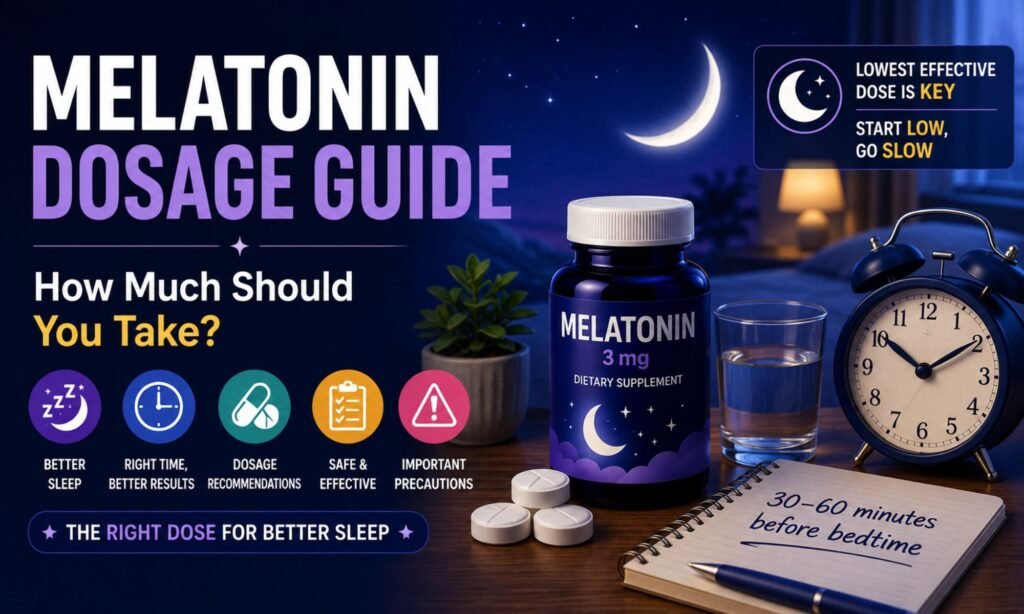
One bottle contains 1 mg.
The one beside it contains 5 mg.
A few shelves away, you’ll find 10 mg gummies labeled “extra strength.”
It’s easy to assume the highest dose works best. But with melatonin, that’s usually not true.
For many people, taking more doesn’t improve sleep. Instead, it increases the chance of side effects such as morning grogginess, headaches, or vivid dreams.
The goal isn’t to take the highest dose.
It’s to find the lowest dose that helps you sleep.
This guide explains what current evidence says about melatonin dosage, when different doses may be appropriate, and why timing often matters as much as the dose itself.
Melatonin Dosage Guide for Sleep
| Situation | Typical Starting Dose* | Important Note |
| First-time adult user | 0.5–1 mg | Start low and increase only if needed. |
| Trouble falling asleep | 1–3 mg | Timing is often more important than taking more. |
| Older adults | 0.3–1 mg | Lower doses often work well and may reduce side effects. |
| Children | Only under medical supervision | Dose depends on age, medical history, and the reason for treatment. |
| Jet lag | Usually 0.5–5 mg | Take it based on bedtime at your destination. |
| Shift workers | Individualized | Timing depends on your work schedule and planned sleep time. |
These are general dosage ranges based on current evidence and expert recommendations. The right dose varies from person to person.
Remember: The best melatonin dose is usually the lowest dose that helps you sleep.
Table of Contents
Also Read: Our Melatonin Guide | Circadian Rhythm and Melatonin | Your Body's Natural Melatonin Production

How to Find the Right Melatonin Dose ?
There isn’t a single melatonin dose that works for everyone.
The right amount depends on your age, why you’re taking it, how your body responds, and when you take it. Two people can take the same dose and have very different results.
Research has also changed over time. While early studies often used higher doses, current evidence supports a simpler approach:
Start with the lowest effective dose and increase only if needed.
Choosing the right dose isn’t just about the number on the label. It also means using a reliable product, taking it at the right time, and having realistic expectations.
This guide focuses on melatonin dosage. For a complete overview of how melatonin works, its benefits, safety, and side effects, see our cornerstone guide.
Melatonin Dosage Guide
Many articles list melatonin doses but don’t explain how to choose the right one.
In this guide you’ll learn:
- Why there isn’t one standard dose for everyone
- Why timing often matters more than dose
- How dosage differs for adults, older adults, children, jet lag, shift work, and circadian rhythm disorders
- Why higher doses don’t always improve sleep
- When it’s time to speak with a healthcare professional
By the end, you’ll know not only how much melatonin to take, but also how to use it safely and effectively
Is There a Standard Melatonin Dose?
No. There isn’t one “perfect” melatonin dose for everyone.
Unlike many medications, the right dose depends on factors such as your age, sleep problem, individual response, and when you take it. One person may sleep well with 0.5 mg, while another may need a different approach—or simply better timing.
Instead of asking, “What’s the standard dose?”, ask:
“What’s the lowest dose that works for me?”
That’s the approach many sleep specialists recommend today.
Why Doesn’t Melatonin Have a Standard Dose?
Melatonin works by supporting your body’s circadian rhythm—your internal clock—not by forcing you to sleep.
Because everyone’s body clock is different, the ideal dose can vary.
Factors that influence melatonin dosage include:
- Age
- Natural melatonin production
- The type of sleep problem
- Individual sensitivity
- Current medications
- Medical conditions
- Evening light exposure
- Daily routine and work schedule
Someone with occasional difficulty falling asleep may not need the same dose as someone recovering from jet lag or managing a circadian rhythm disorder.
The goal isn’t to find a dose that works for everyone.
It’s to find the lowest dose that works for you.
Why Do Some Products Contain 10 mg or More?
If lower doses often work well, why are supplements sold in strengths of 10 mg or even higher?
Because manufacturers can sell melatonin in a wide range of doses, and a higher number doesn’t necessarily mean better results.
Research hasn’t consistently shown that larger doses improve sleep. For many people, they simply increase the risk of side effects.
Quick Fact: Your body naturally produces only a tiny amount of melatonin each night. That’s one reason many experts recommend starting with a low-dose supplement.
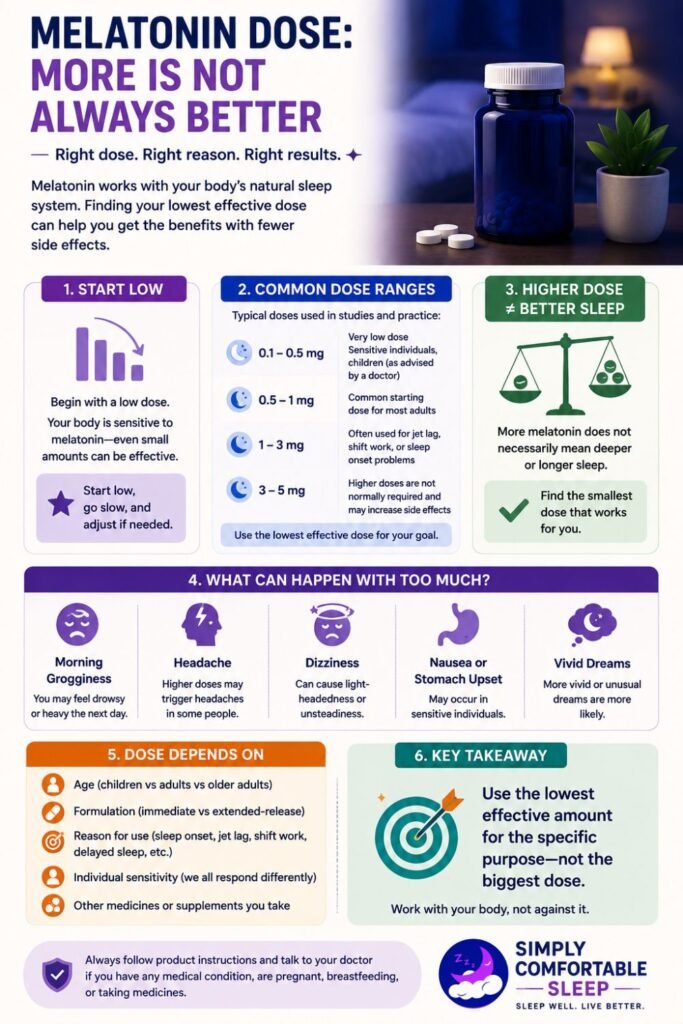
Research Has Shifted Toward Lower Doses
Earlier studies commonly tested doses between 3 mg and 10 mg. As more evidence became available, researchers found that 0.3–3 mg is often enough to help many adults fall asleep.
Higher doses haven’t consistently been shown to improve sleep, but they’re more likely to cause:
- Morning grogginess
- Headache
- Dizziness
- Vivid dreams
- Daytime sleepiness
That’s why current recommendations usually favor starting low rather than starting high.
Common Myth: “If 3 mg helps, 10 mg must work better.”
Fact: Research doesn’t consistently support this. Higher doses often add side effects without providing better sleep.
Why Do Different Websites Recommend Different Doses?
You’ll find recommendations ranging from 1 mg to 10 mg because melatonin has been studied for different sleep problems.
The suggested dose may vary depending on:
- The sleep condition being treated
- Age
- Whether the product is immediate-release or extended-release
- National guidelines
- The quality of available evidence
Rather than relying on one “magic number,” healthcare professionals consider your symptoms, medical history, medications, and sleep schedule before recommending a dose.
The best melatonin dose isn’t the highest one on the shelf—it’s the lowest dose that helps you sleep with the fewest side effects.
Also Read: When to take Melatonin | Can you take Melatonin everynight? | Melatonin Addiction
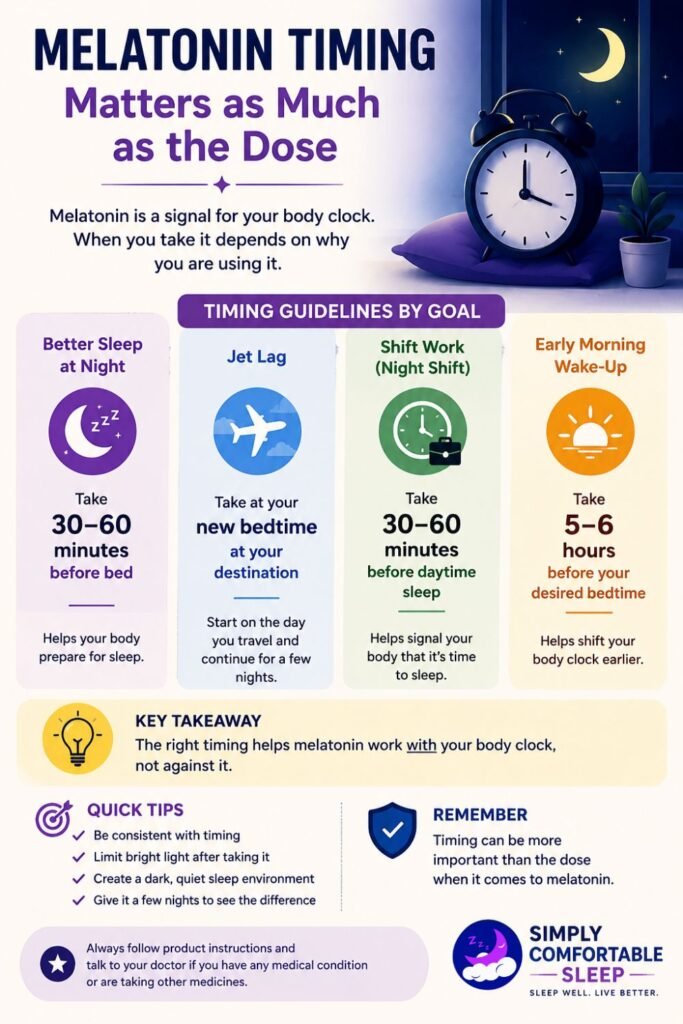
Why Timing Matters More Than Dose
Many people focus on how much melatonin to take. Sleep specialists often ask a different question first:
“What time are you taking it?”
That’s because melatonin is more than a sleep aid—it’s a signal that tells your brain it’s time for sleep. Taking it at the right time can be just as important as choosing the right dose.
Melatonin Works With Your Body Clock
Your body naturally releases melatonin in the evening to prepare you for sleep. A supplement works best when it reinforces that process.
For many adults with difficulty falling asleep, melatonin is commonly taken 30 minutes to 2 hours before bedtime, depending on the product and the reason for use.
However, this timing isn’t right for everyone. People using melatonin for jet lag or circadian rhythm disorders often need a different schedule.
A Small Dose at the Right Time Can Work Better
Imagine these two situations:
- Someone takes 10 mg just before bed, then spends an hour scrolling on their phone.
- Someone else takes 0.5 mg about an hour before bed, dims the lights, and follows a relaxing bedtime routine.
The second person is often more likely to benefit—not because of a higher dose, but because melatonin is working with the body’s natural sleep signals.
Doctor’s Tip: Before increasing your dose, ask yourself: “Am I taking melatonin at the right time?” Improving timing often works better than buying a stronger supplement.
Evening Light Can Reduce Melatonin’s Effect
Bright light from phones, tablets, TVs, and other screens can suppress your body’s natural melatonin production.
To help melatonin work better:
- Dim the lights about an hour before bed.
- Limit screen time whenever possible.
- Use blue-light filters or night mode if screens are unavoidable.
- Keep a regular bedtime.
These habits can improve sleep as much as increasing the dose.
Timing Depends on Why You’re Taking Melatonin
There’s no single schedule that suits everyone.
For example:
- Jet lag: Timing should match bedtime at your destination.
- Shift work: Timing depends on when you plan to sleep.
- Circadian rhythm disorders: Melatonin may need to be taken several hours before your usual bedtime.
The best timing always depends on why you’re using melatonin, not just how many milligrams you take
Melatonin Dosage Basics
Before looking at specific situations, it helps to understand a few principles that apply to most people using melatonin.
Start With the Lowest Effective Dose
This is the most important rule.
Instead of choosing the highest-strength supplement, begin with the lowest dose likely to help. For many adults, that’s 0.3–1 mg, although some people may need more depending on why they’re taking melatonin.
Starting low helps you:
- Reduce the risk of side effects
- Find the smallest dose that works
- Avoid taking more melatonin than necessary
- Adjust the dose more easily if needed
The goal isn’t to take more melatonin. It’s to take just enough.
Doctor’s Tip: If 1 mg helps you sleep, there’s usually no benefit in increasing the dose to 5 mg or 10 mg.
Give the Dose Time to Work
Melatonin doesn’t always produce results on the first night.
Some people notice an improvement quickly, while others may need a few days of consistent use. Avoid changing the dose every night, as it becomes difficult to judge whether it’s working.
Unless your healthcare provider advises otherwise, stay with the same dose for several nights before making changes.
Increase Gradually if Needed
If a low dose isn’t helping, increase it slowly rather than making a large jump.
For example, moving from 1 mg directly to 10 mg is rarely necessary.
A gradual approach makes it easier to find the lowest effective dose while reducing the chance of side effects.
Common Myth: “If melatonin doesn’t work tonight, I’ll double the dose tomorrow.”
Fact: Before increasing the dose, review your timing, bedtime routine, evening light exposure, and caffeine intake. These often affect sleep more than the dose itself.
Match the Dose to the Reason You’re Taking It
The best dose depends on why you’re using melatonin.
Recommendations differ for:
- Occasional difficulty falling asleep
- Jet lag
- Shift work
- Circadian rhythm disorders
- Age-related changes in melatonin production
That’s why there isn’t a single dose that’s right for everyone.
Support Melatonin With Healthy Sleep Habits
Melatonin works best alongside good sleep habits, not instead of them.
For better results:
- Keep a consistent sleep schedule.
- Limit caffeine later in the day.
- Make your bedroom cool, dark, and quiet.
- Avoid large meals close to bedtime.
- Reduce screen time before bed.
Think of melatonin as one part of a healthy sleep routine—not the entire solution.
Melatonin Dosage for Different Situations
The right melatonin dose depends on why you’re taking it. Age, sleep goals, and your body’s internal clock all influence the best approach.
Adults
For most healthy adults, a starting dose of 0.5–1 mg is a sensible place to begin. If needed, it can be increased gradually. Many studies suggest that 0.3–3 mg is enough for people who have trouble falling asleep.
Adult Melatonin Dosage Guide
| Situation | Typical Dose Range |
| First-time users | 0.5–1 mg |
| Difficulty falling asleep | 1–3 mg |
| Persistent sleep problems | Individualized by a healthcare provider |
| Jet lag | Usually 0.5–5 mg |
These are general ranges, not fixed recommendations. The right dose depends on your medical history, sleep problem, and response to treatment.
Doctor’s Tip: Give the same dose for a few nights before increasing it.
If melatonin isn’t helping, review your timing and sleep habits before assuming you need more.
Speak with a healthcare professional before using melatonin if you:
- Are pregnant or breastfeeding
- Have epilepsy or another seizure disorder
- Have an autoimmune disease
- Take blood thinners
- Use medicines for diabetes or high blood pressure
- Have chronic liver disease
- Have persistent insomnia
- Snore loudly or may have obstructive sleep apnea
Also Read: Can you overdose on Melatonin | Melatonin gummies vs Tablets
Older Adults
Natural melatonin production often decreases with age, but that doesn’t mean higher doses are needed.
Older adults may be more sensitive to melatonin and clear it more slowly, increasing the risk of:
- Morning grogginess
- Dizziness
- Balance problems and falls
- Confusion in some people
For this reason, many experts recommend starting with 0.3–1 mg.
Research suggests low-dose melatonin may modestly improve sleep in some older adults, especially when combined with healthy sleep habits.
Some prescription prolonged-release melatonin products have been studied in adults aged 55 years and older. These differ from over-the-counter supplements, which can vary in quality and strength.
Doctor’s Tip: Older adults usually benefit from starting with the lowest effective dose. A smaller dose taken at the right time often works better than a larger one that causes next-day drowsiness.
Because many older adults take several medicines, ask your doctor or pharmacist to check for interactions before starting melatonin.
Children
Not every child who struggles at bedtime needs melatonin.
Many children sleep poorly because of inconsistent bedtimes, excessive screen time, anxiety, or other habits that can often be improved without supplements.
If melatonin is considered, it should ideally be used under medical supervision.
There isn’t a standard dose for children. The right dose depends on factors such as:
- Age
- Body size
- Medical history
- Reason for treatment
- Other medications
- Underlying developmental or neurological conditions
Melatonin has been studied in children with conditions such as autism spectrum disorder (ASD) and ADHD, where it may help some children fall asleep more easily. Treatment should still be supervised by a pediatrician or pediatric sleep specialist.
Because melatonin gummies resemble candy, accidental ingestion has increased in recent years.
Parents should:
- Store melatonin out of sight and out of reach.
- Keep it in the original child-resistant container.
- Never describe it as candy.
- Give only the recommended amount.
Common Myth: “Natural means completely safe for children.”
Fact: Melatonin should be used carefully and, whenever possible, under medical supervision.
Seek medical advice if a child snores loudly, is unusually sleepy during the day, continues to struggle despite good sleep habits, or needs melatonin for an extended period.
Also Read: Melatonin For Jetlag | Melatonin For Shift workers
Jet Lag
Melatonin is one of the best-studied supplements for reducing jet lag.
Studies have used doses ranging from 0.5–5 mg, but many experts recommend starting with a lower dose, especially if you’ve never taken melatonin before.
The key is timing, not the dose.
Doctor’s Tip: Follow your destination’s bedtime from the first night. Melatonin works best when your sleep schedule changes with it.
Melatonin is usually taken close to your planned bedtime at your destination, helping your body adjust to the new time zone.
To recover faster:
- Spend time in natural daylight.
- Go to bed according to local time.
- Stay hydrated.
- Limit alcohol.
- Avoid caffeine later in the day.
Shift Workers
Melatonin may help some people fall asleep after a night shift, although research has shown mixed results.
Studies have commonly used doses between 1–5 mg, but starting with the lowest effective dose remains the preferred approach.
The best time to take melatonin depends on when you plan to sleep, not the clock.
Shift workers may also benefit from:
- Wearing sunglasses on the way home after sunrise
- Using blackout curtains
- Reducing daytime noise
- Keeping a consistent sleep schedule
- Avoiding caffeine before bedtime
Doctor’s Tip: Melatonin works best when combined with a dark, quiet sleeping environment.
Circadian Rhythm Disorders
Melatonin is often used to treat disorders affecting the body’s internal clock, including:
- Delayed Sleep-Wake Phase Disorder (DSWPD)
- Advanced Sleep-Wake Phase Disorder (ASWPD)
- Non-24-Hour Sleep-Wake Rhythm Disorder
- Irregular Sleep-Wake Rhythm Disorder
In these conditions, timing is usually more important than dose.
Melatonin acts as a time signal, helping shift the body’s internal clock. Depending on the disorder, it may need to be taken several hours before the usual bedtime rather than immediately before sleep.
Treatment is often combined with light therapy, regular sleep schedules, and careful management of light exposure for the best results.
Doctor’s Tip: Think of melatonin and light as partners. Melatonin signals that night has arrived, while light tells your brain it’s morning. Using both correctly often produces the best results.
Also Read: Melatonin Side Effects | Melatonin Drug Interactions
Common Melatonin Dosage Mistakes
Melatonin often gets blamed when it doesn’t work. In many cases, the problem is how it’s being used.
1. Starting With the Highest Dose
It’s easy to think a 10 mg tablet works better than 1 mg, but current evidence doesn’t support that.
Many people get good results with lower doses while experiencing fewer side effects.
2. Taking It at the Wrong Time
Timing is one of the most overlooked parts of melatonin use.
Taking melatonin too late or using bright screens before bed can reduce its effectiveness.
Doctor’s Tip: Before increasing your dose, ask yourself:
- Am I taking melatonin at the right time?
- Am I exposing myself to bright light before bed?
- Is my bedtime consistent?
3. Increasing the Dose Too Quickly
Don’t increase your dose after one poor night’s sleep.
Use the same dose for several nights before deciding whether it needs to be adjusted.
4. Ignoring Healthy Sleep Habits
Melatonin isn’t a substitute for good sleep habits.
Poor sleep can persist if you:
- Drink caffeine late in the day
- Use your phone in bed
- Keep an irregular sleep schedule
- Sleep in a bright or noisy room
5. Assuming Every Sleep Problem Needs Melatonin
Sleep problems can also be caused by:
- Stress or anxiety
- Depression
- Chronic pain
- Obstructive sleep apnea
- Restless legs syndrome
- Certain medications
- Thyroid disorders
- Excess caffeine or alcohol
If one of these is the cause, increasing your melatonin dose is unlikely to help.
Common Myth: “If melatonin doesn’t work, I need a higher dose.”
Fact: The real solution may be better timing, improved sleep habits, or treating an underlying sleep disorder.
6. Taking Melatonin for Months Without Reviewing It
If you’ve been taking melatonin regularly for weeks or months, review your sleep instead of automatically continuing.
Ask yourself:
- Has my sleep improved?
- Do I still need melatonin?
- Have my sleep habits improved?
- Could another health condition be affecting my sleep?
If you’re relying on melatonin long term, discuss it with your healthcare provider.
When Should You Talk to a Doctor?
Melatonin isn’t the right solution for every sleep problem.
Speak with a healthcare professional if you:
- Have insomnia lasting more than a few weeks
- Snore loudly or stop breathing during sleep
- Feel excessively sleepy during the day
- Are pregnant or breastfeeding
- Have epilepsy or another seizure disorder
- Have liver disease
- Have an autoimmune disorder
- Take blood thinners or medicines for diabetes, blood pressure, or immune conditions
- Are considering melatonin for a child
Sometimes the best treatment isn’t a different melatonin dose—it’s identifying the underlying cause of poor sleep.
Also Read: Melatonin for Older Adults | Melatonin for Pregnant Women | Melatonin for Kids.
Frequently Asked Questions
Is 10 mg of melatonin too much?
For most adults, 10 mg is more than needed. Research hasn’t consistently shown that doses above 3–5 mg improve sleep, but they are more likely to cause side effects such as morning grogginess, headache, dizziness, and vivid dreams.
Can I take melatonin every night?
Some people use melatonin regularly under medical supervision, while others use it only when needed.
If you rely on it every night for several weeks or months, discuss your sleep with a healthcare professional.
Also Read: Can You Take Melatonin Every Night?
How long before bed should I take melatonin?
For many adults, melatonin is commonly taken 30 minutes to 2 hours before bedtime.
The best timing depends on:
- The type of melatonin
- Why you’re taking it
- Your usual sleep schedule
People using melatonin for jet lag or circadian rhythm disorders may need a different schedule.
Can I take melatonin if I wake up in the middle of the night?
Generally, no, unless your healthcare provider advises it.
Taking melatonin in the middle of the night may increase next-day grogginess if you have only a few hours left before waking.
Can I split a melatonin tablet?
Usually, immediate-release tablets can be split if the manufacturer allows it.
Extended-release tablets should generally not be cut, crushed, or chewed because this can affect how they release melatonin.
Does body weight affect the right dose?
For adults, melatonin dosage is not usually based on body weight.
Healthcare providers are more likely to consider your age, medical history, sleep problem, medications, and previous response to melatonin.
Can I build up a tolerance to melatonin?
Current research suggests melatonin is less likely to cause tolerance than many prescription sleeping pills.
If it becomes less effective, don’t automatically increase the dose. Review your sleep habits and speak with your healthcare provider.
What if 1 mg doesn't help me sleep?
Before increasing your dose, ask yourself:
- Am I taking it at the right time?
- Have I used it consistently for several nights?
- Am I avoiding bright screens before bed?
- Could caffeine or another sleep problem be affecting my sleep?
If you’ve addressed these factors and still aren’t sleeping well, speak with your healthcare provider before making major dose changes.
Also Read: Foods Rich in Melatonin | Blue Light and Melatonin
Bottom Line
The best melatonin dose isn’t the highest one—it’s the lowest dose that helps you sleep while minimizing side effects.
So, start with a low dose, taking it consistently, and allowing a few days to judge its effect before making changes.
Timing is just as important as dosage. A small dose taken at the right time may work better than a much larger dose taken too late.
Melatonin also works best alongside healthy sleep habits, including a regular bedtime, less evening screen time, reduced late-day caffeine, and a comfortable sleep environment.
Also Read: Melatonin and Weird Dreams | Melatonin Myths and Facts | Benefits of Melatonin beyond sleep.
Your Action Plan
- Identify why you’re taking melatonin.
- Start with the lowest effective dose.
- Take it at the right time.
- Give it several days before changing the dose.
- Support it with healthy sleep habits.
- Review your progress instead of continually increasing the dose.
- Seek medical advice if sleep problems persist or you develop symptoms such as loud snoring or excessive daytime sleepiness.
If you remember only one message from this guide, make it this:
The Best Melatonin dose is the lowest dose that helps you sleep safely, consistently, and comfortably.
References
- American Academy of Sleep Medicine Clinical Practice Guideline (Journal of Clinical Sleep Medicine)
Sateia MJ, Buysse DJ, Krystal AD, Neubauer DN, Heald JL. Clinical Practice Guideline for the Pharmacologic Treatment of Chronic Insomnia in Adults. Journal of Clinical Sleep Medicine. 2017;13(2):307–349. - Cochrane Review: Melatonin for the Prevention and Treatment of Jet Lag
Herxheimer A, Petrie KJ. Melatonin for the Prevention and Treatment of Jet Lag. Cochrane Database of Systematic Reviews. 2002;(2):CD001520. - PubMed: Melatonin Treatment for Circadian Rhythm Sleep-Wake Disorders (American Academy of Sleep Medicine)
Auger RR, Burgess HJ, Emens JS, et al. Clinical Practice Guideline for the Treatment of Intrinsic Circadian Rhythm Sleep-Wake Disorders. - PubMed: Health Advisory on Melatonin Use in Children and Adolescents (American Academy of Sleep Medicine)
American Academy of Sleep Medicine. Health Advisory: Melatonin Use in Children and Adolescents. - PubMed: Meta-analysis of Melatonin for Primary Sleep Disorders
Ferracioli-Oda E, Qawasmi A, Bloch MH. Meta-analysis: Melatonin for the Treatment of Primary Sleep Disorders. - PubMed: Melatonin Content of Dietary Supplements Varies Widely
Erland LAE, Saxena PK. Melatonin Natural Health Products and Supplements: Presence of Serotonin and Significant Variability of Melatonin Content. - PubMed: Clinical Review of Melatonin in Humans
Zisapel N. New Perspectives on the Role of Melatonin in Human Sleep, Circadian Rhythms and Their Regulation. - PubMed: Melatonin and Circadian Rhythms Review
Sack RL, et al. Review of melatonin and circadian rhythm disorders. - PubMed: Melatonin in Children With Neurodevelopmental Disorders
Bruni O, Angriman M, et al. Practitioner Review: Treatment of Chronic Insomnia in Children and Adolescents. - PubMed: Safety of Melatonin in Adults – Systematic Review
Besag FMC, Vasey MJ, et al. Safety of Melatonin in Adults: A Systematic Review.