There are many Melatonin benefits beyond sleep. Melatonin is usually associated with sleep, jet lag, and the body’s internal clock. But scientists are studying this hormone for much more than sleep.
Research has explored its possible effects on oxidative stress, inflammation, immune signaling, brain health, mitochondria, cardiovascular function, metabolism, pain and reproductive health.
Some of these effects have been observed in humans, while many of the more exciting findings still come from laboratory or animal studies. The important question is not simply whether melatonin has biological effects beyond sleep, but whether those effects translate into meaningful health benefits for people.
Table of Contents
What Is Melatonin Best Known For?
Melatonin is a hormone produced mainly by the pineal gland in response to darkness. Its natural rise at night helps the brain recognize that it is biological nighttime.
This makes melatonin an important part of the circadian system, the internal timing system that coordinates sleep and wakefulness with the day-night cycle.
Supplemental melatonin can sometimes be useful when this timing system is out of alignment. It has been studied particularly for jet lag, shift-work-related sleep problems and some circadian rhythm disorders.
But that is only the beginning of melatonin’s biological story.
Melatonin-related pathways are present throughout the body, and researchers have been studying what the hormone may do in tissues beyond the brain.
That research has opened up some fascinating questions.
- Could melatonin influence oxidative stress?
- Could it affect inflammatory signaling?
- Could it influence mitochondria, immune responses or cardiovascular biology?
These are legitimate scientific questions. But they should not be confused with proof that melatonin supplements can prevent or treat these conditions.
Melatonin’s biological story does not end with sleep.
Also Read: Our Melatonin Guide | Your Body's Natural Melatonin Production
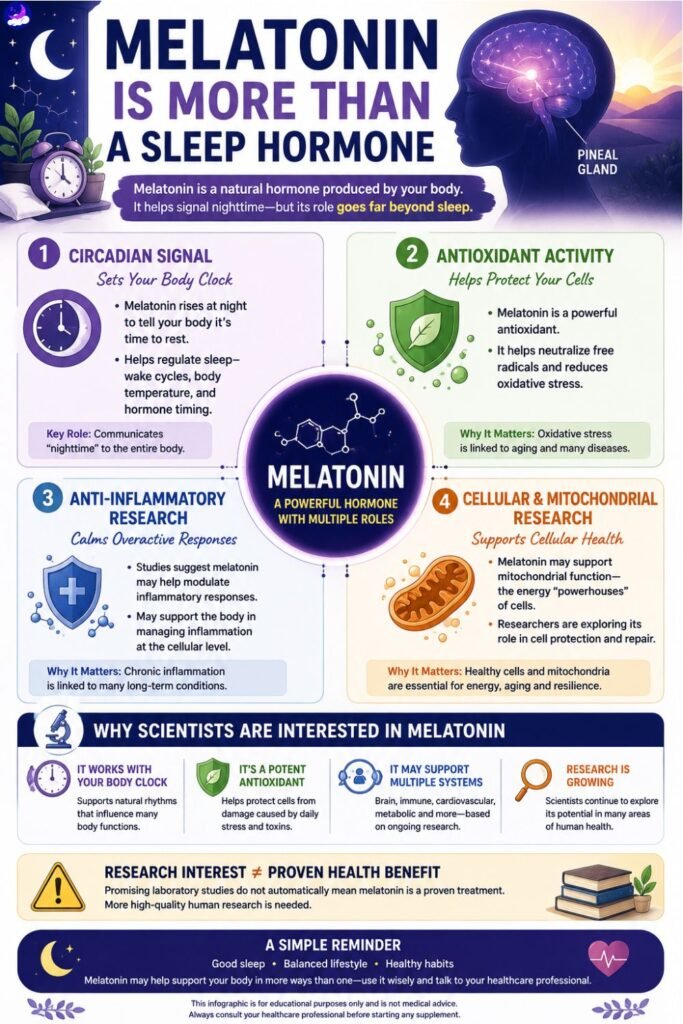
1. Melatonin as an Antioxidant
One of the most widely studied effects of melatonin beyond sleep is its relationship with oxidative stress.
Our cells constantly produce reactive molecules as part of normal metabolism. Some of these molecules are called reactive oxygen species, or ROS. At normal levels, they are part of ordinary cellular signaling.
Problems can arise when production of these reactive molecules exceeds the body’s ability to control them. This imbalance is known as oxidative stress.
Oxidative stress is involved in many biological processes, including inflammation, cellular aging and tissue injury.
Melatonin has attracted attention because it can interact with reactive molecules and influence antioxidant defenses. Laboratory research has demonstrated these biological effects, and human trials have also examined changes in oxidative-stress biomarkers.
For example, a 2024 systematic review and meta-analysis of randomized trials in people with diabetes found improvements in several oxidative-stress and antioxidant markers after melatonin supplementation. However, these studies generally measured laboratory biomarkers rather than major clinical outcomes.
That distinction is important.
There is a big difference between:
“Melatonin has antioxidant activity.”
and
“Taking melatonin prevents diseases caused by oxidative stress.”
The first is supported by biological research.
The second requires convincing clinical evidence, which is much less established.
What to Remember
Melatonin has genuine antioxidant properties, but antioxidant activity is not the same as proven disease prevention.
Also Read: Foods Rich in Melatonin | Blue Light and Melatonin
2. Melatonin and Inflammation
Inflammation is another area where melatonin research has attracted considerable attention.
Inflammation is not automatically bad. It is part of the body’s normal response to infection, injury and tissue stress.
The problem is persistent or poorly regulated inflammation.
Researchers have found that melatonin can interact with several pathways involved in inflammatory signaling. Laboratory and animal studies have reported effects on molecules called cytokines, which act as chemical messengers between immune cells.
But what happens in humans?
A systematic review and meta-analysis of 31 clinical trials involving 1,517 participants found that melatonin supplementation was associated with reductions in several inflammatory markers, including IL-1, IL-6 and IL-8. However, the results were not equally consistent across all markers, and some effects became less convincing in additional analyses.
More recent cardiometabolic research has also reported reductions in markers such as C-reactive protein, TNF-α and IL-6 across randomized trials, but these are still laboratory outcomes rather than proof that melatonin treats inflammatory disease.
So the conclusion should be more careful than:
“Melatonin is an anti-inflammatory treatment.”
A better description is:
“Human studies suggest melatonin can influence some inflammatory biomarkers, but it is not yet established as a treatment for chronic inflammatory disease.”
What to Remember
Melatonin appears to influence inflammatory pathways, but changing an inflammatory marker is not the same as treating an inflammatory disease.
3. Melatonin and the Immune System
Melatonin also interacts with the immune system.
At first glance, this can lead to another popular claim:
“Melatonin boosts immunity.”
That description is too simple.
The immune system is not something that should always be made “stronger.” A healthy immune response needs to be appropriately regulated.
Too little immune activity can make it harder to fight infections. Excessive or poorly controlled immune activity can contribute to inflammation and tissue damage.
Melatonin appears to interact with immune signaling in several ways. Circadian rhythms also influence immune activity, which means melatonin may be one part of the larger relationship between sleep, biological timing and immunity.
Much of the mechanistic evidence comes from laboratory and animal research. Human studies have examined changes in inflammatory and immune-related markers, but this does not establish melatonin as a general immune-enhancing supplement.
In other words, the science is more complicated than:
melatonin → stronger immune system.
It is closer to:
melatonin → interaction with biological pathways involved in immune regulation.
That difference may sound small, but medically it is important.
What to Remember
Melatonin may influence immune regulation, but “boosts immunity” is an oversimplification of the science.
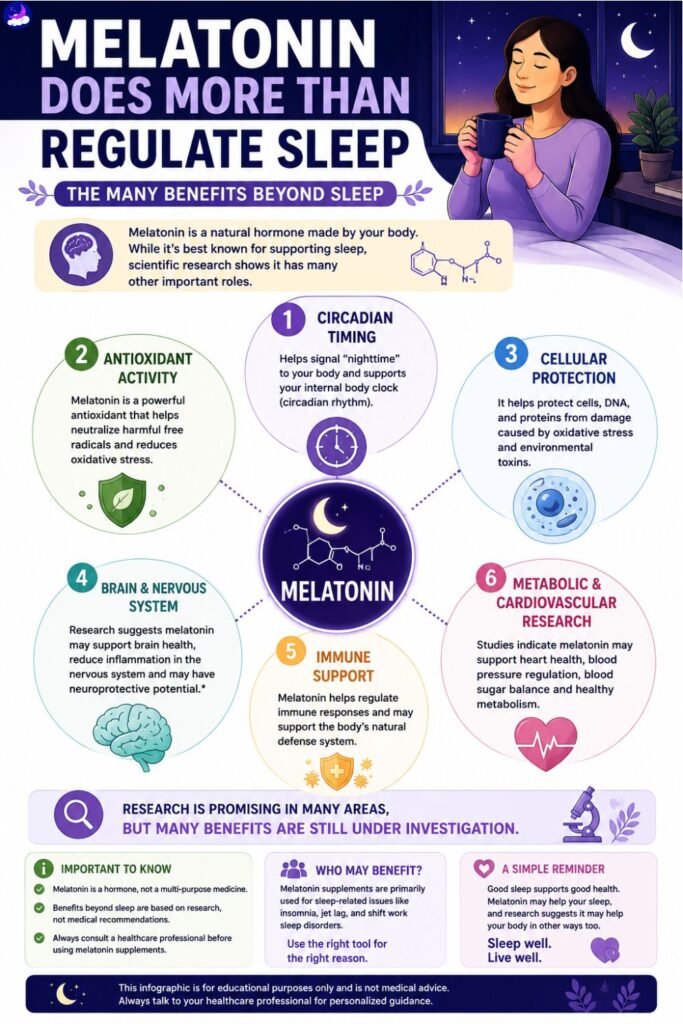
4. Melatonin and Brain Health
The brain is another major area of melatonin research.
Scientists are interested in melatonin because the brain is particularly vulnerable to oxidative stress, inflammation and mitochondrial dysfunction.
Melatonin’s antioxidant and anti-inflammatory properties have therefore led researchers to investigate whether it might have neuroprotective effects.
Research has explored melatonin in conditions such as:
- Alzheimer’s disease
- Parkinson’s disease
- Stroke
- Traumatic brain injury
- Other neurodegenerative conditions
The biological theory is interesting.
If oxidative stress and mitochondrial dysfunction contribute to neuronal injury, and melatonin can influence these pathways, perhaps melatonin could help protect nerve cells.
But that is a hypothesis, not a clinical conclusion.
A large proportion of the evidence in neurodegenerative disease remains mechanistic, laboratory-based or otherwise preclinical. Reviews continue to describe possible effects on neural pathways, but this does not establish that taking melatonin prevents or slows Alzheimer’s disease, Parkinson’s disease or other neurodegenerative disorders.
Most importantly, evidence that melatonin affects oxidative stress or inflammation in the brain does not establish that it prevents or slows a neurodegenerative disease.
What to Remember
Melatonin is being investigated for possible neuroprotective effects, but it is not an established treatment or prevention strategy for neurodegenerative disease.
5. Melatonin and Mitochondrial Health
Mitochondria are often described as the powerhouses of the cell, although their role is more complicated than simply producing energy.
They help cells generate energy, regulate metabolism, manage reactive molecules and respond to cellular stress.
Because mitochondrial dysfunction is involved in many diseases, researchers have become interested in whether melatonin can influence mitochondrial function.
Experimental research suggests that melatonin may affect several mitochondrial processes, including energy production, oxidative balance, membrane stability and mitochondrial signaling. Recent reviews have also examined its possible role in mitochondrial protection, particularly in conditions involving cellular or cardiac injury.
This is an exciting research area.
But it is also an area where it is easy to overstate the evidence.
A laboratory finding showing that melatonin improves mitochondrial function does not prove that taking a supplement prevents mitochondrial disease, reverses mitochondrial dysfunction in humans or slows aging.
At present, much of the detailed mitochondrial evidence remains preclinical.
What to Remember
Melatonin appears to interact with mitochondrial biology, but researchers are still working out how—or whether—these effects translate into meaningful clinical benefits.
6. Melatonin and Cardiovascular Health
Melatonin has also attracted interest in cardiovascular research.
This makes biological sense because cardiovascular function is connected with circadian rhythms, blood pressure, oxidative stress, inflammation and vascular function.
Researchers have studied melatonin in areas such as:
- Blood pressure
- Vascular function
- Oxidative stress
- Cardiac injury
- Ischemia-reperfusion injury
There is now some human evidence worth paying attention to.
A 2026 systematic review and meta-analysis of 14 randomized trials involving 1,027 participants found that melatonin improved the change in left ventricular ejection fraction, with the most consistent signal seen in coronary artery bypass grafting studies. However, final ejection fraction, troponin reduction and infarct-size findings were not consistently improved.
This is interesting evidence, but it does not mean melatonin has become a standard cardiovascular treatment.
The studies differed in their populations, clinical settings, dosing and outcomes. Much of the cardiovascular research has focused on specific situations such as cardiac surgery or ischemia-reperfusion injury rather than routine prevention in otherwise healthy people.
So a careful conclusion is:
Some randomized trials and meta-analyses have reported improvements in selected cardiovascular measures, but the evidence is not yet strong or consistent enough to establish melatonin as a routine cardiovascular treatment.
What to Remember
Melatonin is being actively studied in cardiovascular medicine, but it should not be viewed as a proven treatment for preventing heart disease or heart attacks.
7. Melatonin and Metabolic Health
Melatonin is also connected to metabolism.
This may seem surprising until you remember that metabolism follows daily rhythms too.
The body’s handling of glucose, insulin and energy changes across the day. Circadian disruption can affect metabolic regulation, which has led researchers to investigate whether melatonin plays a role.
Studies have explored melatonin in relation to:
- Blood glucose
- Insulin sensitivity
- Lipid levels
- Blood pressure
- Oxidative stress
- Metabolic rhythms
Recent evidence is becoming more substantial, but the results remain mixed across different outcomes.
A 2025 systematic review and dose-response meta-analysis included 63 randomized controlled trials and found significant improvements in several cardiometabolic measures, including systolic blood pressure, fasting blood glucose, LDL cholesterol, total cholesterol, C-reactive protein, malondialdehyde, TNF-α and IL-6. However, it found no significant effects on several other outcomes, including body weight, BMI, fasting insulin, HOMA-IR, HbA1c and triglycerides.
A newer 2026 meta-analysis focusing on glycemic outcomes also found improvements in some insulin-resistance measures but not fasting glucose, highlighting how results can differ depending on the outcome studied.
This is a useful example of why headlines can be misleading.
Research can find improvements in some metabolic biomarkers without proving that melatonin treats diabetes, causes weight loss or prevents metabolic disease.
What to Remember
Melatonin may influence several metabolic pathways, but current evidence does not establish it as a treatment for diabetes, obesity or metabolic disease.
8. Melatonin and Reproductive Health
Melatonin is also involved in reproductive biology.
Researchers have studied melatonin in relation to reproductive timing, ovarian function, oocyte quality and fertility-related treatments.
This area is particularly interesting because reproductive tissues have their own biological rhythms, and melatonin-related pathways may interact with oxidative stress and cellular function.
Some clinical research has investigated melatonin in women undergoing assisted reproductive technology (ART).
A 2025 systematic review and meta-analysis of 11 randomized trials involving 1,481 participants reported improvements in clinical pregnancy rates and several embryo-related outcomes among women undergoing ART. However, the authors also noted heterogeneity, possible publication bias for some outcomes, and the lack of standardized clinical guidance.
Earlier evidence has been less consistent. A 2024 meta-analysis found improvements in fertilization and some oocyte-related outcomes but did not find a significant improvement in clinical pregnancy rate.
This is exactly why reproductive evidence should be interpreted carefully.
The results from assisted reproduction should not automatically be generalized to natural fertility or to everyone trying to conceive.
What to Remember
Melatonin is being studied in reproductive medicine, particularly assisted reproduction, but it is not a universal fertility supplement.
Also Read: Melatonin for Older Adults | Melatonin for Pregnant Women | Melatonin for Kids.
9. Melatonin and Pain
Pain is another area where interest in melatonin is growing.
Researchers have proposed several possible mechanisms, including effects on inflammation, oxidative stress, central pain processing and sleep.
A 2026 systematic review and meta-analysis included 23 randomized trials involving 2,028 participants with chronic or postoperative musculoskeletal pain. The results were not straightforward: melatonin was not significantly better than placebo for chronic musculoskeletal pain in the primary analysis, although sensitivity analyses and comparisons with active treatments suggested possible benefit.
This is promising enough to justify further research, but not strong enough to call melatonin a proven painkiller.
There is also an important complication.
Pain and sleep are closely connected. If melatonin improves sleep in someone with chronic pain, some improvement in how the person feels may be related to better sleep rather than a direct analgesic effect.
Researchers therefore need studies that can separate these effects.
What to Remember
Melatonin may have a role in pain research, but current evidence is not strong enough to recommend it as a general pain treatment.
10. Melatonin and Aging
Perhaps no area creates more excitement around melatonin than aging.
The reason is understandable.
As people age, several biological changes occur, including alterations in circadian rhythms, oxidative stress, mitochondrial function, inflammation and cellular repair.
Melatonin interacts with several of these pathways.
Researchers are therefore investigating whether melatonin might influence processes associated with healthy aging.
This includes research into:
- Oxidative stress
- Mitochondrial function
- Neuroinflammation
- Circadian changes
- Cellular stress
- Cardiovascular and neurological aging
The biological theory is compelling.
But there is a large gap between:
“Melatonin affects pathways involved in aging”
and:
“Melatonin slows human aging.”
The second claim has not been established.
There is currently no good clinical basis for calling melatonin an anti-aging treatment or longevity supplement.
This is particularly important because supplement marketing can turn promising laboratory findings into dramatic claims about lifespan.
What to Remember
Melatonin has biological properties that make it interesting in aging research, but it has not been proven to slow human aging or extend lifespan.
Also Read: When to take Melatonin | Can you take Melatonin everynight? | Melatonin Addiction
11. Melatonin and Cellular Protection
Many of the effects discussed in this article overlap at the cellular level.
Melatonin can interact with pathways involved in oxidative stress, mitochondrial function, inflammation and cell signaling.
Researchers have therefore investigated whether melatonin can reduce certain forms of cellular injury.
In laboratory and animal models, melatonin has shown protective effects in several types of cellular stress.
But there is a large gap between a promising laboratory result and a useful clinical treatment.
A cell in a laboratory dish is not a human being.
The concentration of melatonin used in an experiment may also differ substantially from the exposure produced by a typical supplement.
And even when an animal study produces an impressive result, human metabolism, disease biology and treatment response can be very different.
This does not make laboratory research unimportant.
Quite the opposite.
Preclinical research is often where promising medical ideas begin.
It simply means that the idea needs to survive several more stages of testing before it becomes a treatment.
What to Remember
Melatonin shows interesting cellular effects in experimental research, but cellular protection has not been established as a broad clinical benefit of supplementation.
Why Promising Research Does Not Always Mean a Proven Health Benefit
This may be the most important section of the entire article.
Medical evidence develops in stages.
A simplified research ladder looks something like this:
Laboratory study
↓
Animal study
↓
Small human study
↓
Larger clinical trial
↓
Systematic review or meta-analysis
↓
Clinical guideline
A finding at the first level can be scientifically important without being ready for patient care.
Imagine researchers discover that melatonin reduces oxidative stress in human cells grown in a laboratory.
That tells us something interesting about melatonin’s biology.
But it does not prove that taking melatonin prevents heart disease, Alzheimer’s disease or diabetes.
The next question is whether the effect occurs in living organisms.
Then researchers need to know whether the effect occurs in humans.
Then they need to know whether it produces a meaningful health outcome.
Even a randomized clinical trial does not automatically make a treatment standard care. The result needs to be reproducible, clinically meaningful, balanced against harms and compared with existing treatments or alternatives.
This is why:
Biological activity ≠ proven clinical benefit.
And there is another distinction worth remembering:
A biomarker is not the same as a health outcome.
Lowering CRP, changing an inflammatory cytokine or improving an antioxidant marker may tell researchers that a biological pathway has changed.
It does not automatically mean fewer heart attacks, less diabetes, slower brain disease or longer life.
Also Read: Can you overdose on Melatonin | Melatonin gummies vs Tablets
What We Know — and What We Don’t
The easiest way to understand melatonin’s expanding research landscape is to look at the evidence area by area.
| Area | What research suggests | Evidence status |
|---|---|---|
| Sleep and circadian timing | Melatonin can influence biological timing and may help in selected sleep-related situations | Better established |
| Antioxidant activity | Melatonin interacts with reactive molecules and antioxidant systems | Biological activity established; clinical benefits not established |
| Inflammation | Human studies show changes in some inflammatory markers | Some human evidence; clinical significance uncertain |
| Immune regulation | Melatonin interacts with immune and circadian signaling | Some human evidence, much experimental research |
| Brain health | Possible neuroprotective effects are being investigated | Limited human evidence; mainly experimental for disease treatment |
| Mitochondrial function | Experimental studies suggest effects on mitochondrial energy and oxidative balance | Mainly experimental |
| Cardiovascular health | Human trials have explored selected cardiovascular outcomes | Some human evidence; not an established treatment |
| Metabolic health | Studies report effects on several glucose, lipid and inflammatory markers | Some human evidence; clinical significance remains uncertain |
| Reproductive health | Melatonin is being studied in reproductive biology and assisted reproduction | Limited to specific clinical settings |
| Pain | Early trials have investigated musculoskeletal pain | Emerging evidence; not established treatment |
| Aging | Effects on oxidative stress, mitochondria and circadian biology are being investigated | Mainly experimental |
This table illustrates something important:
“Research exists” is not the same as “the treatment is proven.”
Also Read: Melatonin For Jetlag | Melatonin For Shift workers
Does This Mean You Should Take Melatonin for These Benefits?
No—not based on the research alone.
A supplement may have fascinating biological effects while still lacking enough evidence to recommend it for preventing or treating a disease.
This is especially important when a claim comes from a laboratory study.
You should not replace established medical treatment with melatonin because an experiment showed that melatonin affected a particular biological pathway.
If you have diabetes, cardiovascular disease, a neurological condition or another chronic illness, evidence-based treatment should remain the foundation of care.
Melatonin research may eventually lead to new treatments.
But researching a treatment is not the same as recommending it.
Why “Natural” Does Not Mean “Risk-Free”
Melatonin is naturally produced by your body, but taking a supplement is not identical to your body’s normal production.
A supplement adds melatonin from outside the body.
Side effects can occur, interactions with medicines are possible, and supplement quality can vary.
The safety question also depends on dose, timing, duration, formulation and the individual using it.
This matters even more when someone is considering melatonin for a purpose that has not been well studied.
[Also Read: Melatonin Side Effects]
How to Think About Melatonin Beyond Sleep
The next time you see a claim such as:
“Melatonin protects the brain.”
or
“Melatonin fights inflammation.”
don’t immediately accept or reject it.
Instead, ask a few simple questions:
- Was this studied in humans?
- How many people were studied?
- Was it a randomized trial?
- What dose and formulation were used?
- What outcome did researchers actually measure?
- Did the study show a clinical benefit or only a biological change?
- Has the finding been replicated?
- Do medical guidelines recommend melatonin for that purpose?
- Was the effect large enough to matter to patients, or was it only statistically significant?
These questions can help you separate interesting science from a treatment claim.
A supplement advertisement may mention an antioxidant effect.
A research paper may report a change in an inflammatory marker.
A headline may turn that into a claim that melatonin prevents disease.
Those are three very different things.
The closer you get to actual patient outcomes and high-quality clinical evidence, the more meaningful the claim becomes.
Also Read: Melatonin and Weird Dreams | Melatonin Myths and Facts | Benefits of Melatonin beyond sleep.
Frequently Asked Questions
What are the benefits of melatonin besides sleep?
Melatonin has biological effects involving oxidative stress, inflammation, immune signaling, mitochondrial function and other cellular pathways. Researchers are also studying possible roles in brain, cardiovascular, metabolic, pain and reproductive health. However, the evidence is much stronger for some biological effects than for proven clinical benefits.
Is melatonin an antioxidant?
Yes, melatonin has antioxidant activity. It can interact with reactive molecules and influence antioxidant defenses. Human studies have also reported changes in oxidative-stress markers. However, this does not prove that taking melatonin prevents diseases related to oxidative stress.
Does melatonin reduce inflammation?
Some human clinical trials have found reductions in certain inflammatory markers after melatonin supplementation. A systematic review of 31 clinical trials found effects on several cytokines, although results were not consistent across all markers. Melatonin is not currently an established treatment for chronic inflammatory disease.
Can melatonin protect the brain?
Researchers are investigating melatonin for possible neuroprotective effects related to oxidative stress, inflammation and mitochondrial function. Much of the evidence for conditions such as Alzheimer’s disease and Parkinson’s disease remains preclinical or limited, so melatonin should not be considered a proven treatment or prevention strategy for these disorders.
Does melatonin have anti-aging effects?
Melatonin affects several biological pathways involved in aging, including oxidative stress, mitochondrial function and circadian regulation. However, there is no established clinical evidence that taking melatonin slows human aging or extends lifespan.
Should I take melatonin for these potential benefits?
Not simply because laboratory or early human research looks promising. A potential biological benefit is not the same as an established medical indication. If you are considering melatonin for a health condition beyond sleep, discuss it with an appropriate healthcare professional rather than replacing established treatment with a supplement.
Bottom Line
Melatonin is much more biologically interesting than simply being a “sleep supplement.”
Researchers have identified effects involving antioxidant activity, inflammatory signaling, immune regulation, mitochondrial function, brain biology, cardiovascular pathways, metabolism, pain and reproductive biology.
Some of these effects have been observed in humans.
Many others remain preliminary.
And some of the most exciting findings still come from cells, laboratory experiments or animal models.
That does not mean the research is unimportant. These studies can reveal how melatonin works and help scientists identify possible future treatments.
But there is a crucial distinction to remember:
Biological possibility is not the same as a proven health benefit.
For now, readers should not take melatonin specifically to prevent or treat a disease simply because a laboratory study produced a promising result.
Melatonin’s best-established clinical role remains related to sleep and circadian timing. Its effects beyond sleep are scientifically fascinating, and some areas now have meaningful human research, but many potential benefits are still being tested.
That is where the science stands today—and in medicine, knowing what we do not yet know is just as important as knowing what we do.
References
- Ang SP, et al. Melatonin Supplementation and Cardiovascular Outcomes: A Systematic Review and Meta-Analysis of Randomized Trials. Journal of Clinical Medicine. 2026.
- Mohammadi S, et al. Comprehensive Effects of Melatonin Supplementation on Cardiometabolic Risk Factors: A Systematic Review and Dose-Response Meta-Analysis. Nutrients. 2025/2026.
- Dias GZT, et al. Melatonin supplementation improves insulin resistance markers but not fasting glucose: a systematic review and meta-analysis of randomized controlled trials. Diabetes Research and Clinical Practice. 2026.
- Cho JH, et al. Anti-inflammatory effects of melatonin: A systematic review and meta-analysis of clinical trials. Brain, Behavior, and Immunity. 2021.
- Wu Y, et al. Melatonin improved the outcomes of women with ART: a systematic review and meta-analysis of randomized trials. Frontiers in Reproductive Health. 2025.
- Veiga ECA, et al. Melatonin improves fertilization rate in assisted reproduction: Systematic review and meta-analysis. Clinics. 2024.
- Wu K, et al. Efficacy and effectiveness of melatonin for the management of musculoskeletal pain: a systematic review and meta-analysis of placebo and active controlled trials. Pain. 2026.
- Giri A, et al. Modulation of neural circuits by melatonin in neurodegenerative and neuropsychiatric disorders. Naunyn-Schmiedeberg’s Archives of Pharmacology. 2024.
- Pedriali G, et al. Melatonin and mitochondrial protection in cardiac ischemia-reperfusion injury: mechanisms, evidence and translational perspectives. Basic Research in Cardiology. 2026.