
For most adults using immediate-release melatonin, the best time to take melatonin is 30 to 60 minutes before bedtime. If you’re using extended-release melatonin, you may need to take it 1 to 2 hours before bed, depending on the product. If melatonin doesn’t seem to work, adjusting when you take it is often more helpful than increasing the dose.
Table of Contents
The ideal schedule isn’t the same for everyone. The best timing depends on several factors, including:
- Why you’re taking melatonin
- Whether you’re using an immediate-release or extended-release product
- Your regular bedtime and wake-up time
- Your age
- Whether you’re adjusting to jet lag or shift work
For example, someone trying to recover from jet lag may need to take melatonin according to the destination’s bedtime, while a person with delayed sleep-wake phase disorder may be advised to take it several hours before their usual bedtime under medical guidance.
Quick Tip: Before changing your melatonin dose, try adjusting when you take it. In many cases, improving the timing can be more helpful than increasing the amount.
When Should You Take Melatonin for the Best Results?
“Should I take melatonin right before bed, an hour earlier, or even a few hours before I plan to sleep?” It’s one of the most common questions people ask after buying a melatonin supplement.
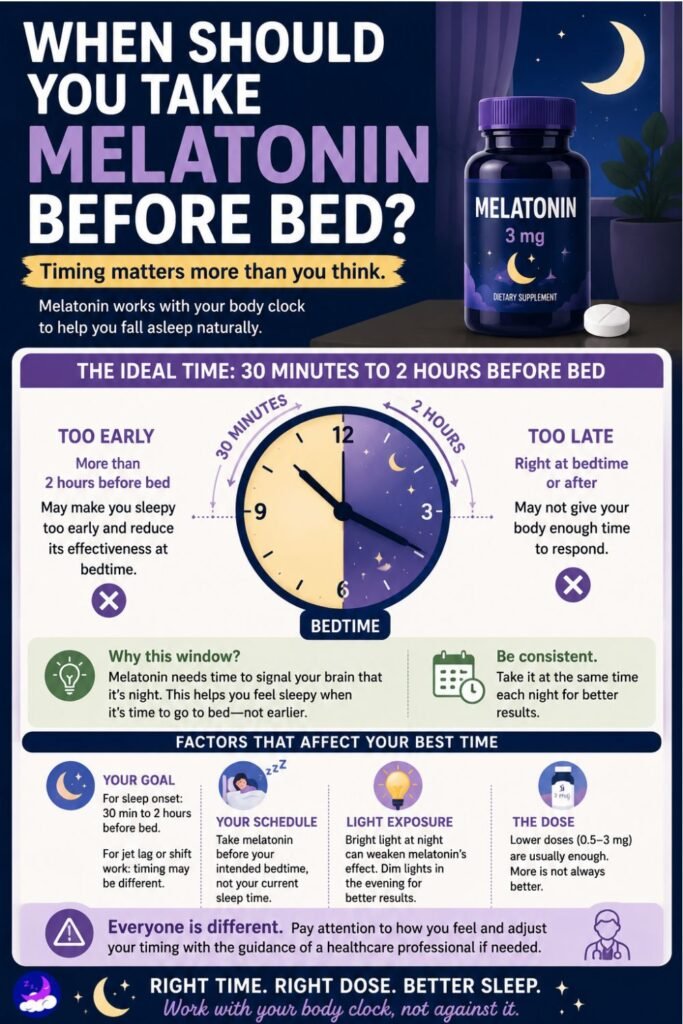
The answer is that timing often matters more than taking a higher dose. Melatonin is different from most sleep medicines. It works best when you take it at the right time for your body’s internal clock. Even a well-chosen dose may not help much if you take it too early, too late, or at a different time every night.
For many adults, taking immediate-release melatonin about 30 to 60 minutes before their planned bedtime is a reasonable starting point. However, that is not the best timing for everyone. The ideal schedule depends on why you’re taking melatonin, the type of melatonin you use, and your usual sleep pattern.
In this guide, you’ll learn the best time to take melatonin for different situations, including general sleep difficulties, jet lag, shift work, and delayed sleep-wake phase disorder. You’ll also discover what happens if you take melatonin too early or too late, whether you should take it with food, and common timing mistakes that can make it seem less effective.
If you’re new to melatonin, you may also want to read Melatonin Explained for a complete overview of how it works in the body.
Why Timing Matters More Than Dose
Many people assume that if melatonin doesn’t seem to work, they simply need a higher dose. Research suggests that this isn’t always the case. For many users, taking melatonin at the right time is more important than taking more of it.
Melatonin is often called the body’s “darkness signal.” As evening approaches and light levels fall, your brain naturally releases melatonin to help prepare your body for sleep. Taking a supplement works best when it supports this natural process rather than fighting against it.
If melatonin is taken too early, you may start feeling sleepy long before you’re ready to go to bed. If it’s taken too late, it may not have enough time to work before you want to fall asleep. Some people then assume the supplement has failed and increase the dose, even though the real issue may simply be poor timing.
Consistency matters as well. Taking melatonin at roughly the same time each evening helps your body receive a more predictable signal. Frequently changing the timing from one night to the next can reduce its effectiveness, especially when you’re trying to adjust your sleep schedule.
It’s also important to remember that melatonin isn’t a sedative that forces you to sleep. Instead, it helps your body recognize that it’s time to prepare for sleep. That’s why healthy sleep habits—such as keeping a regular bedtime, reducing bright light in the evening, and limiting screen use after taking melatonin—can make a noticeable difference.
Also Read: How Long Does Melatonin Take to Work?
Best Time to Take Melatonin for Adults
For most healthy adults using immediate-release melatonin, a good starting point is to take it 30 to 60 minutes before your planned bedtime. This timing matches the way melatonin is commonly used for occasional difficulty falling asleep and is supported by guidance from organizations such as the NHS, Mayo Clinic, and the National Center for Complementary and Integrative Health (NCCIH).
For example, if you usually go to bed at 10:30 PM, consider taking melatonin between 9:30 PM and 10:00 PM.
The goal is not simply to feel sleepy. Melatonin works best when it gives your body enough time to prepare for sleep while you also follow a consistent bedtime routine.
Keep in mind that melatonin is not an instant sleep aid. Some people begin to feel its effects within about 30 minutes, while others may need longer. Factors such as age, the type of melatonin, meals, medications, and individual differences can all affect how quickly it works.
If you’ve just started taking melatonin, avoid changing the timing every night. Instead, use the same schedule for several days before deciding whether an adjustment is needed.
Practical Tip
Choose your bedtime first, then work backward.
For example:
| Planned Bedtime | Take Immediate-Release Melatonin |
| 9:30 PM | 8:30–9:00 PM |
| 10:00 PM | 9:00–9:30 PM |
| 11:00 PM | 10:00–10:30 PM |
After taking melatonin, dim the lights, avoid scrolling on your phone, and begin your normal bedtime routine. Bright light in the evening can reduce the signal that melatonin is trying to provide.
Also Read: Melatonin Dosage Guide
Best Timing for Different Sleep Problems
The best time to take melatonin isn’t the same for everyone. It depends on why you’re using it. Someone adjusting to a new time zone needs a different schedule than someone with a delayed sleep phase or a night-shift job.
General Sleep Difficulties
If your main problem is taking a long time to fall asleep, taking immediate-release melatonin about 30 to 60 minutes before bedtime is usually the first approach.
Melatonin is most likely to help people who have trouble falling asleep rather than those who wake up repeatedly during the night. If you mainly struggle to stay asleep, changing the timing alone may not solve the problem, and your healthcare provider may recommend a different approach.
The most important habit is consistency. Taking melatonin at the same time every evening sends a more reliable signal to your body’s internal clock than taking it at different times each night.
Jet Lag
Crossing several time zones confuses your body’s internal clock. That’s why many travellers struggle to fall asleep at the local bedtime.
Jet lag happens because your internal body clock is still following the time zone you left behind. Melatonin may help your body adjust more quickly to the new local time, especially after traveling across several time zones.
Most experts recommend taking melatonin close to your target bedtime at your destination, rather than according to your home time zone. Starting on the day of arrival is common, although the exact timing may vary depending on the direction of travel and the number of time zones crossed.
For long trips, melatonin works best when combined with other strategies such as getting morning sunlight after eastward travel, avoiding bright light late at night when appropriate, and gradually shifting your sleep schedule before your trip if possible.
Did You Know?
Travelling east is often harder than going to west because your body usually finds it easier to stay awake longer than to fall asleep earlier.
Shift Work
Shift workers often sleep during the day, when the body’s natural melatonin production is lower. This makes it more difficult to fall asleep after a night shift.
In some cases, healthcare providers may recommend taking melatonin before the planned daytime sleep period, rather than at night. The ideal timing depends on your work schedule, the number of consecutive shifts, and your exposure to light.
Melatonin alone is usually not enough for shift work sleep problems. Managing light exposure is equally important. Wearing dark sunglasses on the way home after a night shift, sleeping in a dark room, and limiting daytime noise may improve sleep more than melatonin alone.
Because shift work schedules vary widely, it’s best to discuss the timing with a healthcare professional if you regularly work nights.
Delayed Sleep-Wake Phase Disorder (DSWPD)
People with delayed sleep-wake phase disorder naturally fall asleep much later than they want to. They may not feel sleepy until the early hours of the morning, even when they try to go to bed earlier.
Unlike occasional insomnia, the goal here is to shift the body’s internal clock earlier.
Healthcare providers often recommend taking melatonin several hours before the person’s natural bedtime, not just before they want to sleep. The exact timing varies from person to person and should ideally be based on medical advice.
Taking melatonin at the wrong time may reduce its benefits or even shift the body clock in the opposite direction. That’s why people with DSWPD should avoid self-adjusting the timing without guidance.
Older Adults
Natural melatonin production often decreases with age, which may contribute to changes in sleep patterns in some older adults.
Many older adults can still begin with the usual recommendation of taking melatonin 30 to 60 minutes before bedtime, although individual needs vary. Some healthcare providers may recommend prolonged- or extended-release formulations for people whose main problem is staying asleep, but the timing may differ slightly depending on the product.
Older adults are also more likely to take medicines that can interact with melatonin or increase daytime drowsiness. For this reason, they should discuss the most appropriate timing with their healthcare provider before using it regularly.
Warning
If your sleep problems continue for several weeks despite taking melatonin at the right time, don’t assume that you simply need a higher dose. You need a physician’s help.
Persistent sleep difficulties may have another underlying cause, such as sleep apnea, restless legs syndrome, chronic pain, anxiety, or medication side effects. In these situations, a medical evaluation is more helpful than repeatedly changing the timing or dose.
Also Read: How Long Does Melatonin Take to Work?
Immediate-Release vs Extended-Release: Does Timing Change?
The type of melatonin you take can affect when you should take it. While both forms contain the same hormone, they release it into your body differently.
Immediate-release melatonin dissolves quickly and raises melatonin levels within a short time. It is mainly used by people who have trouble falling asleep.
Extended-release (also called prolonged-release) melatonin is designed to release melatonin gradually over several hours. It is more often used when the goal is to help maintain sleep throughout the night.
Because they work differently, the timing also changes slightly.
| Type of Melatonin | Best Starting Time | Common Purpose |
| Immediate-release | About 30–60 minutes before bedtime | Difficulty falling asleep |
| Extended-release | About 1–2 hours before bedtime (follow the product label or healthcare provider’s advice) | Difficulty staying asleep |
These are general recommendations. Different products may have different instructions based on how they are formulated. Always check the label and follow your healthcare provider’s advice if it differs.
If you’re unsure which type you’re using, look at the product packaging or ask your pharmacist.
Practical Tip
Don’t switch between immediate-release and extended-release melatonin without adjusting the timing. Using the right product at the wrong time may make it seem less effective.
Also Read: Can You Take Melatonin Every Night?
Should You Take Melatonin With Food?
Melatonin can usually be taken with or without food, but the timing of your meals may affect how quickly it starts working.
A heavy meal, especially one high in fat, may slow down stomach emptying. As a result, melatonin may take longer to be absorbed, delaying its effects.
For many people, taking melatonin after a light evening meal works well. If you regularly eat dinner close to bedtime, you may need to allow a little extra time before expecting melatonin to work.
There is no strong evidence that taking melatonin on an empty stomach makes it more effective for everyone. The most important factors remain taking it at the right time and following a consistent bedtime routine.
Checklist
✔ Take melatonin at about the same time each evening.
✔ A light meal is generally fine.
✔ Avoid very heavy meals immediately before taking melatonin if possible.
✔ If you notice that meals affect how quickly melatonin works for you, discuss the timing with your healthcare provider.
Can You Take Melatonin Too Early?
Yes. Taking melatonin several hours earlier than needed may reduce its benefits.
If you take it too early, you may become sleepy long before you’re ready for bed. By the time you actually lie down, that sleepy feeling may have started to wear off.
For people using melatonin to adjust their body clock—such as those with delayed sleep-wake phase disorder—taking it earlier than usual may be recommended. But, this should be done according to a planned schedule rather than by guesswork.
For everyone else, taking melatonin much earlier than necessary usually offers no extra benefit.
Did You Know?
Many people assume that taking melatonin earlier means it will work better. In reality, the goal is to match the supplement with your planned sleep schedule—not simply to take it as early as possible.
Can You Take Melatonin Too Late?
Yes. Taking melatonin too close to bedtime—or after you’ve already been trying to sleep for a while—may not give it enough time to work.
For immediate-release melatonin, swallowing the tablet just as you switch off the lights is often too late. The supplement still needs time to be absorbed before melatonin levels rise.
Taking melatonin very late at night may also increase the chance of feeling drowsy the next morning, particularly if you have to wake up early.
If you regularly forget until you’re already in bed, setting a daily reminder on your phone may help you build a more consistent routine.
Warning
Avoid taking an extra dose later in the night simply because you haven’t fallen asleep yet. This can increase the risk of next-day sleepiness without necessarily improving your sleep.
What If You Forget to Take It?
Missing one dose is usually not a cause for concern.
If you remember before your planned bedtime and there is still enough time for melatonin to work, you may be able to take it. But , if you remember much later in the night, it’s generally better to skip that dose and return to your usual schedule the following evening.
Avoid taking two doses together to make up for a missed one. More melatonin is not necessarily better, and doubling the dose may increase the risk of unwanted effects such as morning drowsiness.
If you frequently forget to take melatonin, consider linking it to another evening habit, such as brushing your teeth or setting an alarm on your phone.
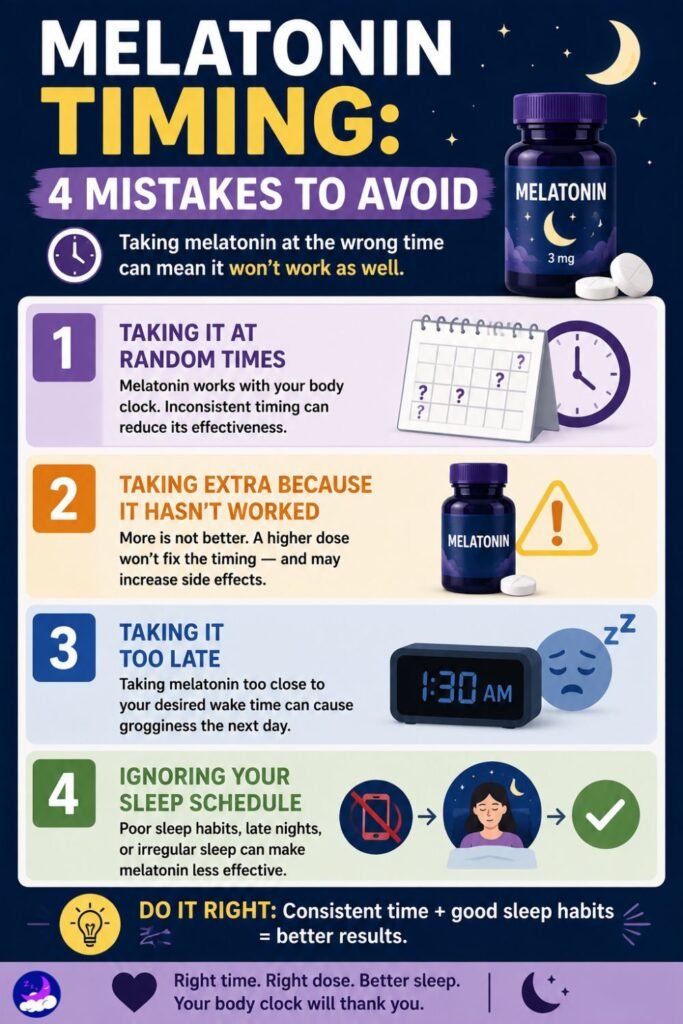
Common Timing Mistakes
Even when people choose the right dose, a few simple timing mistakes can prevent melatonin from working as expected.
Taking it immediately before lying down
Melatonin needs time to be absorbed. Taking it just seconds before turning off the lights may not provide enough time for it to begin working.
Taking it several hours too early
Unless you’re following a treatment plan for a circadian rhythm disorder, taking melatonin far too early may cause sleepiness at the wrong time.
Changing the timing every night
One night at 9 PM, the next at 11 PM, and another at midnight sends mixed signals to your body’s internal clock. Consistency is one of the keys to success.
Expecting instant results
Melatonin is not a sleeping pill that works immediately after swallowing it. Give it time to work and continue following healthy bedtime habits.
Using bright screens after taking melatonin
The light from phones, tablets, and computers—especially bright blue light—can reduce your body’s natural melatonin signal. Even if you’ve taken a supplement, spending the next hour scrolling through social media may make it harder to fall asleep.
Ignoring the real cause of poor sleep
Melatonin is not the answer to every sleep problem. If pain, stress, sleep apnea, restless legs syndrome, caffeine, alcohol, or certain medications are keeping you awake, changing the timing of melatonin alone may not solve the problem.
Also Read: Drug Interactions
Frequently Asked Questions
1. What is the best time to take melatonin before bed?
For most adults using immediate-release melatonin, taking it 30 to 60 minutes before your planned bedtime is a good starting point. However, the ideal timing depends on why you’re taking melatonin, the type of product you use, and your usual sleep schedule.
2. Can I take melatonin right before I lie down?
You can, but it may not be the best approach. Immediate-release melatonin usually needs some time to be absorbed. Taking it 30 to 60 minutes before bedtime often works better than taking it just as you switch off the lights.
3. Is it better to take melatonin at the same time every night?
Yes. Taking melatonin at a consistent time each evening helps provide a more regular signal to your body’s internal clock. Frequently changing the timing may reduce its effectiveness.
4. How many hours before bed should I take extended-release melatonin?
Many extended-release products are taken about 1 to 2 hours before bedtime, but the exact timing depends on the specific formulation. Always follow the instructions on the product label or the advice of your healthcare provider.
5. Should I take melatonin if I wake up in the middle of the night?
In most cases, this is not recommended, especially if you need to wake up early the next morning. Taking melatonin in the middle of the night may increase the risk of morning drowsiness.
6. Can I take melatonin after dinner?
Yes. Melatonin can usually be taken after dinner. If you’ve eaten a very large or high-fat meal, it may take longer for the supplement to be absorbed.
7. Is it okay to take melatonin every night at the same time?
Some people take melatonin nightly under the guidance of a healthcare professional. Whether regular use is appropriate depends on your health, medications, and the reason you’re taking it.
Also Read: Can You Take Melatonin Every Night?
8. Why doesn't melatonin seem to work for me?
Poor timing is one possible reason, but it isn’t the only one. The wrong type of melatonin, inconsistent use, bright evening light, caffeine, certain medications, or an underlying sleep disorder can also reduce its effectiveness.
9. Can taking melatonin too early make me sleepy too soon?
Yes. If you take melatonin several hours before you intend to sleep, you may become sleepy long before bedtime, and the effect may wear off before you’re ready to go to bed.
10. Can I take melatonin in the morning?
Morning melatonin is not recommended for most people because it may interfere with your normal sleep-wake cycle and increase daytime drowsiness.
There are a few specialized medical situations in which healthcare professionals may recommend different timing, but this should only be done under expert supervision.
11. How do I know if I should change the timing instead of the dose?
If you’ve been taking melatonin consistently for several nights without success, adjusting when you take it may be more helpful than immediately increasing the dose. Speak with your healthcare provider before making significant changes to your treatment plan.
12. Does melatonin work better if I go to bed immediately after taking it?
Not necessarily. It’s usually better to take melatonin first and then spend the next 30 to 60 minutes winding down with relaxing activities such as reading a book or listening to calm music in dim lighting.
13. Can I take melatonin earlier when travelling across time zones?
Yes. When using melatonin for jet lag, the goal is to match the bedtime in your destination time zone, not your home time zone. The exact schedule depends on your travel plans and the direction of travel.
Bottom Line
In general, the best time to take melatonin is 30 to 60 minutes before bedtime if using an immediate-release product. However, the ideal timing depends on why you’re taking melatonin, whether you’re using an immediate- or extended-release formulation, and your individual sleep schedule.
Before increasing your dose, make sure you’re taking melatonin at the right time and using it consistently. A simple adjustment in timing is often more helpful than taking more melatonin.
To get the best results:
- Take melatonin at about the same time each evening.
- Follow the timing instructions for your specific product.
- Reduce exposure to bright light and electronic screens after taking it.
- Keep a regular bedtime and wake-up time, even on weekends.
- Give your body several days to adjust before deciding whether the timing needs to change.
Remember that melatonin is only one part of healthy sleep. It works best when combined with good sleep habits, such as maintaining a consistent sleep schedule, creating a comfortable sleep environment, limiting caffeine late in the day, and avoiding bright light before bedtime.
If you’ve tried taking melatonin at the right time and still have ongoing sleep problems, don’t keep increasing the dose on your own.
If melatonin doesn’t seem to be helping, don’t assume you need a higher dose. In many cases, adjusting when you take it is more helpful than taking more. If your sleep problems continue despite using melatonin correctly, speak with your healthcare provider to look for another possible cause.
References
- American Academy of Sleep Medicine (AASM) Clinical Practice Guideline for the Pharmacologic Treatment of Chronic Insomnia in Adults
- National Center for Complementary and Integrative Health (NCCIH). Melatonin: What You Need To Know
- National Health Service (NHS). How and When to Take Melatonin
- National Health Service (NHS). Common Questions About Melatonin
- Mayo Clinic. Melatonin
- Brzezinski A. Melatonin in Humans. New England Journal of Medicine. 1997;336(3):186–195. DOI: 10.1056/NEJM199701163360306.
- Zisapel N. New Perspectives on the Role of Melatonin in Human Sleep, Circadian Rhythms and Their Regulation. Sleep Medicine Reviews. 2018;34:1–15. DOI: 10.1016/j.smrv.2016.06.004.
- Ferracioli-Oda E, Qawasmi A, Bloch MH. Meta-analysis: Melatonin for the Treatment of Primary Sleep Disorders. PLoS ONE. 2013;8(5). DOI: 10.1371/journal.pone.0063773.
- Sack RL, Auckley D, Auger RR, et al. Circadian Rhythm Sleep Disorders: Part I, Basic Principles, Shift Work and Jet Lag Disorders. An American Academy of Sleep Medicine Review. Sleep. 2007;30(11):1460–1483. DOI: 10.1093/sleep/30.11.1460.
- PubMed – Melatonin Research Collection