Melatonin may be safe for many adults when used appropriately, but long-term safety data are still limited. If you need melatonin every night, it is worth reviewing whether you still need it and whether an underlying sleep problem should be addressed.
| Question | Evidence-Based Answer |
| Can you take melatonin every night? | Yes, many healthy adults can use it nightly when appropriate. |
| Is it safe for long-term use? | Current research is reassuring, but studies lasting many years are limited. |
| Does it stop your body from making melatonin? | Current evidence does not suggest this happens in healthy adults. |
| Can it become less effective? | Some people notice less benefit over time, but true tolerance appears uncommon. |
| Should you cycle melatonin? | There is no strong evidence that cycling is necessary for most people. |
| Should you use it forever? | No. Long-term use should be reviewed periodically with a healthcare professional. |
Table of Contents
What We Know About Nightly Melatonin Use
If you’ve been taking melatonin every night, you’re probably wondering whether it’s safe to continue—or whether your body could become dependent on it.
Fortunately, current research provides some reassuring answers, although there are still a few important uncertainties
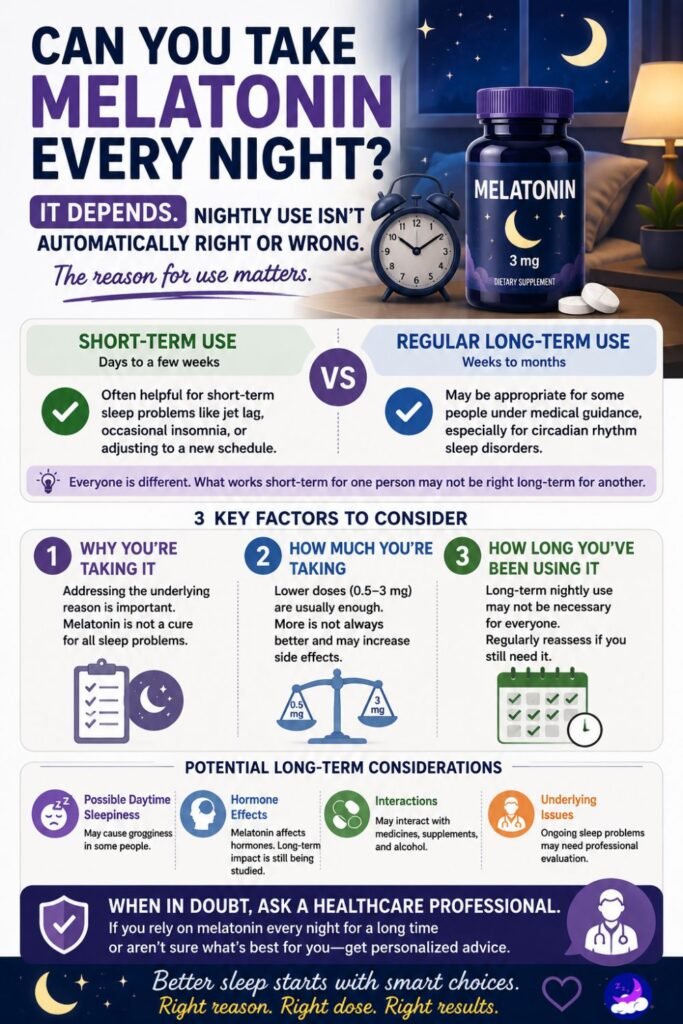
Based on current evidence, the answer is yes for many adults—but with some important conditions.
Research suggests that melatonin is generally well tolerated, does not appear to cause physical dependence, and has a good safety profile when used at appropriate doses.
However, scientists still know much more about using melatonin for a few weeks or months than they do about taking it continuously for many years.
Another point to remember is that melatonin is not meant to replace good sleep habits or hide an untreated sleep disorder. If you continue to sleep poorly despite taking melatonin, the problem may not be low melatonin levels at all.
Conditions such as obstructive sleep apnea, chronic stress, anxiety, depression, restless legs syndrome, chronic pain, or an irregular sleep schedule may all interfere with sleep and require different treatment.
Research Summary
- Short-term use: Generally considered safe for most healthy adults.
- Medium-term use: Studies remain reassuring, with no major safety concerns identified.
- Long-term use: Evidence is encouraging, but studies lasting many years are still limited.
- Best approach: Review your need for melatonin regularly instead of taking it automatically every night.
Also Read: Our Melatonin Guide | Circadian Rhythm and Melatonin | Melatonin Production
What Does Research Say About Taking Melatonin Every Night?
The question isn’t simply whether melatonin is safe. It’s also how long it is used, why it is being taken, and who is taking it.
Researchers have studied melatonin for more than three decades in people with insomnia, delayed sleep-wake phase disorder, jet lag, shift work sleep disorder, and several neurological conditions. Overall, the findings are reassuring.
Still, the quality and length of these studies vary, so it helps to look at the evidence by duration of use.
Short-Term Use: Strong Evidence
The strongest evidence comes from studies lasting a few days to about three months.
Across these studies, melatonin has consistently shown a good safety profile. Most participants tolerate it well, and serious side effects are uncommon. When side effects do occur, they are usually mild and may include:
- Morning sleepiness
- Headache
- Dizziness
- Vivid dreams or unusual dreams
- Mild nausea in some people
Researchers have also found no evidence that healthy adults develop physical dependence after using melatonin for short periods. Unlike many prescription sleeping pills, melatonin has not been shown to cause cravings or withdrawal symptoms when stopped after short-term use.
Also Read: Our Melatonin Dosage Guide | Melatonin Side Effects | Melatonin Drug Interactions
Medium-Term Use: Evidence Remains Reassuring
Researchers have also followed people who used melatonin for six months to about one year. Many of these studies involved older adults, people with circadian rhythm sleep disorders, or those with chronic sleep difficulties.
The overall findings remain positive.
Most participants continued to tolerate melatonin well without developing serious safety concerns. Researchers did not find evidence that melatonin causes addiction, suppresses natural hormone production, or leads to significant withdrawal symptoms after several months of use.
However, the results also showed that melatonin is not equally effective for everyone. Some people continued to experience better sleep, while others noticed that the benefits gradually became less obvious.
In many cases, this did not appear to be because melatonin had stopped working. Instead, the underlying cause of poor sleep had changed or was never fully addressed.
Healthcare professionals therefore recommend reassessing ongoing melatonin use rather than automatically continuing it month after month.
Long-Term Use: Encouraging but Still Incomplete
One of the biggest questions people ask is whether taking melatonin every night for several years is safe.
At present, the answer is probably yes for many people, but we still need more research.
Several long-term studies have followed participants for one to several years, particularly older adults and people with specific neurological or sleep disorders. These studies have not identified major safety problems directly linked to melatonin.
Researchers have not found convincing evidence that long-term melatonin use:
- Stops the body from making its own melatonin
- Causes physical dependence
- Leads to addiction
- Produces serious withdrawal symptoms after stopping
These findings are reassuring, but they should be interpreted carefully. Compared with short-term research, long-term studies are fewer in number, often involve smaller groups of participants, and may not represent the general healthy population.
For this reason, experts generally avoid saying that melatonin has been proven safe for lifelong use. Instead, they conclude that the available evidence is encouraging while acknowledging that important questions remain.
Where Research Is Still Limited
Although melatonin has been studied extensively, researchers are still looking for answers in several areas.
More evidence is needed to understand:
- The effects of taking melatonin every night for many years.
- Whether different doses affect long-term safety.
- Long-term use in healthy younger adults.
- Long-term use in children and teenagers.
- Safety in people with multiple chronic illnesses.
- Whether long-term use interacts differently with certain medications.
As more high-quality studies become available, recommendations may change. For now, most sleep experts agree that melatonin appears to have a favorable safety profile, but it should still be used thoughtfully rather than automatically.
Key Takeaway
- Strongest evidence: Studies lasting a few weeks to several months.
- Long-term safety: Existing research is reassuring but still limited.
- Dependence: No convincing evidence of physical addiction.
- Good practice: Review long-term melatonin use with your healthcare professional from time to time.
Does Your Body Stop Making Melatonin?
One of the most common concerns about taking melatonin every night is whether your body will become “lazy” and stop making its own melatonin.
Based on current research, there is no strong evidence that this happens in healthy adults.
This concern comes from the way some medicines affect the body. For example, long-term use of certain steroid medicines can reduce the body’s natural hormone production. People often wonder if melatonin works the same way.
So far, studies have not shown that taking melatonin supplements permanently suppresses the pineal gland or reduces the body’s natural ability to produce melatonin.
Researchers have measured natural melatonin levels in different groups of people and have not found convincing evidence that appropriate melatonin use switches off normal production.
However, this does not mean everyone should take melatonin indefinitely. Researchers still need more long-term studies involving healthy adults who use melatonin for many years.
It’s also important to remember that natural melatonin production changes with age. Older adults often produce less melatonin than younger people, and some medical conditions or medications can also affect melatonin levels. These natural changes should not be confused with the effects of melatonin supplements.
If your sleep worsens after stopping melatonin, it does not necessarily mean your body has stopped making it. More often, it means the original sleep problem is still there or has returned.
✔ Myth vs Fact
Myth: Taking melatonin every night makes your body stop producing its own melatonin.
Fact: Current research does not support this claim in healthy adults. While long-term studies are still limited, there is no convincing evidence that melatonin permanently suppresses natural melatonin production.
Can Melatonin Stop Working Over Time?
Some people find that melatonin helps them fall asleep quickly when they first start taking it. Months later, they may feel that it isn’t working as well and wonder whether they have developed a tolerance.
The answer isn’t always straightforward.
Does Tolerance Develop?
Tolerance means your body gradually becomes less responsive to a medicine or supplement, so you need a higher dose to get the same effect.
With melatonin, true tolerance appears to be uncommon.
Most clinical studies have not found evidence that people consistently need larger and larger doses over time. This is one reason melatonin is considered different from many prescription sleeping pills, which can become less effective with prolonged use.
Why Might Melatonin Seem Less Effective?
There are several reasons why melatonin may appear to stop working even when tolerance has not developed.
One possibility is that the original sleep problem has changed. For example, melatonin may have helped reset your sleep schedule initially, but ongoing stress, anxiety, poor sleep habits, or a new medical condition may now be affecting your sleep.
Another common reason is unrealistic expectations.
Melatonin is not a sedative. It helps regulate the body’s sleep timing rather than forcing you to fall asleep. If your bedtime habits are poor or your bedroom environment is not sleep-friendly, melatonin alone may not produce the results you expect.
Dose and timing also matter. Taking melatonin too early, too late, or in an unnecessarily high dose can reduce its effectiveness.
Everyone Responds Differently
Not everyone experiences the same benefits from melatonin.
Factors that influence how well it works include:
- Your age
- The reason you’re taking it
- Your natural melatonin production
- Your sleep habits
- Other medical conditions
- Certain medications
Someone with delayed sleep-wake phase disorder may benefit much more than someone whose insomnia is mainly caused by stress or chronic pain.
For this reason, it’s important to judge melatonin based on your overall sleep pattern, not just whether you fall asleep a few minutes faster.
Clinical Pearl
If melatonin seems less effective:
- Don’t increase the dose immediately.
- Review your sleep routine first.
- Consider new stress, illness, or lifestyle changes.
- Talk to your healthcare professional if sleep continues to worsen.
What the Research Says
If you look at the evidence as a whole, a clear picture begins to emerge.
Researchers generally agree that melatonin has a good safety profile, especially when used in appropriate doses for the right reasons. Compared with many sleep medicines, it carries a lower risk of dependence and serious adverse effects.
At the same time, experts remain cautious about making broad claims regarding lifelong use because the number of long-term studies is still relatively small.
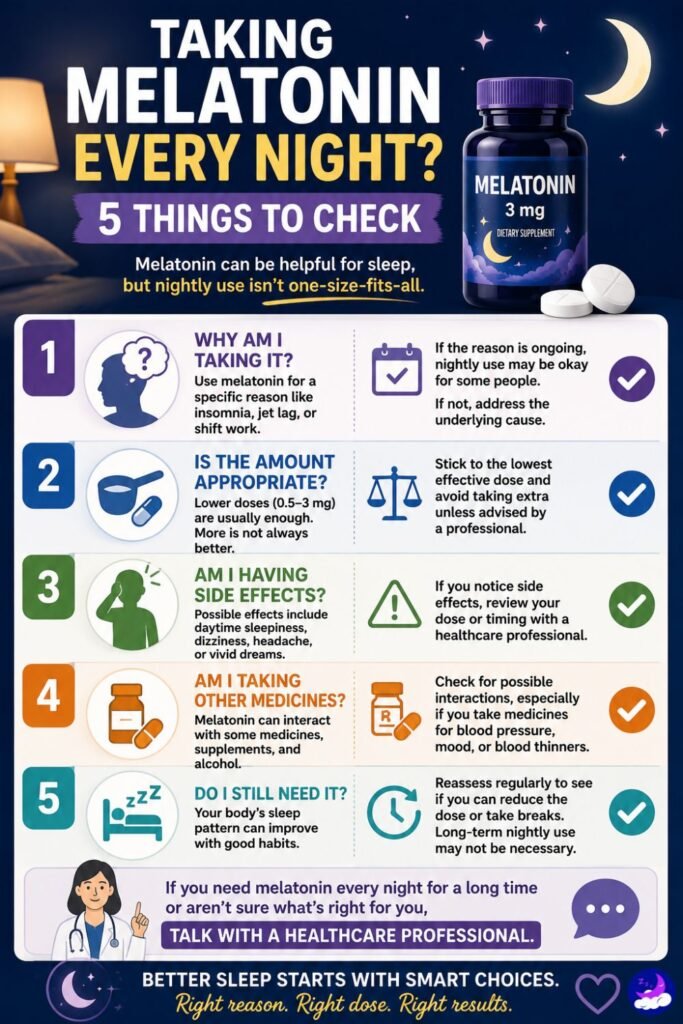
Here are the main conclusions from current evidence:
- Nightly melatonin is generally well tolerated by many adults.
- Research does not show that it causes physical dependence.
- Current evidence does not suggest it permanently stops natural melatonin production.
- True tolerance appears to be uncommon.
- Most reported side effects are mild and often improve after adjusting the dose or timing.
- More high-quality studies are needed to understand safety after many years of continuous use.
This balanced approach is reflected in recommendations from major sleep and medical organizations. Rather than advising everyone to stop melatonin after a certain number of weeks, they encourage healthcare professionals to periodically review whether it is still needed.
That is an important difference.
The goal should not be to stay on melatonin forever or to stop it as quickly as possible. The goal is to use it appropriately while continuing to address the underlying cause of poor sleep.
What This Means for You
- Melatonin is not addictive according to current evidence.
- Most adults tolerate it well when used appropriately.
- Using it every night may be reasonable in some situations.
- The underlying cause of poor sleep still needs attention.
Also Read: When to take Melatonin | Melatonin Addiction
Should You Cycle Melatonin?
You may have heard people suggest taking melatonin for a few weeks, stopping for several days, and then starting again. This practice is known as cycling melatonin.
The idea behind cycling is to prevent tolerance or help the supplement remain effective.
Does Research Support Cycling?
At present, there is no strong scientific evidence that healthy adults need to cycle melatonin.
Researchers have not shown that taking scheduled breaks improves effectiveness or prevents the body from becoming dependent on melatonin.
This is different from certain prescription sleep medicines, where breaks or careful dose reduction may be recommended after long-term use.
When Might Long-Term Use Be Reviewed?
Although routine cycling is not supported by current evidence, healthcare professionals often reassess long-term melatonin use during follow-up visits.
They may ask questions such as:
- Are you still sleeping better?
- Have your sleep habits improved?
- Has the original problem resolved?
- Are you experiencing any side effects?
- Could another condition now be affecting your sleep?
Sometimes the answer is that melatonin is still helping and should be continued. In other cases, the person may no longer need it because their sleep schedule has improved or the underlying cause has been treated.
A Better Approach Than Cycling
Instead of following a fixed schedule of stopping and restarting melatonin, many sleep specialists recommend reviewing your sleep every few months.
Ask yourself:
- Am I still benefiting from melatonin?
- Have I improved my sleep habits?
- Can I sleep well without it?
- Has my doctor recommended continuing it?
These questions are often more helpful than following a cycling plan that is not supported by strong evidence.
Practical Tip
Instead of cycling melatonin:
- Review your sleep every few months.
- Ask whether you still need the supplement.
- Keep healthy sleep habits even if melatonin is helping.
- Discuss stopping it if your sleep has improved.
Also Read: Melatonin and Weird Dreams | Melatonin Myths and Facts | Benefits of Melatonin beyond sleep.
Who Should Be More Careful With Nightly Melatonin Use?
Although melatonin is considered safe for many healthy adults, it is not the right choice for everyone. Certain groups should be more cautious, especially if they plan to take it every night for a long time.
Children and Teenagers
Melatonin is sometimes recommended for children with specific medical or developmental conditions, but it should not be given routinely without medical advice.
Children are still growing and developing, and researchers continue to study the long-term effects of regular melatonin use in this age group. Because evidence is limited, any prolonged use should be supervised by a healthcare professional.
Older Adults
Older adults naturally produce less melatonin, which is one reason it may be more helpful in this age group.
However, they are also more likely to take multiple medications and have medical conditions that can affect sleep. Starting with the lowest effective dose and reviewing treatment regularly is usually the safest approach.
Pregnancy and Breastfeeding
There is not enough high-quality evidence to confirm that melatonin is safe during pregnancy or while breastfeeding.
If you are pregnant, planning a pregnancy, or breastfeeding, speak with your healthcare provider before taking melatonin, even if it is available over the counter.
People With Chronic Insomnia
If you have needed melatonin every night for months but still struggle to sleep, it may be time to look beyond the supplement.
Chronic insomnia often has several contributing factors, including stress, anxiety, depression, poor sleep habits, or untreated sleep disorders. Melatonin alone may not address these underlying causes.
People With Medical Conditions or Multiple Medications
Certain medical conditions and medicines may change whether melatonin is appropriate.
Examples include:
- Autoimmune diseases
- Liver disease
- Kidney disease
- Epilepsy
- Bleeding disorders
- Diabetes
- High blood pressure
People taking blood thinners, medicines for diabetes, blood pressure medications, or drugs that affect the immune system should also seek medical advice before using melatonin regularly.
Also Read: Can you overdose on Melatonin | Melatonin gummies vs Tablets
✔ Checklist: Are You in a Higher-Risk Group?
Talk to a healthcare professional before using melatonin long term if you:
- ✔ Pregnant or breastfeeding
- ✔ Giving melatonin to a child
- ✔ Chronic insomnia
- ✔ Long-term medical condition
- ✔ Multiple prescription medicines
- ✔ Unsure why you’re not sleeping
How to Reduce Your Reliance on Sleep Supplements
Melatonin can be a useful tool, but it should not become the only tool.
The best long-term strategy is to improve the habits that help your body sleep naturally. Many people find they rely less on sleep supplements once these habits become consistent.
Simple changes can make a meaningful difference:
- Get natural sunlight within the first hour after waking.
- Go to bed and wake up at the same time every day, including weekends.
- Exercise regularly, but avoid intense workouts close to bedtime.
- Reduce caffeine late in the day.
- Keep your bedroom cool, dark, and quiet.
- Limit phones, tablets, and other bright screens before bed.
- Practice relaxation techniques if stress keeps you awake.
- Avoid large meals and excessive alcohol close to bedtime.
These changes may seem small, but together they often improve sleep more than increasing the dose of melatonin.
If you’d like more practical ideas, read our [How to Increase Melatonin Naturally] guide.
Practical Tip
Before increasing your melatonin dose, ask yourself whether your sleep habits have changed. Improving your daily routine often has a bigger impact than taking more of the supplement.
Also Read: Melatonin For Jetlag | Melatonin For Shift workers
When Should You Stop Taking Melatonin?
There is no single rule for when everyone should stop taking melatonin.
Instead, the decision depends on whether it is still helping and whether your sleep problem has improved.
You should consider stopping melatonin or speaking with your healthcare professional if:
- It is no longer improving your sleep.
- You develop persistent side effects.
- Your sleep has improved and you no longer feel you need it.
- A new medical condition develops.
- You start taking medicines that may interact with melatonin.
- Your healthcare professional advises stopping it.
Some people choose to stop melatonin suddenly, while others prefer to reduce it gradually. Unlike many prescription sleeping pills, melatonin has not been shown to cause physical withdrawal symptoms in most people. However, if you have been taking it for a long time, discussing the best approach with your healthcare provider is sensible.
The most important question is not “Can I keep taking melatonin?” but “Why do I still need it?”
If the answer is unclear, it’s time to reassess your sleep.
✔ Stop and Review
Before continuing melatonin, ask yourself:
□ Is it still helping?
□ Have my sleep habits improved?
□ Has the reason for my poor sleep changed?
□ Do I still need it every night?
If you’re unsure about the answer, speak with your healthcare professional.
When Should You See a Doctor?
⚠️ See a Doctor If You:
- Have trouble sleeping for 3 months or longer
- Still can’t sleep despite melatonin
- Feel very sleepy during the day
- Snore loudly or stop breathing during sleep
- Develop persistent side effects
- Are pregnant or breastfeeding
- Want to give melatonin to a child
- Have a chronic illness or take several medicines
Melatonin can help some people sleep better, but persistent sleep problems often have an underlying cause that deserves proper evaluation and treatment.
Also Read: Melatonin for Older Adults | Melatonin for Pregnant Women | Melatonin for Kids.
Frequently Asked Questions
Can I take melatonin every night for a year?
Current research suggests that many adults can use melatonin safely for a year when it is appropriate. However, if you still need it after many months, it’s worth reviewing why you continue to have sleep problems.
Is it better to stop melatonin once my sleep improves?
In many cases, yes. If your sleep has improved and you are sleeping well consistently, you may no longer need melatonin. Speak with your healthcare professional if you’re unsure.
Can I skip melatonin on some nights?
Yes. Melatonin does not usually need to be taken every single night unless your healthcare professional has recommended a regular schedule for a specific sleep disorder.
Is taking melatonin every night better than increasing the dose?
Often, yes. Increasing the dose does not necessarily improve sleep and may increase the chance of side effects. It’s usually better to review your sleep habits and the reason you’re taking melatonin before increasing the dose.
Can I become psychologically dependent on melatonin?
Some people may feel they cannot sleep without it, even though melatonin is not considered physically addictive. If you feel anxious about sleeping without it, discuss this with your healthcare professional.
Should I take melatonin forever if it helps me sleep?
Not necessarily. Even if melatonin continues to help, it’s a good idea to review your need for it periodically and address any underlying causes of poor sleep.
Does taking melatonin every night mean I have insomnia?
No. People use melatonin for many reasons, including jet lag, shift work, delayed sleep-wake phase disorder, and temporary sleep difficulties. However, if you have ongoing trouble sleeping for several months, you should seek medical advice.
Bottom Line
Current evidence suggests that many adults can safely take melatonin every night for a period of time, and research has not shown that it causes physical dependence or permanently stops the body’s natural melatonin production.
Studies lasting several months—and even a few years—have generally reported a good safety profile.
At the same time, long-term research is still limited. That is why sleep experts recommend using melatonin thoughtfully rather than automatically. If you have been taking it every night for months, ask yourself whether it is still helping and whether the original reason for your poor sleep has been identified.
Your Action Plan
- ✔ Use melatonin only when needed.
- ✔ Take the lowest effective dose.
- ✔ Build healthy sleep habits.
- ✔ Review your need every few months.
- ✔ Seek medical advice if sleep problems continue.
Melatonin can be a helpful part of a sleep plan for the right person, but it should never replace finding and treating the underlying cause of poor sleep. Periodically reviewing whether you still need melatonin is one of the best ways to use it safely and effectively over the long term.
Also Read: Foods Rich in Melatonin | Blue Light and Melatonin
References
- Besag FMC, Vasey MJ, Lao KSJ, Wong IC. Adverse Events Associated with Melatonin for the Treatment of Primary or Secondary Sleep Disorders: A Systematic Review. CNS Drugs. 2019;33:1167–1186. This supports the discussion of short-term safety, common side effects, and overall tolerability.
PubMed — Adverse Events Associated With Melatonin - Foley H, Steel A. Adverse events associated with oral administration of melatonin: A critical systematic review of clinical evidence. Complementary Therapies in Medicine. 2019;42:65–81. Useful for the article’s discussion of adverse effects and safety evidence.
PubMed — Oral Melatonin Safety Review - Besag FMC, Vasey MJ, Lao KSJ, Wong IC. Adverse events in long-term studies of exogenous melatonin. This review specifically examined prospective studies lasting six months or longer and is one of the most important references for the article’s discussion of long-term safety. It found relatively few clinically significant adverse events but emphasized that high-quality long-term randomized evidence remains limited.
PubMed — Long-Term Melatonin Safety Review - Andersen LPH, Gögenur I, Rosenberg J, Reiter RJ. The safety of melatonin in humans. This review provides background on melatonin safety, adverse effects and areas where evidence remains incomplete.
PubMed — The Safety of Melatonin in Humans - Wurtman R. Physiology and available preparations of melatonin. This provides background on melatonin’s physiological role and its relationship to the body’s endogenous melatonin system.
PubMed — Melatonin Physiology and Preparations - Wade AG, Ford I, Crawford G, et al. Efficacy of prolonged release melatonin in adults aged 55–80 years with insomnia. Long-term follow-up data from prolonged-release melatonin support the discussion of tolerance, withdrawal and endogenous melatonin production during treatment.
PubMed — Prolonged-Release Melatonin Long-Term Study - NCCIH. Melatonin: What You Need To Know. National Center for Complementary and Integrative Health, NIH. This is particularly useful for the article’s sections on short-term versus long-term safety, medication interactions, pregnancy and breastfeeding, older adults, children, and supplement quality.
NCCIH — Melatonin: What You Need To Know - NCCIH. Sleep Disorders and Complementary Health Approaches: Usefulness and Safety. This source supports the article’s discussion of melatonin for sleep disorders and the uncertainty surrounding long-term safety.
NCCIH — Sleep Disorders and Complementary Health Approaches - Andersen LPH, Werner MU, Rosenberg J, Gögenur I. A systematic review of melatonin’s adverse effects in humans. This provides additional evidence regarding the reported adverse effects and tolerability of melatonin.
PubMed — Melatonin Adverse Effects Review - Menczel Schrire Z, Phillips CL, Chapman JL, et al. Safety of higher doses of melatonin in adults: A systematic review and meta-analysis. This is particularly useful for the article’s point that higher doses should not automatically be assumed to be safer or more effective, with increased reports of drowsiness, headache and dizziness in the available evidence.
PubMed — Safety of Higher-Dose Melatonin