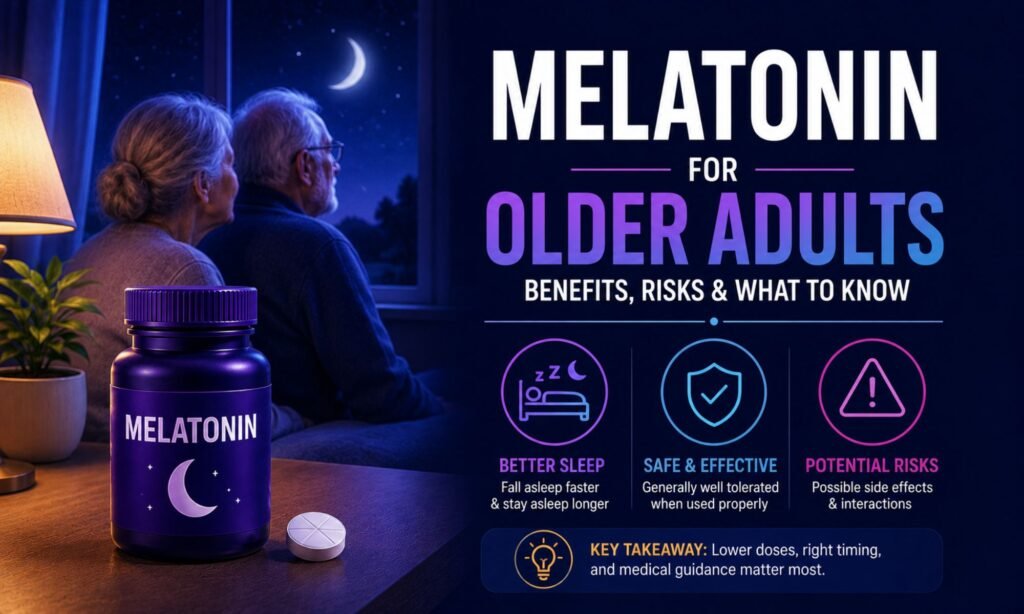
Sleep often changes with age, and melatonin may help some older adults with certain sleep or circadian problems. Natural melatonin production tends to change as we get older, but lower melatonin does not automatically mean that a supplement is needed. Research suggests that some older adults, particularly those with certain types of insomnia, may experience modest benefits from melatonin.
At the same time, older adults are more likely to take several medicines and may have concerns such as dizziness or falls, so the benefits and risks need to be considered together.
Table of Contents
Why Does Sleep Change as We Get Older?
Getting older does not automatically mean having a sleep disorder.
However, normal sleep patterns often change over time. An older adult may notice that they go to bed earlier, wake earlier in the morning, or wake more often during the night.
Sleep may also become lighter and more fragmented. The amount of deep sleep generally decreases with age, and the body’s internal clock may become less robust.
These changes can affect how easily someone stays asleep or how refreshed they feel the next morning.
There are also many reasons unrelated to normal aging that can disturb sleep. Pain, medications, anxiety, depression, frequent urination, reduced physical activity, sleep apnea, and changes in daily routine can all play a role.
That is why it is important not to assume that an older person’s sleep problem is simply caused by low melatonin.
Does Melatonin Production Decline With Age?
Nighttime melatonin production generally tends to decrease with age, although the change varies considerably from one person to another.
Research has found age-related changes in the amount and timing of melatonin secretion. However, there is no single “normal” melatonin level that applies to every older adult.
This distinction matters.
An older person may have a lower nighttime melatonin rhythm and still sleep reasonably well. Another person may have insomnia for reasons that have little to do with melatonin.
In fact, one long-term randomized study found that low endogenous melatonin production did not reliably predict who would respond to prolonged-release melatonin.
So the idea that every older adult needs to “replace” melatonin lost with age is too simplistic.
Lower melatonin may be one part of aging-related sleep changes, but it is not by itself a reason to start a supplement.
Also Read: Our Melatonin Guide | Circadian Rhythm and Melatonin | Your Body's Natural Melatonin Production
Why Might Lower Melatonin Matter for Sleep?
Melatonin is often described as a sleep hormone, but that description can be misleading.
Its more important role is as a signal of biological night.
As darkness approaches, the body normally begins producing more melatonin. This rise helps tell the brain and body that it is time to transition toward the nighttime phase of the circadian cycle.
With aging, the melatonin rhythm may become weaker or change in timing. For some people, this may contribute to changes in when they naturally become sleepy or wake up.
That is one reason melatonin can sometimes be useful when the problem involves sleep timing or circadian disruption.
But this is different from saying that melatonin treats every form of insomnia.
If someone is waking repeatedly because of pain, urinary symptoms, sleep apnea, or medication effects, simply taking more melatonin may not address the real problem.
Also Read: Foods Rich in Melatonin | Blue Light and Melatonin
What Does the Research Say About Melatonin in Older Adults?
This is where the evidence needs a little nuance.
Research in older adults is mixed. Some randomized trials have found improvements in sleep quality, sleep-onset latency, morning alertness, or other sleep measures, particularly with prolonged-release melatonin. Other trials have found little or no meaningful improvement.
A 2022 systematic review and meta-analysis specifically examined melatonin and ramelteon for insomnia in older adults. The authors concluded that melatonin may improve some sleep outcomes, but the evidence was limited by differences between studies and by the relatively small number of high-quality trials.
A newer systematic review and meta-analysis of prolonged-release melatonin found small improvements in sleep-onset latency and objective sleep efficiency compared with placebo. The subgroup of studies involving people with a mean age of at least 55 showed a larger improvement in objective sleep efficiency.
At the same time, the American Academy of Sleep Medicine has historically taken a more cautious position, recommending against routine use of melatonin for sleep-onset or sleep-maintenance insomnia in adults because of the limited quality of evidence available for that specific indication.
So the fairest conclusion is not that melatonin “works” or “doesn’t work.”
It is this:
Some older adults may benefit, but the average benefit appears modest and may depend on the sleep problem and formulation being used.
The evidence may also differ depending on the goal. Melatonin used to influence circadian timing is not exactly the same question as using it as a general treatment for chronic insomnia.
Potential Benefits of Melatonin for Older Adults
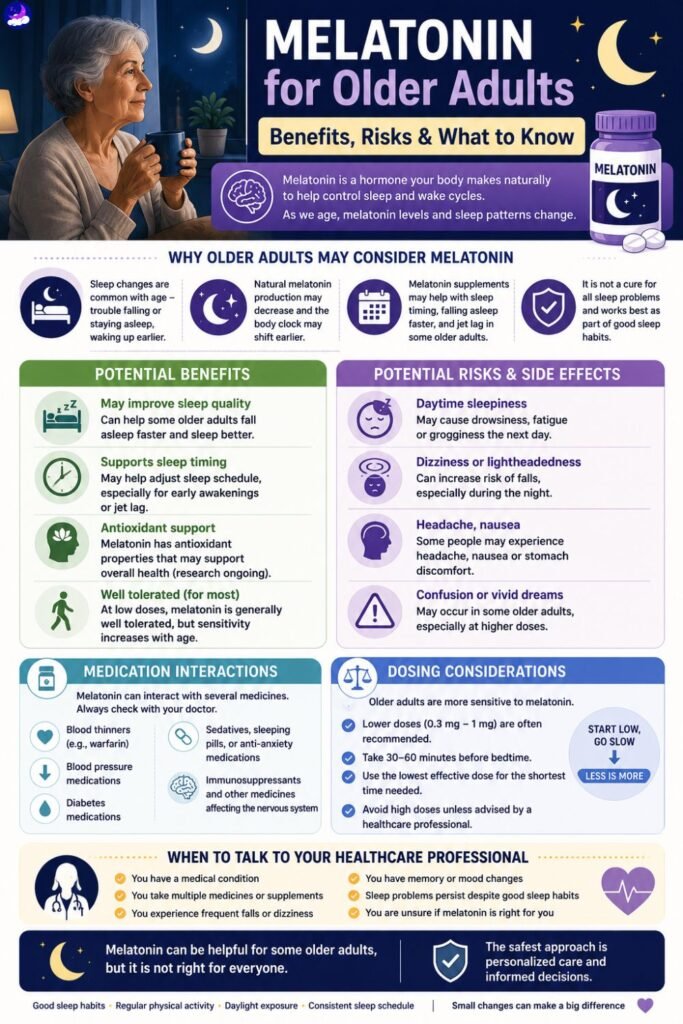
If melatonin is appropriate for a particular older adult, potential sleep-related benefits may include the following.
Helping With Sleep Onset
Some studies in older adults with insomnia have found that prolonged-release melatonin can reduce the time needed to fall asleep. In one large randomized trial involving adults aged 55–80, prolonged-release melatonin improved sleep quality and shortened sleep-onset latency compared with placebo.
The improvement should still be viewed realistically.
Melatonin is not likely to transform a severe sleep problem overnight, and not everyone will experience the same benefit.
Supporting Sleep Quality
Several studies have reported improvements in perceived sleep quality among older adults taking prolonged-release melatonin.
Again, the results are not universal.
A small randomized crossover trial in healthy adults aged 65 and older found that fast-release melatonin did not significantly improve the measured sleep parameters in people with age-related sleep-maintenance problems.
This is a useful reminder that different formulations and different sleep problems can produce different results.
Supporting Sleep Timing
Because melatonin is closely linked to the circadian clock, it may be useful when the main issue involves when sleep occurs, rather than simply an inability to sleep.
That is a different situation from taking melatonin purely as a sedative.
What Are the Risks and Side Effects?
Melatonin has generally been well tolerated in clinical studies involving older adults, but that does not mean it is risk-free for every person.
Possible adverse effects include:
- Daytime sleepiness
- Dizziness
- Headache
- Fatigue
- Nausea
- Changes in alertness
In trials of prolonged-release melatonin in older adults, adverse effects were generally mild, and some studies found no important difference from placebo.
However, an older adult may have other factors that make even a mild side effect more important.
For example, dizziness that would be inconvenient for a younger person could be much more concerning for someone who already has poor balance or has fallen recently.
Also Read: Our Melatonin Dosage Guide | Melatonin Side Effects | Melatonin Drug Interactions
Could Melatonin Increase Fall Risk?
This question deserves careful wording.
It would be too strong to say:
“Melatonin causes falls in older adults.”
There is not enough evidence to make that claim.
The concern is more indirect.
An older adult who becomes excessively sleepy, dizzy, or less steady after taking a sleep-related product may be more vulnerable to losing balance, particularly when getting out of bed during the night.
There is some experimental evidence worth noting. In a small study of community-dwelling older adults, a 3-mg dose of melatonin affected measures of postural sway during certain balance tests.
But there is an important limitation: the study measured postural control, not actual falls. It therefore cannot tell us whether melatonin increases the number of falls that occur in everyday life.
The practical lesson is simple.
If an older adult already has dizziness, balance problems, weakness, or a history of falls, anything that could increase nighttime sleepiness deserves extra attention.
Melatonin and Medications in Older Adults
Medication review is particularly important in this age group.
Many older adults take several prescription medicines, sometimes along with over-the-counter products and supplements. That makes it harder to judge the safety of adding melatonin without considering the complete medication list.
Medicines that may deserve particular attention include:
- Sedating medicines
- Sleep medicines
- Blood-thinning medicines
- Blood-pressure medicines
- Antidepressants
- Diabetes medicines
The important point is not that melatonin interacts with every medicine in these categories.
Rather, some medicines can alter melatonin’s effects, affect how it is processed, or add to problems such as sleepiness or dizziness. The exact interaction depends on the specific medicine, dose, timing, and the person’s health.
This is especially relevant when someone takes several medicines.
If an older adult is already taking multiple prescriptions, it is sensible to check the complete medication and supplement list with a doctor or pharmacist before starting melatonin.
[Also Read: Melatonin Drug Interactions]
Should Older Adults Take Melatonin Every Night?
There is no simple yes-or-no answer.
Nightly use is not automatically inappropriate, but it should have a reason.
Some clinical trials have evaluated prolonged-release melatonin over several months in adults with insomnia, including older adults, without finding evidence of tolerance or withdrawal. A randomized six-month study also found continued sleep benefits without clinically important differences in safety outcomes between prolonged-release melatonin and placebo.
However, this does not prove that every older adult can safely take every melatonin product indefinitely.
Long-term evidence varies according to:
- Age
- Formulation
- Amount
- Health conditions
- Other medicines
- Duration of use
If someone has been taking melatonin every night for a long time, it is worth asking why it is still needed and whether the original sleep problem has been properly evaluated.
Also Read: Melatonin for Pregnant Women | Melatonin for Kids.
What About Melatonin Dosage in Older Adults?
Older adults should not assume that a larger amount will produce better sleep.
A clinical review of melatonin use in adults aged 65 and older found no clear dose-response relationship for sleep improvement. Studies used different doses and formulations, making it difficult to identify one amount that is best for everyone.
This is one reason not to increase the amount simply because the first dose does not seem helpful.
More melatonin is not necessarily better melatonin.
The appropriate amount can depend on the formulation, the reason for using it, other medicines, and the person’s individual response.
If the initial amount does not seem helpful, increasing it on your own is not necessarily the best next step.
[Also Read: Melatonin Dosage Guide]
Timing May Matter More Than Taking More
With melatonin, when it is taken can matter as much as how much is taken.
That is because melatonin is closely connected to the body’s circadian clock.
The effect can depend on:
- Usual sleep schedule
- Circadian timing
- Light exposure
- Time of administration
- Formulation
This is another reason why simply taking more when melatonin does not seem to work may not solve the problem.
The timing of melatonin is a more complicated subject than simply taking it immediately before bed, particularly when it is being used to influence circadian rhythms.
Also Read: When to take Melatonin | Can you take Melatonin everynight? | Melatonin Addiction
Immediate-Release vs Extended-Release Melatonin
Melatonin products are not all formulated in the same way.
Immediate-release products are designed to release melatonin relatively quickly.
Prolonged- or extended-release products release melatonin more gradually.
This difference matters because much of the research involving older adults with insomnia has specifically examined prolonged-release melatonin, rather than every possible melatonin product.
Several randomized trials in adults aged 55 and older found improvements in sleep quality and sleep onset with prolonged-release melatonin.
But these findings should not automatically be applied to every gummy, tablet, capsule, or immediate-release product.
Evidence for one formulation is not automatically evidence for all melatonin formulations.
That is an important point when comparing products or reading online claims.
Melatonin Is Not the Only Way to Improve Sleep in Older Adults
Not every sleep problem needs a supplement.
Sleep in later life can be affected by:
- Pain
- Frequent nighttime urination
- Sleep apnea
- Restless legs symptoms
- Anxiety or depression
- Medication effects
- Irregular sleep schedules
- Medical conditions
- Changes in circadian timing
For example, loud snoring, repeated pauses in breathing, or gasping during sleep may suggest sleep apnea rather than a simple melatonin problem.
Likewise, an uncomfortable urge to move the legs at night may need a different evaluation.
For persistent insomnia, cognitive behavioral therapy for insomnia (CBT-I) is also an important treatment option. Rather than simply adding a sleep supplement, CBT-I addresses behaviors and thought patterns that can maintain chronic insomnia.
The key point is:
Persistent sleep problems deserve evaluation rather than automatically adding melatonin.
Practical Steps Before an Older Adult Starts Melatonin
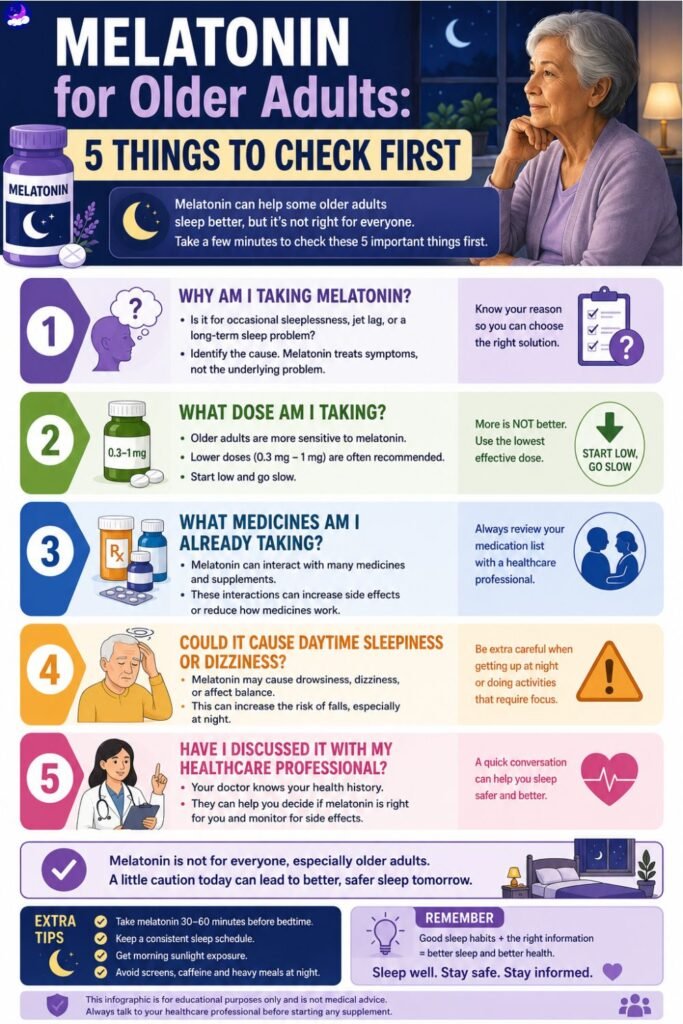
Before starting melatonin, it can help to ask:
- What sleep problem am I trying to solve?
- How long has it been happening?
- What medicines and supplements am I already taking?
- Do I have dizziness, balance problems, or previous falls?
- Am I unusually sleepy during the day?
- Is my sleep schedule reasonably regular?
- Could another sleep disorder or medical problem be involved?
These questions do not mean that every older adult needs a medical evaluation before trying melatonin.
They are simply a useful way to think about whether melatonin is addressing the actual problem.
For someone taking several medicines or dealing with significant medical conditions, discussing the situation with a doctor or pharmacist is particularly sensible.
Also Read: Can you overdose on Melatonin | Melatonin gummies vs Tablets
When Should an Older Adult Talk to a Doctor?
Medical advice is particularly appropriate when an older adult has:
- Persistent or worsening insomnia
- Excessive daytime sleepiness
- Frequent dizziness
- Falls or near-falls
- Suspected sleep apnea
- Restless legs symptoms
- A major change in sleep pattern
- Confusion or unusual nighttime behavior
- Several prescription medicines
- Long-term melatonin use without a clear reason
This is not meant to make melatonin sound dangerous.
It is simply a reminder that sleep problems in older adults can have many causes, and some of those causes are worth identifying rather than masking with a supplement.
Frequently Asked Questions
Does melatonin work better in older adults?
Not necessarily. Some older adults may benefit, particularly those with certain types of insomnia, but the response varies. Research suggests that some prolonged-release formulations can produce modest improvements in sleep-related outcomes.
Does melatonin decrease with age?
Generally, yes. Nighttime melatonin secretion tends to change and often decline with aging, although the degree varies between individuals. Lower melatonin does not automatically mean that supplementation is necessary.
Is melatonin safe for older adults?
Melatonin has generally been well tolerated in clinical studies involving older adults, but it is not risk-free for everyone. Dizziness, sleepiness, medication interactions, and individual health conditions should be considered.
Can melatonin make older adults sleepy during the day?
It can. Daytime sleepiness or fatigue is a possible adverse effect, although not everyone experiences it. This matters particularly for someone who already has balance problems or needs to remain highly alert during the day.
Can melatonin increase fall risk?
There is not enough evidence to say that melatonin directly causes falls. However, if it contributes to dizziness, excessive sleepiness, or impaired balance, it could be a concern for an older adult who is already vulnerable to falls.
Also Read: Melatonin For Jetlag | Melatonin For Shift workers
Bottom Line
Melatonin may help some older adults, but it is not a universal solution for age-related sleep changes.
Natural melatonin production generally changes with age, but lower levels do not automatically mean that supplementation is needed.
Some studies suggest that particular prolonged-release formulations can produce modest improvements in sleep onset, sleep quality, or sleep efficiency in older adults with insomnia. Other studies have found little benefit, and clinical guidelines have been more cautious about recommending melatonin routinely for chronic insomnia.
For an older adult, the decision should consider the reason for using melatonin, formulation, timing, other medicines, daytime alertness, balance, fall history, and possible underlying sleep problems.
The goal is not simply to take melatonin.
The goal is to understand the sleep problem and choose an approach that is appropriate and safe for that individual.
Also Read: Melatonin and Weird Dreams | Melatonin Myths and Facts | Benefits of Melatonin beyond sleep.
References
- Marupuru S, Arku D, Campbell AM, Slack MK, Lee JK. Use of Melatonin and/or Ramelteon for the Treatment of Insomnia in Older Adults: A Systematic Review and Meta-Analysis. Journal of Clinical Medicine. 2022;11(17):5138.
PubMed — Older Adults Melatonin Systematic Review and Meta-Analysis - Wade AG, Ford I, Crawford G, et al. Efficacy of prolonged release melatonin in insomnia patients aged 55–80 years: quality of sleep and next-day alertness outcomes. Current Medical Research and Opinion. 2007;23(10):2597–2605.
PubMed — Prolonged-Release Melatonin in Adults 55–80 - Lemoine P, Nir T, Laudon M, Zisapel N. Prolonged-release melatonin improves sleep quality and morning alertness in insomnia patients aged 55 years and older and has no withdrawal effects. Journal of Sleep Research. 2007;16(4):372–380.
PubMed — Melatonin in Adults 55+ - Wade AG, Ford I, Crawford G, et al. Nightly treatment of primary insomnia with prolonged release melatonin for 6 months: a randomized placebo controlled trial on age and endogenous melatonin as predictors of efficacy and safety. BMC Medicine. 2010;8:51.
PubMed — Six-Month Melatonin Trial - Luthringer R, Muzet M, Zisapel N, Staner L. The effect of prolonged-release melatonin on sleep measures and psychomotor performance in elderly patients with insomnia. International Clinical Psychopharmacology. 2009;24(5):239–249.
PubMed — Melatonin, Sleep and Psychomotor Performance in Older Adults - Baskett JJ, Broad JB, Wood PC, et al. Does melatonin improve sleep in older people? A randomised crossover trial. Age and Ageing. 2003;32(2):164–170.
PubMed — Randomized Trial in Older People - Lemoine P, Garfinkel D, Laudon M, Nir T, Zisapel N. Prolonged-release melatonin for insomnia: an open-label long-term study of efficacy, safety, and withdrawal. Therapeutics and Clinical Risk Management. 2011.
PubMed — Long-Term Prolonged-Release Melatonin Study - Pierce M, Linnebur SA, Pearson SM, Fixen DR. Optimal Melatonin Dose in Older Adults: A Clinical Review of the Literature. Sr Care Pharm. 2019;34(7):419–431.
PubMed — Melatonin Dose Review in Older Adults - Qaseem A, Kansagara D, Forciea MA, Cooke M, Denberg TD. Management of Chronic Insomnia Disorder in Adults: A Clinical Practice Guideline From the American College of Physicians. Annals of Internal Medicine. 2016;165(2):125–133.
PubMed — Chronic Insomnia Clinical Practice Guideline - Sateia MJ, Buysse DJ, Krystal AD, Neubauer DN, Heald JL. Clinical Practice Guideline for the Pharmacologic Treatment of Chronic Insomnia in Adults: An American Academy of Sleep Medicine Clinical Practice Guideline. Journal of Clinical Sleep Medicine. 2017;13(2):307–349.
PubMed — AASM Pharmacologic Insomnia Guideline