Melatonin may help some shift workers sleep better during the day, especially after a night shift, but it is not a complete solution to shift-work sleep problems. The evidence suggests that timed melatonin can improve daytime sleep in some people, although the benefits appear modest and the certainty of the evidence is low.
Timing, light exposure, the type of shift, and the person’s sleep schedule all matter.
Table of Contents
Why Is Sleep So Difficult for Night-Shift Workers?
For someone working a night shift, sleep can feel like a battle against the clock.
You may finish work at 7 or 8 in the morning, when your family is starting the day and sunlight is filling the streets. You may be exhausted and ready for bed, yet your brain is receiving strong signals that it is time to stay awake.
That is the basic problem.
Your work schedule says “be awake,” your circadian clock says “it is nighttime,” and then, just when you are ready to sleep, the outside world starts sending daytime signals.
Night-shift workers therefore have to manage three competing schedules:
Work schedule → Body clock → Sleep schedule
These do not automatically line up.
The circadian system normally promotes wakefulness during daylight and sleep at night. Working through the biological night means asking the body to remain alert when its internal timing system is pushing in the opposite direction.
NIOSH notes that night-shift workers commonly experience shorter and poorer-quality sleep, and large population data have found more difficulty falling asleep, excessive daytime sleepiness and insomnia among night-shift workers than among daytime workers.
There is another problem: daytime sleep is usually more fragile.
Your bedroom may be brighter. Traffic and neighborhood noise may be louder. Children or family members may be awake. You may have errands to do. Even if you have enough time available for sleep, the environment may not allow you to use all of that time for actual sleep.
This is why a night worker can be completely exhausted and still wake after only a few hours.
Also Read: Our Melatonin Guide | Circadian Rhythm and Melatonin | Your Body's Natural Melatonin Production
Can Melatonin Help Shift Workers Sleep?
Yes, melatonin may help some shift workers sleep during the day, particularly when they have difficulty sleeping after a night shift.
The 2025 American Academy of Sleep Medicine guideline conditionally recommends melatonin over no melatonin for adults with shift work disorder who have daytime sleep disturbance or insomnia following a night shift. However, the certainty of evidence is very low, so the expected benefit should not be overstated. (AASM Clinical Practice Guideline)
Research suggests melatonin may increase sleep duration or improve aspects of sleep quality in some shift workers. But studies have often been small, used different doses and schedules, and included laboratory simulations as well as real-world workers.
That makes it difficult to give everyone the same advice.
Melatonin may be useful as one part of a sleep strategy. It does not remove daylight, noise, family responsibilities, changing work hours or the underlying circadian conflict.
And there is an important safety issue.
Melatonin can temporarily increase sleepiness and reduce alertness. A worker should not take it before driving, operating machinery, or performing other safety-sensitive activities when residual sleepiness could create a risk. (AASM Clinical Practice Guideline)
What Happens to Melatonin During a Night Shift?
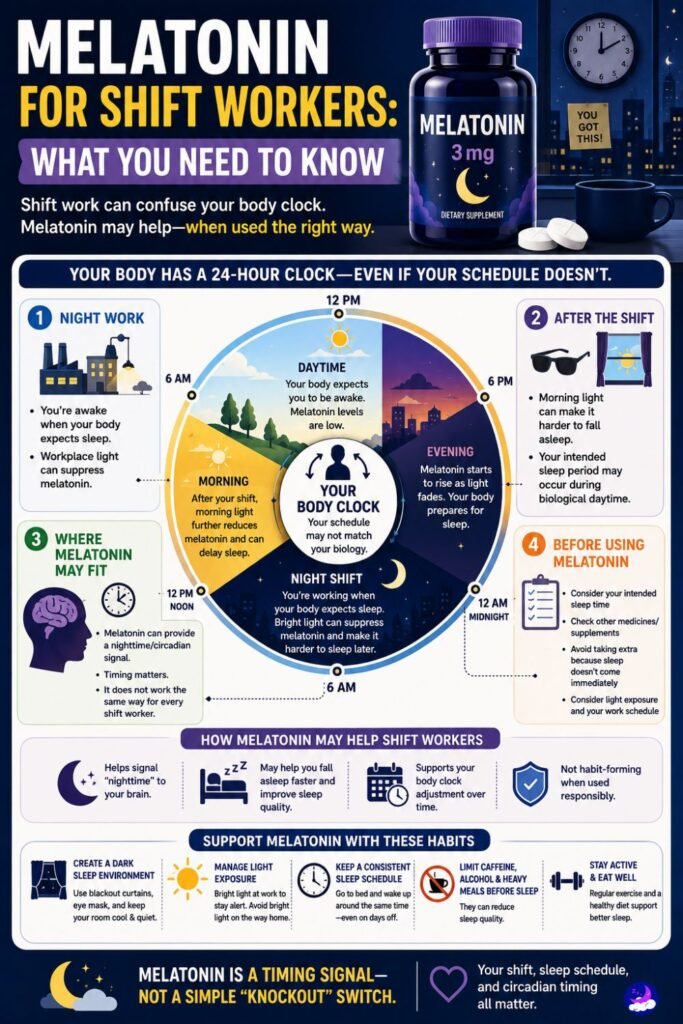
Under normal conditions, melatonin follows a strong daily rhythm.
It usually begins to rise in the evening, remains higher during the biological night, and falls toward morning.
A night-shift worker may therefore be awake and working at exactly the time when melatonin would normally be elevated.
That creates an uncomfortable biological mismatch.
Imagine someone working from 11 PM to 7 AM.
Around the middle of the shift, their body may still be operating in its biological night. Melatonin may be elevated, sleep pressure is increasing, and circadian alerting signals are relatively weak.
Yet the worker has to stay awake, concentrate and perform their job.
Light can change this picture.
Exposure to bright light during the biological night can suppress melatonin and increase alertness. This can be useful during a night shift, particularly when a worker needs to remain alert, but it can become a problem if the same worker wants to sleep immediately after getting home.
Research suggests that night-shift work is associated with lower melatonin levels or melatonin metabolites in some workers, particularly those on fixed night shifts. A systematic review and meta-analysis involving more than 1,800 night-shift workers found lower measures of melatonin or its urinary metabolite in night workers compared with day workers. (PubMed)
That does not mean every night worker has low melatonin.
The response can vary depending on light exposure, shift pattern, circadian adaptation and individual biology.
The important issue is that night work can disturb the normal relationship between melatonin, light, sleep and wakefulness.
Also Read: Foods Rich in Melatonin | Blue Light and Melatonin
Why Is Daytime Sleep So Difficult?
Daytime sleep is not simply nighttime sleep moved to a different part of the clock.
Your body has an internal timing system that actively influences when you feel sleepy and when you feel alert.
After a night shift, two forces can work against each other.
The first is sleep pressure.
After being awake all night, you have accumulated a strong need for sleep. This is why many night workers feel exhausted when they finish work.
The second is the circadian alerting signal.
As morning arrives, your circadian system begins moving toward daytime physiology. Light increases, body temperature begins to rise, and the brain becomes more prepared for wakefulness.
So you can have a strong sleep drive while your circadian system is simultaneously pushing you toward being awake.
That is one reason daytime sleep can be shorter than expected.
Then there are the practical problems.
Light can enter through curtains.
Noise can come from traffic, construction, phones or household activity.
Temperature may be less comfortable than at night.
Family and social responsibilities may interrupt sleep.
And if the worker has to return to work again that evening, the available sleep window may already be limited.
The result can be a cycle of short sleep → fatigue → poorer alertness → greater dependence on stimulants → difficulty sleeping → more fatigue.
This is why protecting the sleep opportunity itself is just as important as considering melatonin.
How Could Melatonin Help a Shift Worker?
Melatonin is sometimes described as a sleep hormone, but that description is incomplete.
It is better understood as a biological nighttime signal.
When your body produces melatonin at night, it helps communicate that the biological environment is in its nighttime phase.
For a night-shift worker trying to sleep during daylight hours, taking melatonin at an appropriate time may provide an additional nighttime signal when the external environment is saying the opposite.
That may help some people fall asleep more easily or remain asleep longer.
This does not mean melatonin creates normal nighttime physiology during the day.
It cannot remove sunlight from the window. It cannot silence a noisy street. It cannot change a rotating work schedule.
And it cannot replace the sleep that a worker simply does not have enough time to obtain.
Melatonin is therefore best viewed as one tool within a larger sleep strategy, rather than a way to make night work biologically harmless.
Also Read: Our Melatonin Dosage Guide | Melatonin Side Effects | Melatonin Drug Interactions
What Does the Research Say About Melatonin and Shift Work?
This is where some caution is needed.
The evidence is supportive but not definitive.
The 2025 AASM clinical practice guideline specifically evaluated melatonin for adults with shift work disorder. For daytime sleep disturbance or insomnia following a night shift, the AASM suggests melatonin over no melatonin, but classifies the recommendation as conditional with very low-certainty evidence. (AASM Clinical Practice Guideline)
The AASM task force identified 10 randomized controlled trials examining melatonin for daytime sleep after night work. Pooled findings suggested improvements in sleep quality and potentially meaningful increases in self-reported and objectively measured sleep duration.
However, the task force also judged the overall certainty of evidence to be very low because of factors including indirectness, imprecision and risk of bias. Importantly, the task force judged the overall benefit to be relatively small. (AASM Clinical Practice Guideline)
The average benefit seen in studies is therefore modest. Melatonin should not be presented as a treatment that transforms daytime sleep into normal nighttime sleep.
A systematic review focused specifically on healthcare personnel found improvements in several outcomes, including sleep onset, total sleep period and daytime attention in some studies. But the review also highlighted major limitations, including small samples, differences in doses and follow-up periods, and variation in the type of melatonin used. (PubMed)
Many shift-work studies also involve healthcare workers, laboratory simulations or relatively small groups.
The results may not apply equally to a nurse working rotating 12-hour shifts, a factory worker on permanent nights, a security guard working irregular hours, and an airline employee working changing schedules.
The evidence therefore supports individualized use rather than a universal prescription.
When Should a Night-Shift Worker Take Melatonin?
This is one of the hardest questions to answer with a single clock time.
There is no universal rule such as:
“Take melatonin at 8 AM after every night shift.”
That may make sense for one schedule and be poorly timed for another.
First, consider the purpose.
Are you taking melatonin mainly to support a planned daytime sleep period?
Or are you trying to change the timing of your circadian rhythm so that your body becomes more adapted to night work?
These are not exactly the same goal.
The timing also depends on:
- When your night shift starts
- When it ends
- When you intend to sleep
- How much light you receive during and after work
- Whether you work permanent nights
- Whether your schedule rotates
- Whether you need to be alert soon after taking it
For someone on a permanent night shift, a relatively consistent sleep period may allow a more consistent strategy.
For someone whose schedule changes every few days, the situation is much more complicated.
The 2025 AASM guideline also separates treatment aimed at sleep disturbance from treatment aimed at circadian adaptation. That distinction is important because the goal is not always to completely shift the body clock to a night-work schedule. (AASM Clinical Practice Guideline)
Also Read: When to take Melatonin | Can you take Melatonin everynight? | Melatonin Addiction
What About Taking Melatonin After a Night Shift?
Yes, it may help.
The 2025 AASM guideline conditionally recommends melatonin for adults with shift work disorder who have difficulty sleeping during the day after a night shift. However, the recommendation is based on very low-certainty evidence, so this does not mean every night-shift worker will benefit. (AASM Clinical Practice Guideline)
Suppose your shift ends at 7 AM and you plan to sleep from around 9 AM until 3 or 4 PM.
Melatonin may help support that planned sleep period in some people.
But your light exposure matters.
Your intended sleep time matters.
Your next shift matters.
And your need to remain alert matters.
If you take melatonin and then need to drive home, operate machinery, supervise patients, or perform another safety-sensitive task, residual sleepiness could become a serious problem.
The AASM specifically warns that melatonin may temporarily increase sleepiness and decrease cognitive performance, and recommends allowing adequate time for this effect to resolve before driving, returning to work or performing safety-sensitive activities. (AASM Clinical Practice Guideline)
So the question is not simply:
“Can I take melatonin after my shift?”
It is:
“Does taking melatonin at this point fit safely with my planned sleep period and the activities I still need to perform?”
What If You Work Rotating Shifts?
Rotating shifts create a different problem.
A permanent night worker may at least have the opportunity to develop a relatively stable sleep schedule.
A rotating worker might work:
Day shift → Evening shift → Night shift → Day shift
within the same week.
Just as the body begins adapting to one schedule, the schedule changes again.
This makes complete circadian adaptation difficult.
The 2025 AASM guideline makes an important point: for people who work rotating or frequently changing shifts, circadian adaptation is generally not a realistic treatment goal. The evidence supporting deliberate circadian adaptation comes mainly from people who achieved partial adaptation to a night-shift schedule. (AASM Clinical Practice Guideline)
That changes how melatonin should be viewed.
For a permanent night worker, a consistent sleep and light strategy may be possible.
For a rotating worker, the priority may instead be protecting sleep, reducing sleepiness and managing each transition safely.
Melatonin may still help some rotating workers sleep, but there is much less reason to expect it to “reset” the body clock every few days.
Permanent Night Shift vs Rotating Shift
| Permanent Night Shift | Rotating Shift |
|---|---|
| More consistent work schedule | Frequent schedule changes |
| Greater opportunity for a predictable sleep period | Sleep timing repeatedly changes |
| Circadian adaptation may be possible to some degree | Full adaptation is usually unrealistic |
| Light and sleep strategies can be more consistent | Timing strategies become more complicated |
| Melatonin timing may be easier to plan | Melatonin timing may need repeated adjustment |
This distinction is important because advice designed for permanent night workers should not automatically be given to someone whose shifts change frequently.
Melatonin and Light: The Two Signals Matter
If melatonin provides a nighttime signal, light is another—and one of the strongest environmental signals to the circadian system.
For night-shift workers, light can be both helpful and disruptive depending on when it occurs.
During the shift, appropriately timed bright light can help increase alertness. The 2025 AASM guideline conditionally recommends bright light during the night shift for adults with shift work disorder and excessive sleepiness, although the certainty of evidence is very low. (AASM Clinical Practice Guideline)
But the situation changes toward the end of the shift.
If your goal is to sleep soon after reaching home, strong morning light may reinforce daytime alerting signals just when you are trying to sleep.
NIOSH advises night-shift workers to manage light exposure carefully, with brighter light during the earlier part of the shift and reduced exposure later when appropriate. It also warns that dark sunglasses on the commute home can increase drowsiness in someone who is already sleepy and therefore may increase driving risk. (CDC/NIOSH)
So there is no sensible rule that says:
“Always wear dark sunglasses after a night shift.”
If you are already struggling to stay awake while driving, anything that increases sleepiness could make the commute more dangerous.
Also Read: Can you overdose on Melatonin | Melatonin gummies vs Tablets
The Trip Home After a Night Shift
The journey home deserves more attention than it usually gets.
You may finish work exhausted at 7 AM, walk outside into bright sunlight and immediately begin receiving strong daytime signals.
If your plan is to sleep soon after reaching home, reducing unnecessary bright-light exposure may make sense.
That could mean:
- Avoiding unnecessary outdoor exposure after work.
- Keeping the home environment relatively dim while preparing for bed.
- Using curtains or blinds to reduce daylight entering the bedroom.
- Avoiding stimulating activities that delay bedtime.
- Going to bed according to your planned sleep schedule.
But there is one non-negotiable rule:
Never compromise commuting safety in an attempt to control light exposure.
If you are very sleepy after a night shift, do not drive yourself home. Arrange another way to get home safely.
Light-management strategies should never take priority over avoiding drowsy driving. (CDC/NIOSH)
What Should a Shift Worker Do on the Day Off?
Days off create another difficult choice.
You may want to return to a normal daytime schedule so you can spend time with family and friends.
But switching completely back and forth can create another circadian challenge.
For some permanent night workers, maintaining at least part of a consistent sleep schedule on days off may make it easier to preserve adequate sleep.
For others, especially people with family responsibilities, maintaining a completely reversed schedule may be unrealistic.
There is no single perfect solution.
The main goal is to avoid extreme swings that repeatedly disrupt your sleep opportunity.
If your work schedule allows it, maintaining some overlap between your workday sleep schedule and your days-off schedule may be easier than completely flipping between day and night every few days.
The best approach depends on how many night shifts you work, how quickly the schedule changes and what your life outside work requires.
Can Melatonin Fix Shift-Work Sleep Problems?
No.
Melatonin can address one part of the problem.
It may help with sleep timing and, in some people, improve daytime sleep after a night shift.
But shift-work sleep problems can also involve:
- Circadian misalignment
- Bright light
- Noise
- Insufficient sleep opportunity
- Irregular work hours
- Family responsibilities
- Long commutes
- Caffeine or stimulant use
- Stress
- Other sleep disorders
A supplement cannot solve all of these.
The 2025 AASM guideline therefore considers several approaches to shift work disorder, including CBT-I, planned naps, bright light, caffeine strategies and work-schedule considerations, depending on the person’s symptoms and circumstances. (AASM Clinical Practice Guideline)
Melatonin is best viewed as one component of a broader plan.
How Much Melatonin Should Shift Workers Take?
This article is not intended to replace the SCS Melatonin Dosage Guide.
The important point for shift workers is that studies have used very different amounts of melatonin, and there is no evidence that simply taking more produces better results.
The AASM evidence review found substantial variation in doses used in clinical trials, including studies using amounts from very low doses to much higher doses. The evidence was also limited by small studies and differences in study design. (AASM Systematic Review)
So avoid the assumption:
More melatonin = better daytime sleep.
Formulation can also matter because immediate-release and extended-release products do not behave identically.
For a shift worker, timing, purpose and safety may be just as important as the amount taken.
Also Read: Melatonin For Jetlag
How Long Should a Shift Worker Use Melatonin?
There is no universal duration.
Someone working permanent nights may have a different need from someone who works occasional night shifts.
Likewise, someone using melatonin to help with a specific daytime sleep problem may have a different goal from someone attempting to influence circadian timing.
Rather than asking:
“How many weeks should I keep taking melatonin?”
it is better to ask:
“Is it actually helping, and why am I still having trouble sleeping?”
If the problem persists despite adequate opportunity for sleep, the underlying issue deserves attention.
Long-term difficulty sleeping may reflect shift work disorder, insomnia, sleep apnea, restless legs syndrome, medication effects, mood disorders or another sleep problem.
Indefinitely increasing or continuing melatonin without reassessing the problem is not a good substitute for evaluation.
Safety: When Should Shift Workers Be Careful With Melatonin?
This is especially important for people whose jobs involve responsibility for other people’s safety.
Melatonin can cause drowsiness, dizziness, headache or reduced alertness in some people.
That matters if you are:
- Driving
- Operating machinery
- Working at heights
- Working around heavy equipment
- Providing patient care
- Flying or controlling transport
- Performing another safety-sensitive task
The AASM specifically warns that melatonin may temporarily increase sleepiness and decrease cognitive performance, particularly around the time it is taken. Adequate time should be allowed for these effects to resolve before driving or performing safety-sensitive activities. (AASM Clinical Practice Guideline)
Alcohol and other sedating substances can add to the problem.
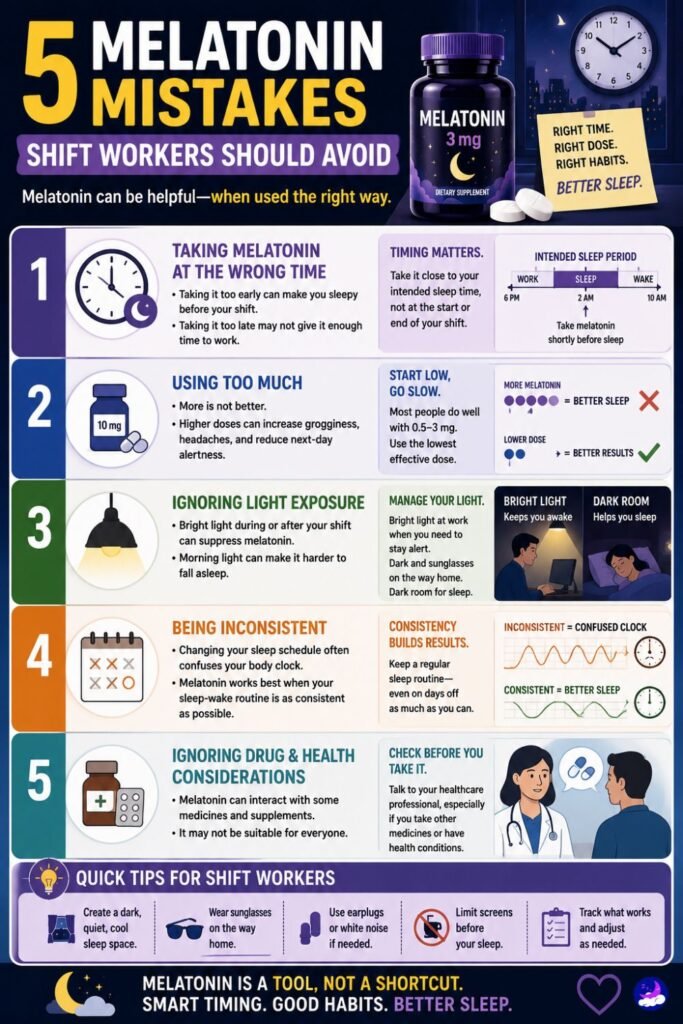
People who take prescription medicines should also consider possible drug interactions before starting melatonin.
Extra caution is appropriate during pregnancy and breastfeeding, and melatonin should not be casually given to children or adolescents without appropriate medical guidance.
Also Read: Melatonin for Older Adults | Melatonin for Pregnant Women | Melatonin for Kids.
Common Mistakes Shift Workers Make With Melatonin
1. Taking It at a Random Time
Melatonin is a timing signal. Taking it whenever you happen to feel tired is not the same as using it as part of a planned sleep strategy.
2. Taking It Based Only on the Clock
A worker may think, “It is 8 AM, so this must be my bedtime.”
But the biological context matters too. Shift start, shift end, light exposure and intended sleep period all affect the decision.
3. Assuming More Is Better
Higher amounts do not automatically produce better sleep or a better circadian adjustment.
4. Ignoring Light
A worker may take melatonin and then spend an hour in bright morning light, weakening the nighttime signal they are trying to create.
5. Taking It Before Driving
This is a serious mistake.
If melatonin makes you sleepy, taking it before a morning commute can increase risk.
6. Using It Every Day Without Reassessing the Problem
If you still cannot sleep after weeks of trying, the question should not simply be whether you need more melatonin.
You may need to identify another cause.
7. Expecting It to Reverse Night Work Completely
Melatonin cannot make a night shift biologically identical to a daytime schedule.
8. Using Melatonin When There Is Not Enough Time to Sleep
If your schedule gives you only four hours between getting home and leaving again, melatonin cannot create the missing hours.
Adequate sleep opportunity comes first.
Also Read: Melatonin and Weird Dreams | Melatonin Myths and Facts | Benefits of Melatonin beyond sleep.
A Practical Sleep Strategy for Night-Shift Workers
Melatonin works best when it fits into a broader routine.
Before the shift
- Plan your main sleep period.
- Give yourself enough time in bed.
- Consider a pre-shift nap if appropriate.
- Avoid starting a night shift already severely sleep-deprived.
- Use light strategically to support alertness.
During the shift
- Stay appropriately alert, particularly during the early-morning hours when sleepiness can be strong.
- Work in an appropriately lit environment.
- Avoid unnecessary sedating substances.
- Be careful with caffeine late in the shift if you plan to sleep soon after getting home.
The AASM recommends a planned nap before the night shift for adults with excessive sleepiness, although sleep inertia immediately after a nap can temporarily impair performance and increase accident risk. (AASM Clinical Practice Guideline)
After the shift
- Get home safely.
- Reduce unnecessary bright light when appropriate.
- Keep the bedroom dark, quiet and comfortable.
- Avoid unnecessary chores or errands before your main sleep period.
- Follow the sleep schedule you have planned.
- Use melatonin only if it fits safely and appropriately into that plan.
NIOSH recommends going to bed soon after returning home and maximizing the amount of sleep obtained before the afternoon, because the body’s circadian alerting system can make it increasingly difficult to remain asleep later in the day. (CDC/NIOSH)
Before the next shift
- Wake with enough time to prepare without rushing.
- Get appropriately timed light exposure.
- Consider a nap if needed and if it fits safely into your schedule.
- Make sure you have enough total sleep opportunity before starting work again.
Frequently Asked Questions
Can I take melatonin after a night shift?
Possibly. The 2025 AASM guideline conditionally recommends melatonin for adults with shift work disorder who have daytime sleep disturbance or insomnia following a night shift. The decision should consider your intended sleep period, light exposure and safety needs. (AASM Clinical Practice Guideline)
Does melatonin help daytime sleep?
It may. Research suggests that melatonin can improve aspects of daytime sleep in some night-shift workers, although the certainty of evidence is low or very low.
Should night-shift workers take melatonin every day?
Not automatically. The appropriate duration depends on the person’s schedule, symptoms and treatment goal. Persistent sleep problems deserve reassessment rather than indefinite self-treatment.
Does melatonin help rotating shift workers?
It may help some people sleep, but rotating workers face a different problem from permanent night workers. Because their schedules change frequently, full circadian adaptation is generally not a realistic goal. (AASM Clinical Practice Guideline)
Can melatonin make me too sleepy for work?
Yes. Drowsiness is a possible effect. Never take melatonin immediately before driving, operating machinery or performing another safety-sensitive task if it could impair alertness.
Should I take melatonin before a night shift?
Not as a universal rule. Some research and the AASM guideline support melatonin before a planned nap before the first night shift in people who have difficulty napping, but the evidence is very low certainty and safety timing is important. (AASM Clinical Practice Guideline)
Does melatonin reset the body clock for night-shift workers?
Not necessarily. Melatonin can influence circadian timing, but complete adaptation to night work is uncommon, and the AASM notes that full circadian adaptation is generally not a realistic treatment goal for rotating or frequently changing shifts. (AASM Clinical Practice Guideline)
What if I still cannot sleep after a night shift?
First, look at the basics: adequate sleep opportunity, light exposure, noise, temperature, caffeine, alcohol and your schedule. If insomnia or excessive sleepiness persists despite reasonable sleep opportunity, speak with a healthcare professional. A sleep disorder may be contributing to the problem.
Bottom Line
Night-shift work can place sleep directly against the body’s natural circadian timing. You may finish work when your body is beginning to receive daytime signals, yet need to sleep for several hours during daylight.
Melatonin may help some workers make that transition.
The 2025 American Academy of Sleep Medicine guideline conditionally recommends melatonin for adults with shift work disorder who have daytime sleep disturbance or insomnia after a night shift, but the certainty of evidence is very low. That means melatonin is a reasonable option for some people, but its benefits should not be exaggerated. (AASM Clinical Practice Guideline)
The best results are unlikely to come from treating melatonin as a standalone solution.
Think about the whole system:
Sleep schedule + light exposure + sleep environment + adequate sleep opportunity + melatonin when appropriate
Permanent night workers and rotating workers also need different expectations. A stable night schedule may allow some degree of circadian adaptation, while frequent rotation makes complete adaptation much less realistic.
Most importantly, melatonin should never be used in a way that leaves you too sleepy to drive, operate machinery, care for patients or perform other safety-sensitive work.
If you continue to have significant insomnia, excessive daytime sleepiness or difficulty functioning despite having enough opportunity to sleep, it is worth looking beyond melatonin.
Sometimes the problem is not that you need a better supplement.
It is that your sleep disorder, work schedule or circadian problem needs proper evaluation.
References
- Management of Shift Work Disorder: An American Academy of Sleep Medicine Clinical Practice Guideline. American Academy of Sleep Medicine. 2025.
AASM Clinical Practice Guideline — Management of Shift Work Disorder - Management of Shift Work Disorder: Systematic Review and Evidence Report. American Academy of Sleep Medicine. 2025.
AASM Systematic Review — Shift Work Disorder - Association between night-shift work and level of melatonin: systematic review and meta-analysis. Sleep. 2020;43(11):zsaa089.
PubMed — Night Shift Work and Melatonin Meta-analysis - The Effects of the Exogenous Melatonin on Shift Work Sleep Disorder in Health Personnel: A Systematic Review. International Journal of Environmental Research and Public Health. 2022;19(16):10199.
PubMed — Melatonin and Shift Work Disorder Systematic Review - Shift Work and Sleep. National Institute for Occupational Safety and Health (NIOSH), CDC.
CDC/NIOSH — Shift Work and Sleep - Coping with the Night and Evening Shifts: Light. NIOSH Training for Nurses on Shift Work and Long Hours. CDC.
CDC/NIOSH — Light and Night Shift Work - Coping with the Night and Evening Shifts: Sleep. NIOSH Training for Nurses on Shift Work and Long Hours. CDC.
CDC/NIOSH — Sleep After Night Shift - Cochrane Review: Melatonin for the prevention and treatment of sleep disturbance in shift workers.
PubMed — Melatonin for Shift Workers