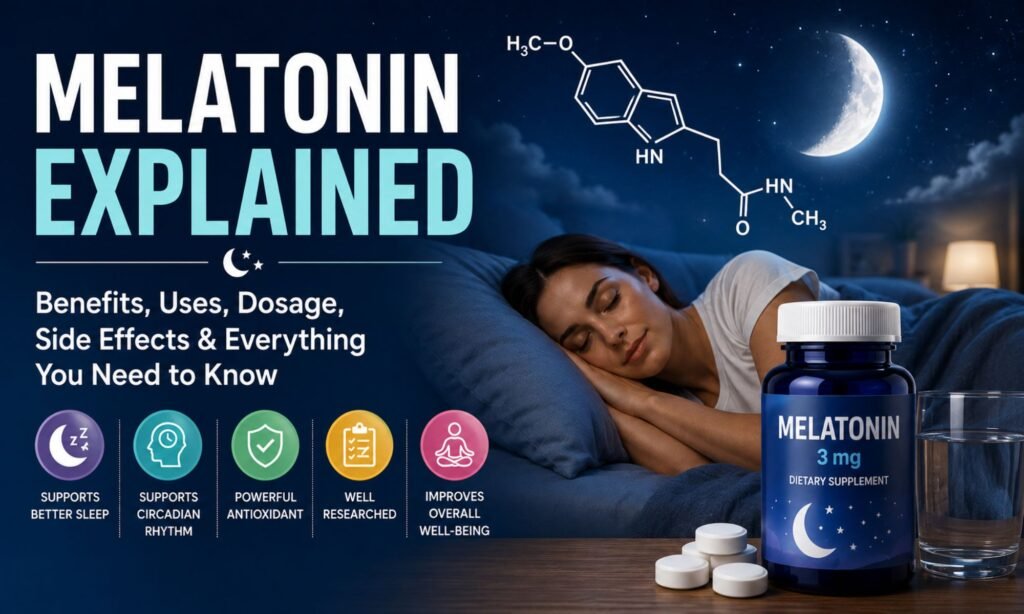
Melatonin is a natural sleep hormone that helps regulate your body clock and sleep timing. This Melatonin Guide explains how it works, its benefits, dosage, safety, side effects, and when supplements may help.
| Quick Fact | Answer |
|---|---|
| What is melatonin? | A hormone your brain naturally produces to help regulate your sleep-wake cycle. |
| Is it a sleeping pill? | No. Melatonin signals that it’s nighttime, but it doesn’t force you to sleep. |
| Who may benefit from supplements? | People with jet lag, some circadian rhythm sleep disorders, and certain other conditions under medical guidance. |
| Can everyone take melatonin? | No. It may not be suitable for everyone and can interact with some medications. |
| Should you take a high dose? | Usually not. Research suggests that the lowest effective dose is often the best choice. |
Table of Contents
Why Everyone Is Talking About Melatonin
Sleep should be one of the easiest things we do.
Yet for millions of people, it isn’t.
Some people struggle to fall asleep even after a long day. Others wake up in the middle of the night and can’t get back to sleep. Shift workers often sleep during the day but never feel fully rested, while travelers crossing multiple time zones may find themselves wide awake when everyone else is asleep.
When sleep becomes a problem, many people start searching for a solution.
That search often leads to one word:
“Melatonin.“
Walk into almost any pharmacy or browse an online store, and you’ll find a wide range of melatonin products—tablets, gummies, liquids, fast-dissolving strips, and more. Social media, blogs, and health websites have also made melatonin one of the world’s most talked-about sleep supplements.
But with its popularity comes confusion.
Some people believe melatonin is a natural sleeping pill that anyone can take. Others worry that using it regularly might stop the body from producing its own melatonin or make it less effective over time.
So, what is the truth?
While looking for truth, you have searched online and found countless articles recommending melatonin.
But instead of clear answers, you have found even more questions.
- Will melatonin help me sleep?
- Is it safe to take every night?
- How much should I take?
- Can I become dependent on it?
- If my body already makes melatonin, why would I need a supplement?
If you’ve ever wondered the same things, you’re not alone.
The Biggest Misunderstanding About Melatonin
Here’s the most important fact to understand before going any further:
Melatonin is not a sleeping pill.
Your brain naturally produces melatonin every evening as it gets dark. Rather than forcing you to fall asleep, melatonin acts as a biological signal, telling your body that nighttime has arrived and it’s time to start preparing for sleep.
Think of the lights dimming inside a movie theater. The dim lights don’t make people fall asleep—they simply signal that the movie is about to begin.
Melatonin works in much the same way.
It doesn’t switch your brain off. Instead, it tells your body, “It’s nighttime. Start getting ready for sleep.”
Whether you actually fall asleep depends on many other factors, including stress, caffeine, your sleep environment, screen exposure before bed, and underlying medical conditions.
This is why two people can take the same melatonin supplement and have completely different experiences.
Why Understanding Melatonin Matters ?
Melatonin is one of the most widely used sleep supplements in the world, but it isn’t the right solution for every sleep problem.
Research shows that melatonin is most helpful for certain circadian rhythm-related sleep disorders, where the body’s internal clock is out of sync with the day-night cycle. However, if poor sleep is caused by factors such as stress, chronic pain, untreated sleep apnea, anxiety, or poor sleep habits, melatonin alone is unlikely to solve the problem.
Understanding why you’re having trouble sleeping is often more important than simply choosing a supplement.
What You’ll Learn in This Guide ?
By the end of this guide, you’ll understand:
- What melatonin is and why your body produces it.
- How melatonin works with your internal body clock.
- What affects your natural melatonin levels.
- When melatonin supplements may help—and when they probably won’t.
- Possible side effects, safety concerns, and drug interactions.
- The difference between scientific facts and common myths.
- Practical ways to support healthy melatonin production naturally.
Whether you’re thinking about trying melatonin, already taking it, or simply curious about how it works, this guide will help you separate evidence from myths so you can make informed decisions about your sleep.
Everything in this guide is based on current scientific evidence from trusted medical organizations and published research. When experts agree on a topic, we’ll explain the evidence clearly. When questions remain unanswered, we’ll tell you that too.
Our goal isn’t to convince you to take melatonin—or to avoid it.
Our goal is much simpler:
To help you understand how melatonin really works, so you can make informed decisions and build healthier sleep habits with confidence.
- Melatonin is a hormone, not a sleeping pill.
- Your brain naturally produces melatonin every evening.
- Melatonin helps regulate your sleep-wake cycle by signaling that it’s nighttime.
- Melatonin supplements may help some people, but they are not the right solution for every sleep problem.
- Understanding the cause of your sleep difficulty is the first step toward finding the right treatment.
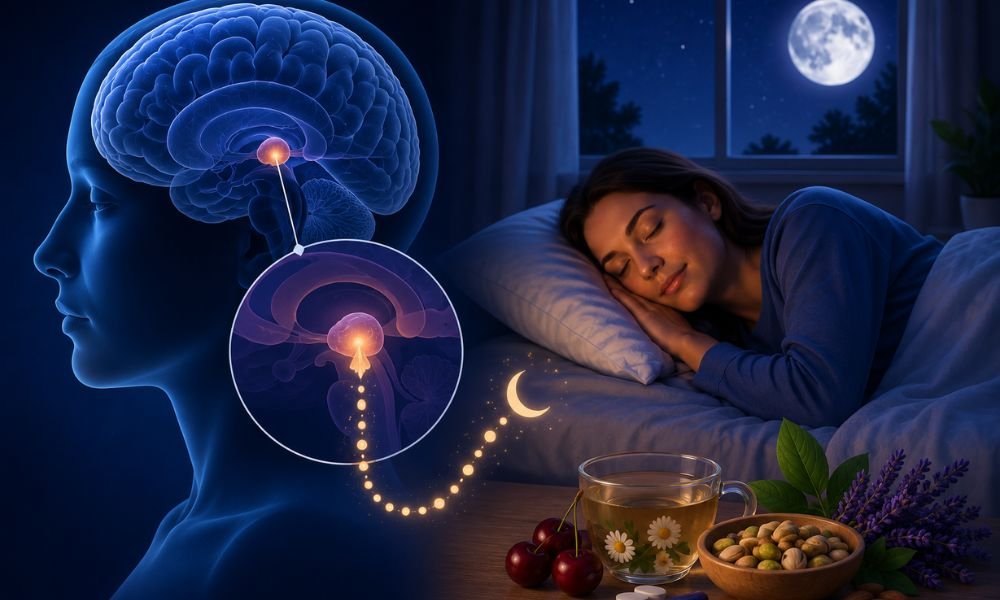
What Is Melatonin? Your Body’s Natural Nighttime Messenger
Most people first hear about melatonin when they’re having trouble sleeping. A friend recommends it, a pharmacist points it out, or they come across melatonin gummies while shopping online.
It’s easy to think of melatonin as just another sleep supplement.
In reality, melatonin is something your body has been producing naturally every day since before you were born.
Understanding what melatonin is—and what it isn’t—is the first step toward deciding whether a melatonin supplement is appropriate for you.
What Is Melatonin?
Melatonin is a hormone that helps regulate your body’s sleep-wake cycle.
Hormones are chemical messengers that allow different parts of the body to communicate with each other. For example:
- Insulin helps regulate blood sugar.
- Thyroid hormones help control metabolism.
- Adrenaline prepares your body to respond to stress.
- Melatonin signals that it’s time to prepare for sleep.
Unlike medicines, melatonin is produced naturally by your body. As daylight fades, your brain releases more melatonin into your bloodstream. Levels remain high during the night and fall again as morning approaches, helping maintain your daily sleep-wake rhythm.
Is Melatonin a Vitamin, Mineral, or Medicine?
No.
Melatonin is a hormone.
Although it’s sold as a dietary supplement in some countries and as a prescription medicine in others, its biological role doesn’t change.
Here’s the difference:
| Substance | What It Does | Example |
|---|---|---|
| Vitamin | Helps your body stay healthy and carry out important functions | Vitamin D, Vitamin C |
| Mineral | Supports body functions such as nerve activity and bone health | Calcium, Iron, Magnesium |
| Hormone | Acts as a chemical messenger between different parts of the body | Melatonin, Insulin, Cortisol |
| Medicine | Used to prevent or treat diseases or symptoms | Antibiotics, Pain relievers |
This distinction is important because hormones don’t work like vitamins or pain relievers. Instead of forcing your body to do something, they send signals that help coordinate normal body functions.
Where Is Melatonin Produced?
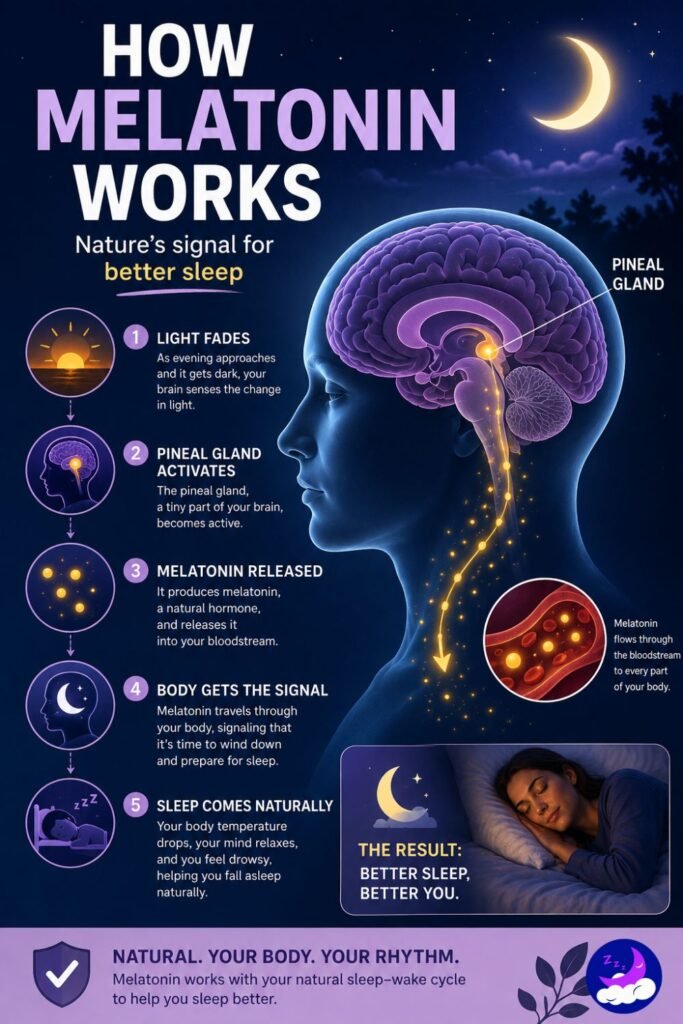
Most of the melatonin involved in sleep is produced by the pineal gland, a tiny structure located near the center of the brain.
As darkness falls, your eyes detect the reduction in light and send signals to your body’s master clock, known as the suprachiasmatic nucleus (SCN). The SCN then signals the pineal gland to release melatonin.
During the day, melatonin production remains low. As night approaches, it rises naturally, which is why melatonin is often called the “hormone of darkness.”
Science Snapshot
Your brain doesn’t check a watch to know when it’s bedtime.
Instead, it measures light. Less light means more melatonin. More light means less melatonin.
Does Only the Brain Make Melatonin?
No.
Although the pineal gland produces the melatonin responsible for regulating sleep, scientists have found smaller amounts of melatonin in other parts of the body, including the:
- Digestive tract
- Eyes
- Bone marrow
- Skin
- Immune cells
Researchers believe these locally produced forms of melatonin help protect cells and support normal body functions. However, the melatonin released by the pineal gland remains the most important for regulating sleep.
Why Is Melatonin Called the “Sleep Hormone”?
Melatonin is often called the sleep hormone, but that name can be misleading.
Melatonin doesn’t make you fall asleep the way a sleeping pill or anesthetic does.
Instead, it tells your body that nighttime has arrived and it’s time to begin preparing for sleep.
As melatonin levels rise, your body gradually becomes less alert, your internal clock stays synchronized, and several nighttime processes begin. Whether you actually fall asleep, however, also depends on many other factors, including stress, caffeine, medications, pain, your sleep environment, and overall health.
Melatonin is an important part of healthy sleep—but it’s only one piece of a much larger system.
Also Read: Circadian Rhythm and Melatonin | Your Body's Natural Melatonin Production
How Does Melatonin Work? Understanding Your Body’s Internal Clock
Have you ever noticed that you usually feel sleepy around the same time every night, even without checking the clock?
Or perhaps you’ve woken up just a few minutes before your alarm goes off.
That’s because your body has its own internal timing system, known as the circadian rhythm.
Melatonin is one of the key hormones that helps keep this system running on time.
Your Body Has a Built-In Clock
Deep inside your brain is a small group of nerve cells called the suprachiasmatic nucleus (SCN). You don’t need to remember the name, but it’s helpful to know its role.
The SCN acts as your body’s master clock, coordinating many daily functions, including:
- When you feel sleepy
- When you wake up
- Body temperature
- Hormone release
- Hunger and digestion
- Mental alertness
Rather than controlling these processes directly, the SCN keeps them working together on a roughly 24-hour schedule.
How Does Your Brain Know It’s Day or Night?
Your brain relies on light, not the time on your watch.
Special light-sensitive cells in your eyes constantly monitor the amount of light around you and send that information to the SCN.
During the day:
- Bright light reaches your eyes.
- The SCN suppresses melatonin production.
- You stay more alert.
As evening approaches:
- Light levels fall.
- The SCN recognizes that night is approaching.
- It signals the pineal gland to release melatonin.
- Your body begins preparing for sleep.
This entire process happens automatically every day.
From Light to Sleep
The pathway is surprisingly simple:
Light decreases → Eyes detect darkness → SCN receives the signal → Pineal gland releases melatonin → Melatonin levels rise → Your body prepares for sleep
This is why exposure to light plays such an important role in regulating your sleep-wake cycle.
| Step | What Happens |
|---|---|
| 1. Light enters your eyes | Your brain measures the amount of light around you. |
| 2. The master clock responds | The SCN decides whether it’s day or night. |
| 3. Melatonin is released | As darkness increases, the pineal gland produces melatonin. |
| 4. Your body prepares for sleep | Alertness decreases, and your body begins its nighttime routine. |
| 5. Morning light arrives | Melatonin production falls, helping you become more awake. |
Why Bright Light at Night Can Delay Sleep
Bright light in the evening—especially from phones, tablets, computers, and other screens—can delay melatonin release.
As a result, your brain receives signals that it’s still daytime, making it harder to fall asleep.
Reducing screen exposure before bed or lowering screen brightness can help your body’s natural melatonin rhythm.
Practical Tip
If you need to use a screen at night, dim the brightness, enable night mode, and try to stop using it at least 30–60 minutes before bedtime whenever possible.
Melatonin Is Only One Part of Healthy Sleep
Melatonin plays an important role, but it doesn’t control sleep by itself.
Good sleep depends on several systems working together, including:
- Sleep pressure, which builds throughout the day.
- Your circadian rhythm, which determines when your body expects to sleep.
- Your environment, including light, noise, and temperature.
- Your overall health, including stress, pain, medications, and medical conditions.
When these systems work together, falling asleep becomes much easier.
Also Read: Melatonin for Older Adults | Melatonin for Pregnant Women | Melatonin for Kids.
Why Is Melatonin Important? Beyond Just Helping You Sleep
Most people know melatonin as the hormone that helps regulate sleep.
While that’s its best-known role, melatonin also participates in several other biological processes. Some of these functions are well established, while others are still being investigated.
Understanding what melatonin does—and what it doesn’t do—can help separate scientific evidence from popular marketing claims.
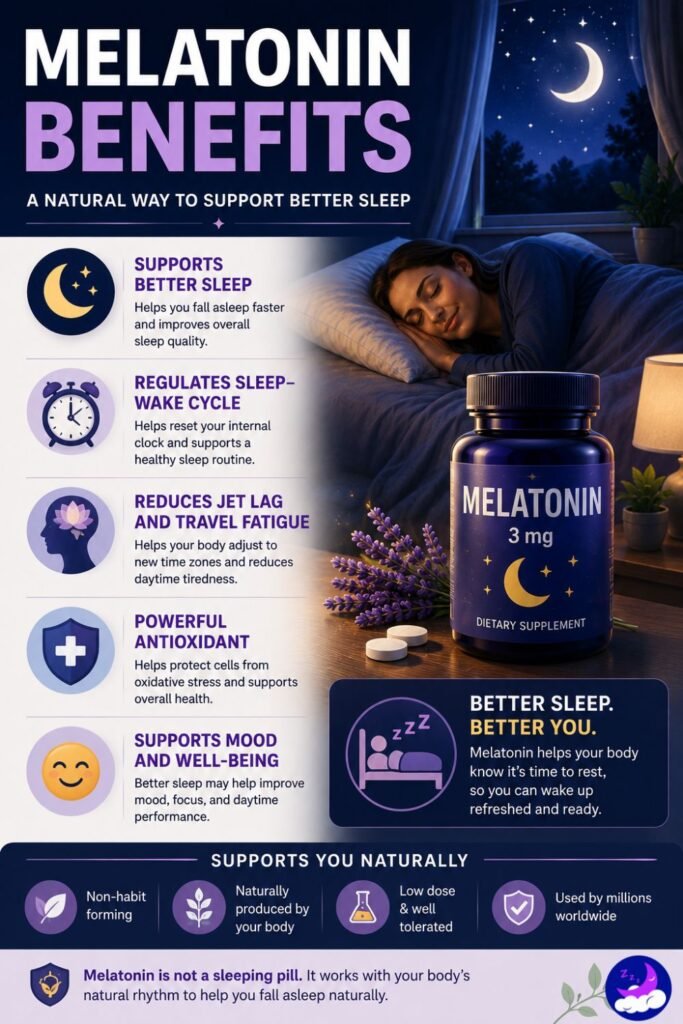
Melatonin’s most important job is helping regulate your internal body clock, but it also has several other functions in the body.
1. It Helps Regulate Your Sleep-Wake Cycle
This is melatonin’s primary and best-understood role.
As evening becomes darker, your brain releases more melatonin. Rising melatonin levels tell your body that it’s time to prepare for sleep. In the morning, exposure to light suppresses melatonin production, helping you become more alert.
Without this daily rhythm, it would be much harder for your body to maintain a regular sleep schedule.
Evidence Strength: Strong
2. It Helps Keep Your Circadian Rhythm on Time
Melatonin doesn’t just make you feel sleepy. It also helps keep your circadian rhythm synchronized with the 24-hour day.
This becomes especially important when your body clock is disrupted, such as during:
- Jet lag
- Night-shift work
- Delayed sleep phase disorder
- Irregular sleep schedules
In these situations, properly timed melatonin may help your body adjust more quickly.
Evidence Strength: Strong for certain circadian rhythm disorders.
3. It Acts as an Antioxidant
Melatonin also functions as an antioxidant.
Antioxidants help protect cells from damage caused by unstable molecules called free radicals. Cell damage happens naturally as we age and is also influenced by pollution, smoking, inflammation, and other factors.
Laboratory studies suggest that melatonin can help reduce this type of damage.
However, most of this evidence comes from laboratory and animal studies. Scientists are still studying how much this effect benefits human health.
Evidence Strength: Moderate for antioxidant activity; limited evidence for routine health benefits in healthy adults.
4. It May Support the Immune System
Researchers have found that melatonin interacts with several parts of the immune system.
Some studies suggest it may help regulate immune responses and inflammation.
However, this doesn’t mean taking melatonin will “boost” your immune system or prevent infections.
That claim is not supported by strong clinical evidence.
Evidence Strength: Emerging
5. It May Influence Other Hormones
Melatonin communicates with several hormone systems in the body.
Researchers are studying how it may influence:
- Reproductive hormones
- Stress hormones
- Metabolism
- Body temperature regulation
These interactions are complex and continue to be investigated.
At present, melatonin supplements are not recommended simply to improve hormone balance.
Evidence Strength: Limited to Moderate, depending on the condition.
6. Researchers Are Studying Many Other Possible Benefits
Because melatonin is found throughout the body, scientists are exploring whether it could play a role in many different medical conditions.
What Does This Mean for You?
The strongest scientific evidence supports melatonin’s role in regulating the sleep-wake cycle and helping certain circadian rhythm disorders, such as jet lag and delayed sleep-wake phase disorder.
Many of its other proposed benefits—including healthy aging, brain protection, and immune support—are promising but not yet supported by enough high-quality clinical evidence to recommend melatonin for these purposes.
That’s why it’s important to distinguish between proven uses and areas of active research.
Some advertisements describe melatonin as a “miracle hormone” that can improve nearly every aspect of health. Current scientific evidence does not support those claims.
As research continues, scientists may discover additional benefits. Until then, melatonin should be viewed as an important hormone with a few well-established uses and several promising—but still unproven—areas of research.
Natural Melatonin vs. Melatonin Supplements: What’s the Difference?
Your body naturally produces melatonin every day.
So why do melatonin supplements exist?
The answer is simple.
Sometimes, your body produces melatonin at the wrong time, or the natural signal isn’t strong enough to help your sleep schedule. In certain situations, taking melatonin as a supplement may help shift or reinforce that signal.
However, a supplement is not the same as the melatonin your body naturally makes.
Let’s look at the differences.
Your Body’s Natural Melatonin
Natural melatonin is made by your pineal gland in response to darkness.
Your brain carefully controls:
- When melatonin is released
- How much is released
- How long it stays elevated
- When production stops in the morning
This process happens automatically every day.
In healthy adults, melatonin usually starts rising 2–3 hours before your usual bedtime, reaches its highest level during the night, and falls again after sunrise.
Your body adjusts this timing based on your exposure to light and your internal clock.
Melatonin Supplements
Melatonin supplements contain manufactured melatonin that is designed to work like the hormone your body naturally produces.
After you take a supplement, it is absorbed into your bloodstream and reaches your brain, where it acts on melatonin receptors.
Unlike your body’s own melatonin, a supplement cannot perfectly copy your natural nightly rhythm.
Instead, it provides an extra melatonin signal, which may help in certain situations.
Also Read: Our Melatonin Dosage Guide | Melatonin Side Effects | Melatonin Drug Interactions
Natural Melatonin vs. Supplement: A Quick Comparison
| Feature | Natural Melatonin | Melatonin Supplement |
|---|---|---|
| Source | Made by your pineal gland | Manufactured for medical use |
| Trigger | Darkness | Taken by mouth or other forms |
| Timing | Controlled by your body clock | Controlled by when you take it |
| Amount | Regulated naturally | Depends on the product and dose |
| Main purpose | Regulates sleep-wake cycle | May help adjust sleep timing in some people |
Also Read: Foods Rich in Melatonin | Blue Light and Melatonin
When Can Supplements Be Helpful?
Melatonin supplements are most helpful when your body clock needs adjusting, not simply because you had a poor night’s sleep.
Research supports their use in certain situations, including:
- Jet lag
- Delayed Sleep-Wake Phase Disorder
- Some circadian rhythm sleep disorders
- Certain shift workers
- Some blind individuals who cannot detect light normally
Your healthcare provider may also recommend melatonin for certain children with neurodevelopmental conditions, but this should only be done under medical supervision.
When Supplements Are Less Likely to Help
Melatonin is not a cure for every sleep problem.
If your sleep difficulty is mainly caused by:
- Stress
- Anxiety
- Depression
- Chronic pain
- Untreated sleep apnea
- Restless legs syndrome
- Poor sleep habits
- Excessive caffeine use
then melatonin alone is unlikely to solve the problem.
Treating the underlying cause usually leads to better results.
Different Types of Melatonin Supplements
Not all melatonin products work the same way.
Immediate-Release Melatonin
This type dissolves quickly after you take it.
It raises melatonin levels rapidly and is mainly used for people who have difficulty falling asleep.
Extended-Release (Prolonged-Release) Melatonin
This form releases melatonin slowly over several hours.
It is designed to more closely mimic the body’s natural overnight melatonin pattern.
Some people who wake frequently during the night may benefit from this type, although it is not appropriate for everyone.
Common Forms Available
Depending on the country, melatonin may be sold as:
- Tablets
- Capsules
- Gummies
- Liquid drops
- Oral sprays
- Fast-dissolving tablets
The form usually matters less than the dose, timing, and product quality.
For many adults, a standard tablet works just as well as more expensive options.
Does a Higher Dose Work Better?
Many people assume that taking more melatonin will produce better sleep.
Research suggests that this is often not true.
Once melatonin receptors are activated, taking a much larger dose may not provide additional benefit. Instead, higher doses may increase the chance of side effects such as:
- Morning drowsiness
- Headache
- Dizziness
- Vivid dreams
For many people, a low dose taken at the right time works better than a high dose taken at the wrong time.
We’ll discuss recommended doses in a later section.
Are All Melatonin Supplements the Same?
No.
The quality of melatonin supplements can vary.
Studies have found that the actual amount of melatonin in some products may differ from what is listed on the label. Some products have also been found to contain unwanted ingredients or inconsistent amounts between batches.
Because of this, it’s wise to:
- Buy from well-known manufacturers.
- Choose products that have undergone independent quality testing when available.
- Avoid products that make unrealistic health claims.
Also Read: When to take Melatonin | Can you take Melatonin everynight? | Melatonin Addiction
Is Melatonin a Supplement or a Medicine?
The answer depends on where you live.
In some countries, melatonin is sold as an over-the-counter dietary supplement.
In others, it is available only with a prescription, especially at certain doses or formulations.
These differences reflect national regulations rather than differences in the hormone itself.
Always follow the rules and medical advice that apply in your country.
Natural vs. Supplement: Which Is Better?
Whenever possible, it’s best to support your body’s natural melatonin production through healthy habits such as:
- Getting morning sunlight.
- Keeping a regular sleep schedule.
- Limiting bright light before bedtime.
- Avoiding caffeine late in the day.
- Maintaining good sleep hygiene.
Melatonin supplements can be helpful for some people, but they work best when combined with healthy sleep habits—not as a replacement for them.
Key Takeaways
- Natural melatonin is produced by your brain in response to darkness.
- Melatonin supplements provide an additional melatonin signal but cannot exactly copy your body’s natural rhythm.
- Supplements are most effective for certain circadian rhythm-related sleep problems.
- Higher doses are not always more effective and may increase side effects.
- Choose high-quality products from trusted manufacturers whenever possible.
Also Read: Melatonin For Jetlag | Melatonin For Shift workers
Who May Benefit from Melatonin Supplements?
Melatonin isn’t for everyone.
For some people, it can be helpful. For others, it may have little or no benefit.
The key question isn’t “Do I have trouble sleeping?”
It’s “Why am I having trouble sleeping?”
Melatonin works best when the problem is related to your body’s internal clock (circadian rhythm) rather than sleep itself.
Let’s look at the groups that may benefit.
1. People with Jet Lag
Evidence Strength: Strong
Jet lag happens when you travel quickly across several time zones.
Your body clock still follows the time at your departure city, even though the local time has changed.
For example, if you fly from New York to London, your body may think it’s only evening when it’s already midnight in London.
This can cause:
- Difficulty falling asleep
- Waking too early
- Daytime tiredness
- Poor concentration
Taking melatonin at the correct local bedtime after arriving may help your body adjust faster and reduce jet lag symptoms.
Best suited for:
- Travelers crossing multiple time zones, especially eastward travel.
2. People with Delayed Sleep-Wake Phase Disorder (DSWPD)
Evidence Strength: Strong
Some people naturally feel sleepy very late at night.
They may not fall asleep until 2:00 a.m. or 3:00 a.m., even if they go to bed much earlier.
As a result, waking up for work or school becomes difficult.
This condition is called Delayed Sleep-Wake Phase Disorder (DSWPD).
For these individuals, carefully timed melatonin—often taken several hours before their desired bedtime—may help shift the body clock earlier.Timing is critical. Taking melatonin too late may reduce its benefit.
3. Some Shift Workers
Evidence Strength: Moderate
Night-shift workers often need to sleep during the day when their body expects to be awake.
Examples include:
- Nurses
- Doctors
- Police officers
- Factory workers
- Security staff
Some studies suggest melatonin may help certain shift workers fall asleep after a night shift.
However, results have been mixed.
Shift workers also benefit from:
- Wearing sunglasses on the way home after a night shift.
- Sleeping in a dark, quiet room.
- Following a consistent sleep schedule whenever possible.
Melatonin should be viewed as one part of a broader strategy, not the only solution.
4. Older Adults with Low Melatonin Production
Evidence Strength: Moderate
Natural melatonin production often decreases with age.
Some older adults experience:
- Difficulty falling asleep
- Earlier morning waking
- Lighter sleep
For selected older adults, especially those with insomnia related to reduced melatonin production, prolonged-release melatonin may improve sleep quality.
However, not every sleep problem in older adults is caused by low melatonin.
Pain, medications, medical conditions, and sleep disorders are often equally important.
5. Some Blind Individuals
Evidence Strength: Strong
Many people who are completely blind cannot detect light.
Without light signals reaching the brain, the body’s internal clock may gradually drift out of sync with the normal 24-hour day.
This can cause irregular sleep patterns.
Melatonin may help synchronize the sleep-wake cycle in some of these individuals.
Treatment should be supervised by a healthcare professional.
6. Some Children with Neurodevelopmental Disorders
Evidence Strength: Moderate to Strong (for selected conditions)
Some children with conditions such as:
- Autism spectrum disorder (ASD)
- Attention-deficit/hyperactivity disorder (ADHD)
- Certain developmental disorders
may experience significant sleep difficulties.
For selected children, melatonin may improve sleep onset and total sleep time.
However:
- It should only be used under medical supervision.
- The child’s sleep habits should also be addressed.
- The lowest effective dose should be used.
Melatonin should never be started regularly in children without discussing it with a pediatrician or sleep specialist.
7. Certain Circadian Rhythm Sleep Disorders
Evidence Strength: Strong
Melatonin may benefit people with other circadian rhythm disorders where the body’s internal clock is out of sync with daily life.
These conditions are less common but are recognized by sleep specialists.
Treatment usually combines:
- Correct timing of melatonin
- Bright light therapy
- Good sleep hygiene
- A regular sleep schedule
Who Is Less Likely to Benefit from Melatonin ?
Melatonin may not be the right answer if your sleep problems are mainly caused by something else.
For example:
Stress or Anxiety
If your mind races when you lie down, managing stress may be more effective than taking melatonin.
Poor Sleep Habits
Examples include:
- Drinking coffee late in the evening
- Using bright screens until bedtime
- Going to bed at different times every night
- Sleeping for long periods during the day
Improving sleep habits often provides greater benefit than supplements.
Sleep Apnea
People with sleep apnea repeatedly stop breathing during sleep.
Melatonin does not treat this condition.
Proper diagnosis and treatment are much more important.
Restless Legs Syndrome
This condition causes an uncomfortable urge to move the legs, especially at night.
Melatonin does not treat the underlying cause.
Chronic Pain
Pain can make it difficult to fall asleep and stay asleep.
Managing the pain is usually more effective than relying on melatonin alone.
Depression or Other Mental Health Conditions
Sleep problems are common in depression and anxiety disorders.
While melatonin may sometimes be part of a treatment plan, it should not replace appropriate evaluation and treatment for the underlying condition.
Who May Benefit Most?
| Group | Evidence |
|---|---|
| Jet lag | ⭐⭐⭐⭐ Strong |
| Delayed Sleep-Wake Phase Disorder | ⭐⭐⭐⭐ Strong |
| Blind individuals with circadian rhythm disorders | ⭐⭐⭐⭐ Strong |
| Some circadian rhythm disorders | ⭐⭐⭐⭐ Strong |
| Older adults with certain sleep problems | ⭐⭐⭐ Moderate |
| Shift workers | ⭐⭐⭐ Moderate |
| Selected children (under medical supervision) | ⭐⭐⭐ Moderate to Strong |
Before Buying Melatonin, Ask Yourself These Questions
✔ Is my sleep schedule irregular?
✔ Have I recently crossed several time zones?
✔ Do I work night shifts?
✔ Am I trying to shift my bedtime earlier?
✔ Have I already improved my sleep habits?
If you answered “No” to most of these questions, melatonin may not be the first solution to try.
- Melatonin works best for problems related to the body’s internal clock.
- The strongest evidence supports its use for jet lag and certain circadian rhythm sleep disorders.
- Some older adults, shift workers, and selected children may also benefit under appropriate guidance.
- Melatonin is less likely to help if poor sleep is caused by stress, pain, sleep apnea, or unhealthy sleep habits.
- Finding the cause of your sleep problem is more important than simply taking a supplement.
Who Should Avoid Melatonin or Use It with Caution?
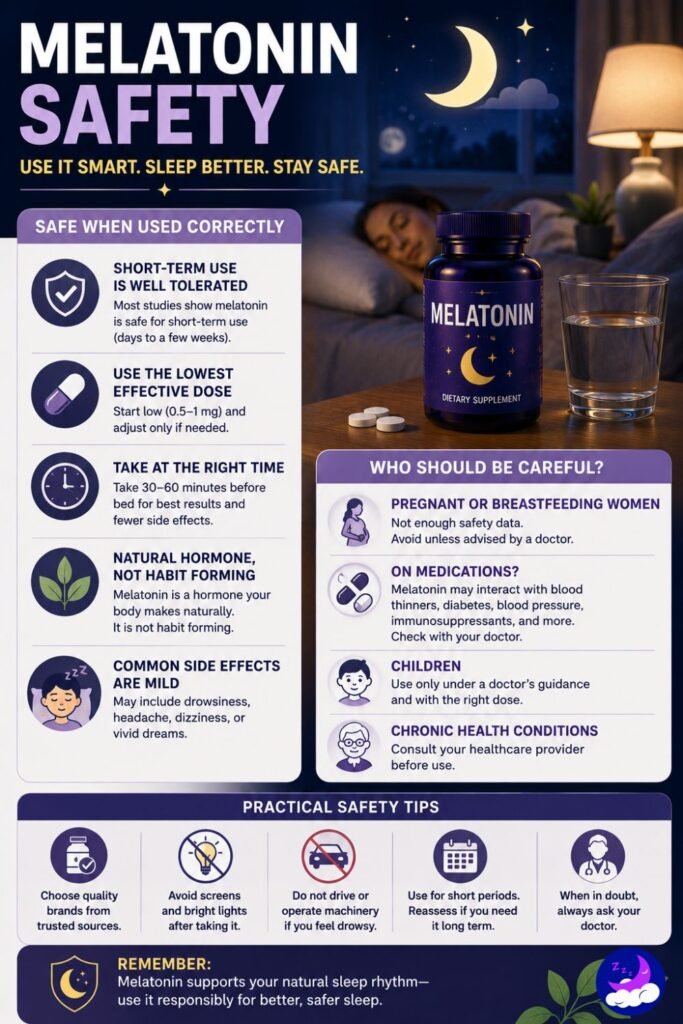
Melatonin is considered safe for many adults when used correctly for a short period. However, it isn’t suitable for everyone.
Certain people should avoid melatonin or talk to a healthcare provider before taking it.
1. Pregnant or Breastfeeding Women
There isn’t enough high-quality evidence to confirm that melatonin supplements are safe during pregnancy or while breastfeeding.
If you’re pregnant, planning a pregnancy, or breastfeeding, consult your healthcare provider before using melatonin.
2. Children
Melatonin should not be given to children routinely without medical advice.
While it may help some children with specific medical conditions, healthy children with sleep problems usually benefit first from improving sleep habits.
3. People with Autoimmune Diseases
Melatonin affects the immune system, and researchers are still studying its role in autoimmune conditions.
If you have an autoimmune disease, discuss melatonin use with your doctor before starting it.
4. People Taking Certain Medications
Melatonin can interact with some medicines, including:
- Blood thinners
- Diabetes medications
- Blood pressure medicines
- Sedatives
- Some antidepressants
Never stop or change your prescribed medicines without medical advice.
5. People with Liver or Kidney Disease
Melatonin is processed by the body through the liver and removed mainly by the kidneys.
People with significant liver or kidney disease should seek medical advice before taking melatonin.
6. People with Certain Sleep Disorders
Not all sleep problems are caused by low melatonin.
For example, melatonin is not a treatment for:
- Obstructive sleep apnea
- Restless legs syndrome
- Chronic insomnia caused by another medical condition
These conditions require proper diagnosis and treatment.
Who Should Talk to a Doctor First?
| You should seek medical advice if you… |
|---|
| Are pregnant or breastfeeding |
| Want to give melatonin to a child |
| Have liver or kidney disease |
| Have an autoimmune condition |
| Take multiple prescription medicines |
| Have long-term sleep problems lasting more than a few weeks |
Key Takeaway
- Melatonin is not suitable for everyone.
- Pregnant women, children, and people with certain medical conditions should seek medical advice before using it.
- Melatonin can interact with several prescription medicines.
- Persistent sleep problems should be evaluated rather than treated with supplements alone.
How to Take Melatonin Correctly
Taking melatonin isn’t just about choosing the right dose. Timing matters just as much—sometimes even more.
If you take melatonin at the wrong time, it may not help. In some cases, it can even shift your body clock in the wrong direction.
Start with the Lowest Effective Dose
For most adults, a low dose is often enough.
Research suggests that taking more melatonin doesn’t always improve sleep and may increase the risk of side effects such as morning drowsiness or vivid dreams.
The goal is to use the lowest dose that provides the desired effect.
Take It at the Right Time
The best time to take melatonin depends on why you’re taking it.
| Reason | General Timing |
|---|---|
| Trouble falling asleep | About 30–60 minutes before bedtime* |
| Jet lag | Around the target bedtime at your destination* |
| Circadian rhythm disorders | Timing varies and should be individualized |
*General guidance only. The ideal timing may vary depending on the person and the product.
Be Consistent
If you’re using melatonin for several days or weeks, try to take it at the same time each evening.
A regular schedule helps reinforce your body’s natural sleep-wake rhythm.
Create the Right Sleep Environment
Melatonin works best when combined with healthy sleep habits.
Try to:
- Keep your bedroom dark and quiet.
- Avoid bright screens before bed.
- Limit caffeine late in the day.
- Follow a regular sleep schedule.
Good sleep habits often improve results more than increasing the dose.
Common Mistakes
Avoid these common errors:
- Taking melatonin immediately after drinking coffee.
- Expecting it to work like a sleeping pill.
- Taking higher doses without medical advice.
- Using it while continuing poor sleep habits.
- Taking it at different times every night.
Quick Checklist
Before taking melatonin, ask yourself:
- Am I taking it for the right reason?
- Am I taking it at the correct time?
- Have I given myself enough time to relax before bed?
- Have I reduced light exposure this evening?
If the answer to most of these questions is yes, melatonin is more likely to work as intended.
Key Takeaways
- Timing is often more important than the dose.
- Start with the lowest effective dose.
- Take melatonin consistently if using it regularly.
- Combine melatonin with healthy sleep habits for the best results.
- If melatonin isn’t helping after a reasonable trial, speak with a healthcare provider instead of simply increasing the dose.
Also Read: Can you overdose on Melatonin | Melatonin gummies vs Tablets
Melatonin Dosage: How Much Should You Take?
There isn’t a single melatonin dose that works for everyone. The right dose depends on your age, why you’re taking it, and how your body responds.
In general, experts recommend starting with the lowest effective dose. Taking more melatonin does not always improve sleep and may increase the chance of side effects.
Always follow the instructions on the product label or the advice of your healthcare provider.
General Principles
- Start with the lowest effective dose.
- Increase the dose only if advised by a healthcare professional.
- Higher doses are not always more effective.
- Timing is often more important than the dose.
| Situation | General Advice |
|---|---|
| Healthy adults | Start with a low dose |
| Older adults | Lower doses are often sufficient |
| Children | Only under medical supervision |
Read our detailed Melatonin Dosage Guide for recommended doses, timing, and special situations.
Key Takeaways
- There is no “perfect” dose for everyone.
- Low doses are often enough.
- Higher doses may increase side effects without improving sleep.
Melatonin Side Effects
Melatonin is generally well tolerated when used for a short period. However, like any supplement, it can cause side effects in some people.
Most side effects are mild and improve after reducing the dose or stopping the supplement.
Common Side Effects
- Morning drowsiness
- Headache
- Dizziness
- Nausea
- Vivid dreams
Less Common Side Effects
Some people may also notice:
- Irritability
- Dry mouth
- Daytime sleepiness
- Mild stomach discomfort
If you develop severe symptoms or an allergic reaction, seek medical attention immediately.
Key Takeaways
- Most side effects are mild and temporary.
- Taking more melatonin than needed may increase side effects.
- If side effects persist, stop using the supplement and consult your healthcare provider.
Also Read: Melatonin and Weird Dreams | Melatonin Myths and Facts | Benefits of Melatonin beyond sleep.
Melatonin Safety and Precautions
Melatonin is considered safe for many healthy adults when used appropriately for short-term use. However, it is not suitable for everyone.
Talk to a healthcare provider before taking melatonin if you:
- Are pregnant or breastfeeding.
- Have liver or kidney disease.
- Have an autoimmune condition.
- Have epilepsy or another chronic neurological condition.
- Take multiple prescription medicines.
Melatonin should also be used with caution if you need to drive or operate machinery, especially when you are first starting it.
Key Takeaways
- Melatonin has a good safety profile for many adults.
- Some people should seek medical advice before using it.
- Always use melatonin responsibly and follow product instructions.
Read our full Melatonin Safety Guide to learn who should avoid melatonin and when to seek medical advice
Melatonin Drug Interactions
Melatonin can interact with certain medications. While many interactions are mild, some may affect how medicines work or increase the risk of side effects.
Common examples include:
- Blood thinners (anticoagulants)
- Diabetes medications
- Blood pressure medicines
- Sedatives and sleeping pills
- Some antidepressants
- Medicines that affect the immune system
This doesn’t mean melatonin cannot be used, but it should be discussed with your healthcare provider.
| Medication Type | Possible Concern |
|---|---|
| Blood thinners | Increased bleeding risk |
| Sedatives | Excessive drowsiness |
| Diabetes medicines | Possible effect on blood sugar |
| Blood pressure medicines | May alter blood pressure response |
Never stop or change a prescribed medicine without medical advice.
Key Takeaways
- Melatonin can interact with several common medications.
- Always tell your healthcare provider about any supplements you take.
- Ask a pharmacist or doctor if you’re unsure about a possible interaction.
Internal Link: See our detailed guide on Melatonin Drug Interactions.
Can You Take Melatonin Every Night?
This is one of the most common questions about melatonin.
Current evidence suggests that short-term use is generally safe for many healthy adults. However, there is still limited evidence about long-term use in healthy people.
If you find that you need melatonin every night for weeks or months, it’s worth asking why.
Persistent sleep problems may be caused by:
- Poor sleep habits
- Stress or anxiety
- Sleep apnea
- Chronic pain
- Another sleep disorder
In these situations, treating the underlying cause is often more effective than relying on a supplement.
When Should You See a Doctor?
Consider speaking with a healthcare provider if:
- You have difficulty sleeping for more than 3 months.
- Melatonin is no longer helping.
- You regularly need high doses.
- You experience troublesome side effects.
- Your sleep problems affect work, school, or daily life.
Key Takeaways
- Short-term nightly use appears safe for many adults.
- Long-term use should be discussed with a healthcare provider.
- Melatonin should not replace a proper evaluation of ongoing sleep problems.
Read our complete article: Can You Take Melatonin Every Night? What the Research Says.
Can You Become Dependent on Melatonin?
One of the biggest concerns people have is whether melatonin is addictive.
The good news is that current research suggests melatonin is not addictive. Unlike many prescription sleeping pills, melatonin does not appear to cause cravings or drug dependence.
However, some people may become psychologically dependent. This means they may feel they cannot sleep without taking a supplement, even if their body no longer needs it.
If you find yourself relying on melatonin every night, it’s worth looking at your sleep habits and the underlying cause of your sleep problem.
What Research Says
Current studies have not shown evidence of physical dependence or withdrawal symptoms when melatonin is stopped after short-term use. More research is still needed on long-term use.
Key Takeaways
- Melatonin is not considered addictive.
- There is no strong evidence that it causes physical dependence.
- Some people may develop a psychological habit of taking it every night.
- Healthy sleep habits remain the foundation of good sleep.
Read our complete guide on Melatonin Dependence and Withdrawal.
Common Melatonin Myths vs. Facts
Melatonin is one of the most misunderstood sleep supplements. Let’s separate myth from fact.
| Myth | Fact |
|---|---|
| Melatonin is a sleeping pill. | No. It is a hormone that helps regulate your sleep-wake cycle. |
| Higher doses work better. | Not always. Low doses are often just as effective. |
| Melatonin works for all types of insomnia. | No. It works best for certain circadian rhythm-related sleep problems. |
| Natural means completely safe. | False. Natural products can still cause side effects and interact with medications. |
| You’ll fall asleep immediately after taking melatonin. | Not necessarily. It prepares your body for sleep but doesn’t force sleep. |
Key Takeaways
- Many online claims about melatonin are misleading.
- Melatonin is most effective when used correctly and for the right reason.
- Always rely on evidence-based information rather than marketing claims.
Explore more in our article 25 Common Melatonin Myths and Facts.
How to Support Natural Melatonin Production
For many people, improving their daily habits is more helpful than taking a supplement.
Your brain naturally produces melatonin every evening. The goal is to support this natural process, not replace it.
Simple Ways to Support Melatonin Naturally
- Get morning sunlight soon after waking up.
- Keep a regular sleep schedule, even on weekends.
- Dim lights in the evening.
- Reduce screen time before bed.
- Avoid caffeine late in the day.
- Keep your bedroom cool, dark, and quiet.
- Manage stress through relaxation or mindfulness.
These habits help strengthen your body’s natural circadian rhythm and may improve sleep quality over time.
Lifestyle vs. Supplements
| Healthy Habit | Benefit |
|---|---|
| Morning sunlight | Helps regulate your body clock |
| Regular bedtime | Supports a consistent melatonin rhythm |
| Less evening light | Allows natural melatonin to rise |
| Limit caffeine | Reduces interference with sleep |
| Relaxing bedtime routine | Helps your body prepare for sleep |
Key Takeaways
- Healthy sleep habits should always come first.
- Natural melatonin production depends largely on light exposure and a regular routine.
- Melatonin supplements work best when combined with good sleep hygiene—not as a replacement for it.
Read our complete guide on How to Increase Melatonin Naturally.
What Does the Latest Research Say About Melatonin?
Melatonin is one of the most studied sleep supplements, with thousands of research papers published over the past several decades.
Current evidence shows that melatonin works best for problems related to the body’s internal clock, such as jet lag and certain circadian rhythm sleep disorders.
For general insomnia, the benefits are usually modest and vary from person to person. It is not considered a first-line treatment for chronic insomnia in most adults.
Researchers are also studying melatonin for conditions such as healthy aging, migraine prevention, brain health, immune function, and cancer supportive care. While some early findings are promising, there is not enough evidence to recommend melatonin for these purposes.
What This Means for You
Current research supports using melatonin for the right person, at the right time, and for the right reason. It should be part of an overall sleep plan, not a replacement for healthy sleep habits or medical care.
Key Takeaways
- Strong evidence supports melatonin for jet lag and certain circadian rhythm sleep disorders.
- Benefits for general insomnia are limited and depend on the underlying cause.
- Many other proposed health benefits are still under investigation.
- Use melatonin based on scientific evidence, not marketing claims.
Visit our Melatonin Research Hub for the latest studies, clinical guidelines, and evidence summaries.
Frequently Asked Questions (FAQs)
1. What is melatonin?
Melatonin is a natural hormone produced by the brain that helps regulate your sleep-wake cycle. It signals to your body that it’s time to prepare for sleep.
No. Melatonin is not a sleeping pill. It helps your body recognize that it’s nighttime, but it doesn’t force you to fall asleep.
2. Is melatonin a sleeping pill?
No. Melatonin is not a sleeping pill. It helps your body recognize that it’s nighttime, but it doesn’t force you to fall asleep.
3. What is melatonin used for?
Melatonin is commonly used to help with jet lag, certain circadian rhythm sleep disorders, and some sleep problems under medical guidance.
4. Does melatonin work for insomnia?
It may help some people, especially if their sleep problem is related to their body clock. However, it is not the best treatment for every type of insomnia.
5. How long does melatonin take to work?
For many people, melatonin starts working within 30 to 60 minutes, although this can vary depending on the product and the individual.
6. When should I take melatonin?
In general, melatonin is taken 30 to 60 minutes before bedtime. The ideal timing depends on why you’re taking it.
7. How much melatonin should I take?
Most experts recommend starting with the lowest effective dose. Higher doses do not always work better.
8. Can I take melatonin every night?
Short-term use is generally considered safe for many healthy adults. If you need melatonin every night for a long time, speak with a healthcare provider to identify the underlying cause of your sleep problems
9. Is melatonin addictive?
Current research suggests that melatonin is not physically addictive and does not cause dependence like many prescription sleeping pills.
10. What are the side effects of melatonin?
The most common side effects include:
- Morning drowsiness
- Headache
- Dizziness
- Nausea
- Vivid dreams
Most side effects are mild and temporary.
11. Can children take melatonin?
Melatonin should only be given to children under medical supervision, especially for long-term use.
12. Is melatonin safe during pregnancy?
There isn’t enough evidence to confirm that melatonin is safe during pregnancy or while breastfeeding. Consult your healthcare provider before using it.
13. Can I take melatonin with other medications?
Melatonin can interact with some medicines, including blood thinners, diabetes medications, blood pressure medicines, sedatives, and certain antidepressants. Always check with your healthcare provider or pharmacist.
14. Is melatonin natural?
Yes. Your body naturally produces melatonin every day. Supplements contain manufactured melatonin that is designed to work like the natural hormone.
15. Can I increase melatonin naturally?
Yes. You can support natural melatonin production by:
- Getting morning sunlight.
- Keeping a regular sleep schedule.
- Reducing bright light before bed.
- Avoiding caffeine late in the day.
- Practicing good sleep hygiene.
16. Should I take melatonin or improve my sleep habits first?
For most people, healthy sleep habits should be the first step. Melatonin works best when combined with good sleep hygiene rather than replacing it.
17. When should I see a doctor for sleep problems?
Speak with a healthcare provider if:
- Your sleep problems last more than three months.
- Melatonin isn’t helping.
- You regularly rely on sleep aids.
- Your sleep affects your work, health, or daily life
Short Guide on Melatonin Usage
If you remember just a few things from this guide, let them be these:
- Melatonin is a natural hormone, not a sleeping pill.
- It helps regulate your sleep-wake cycle by signaling that it’s time to sleep.
- Melatonin supplements work best for jet lag and certain circadian rhythm sleep disorders.
- Timing is often more important than the dose.
- Higher doses are not always more effective.
- Melatonin is generally safe for short-term use in many healthy adults but isn’t suitable for everyone.
- Healthy sleep habits remain the most important foundation for good sleep.
- If your sleep problems are ongoing or severe, seek medical advice instead of relying only on supplements.
Practical Action Steps
If you’re considering melatonin, here’s a simple plan to get started.
Step 1: Identify the Cause
Ask yourself why you’re having trouble sleeping.
- Is it jet lag?
- Do you work night shifts?
- Is your bedtime much later than you’d like?
- Or is it stress, pain, or poor sleep habits?
Understanding the cause is the first step toward choosing the right solution.
Step 2: Improve Your Sleep Habits
Before taking melatonin, try to:
- Get morning sunlight.
- Keep a regular sleep schedule.
- Reduce screen time before bed.
- Avoid caffeine late in the day.
- Make your bedroom dark, quiet, and comfortable.
Step 3: Use Melatonin Wisely
If you decide to try melatonin:
- Choose a trusted product.
- Start with the lowest effective dose.
- Take it at the right time.
- Follow the product instructions or your healthcare provider’s advice.
Step 4: Review Your Progress
After a few days or weeks, ask yourself:
- Am I falling asleep more easily?
- Am I waking up feeling refreshed?
- Have I noticed any side effects?
If melatonin isn’t helping, don’t simply increase the dose. Consider speaking with a healthcare provider
When Should You See a Doctor?
Occasional poor sleep is common and usually improves with healthy habits.
However, you should speak with a healthcare provider if:
- Sleep problems last longer than three months.
- You regularly need melatonin or other sleep aids.
- You snore loudly, stop breathing during sleep, or wake up gasping.
- You feel extremely sleepy during the day.
- Your sleep problems affect your work, school, or daily life.
- You have another medical condition that may be affecting your sleep.
A healthcare provider can help identify the underlying cause and recommend the most appropriate treatment.
Remember: Melatonin can be a useful tool, but it is not a substitute for proper medical evaluation when sleep problems are persistent or severe.
References
The following sources were used to prepare this guide. These are trusted organizations, medical institutions, and peer-reviewed resources that regularly review the latest evidence on melatonin and sleep medicine.
- Mayo Clinic – Melatonin: Overview, Uses and Research – Comprehensive overview of melatonin, including uses, benefits, research evidence, and safety.
- Mayo Clinic – Melatonin Side Effects: What Are the Risks? – Evidence-based information on common side effects, safety, and precautions.
- Mayo Clinic – Jet Lag: Diagnosis and Treatment – Guidance on the role of melatonin in managing jet lag and the importance of timing.
- National Institutes of Health (NIH) – Use of Melatonin Supplements Rising Among Adults – Summary of melatonin use, effectiveness, and long-term safety considerations.
- CDC Yellow Book – Jet Lag Disorder – Travel medicine guidance on circadian rhythms, jet lag, and melatonin use.
- NHS – About Melatonin – Practical information on melatonin, approved uses, and precautions in the UK.
Key Clinical Guidelines
- American Academy of Sleep Medicine (AASM) Clinical Practice Guideline for Pharmacologic Treatment of Chronic Insomnia in Adults
- American Academy of Sleep Medicine (AASM) – Health Advisory: Melatonin Use in Children and Adolescents
- American Academy of Sleep Medicine (AASM) – Circadian Rhythm Sleep-Wake Disorders Resources
Government and Research Resources
- National Center for Complementary and Integrative Health (NCCIH) – Melatonin: What You Need To Know
- National Library of Medicine (PubMed) – Melatonin Research Database
- Cochrane Library – Melatonin Systematic Reviews
Selected Scientific Reviews
- Ferracioli-Oda E, Qawasmi A, Bloch MH. Meta-analysis: Melatonin for the Treatment of Primary Sleep Disorders. PLOS ONE. 2013;8(5):e63773. DOI: 10.1371/journal.pone.0063773.
- Givler D, Givler A, et al. Chronic Administration of Melatonin: Physiological and Clinical Considerations. Neurology International. 2023;15(1). DOI: 10.3390/neurolint15010031.
- Sack RL, Auckley D, Auger RR, et al. Circadian Rhythm Sleep Disorders: Part I & II. Sleep. American Academy of Sleep Medicine.
- Zisapel N. New Perspectives on the Role of Melatonin in Human Sleep, Circadian Rhythms and Their Regulation. British Journal of Pharmacology.
- Arendt J. Melatonin and the Mammalian Pineal Gland. Chapman & Hall.
- Brzezinski A. Melatonin in Humans. New England Journal of Medicine. 1997.
Further Reading
For readers who want to explore the topic in greater depth, the following resources are excellent starting points: