
Melatonin may help reduce jet lag and make it easier to adjust to a new time zone, but the timing of use is crucial. It can provide the body with a biological-night signal and, when correctly timed, help shift the circadian clock toward the destination schedule.
The best approach depends on travel direction, number of time zones crossed, destination bedtime, and light exposure.
Table of Contents
Why Melatonin Matters When You Travel
You land after a long flight, look at the clock and realize it is 10 PM.
It should be bedtime.
But you are wide awake.
Or perhaps the opposite happens. You fall asleep at the destination without much trouble, only to wake at 3 or 4 AM feeling completely alert.
This is the frustrating part of jet lag. Your watch has changed almost instantly, but your internal body clock has not.
Melatonin is relevant because it is one of the hormones that helps tell the body when it is biological night. Under normal conditions, melatonin rises in the evening, remains elevated during the night and falls toward morning.
After crossing several time zones, that rhythm is still partly synchronized with your old location.
That is why melatonin can sometimes help.
But there is an important distinction between taking melatonin simply because you want to sleep and using it to help shift your circadian rhythm.
Those are related, but they are not exactly the same thing.
For jet lag, timing is part of the treatment.
Taking melatonin at the wrong biological time may provide little benefit and, in some circumstances, can push the circadian clock in the wrong direction.
Also Read: Our Melatonin Guide | Circadian Rhythm and Melatonin | Your Body's Natural Melatonin Production
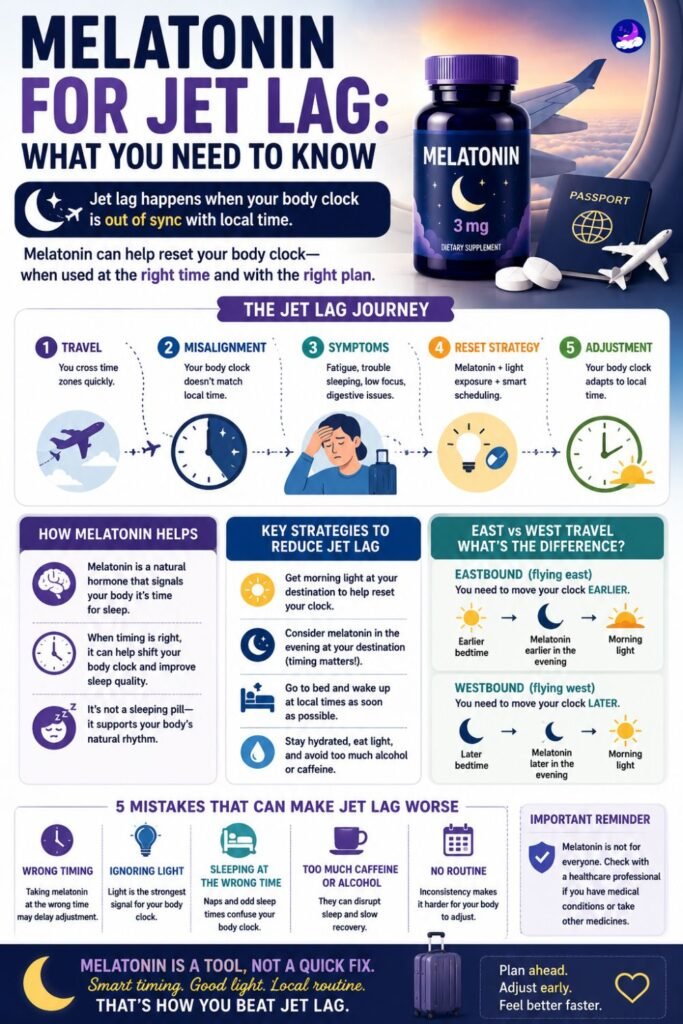
Does Melatonin Help With Jet Lag?
Yes. Melatonin can help reduce jet-lag symptoms and improve sleep after crossing multiple time zones, particularly when it is used at an appropriate time.
Its usefulness is greatest when the aim is to help the body adjust to the destination schedule, rather than simply make you sleepy after a tiring journey.
The effect varies from person to person. It depends on how many time zones you crossed, whether you traveled east or west, when you take melatonin, and when you expose yourself to light.
Research supports melatonin as one option for managing jet lag, but it is not an instant cure. Your circadian system still needs time to adapt.
The simplest way to think about it is:
Melatonin can help guide the body clock, but it cannot instantly reset it.
Also Read: Foods Rich in Melatonin | Blue Light and Melatonin
What Exactly Is Jet Lag?
Jet lag occurs when your internal circadian rhythm becomes temporarily misaligned with the local time after rapid travel across time zones.
Your circadian system helps coordinate a wide range of daily processes, including sleep and wakefulness, hormone secretion, body temperature, alertness and digestion.
Before travel, these processes have become synchronized with your usual environment.
Then you cross several time zones in a matter of hours.
Your destination may suddenly be six, eight or even twelve hours different from the time your body has been following.
Your internal clock needs time to catch up.
For example, imagine flying:
New York → London
You leave New York in the evening and arrive in London the following morning.
The local clock says it is morning.
But your biological clock may still be closer to the middle of the night.
You may therefore feel sleepy during the day and struggle to sleep when local bedtime arrives.
Now reverse the journey:
London → New York
The local time is several hours behind.
Your body may feel as though it is already late at night when the local clock says it is only afternoon.
These mismatches produce the familiar symptoms of jet lag.
What Are the Symptoms of Jet Lag?
Jet lag is more than simply feeling tired after a flight.
It can involve:
- Difficulty falling asleep
- Waking too early
- Daytime sleepiness
- Reduced alertness
- Poor concentration
- Fatigue
- Mood changes
- Headache or general discomfort
- Gastrointestinal symptoms
- Reduced daytime functioning
The CDC’s clinical description of jet lag disorder includes insomnia or excessive daytime sleepiness associated with trans-meridian travel, together with reduced sleep time and impairment of daytime functioning.
This distinction is useful.
If you are simply exhausted after sitting on an airplane for 12 hours, that does not necessarily mean you have jet lag.
Jet lag specifically involves a circadian mismatch caused by rapid travel across time zones.
Why Doesn’t Your Body Clock Adjust Immediately?
Your circadian clock does not read the time displayed on your phone.
It receives timing information from the environment, with light being one of the strongest signals.
Your body has become accustomed to receiving light, darkness, meals, activity and sleep at roughly predictable times.
After crossing time zones, those cues suddenly occur at different clock times.
The internal clock therefore has to be re-entrained, or shifted, to match the new environment.
This takes time. That is why simply staying awake until the local bedtime does not always solve the problem.
You can change your behavior immediately. Your circadian rhythm changes more gradually.
This is where melatonin becomes interesting.
How Does Melatonin Help With Jet Lag?
Melatonin is produced mainly by the pineal gland and normally rises during the biological night.
After a time-zone change, the timing of that rise may no longer match local nighttime. Taking melatonin at an appropriate time can provide an additional nighttime signal.
In other words, you are giving the body a cue that says:
“This is when biological night should be occurring.”
That signal can help shift the circadian system toward the desired schedule. This is why melatonin is sometimes described as a chronobiotic.
A chronobiotic is a substance that can influence the timing of biological rhythms. That is different from saying melatonin is simply a sleeping pill.
It can make some people feel sleepy, but when used for jet lag, its more important role may be helping to change the timing of the circadian clock.
The CDC specifically describes timed melatonin as one of the strategies that can facilitate circadian adaptation after travel.
What Does the Research Say?
Clinical research on melatonin and jet lag has been conducted for several decades.
A Cochrane review of randomized trials found that melatonin reduced jet-lag symptoms in many of the included studies, particularly among people crossing five or more time zones.
The evidence suggested greater benefit with eastward travel, although the review was published in 2002 and should be interpreted alongside more recent guidance.
Current CDC guidance also recognizes that melatonin can help with sleep problems caused by jet lag in people traveling either east or west.
The important point is that the evidence does not support a single universal melatonin schedule for every traveler.
Studies have differed in:
- Number of time zones crossed
- Direction of travel
- Dose
- Timing
- Formulation
- Duration of use
- Participant characteristics
So the evidence supports melatonin as a useful option, but not as a guaranteed cure for jet lag.
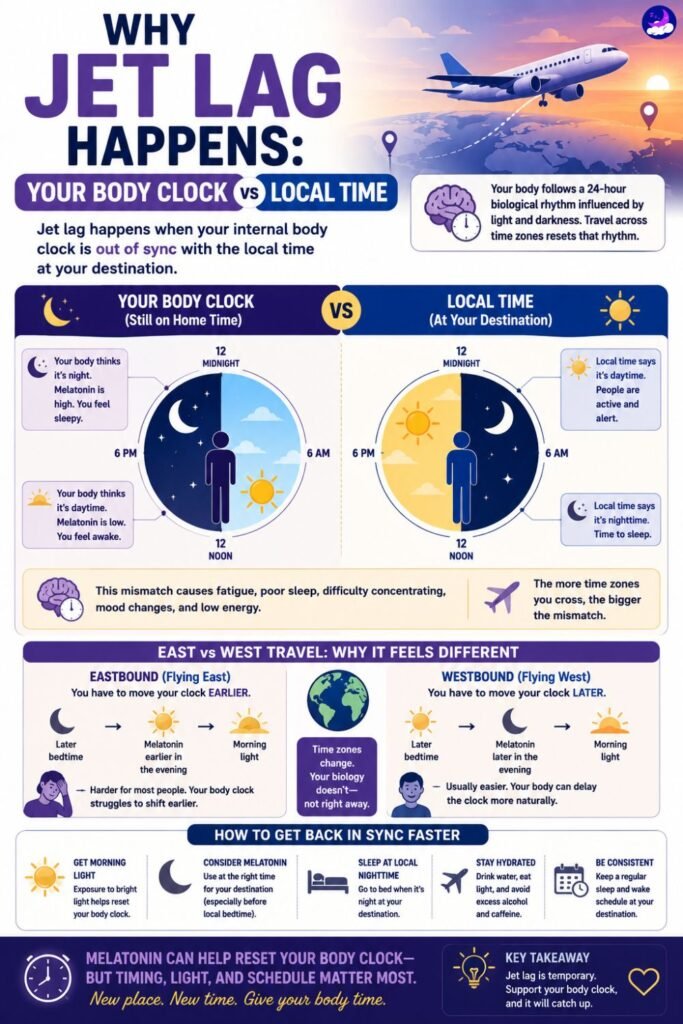
Why Eastward and Westward Travel Are Different
This is one of the most important concepts to understand.
Your body clock can shift in both directions, but it generally finds it easier to delay than to advance.
That means eastward travel is often more difficult.
Eastward Travel: The Clock Needs to Move Earlier
Consider:
New York → London
When you travel east, the destination clock is ahead of the clock you left behind.
Your body therefore needs to adjust toward an earlier sleep-wake schedule.
This is called a phase advance.
You may need to:
Sleep earlier → Wake earlier → Become alert earlier
That is not always easy because your circadian system naturally tends to run slightly longer than 24 hours.
The CDC estimates that average adaptation is roughly 1 hour per day for eastward travel, compared with about 1.5 hours per day for westward travel, although individual responses vary.
This is one reason eastward trips can produce particularly troublesome jet lag.
Westward Travel: The Clock Needs to Move Later
Now consider:
London → New York
The destination clock is behind.
Your body therefore needs to adjust toward a later schedule.
This is called a phase delay.
You may need to:
Sleep later → Wake later → Become alert later
This direction of adjustment is generally easier for the human circadian system.
That does not mean westward travel cannot cause significant jet lag.
It simply means that, biologically, the required adjustment is usually easier to achieve.
Also Read: Melatonin and Weird Dreams | Melatonin Myths and Facts | Benefits of Melatonin beyond sleep.
When Should You Take Melatonin for Jet Lag?
This is where many online articles become misleading.
You may see advice such as:
“Take melatonin 30 minutes before bedtime.”
That is too simplistic for jet lag.
If you are using melatonin to help shift the circadian clock, the relevant question is not simply:
“What time do I want to sleep?”
It is:
“What time does my body clock need to move toward?”
Melatonin can have different effects on circadian timing depending on when it is taken relative to your internal biological clock.
Taking it at the wrong time can therefore be ineffective or potentially shift the clock in an undesirable direction.
The correct timing depends on:
- Direction of travel
- Number of time zones crossed
- Current sleep schedule
- Destination sleep schedule
- Internal circadian phase
- Timing of light exposure
For a complex trip, a clinician or a validated jet-lag calculator can help determine the timing more precisely.
Also Read: Our Melatonin Dosage Guide | Melatonin Side Effects | Melatonin Drug Interactions
Should You Take Melatonin Before the Flight?
Not necessarily.
There is no rule that says you should take melatonin simply because you are about to board a long-haul flight.
The timing needs to fit the circadian shift you are trying to achieve.
Suppose you are flying east and want to move your body clock earlier.
Taking melatonin at a random point during the flight may not provide the intended circadian signal.
The same applies to westward travel.
Feeling sleepy on an airplane is also not enough information to determine whether it is the right time to take melatonin.
You may simply be tired because you slept poorly, because of the length of the journey, or because the cabin environment is exhausting.
Sleepiness and circadian timing are not always the same thing.
For that reason, melatonin should not be treated as an automatic in-flight sleep aid.
Also Read: Can you overdose on Melatonin | Melatonin gummies vs Tablets
What About Taking Melatonin After You Arrive?
For many travelers, the period after arrival is when the new schedule really begins.
You are now exposed to the destination’s light-dark cycle, meals and daily activities.
If it is nighttime locally but your internal clock still thinks it is daytime, falling asleep can be difficult.
Appropriately timed melatonin may help reinforce the new nighttime signal.
For some eastward trips, taking melatonin around the intended destination bedtime may be part of the strategy.
But even here, there is no universal clock time.
The CDC recommends that melatonin timing be planned according to travel direction and the number of time zones crossed, because the desired circadian shift differs between trips.
This is why a detailed travel plan is better than simply carrying melatonin and deciding when to take it after landing.
How Much Melatonin Is Used for Jet Lag?
There is no single dose that is ideal for every traveler.
Clinical studies have used different doses, and more melatonin does not necessarily mean a faster or better circadian adjustment.
Current CDC guidance states that 0.5–1 mg is often sufficient to produce a circadian shift and advises against high doses above 5 mg for this purpose because excess melatonin may remain present when it is no longer biologically useful.
This is an important distinction from the way many people think about supplements.
With melatonin, increasing the dose is not necessarily the same as increasing the benefit.
For jet lag, timing is often more important than simply taking a larger amount.
Because this article is focused on jet lag rather than general melatonin dosing, detailed dose selection and product considerations are better covered in a dedicated dosing article.
Also Read: When to take Melatonin | Can you take Melatonin everynight? | Melatonin Addiction
Melatonin and Light Need to Work Together
If melatonin is one timing signal, light is another—and arguably the most powerful environmental signal for the circadian system.
This is why taking melatonin while ignoring light exposure can make jet-lag management unnecessarily difficult.
The timing of light matters.
For example, after eastward travel, appropriately timed morning light can help move the body clock earlier. Evening light can have the opposite effect.
After westward travel, the useful timing changes.
This does not mean you should simply avoid all light after a long flight.
It means light should be used strategically.
The CDC notes that appropriately timed light exposure can facilitate circadian adaptation and that the optimal timing depends on travel direction and the number of time zones crossed.
A useful way to think about the combination is:
- Melatonin provides a biological-night signal.
- Light provides a powerful time-of-day signal.
- Sleep timing reinforces the new schedule.
When those signals are coordinated, adaptation is more likely to proceed smoothly.
Also Read: Melatonin For Shift workers
What Should You Do Before the Trip?
You do not have to wait until landing to think about jet lag.
For a major time-zone change, you may be able to reduce the adjustment burden by gradually moving your sleep schedule toward the destination.
For example, if you are traveling east and normally sleep from midnight to 8 AM, moving bedtime and wake time a little earlier over the few days before departure may help.
For westward travel, shifting the schedule later may be useful.
You do not need to make a dramatic change.
The goal is simply to reduce the size of the adjustment your body has to make after arrival.
The CDC suggests that, when practical, travelers shift sleep by about one hour per day for the two to three days before travel.
This is not always possible, especially with work, school, family responsibilities or fixed flight schedules.
Even then, understanding the destination schedule can help you plan your sleep and light exposure more intelligently.
What Should You Do During the Flight?
Long flights create another problem: sleep loss.
Even if you manage your circadian timing perfectly, arriving severely sleep-deprived can make you feel terrible.
During the journey, try to think in terms of destination time when practical.
You can:
- Adjust your sleep toward the destination schedule.
- Time meals closer to destination time.
- Drink enough fluids.
- Avoid excessive alcohol.
- Avoid using sedating medicines casually to force sleep.
- Use light exposure according to the planned circadian shift.
Alcohol deserves particular attention.
It may make you feel sleepy initially, but it can fragment sleep and worsen dehydration, neither of which is helpful when you are already dealing with circadian disruption.
What Should You Do After Landing?
Once you arrive, your main job is to live according to local time.
That means:
- Wake according to the destination schedule.
- Eat according to local time.
- Seek appropriate daylight.
- Stay awake during the local day when possible.
- Sleep at the local bedtime.
If you are extremely sleepy, a short nap can help you function.
But a long afternoon sleep can make it harder to sleep that night.
The CDC recommends short naps of around 20–30 minutes when needed for alertness and advises against lengthy daytime naps that could interfere with nighttime sleep.
This is one reason jet lag recovery is not simply about taking melatonin.
Your behavior after arrival helps reinforce the circadian signal.
Common Mistakes When Using Melatonin for Jet Lag
Taking It at the Wrong Time
This is probably the most important mistake.
A mistimed dose may do little or may shift the circadian rhythm in a direction you do not want.
Assuming “Before Bed” Always Means the Same Thing
Your destination bedtime and your biological bedtime may initially be very different.
That is why destination time alone is not always enough for a precise circadian plan.
Taking a Large Dose Because You Want Faster Results
More is not necessarily better. The goal is not to flood the body with melatonin.
The goal is to provide an appropriately timed signal.
Taking Melatonin Whenever You Feel Tired
Fatigue after a long flight does not automatically mean that your circadian system needs melatonin at that moment.
You may simply be sleep-deprived.
Ignoring Light
Light can either support or interfere with the circadian shift you are trying to achieve.
Melatonin and light should therefore be considered together.
Expecting an Instant Reset
Your internal clock does not change instantly.
Even with a well-planned strategy, circadian adaptation takes time.
Using It Indefinitely
Melatonin for jet lag is generally a short-term intervention.
Once your sleep-wake cycle has adjusted to the destination, continued use may not be necessary.
Also Read: Melatonin for Older Adults | Melatonin for Pregnant Women | Melatonin for Kids.
Who Should Be More Careful With Melatonin?
Melatonin supplements are generally well tolerated for short-term use by many adults, but “natural” does not mean “risk-free.”
The CDC notes that reported short-term adverse effects can include daytime sleepiness, dizziness and headache, although these are generally mild. Supplement quality can also vary because dietary supplements are not regulated in the same way as prescription medicines.
People should be particularly cautious if they:
- Are pregnant or breastfeeding
- Are considering melatonin for a child or teenager
- Take prescription medicines that may interact with melatonin
- Have a significant medical condition
- Have epilepsy or another neurological disorder
- Take warfarin or other medicines requiring careful monitoring
- Regularly need melatonin because of frequent international travel
If you take prescription medicines, it is sensible to check with a doctor or pharmacist before adding melatonin.
Frequent travelers may also benefit from a personalized circadian plan rather than repeatedly experimenting with timing themselves.
[Also Read: Melatonin Drug Interactions]
What If You Are Only Away for a Few Days?
This is an interesting situation that many travelers overlook.
Suppose you fly across several time zones for a two-day business meeting and then fly home.
Do you really want your body to fully adapt to the destination?
Not necessarily.
The CDC notes that for very short trips—such as less than two days—maintaining your home-base sleep schedule may sometimes be preferable because there is little time to benefit from adapting to the destination before returning home.
This is particularly relevant to frequent business travelers.
The goal is not always:
“Adapt as quickly as possible.”
Sometimes the better question is:
“Which schedule will minimize disruption over the entire trip?”
That is a much more medically sensible way to approach jet lag.
Can Melatonin Completely Prevent Jet Lag?
No.
Melatonin can help, but it cannot guarantee that you will feel normal immediately after crossing several time zones.
Your response depends on:
- Number of time zones crossed
- Travel direction
- Age
- Sleep loss
- Light exposure
- Individual circadian characteristics
- How long you remain at the destination
A traveler crossing two time zones for a weekend trip is in a very different situation from someone crossing eight time zones and staying for a month.
Melatonin may reduce the symptoms or shorten the adjustment period for some people, but the body still has to do the work of adapting.
Frequently Asked Questions
Does melatonin really work for jet lag?
Yes. Evidence suggests that melatonin can reduce jet-lag symptoms and improve sleep after crossing multiple time zones, particularly when appropriately timed. The size of the benefit varies between individuals and travel situations.
Is melatonin better for eastward travel?
Evidence has historically suggested stronger benefit for eastward travel, but current CDC guidance recognizes potential benefit for travelers going both east and west. The timing differs because the desired circadian shift differs.
Should I take melatonin on the airplane?
Not automatically. Taking it simply because you feel sleepy during a flight is not the same as using it strategically for circadian adjustment.
Should I take melatonin before or after landing?
There is no universal answer. The appropriate timing depends on travel direction, number of time zones crossed and your intended circadian shift.
How much melatonin should I take for jet lag?
Current CDC guidance states that 0.5–1 mg is often sufficient to produce a circadian shift, while high doses above 5 mg are not recommended for this purpose. Individual circumstances may require professional guidance.
How many days should I take melatonin?
There is no universal number. It is generally used short term during the period of adjustment, rather than indefinitely.
Can taking melatonin at the wrong time make jet lag worse?
It can potentially shift the circadian clock in an unwanted direction or increase misalignment. Timing is therefore especially important when melatonin is being used as a circadian intervention.
Does light matter if I take melatonin?
Yes. Light is one of the strongest signals controlling the circadian clock, so appropriately timed light exposure should be considered alongside melatonin.
Is jet lag worse when traveling east?
Often, yes. The circadian system generally adapts more easily to a delay than an advance, making eastward travel more challenging for many people.
Can I use melatonin for a two-day business trip?
Not necessarily. For very short trips, maintaining your home-base sleep schedule may sometimes be more practical than trying to fully adapt to the destination and then readjust again when you return.
Bottom Line
Melatonin can be a useful tool for jet lag, but it is not simply a sleeping pill for travelers.
Its real value lies in its ability to act as a timing signal for the circadian system.
After crossing time zones, your internal clock and the local clock are temporarily out of sync. Melatonin can help reinforce a nighttime signal and, when correctly timed, assist the body in moving toward the destination schedule.
The direction of travel matters.
Eastward travel requires a circadian advance.
Westward travel requires a circadian delay.
Because these are different biological shifts, the timing of melatonin also differs.
Light matters just as much. Appropriate exposure to daylight can help move the body clock, while poorly timed bright light can work against the desired adjustment.
For most travelers, the most sensible approach is therefore not to ask:
“What time should I take melatonin?”
Instead, ask:
“What time does my body clock need to move toward?”
That question changes the entire way you think about jet lag.
Plan around the destination time zone, direction of travel, sleep schedule and light exposure. Use melatonin strategically rather than randomly, and remember that your circadian system cannot be reset instantly.
Melatonin may help shorten the adjustment—but your body still needs time to catch up with the clock.
[Also Read: Circadian Rhythm and Melatonin]
References
- Jet Lag Disorder. CDC Yellow Book 2026: Health Information for International Travel. Centers for Disease Control and Prevention. 2025.
CDC Yellow Book — Jet Lag Disorder - Complementary and Integrative Health Approaches to Travel Wellness. CDC Yellow Book 2026. Centers for Disease Control and Prevention. 2025.
CDC Yellow Book — Travel Wellness and Melatonin - Herxheimer A, Petrie KJ. Melatonin for the prevention and treatment of jet lag. Cochrane Database of Systematic Reviews. 2002;CD001520.
Cochrane — Melatonin for the Prevention and Treatment of Jet Lag - Morgenthaler TI, Lee-Chiong T, Alessi C, et al. Practice parameters for the clinical evaluation and treatment of circadian rhythm sleep disorders: an American Academy of Sleep Medicine report. Sleep. 2007;30(11):1445–1459.
- Janse van Rensburg DC, Jansen van Rensburg A, Fowler PM, et al. Managing travel fatigue and jet lag in athletes: a review and consensus statement. Sports Medicine. 2021;51:2029–2050.