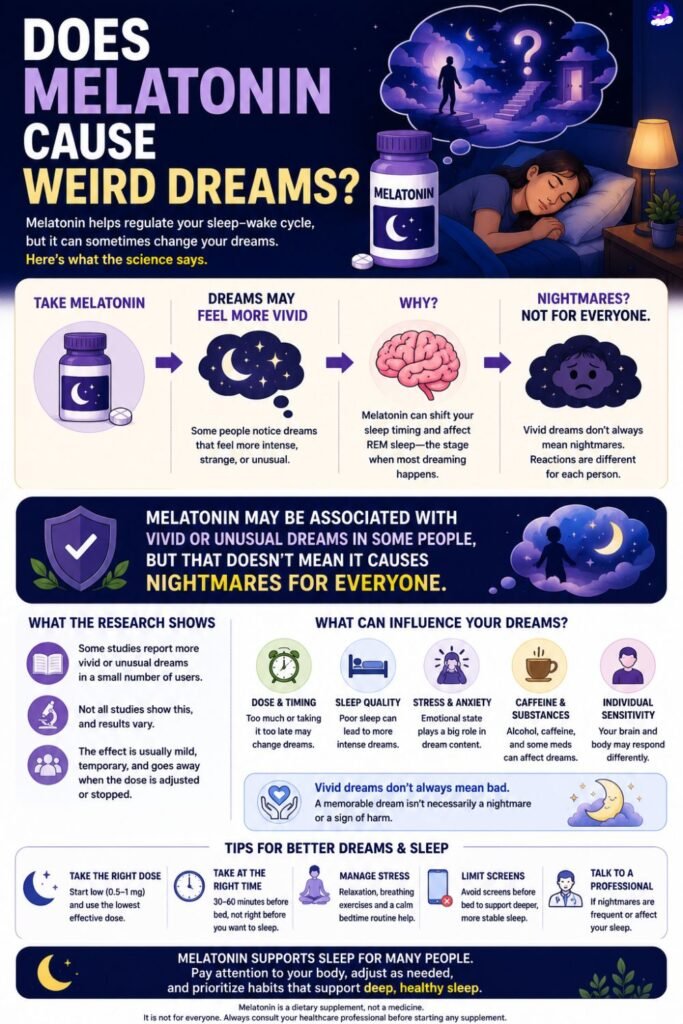
Does Melatonin Cause Weird Dreams? Melatonin may cause vivid dreams, unusual dreams, or more memorable dreams in some people, but it does not necessarily cause nightmares or poor sleep quality.
Reports of vivid or abnormal dreams exist, but the evidence does not clearly establish that melatonin directly causes them. Sleep timing, REM sleep, stress, sleep deprivation, other medicines, and individual differences can all influence what we dream and how well we remember it.
Table of Contents
What Do People Mean by “Weird Dreams”?
When someone says melatonin gives them “weird dreams,” they may be describing several different experiences.
A vivid dream feels unusually detailed, realistic, colorful, or emotionally intense.
A strange dream may contain unusual people, places, events, or combinations that would not normally make sense.
A memorable dream is simply one that you can recall clearly after waking.
A lucid dream occurs when you become aware that you are dreaming while the dream is still happening.
A nightmare is different. It is a disturbing dream that causes fear, anxiety, distress, or an unpleasant awakening.
These experiences overlap, but they are not the same thing.
Having a very vivid dream does not automatically mean you had a nightmare. You may remember an unusually detailed dream without finding it frightening at all.
This distinction matters because reports of “weird dreams” are often grouped together even though the actual experience may be quite different.
[IMAGE: Vivid dreams vs nightmares comparison]
Can Melatonin Make Dreams More Vivid?
Some people report more vivid or memorable dreams after taking melatonin, but research does not show that this happens consistently in everyone.
Nightmares and other sleep-related effects have been reported in clinical studies of melatonin, but they appear to be uncommon. A systematic review of 37 randomized controlled trials found that melatonin was generally well tolerated, although the studies varied considerably in quality and duration. Most were short-term, and the evidence was not strong enough to establish a clear cause-and-effect relationship between melatonin and unusual dreams.
More recent research looking specifically at medications and dream content also found that evidence concerning melatonin remains limited and methodologically inconsistent. The authors noted that many studies rely on retrospective or anecdotal reports, making it difficult to determine how medications actually change dream experiences.
So if your dreams became unusual after starting melatonin, it is reasonable to notice the timing.
But it would be too strong to conclude:
“Melatonin definitely caused my dreams.”
There may be other factors involved.
Also Read: Our Melatonin Guide | Circadian Rhythm and Melatonin | Your Body's Natural Melatonin Production
Why Might Melatonin Change Dream Recall?
There are several possible explanations, and researchers do not yet have one definitive answer.
Changes in Sleep Timing
Melatonin is closely connected to the body’s circadian rhythm.
Taking it at a particular time can influence the timing of sleep and other biological rhythms. If your sleep timing changes, the stage of sleep you are in when you wake may also change.
That can affect how easily you remember dreams.
Changes in Sleep Continuity
Dream recall is strongly influenced by awakenings.
If you wake briefly during or shortly after a dream, you are more likely to remember it.
This means that a person can experience more memorable dreams without necessarily having more dreams.
REM Sleep
Many vivid dreams occur during REM sleep, although dreaming can also occur during other sleep stages.
Some experimental studies have found that melatonin can influence REM sleep under particular circumstances. For example, a small randomized study involving 14 people with reduced REM sleep found that 3 mg of melatonin increased the percentage of REM sleep over four weeks.
But that was a small study involving a specific group of people with reduced REM sleep. It cannot be used to say that melatonin increases REM sleep in everyone who takes it.
And even if REM sleep changes, that does not prove that melatonin will cause vivid dreams.
Improved or Changed Sleep May Affect Dream Recall
There is another possibility.
If melatonin changes someone’s sleep pattern or helps them sleep more consistently, their opportunities to wake near a dream period may change.
The result may be that they remember dreams more clearly, rather than actually having more dreams.
This is an important distinction.
Also Read: Foods Rich in Melatonin | Blue Light and Melatonin
What About Nightmares?
Nightmares are more specific than vivid dreams.
A nightmare is generally a disturbing dream that produces fear, distress, or an unpleasant awakening.
Nightmares have been reported with melatonin, but current evidence does not show that melatonin routinely causes nightmares.
The systematic review of melatonin adverse events identified nightmares among the reported sleep-related adverse effects, but these were uncommon. The authors also emphasized limitations in the available evidence, including short study durations and variable study quality.
Other factors can also make nightmares more likely, including:
- Stress or anxiety
- Sleep deprivation
- Irregular sleep schedules
- Alcohol
- Some medicines
- Illness or fever
- Changes in sleep patterns
- Other sleep disorders
So if nightmares begin soon after starting melatonin, the timing is worth noticing.
But timing alone does not prove causation.
Also Read: When to take Melatonin | Can you take Melatonin everynight? | Melatonin Addiction
Does Melatonin Increase Dreaming?
This is harder to answer than it sounds.
Everyone dreams, although dream recall varies considerably from person to person.
When people report “more dreams” after taking melatonin, they may actually be describing more vivid dreams or better dream recall.
Research does not provide strong evidence that melatonin simply increases the total amount of dreaming in everyone.
Some experimental studies have found changes in REM sleep after melatonin administration. In addition to the small study involving people with reduced REM sleep, an older experimental study in healthy young men found that an early-evening dose of melatonin increased REM sleep.
But these were controlled experimental conditions.
They do not mean that every person taking melatonin will experience more REM sleep or more vivid dreams.
There is an important point here:
REM sleep and vivid dreaming are related, but that does not prove that a melatonin-related change in REM sleep causes vivid dreams.
The evidence is simply not strong enough to make that causal claim.
Does a Higher Amount of Melatonin Cause More Vivid Dreams?
There is no simple rule that:
MORE MELATONIN = MORE DREAMS
or:
MORE MELATONIN = MORE VIVID DREAMS
People respond differently to melatonin, and the effect can depend on timing, formulation, individual sensitivity, and the reason it is being used.
Research on melatonin and sleep also does not support a simple idea that taking more will automatically produce better sleep.
Taking more than needed may instead increase unwanted effects without providing additional benefit.
So if unusual dreams begin after increasing your melatonin intake, it is reasonable to review the change rather than simply assuming that a higher amount is better.
Also Read: Our Melatonin Dosage Guide | Melatonin Side Effects | Melatonin Drug Interactions
Is Melatonin Actually Ruining Sleep Quality?
Not necessarily.
A vivid dream by itself does not mean your sleep quality is poor.
Sleep quality involves much more than what happens in your dreams.
Consider the difference between these two situations.
Someone has a vivid but pleasant dream, sleeps through the night, wakes feeling refreshed, and functions normally the next day.
Another person has repeated nightmares, wakes several times, struggles to fall back asleep, and feels exhausted the next morning.
Both people may describe their dreams as “vivid,” but their sleep experiences are very different.
This is why it is useful to separate:
- Dream vividness
- Nightmare distress
- Sleep duration
- Sleep continuity
- Morning alertness
- Overall sleep quality
Melatonin can have modest effects on some aspects of sleep, but its effects vary between people and sleep problems. A recent scoping review of systematic reviews found substantial variation in the evidence for melatonin and sleep quality, reinforcing that its effects should not be reduced to a simple “better” or “worse” label.
So unusual dreams do not automatically mean melatonin is damaging your sleep.
The more useful question is whether the dreams are actually disturbing your sleep or affecting how you feel during the day.
Also Read: Can you overdose on Melatonin | Melatonin gummies vs Tablets
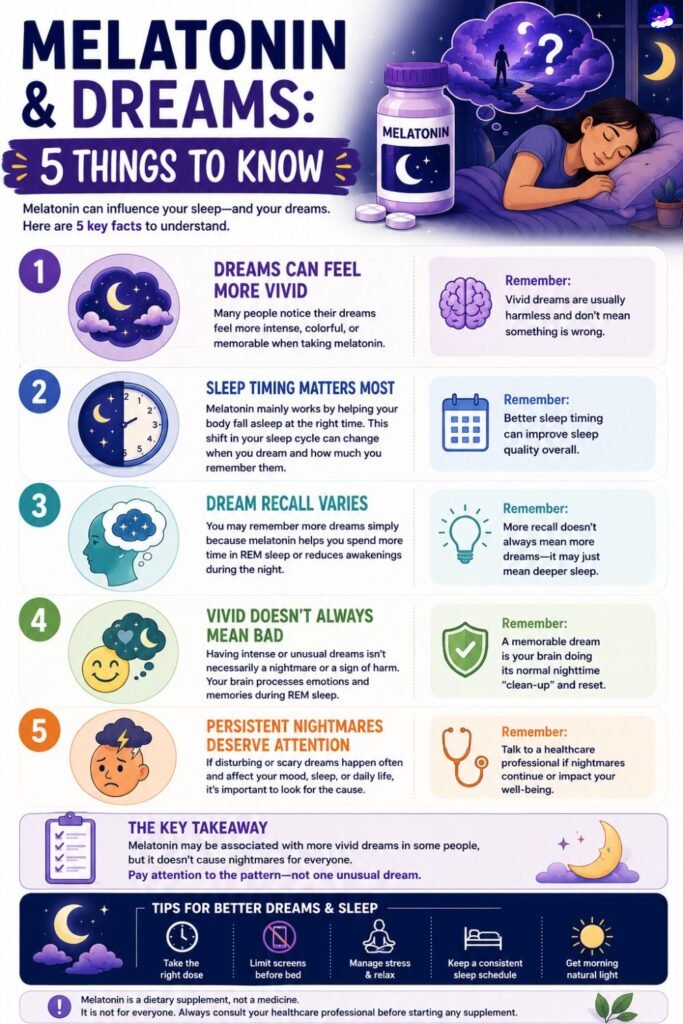
What Should You Do If Melatonin Gives You Weird Dreams?
If you notice unusual dreams after starting melatonin, don’t panic.
Instead, look for a pattern.
Think About When It Started
Did the dreams begin soon after you started melatonin?
Did they appear after changing the amount or formulation?
Do they seem to occur repeatedly on nights when you take it?
A consistent pattern is more useful than a single unusual dream.
Look at Other Possible Causes
Consider whether anything else changed around the same time.
For example:
- Stress increased
- Sleep became shorter
- Your bedtime changed
- Alcohol intake changed
- You started another medicine or supplement
- Your sleep schedule became irregular
Any of these can affect dreams.
Don’t Automatically Take More
If melatonin does not seem to work quickly, taking additional amounts may not solve the problem.
More is not automatically better.
Review Other Medicines and Supplements
Some medicines can affect dreaming or sleep architecture.
If several medicines or supplements are involved, it may be difficult to identify the cause without reviewing the full picture.
Consider Discussing the Pattern
If the dreams began soon after starting melatonin and repeatedly return when you take it, that pattern is worth discussing with a healthcare professional.
The goal is not simply to blame melatonin.
It is to work out whether melatonin is actually contributing and whether it is still appropriate for you.
Also Read: Melatonin For Jetlag | Melatonin For Shift workers
When Should You Talk to a Doctor?
An occasional strange dream is usually not a reason for concern.
Medical advice is more appropriate when dreams become frequent, severe, or disruptive.
Consider speaking with a healthcare professional if:
- Nightmares repeatedly wake you
- Your sleep quality is getting worse
- You are unusually sleepy during the day
- Dreams are causing significant distress
- You physically act out your dreams
- You have other unusual sleep symptoms
- You take multiple medicines or supplements
- A child has significant or persistent sleep problems
Physically acting out dreams is different from simply having vivid dreams.
Repeated punching, kicking, shouting, or other dream-enactment behaviors during sleep can occur with REM sleep behavior disorder and other sleep conditions.
Melatonin has actually been studied as a treatment for REM sleep behavior disorder, although the evidence is mixed and does not mean melatonin should be used for this purpose without medical guidance.
So if someone is repeatedly acting out dreams, the priority should be proper evaluation rather than assuming melatonin is the cause.
Also Read: Melatonin Myths and Facts | Benefits of Melatonin beyond sleep.
Frequently Asked Questions
Does melatonin cause vivid dreams?
Some people report vivid or unusually memorable dreams after taking melatonin, but the evidence is limited and does not show that this happens to everyone. Changes in sleep timing, sleep continuity, REM sleep, and dream recall may all play a role.
Can melatonin cause nightmares?
Nightmares have been reported with melatonin, but there is not strong evidence that melatonin routinely causes nightmares. Stress, sleep deprivation, alcohol, medicines, and irregular sleep can also affect nightmares.
Why are my dreams so strange after taking melatonin?
You may be experiencing greater dream recall or more vivid dreams, rather than necessarily having more dreams. Changes in sleep timing and brief awakenings can make dreams easier to remember.
Does melatonin increase REM sleep?
Some studies have found changes or increases in REM sleep after melatonin, but the effect is not universal. The available studies are often small or involve specific populations, so they cannot be generalized to everyone taking melatonin.
Should I stop melatonin if I have bad dreams?
Not necessarily. If the change is persistent or disturbing, consider when it started, whether anything else changed, and whether other medicines or supplements could be contributing. Discuss ongoing problems with a healthcare professional rather than assuming melatonin is definitely responsible.
Bottom Line
Melatonin may be associated with vivid, unusual, or memorable dreams in some people, but it does not routinely cause nightmares.
The experience of “weird dreams” can mean several different things. You may be having more vivid dreams, remembering dreams more clearly, or experiencing genuinely disturbing nightmares.
Melatonin can influence circadian timing and sleep architecture, and these changes may affect dream recall in some people. But the evidence is not strong enough to say that melatonin universally increases REM sleep, dreaming, or nightmares.
Other factors matter too.
Stress, sleep deprivation, irregular sleep, alcohol, other medicines, and individual differences can all influence dreams.
If the dreams are occasional and do not disturb your sleep, they are usually not a major concern.
If nightmares repeatedly wake you, your sleep quality is deteriorating, or you are physically acting out dreams, it is worth looking beyond melatonin and considering whether another sleep problem is present.
The most useful question is not simply:
“Did melatonin cause this dream?”
It is:
“Did my sleep or dream pattern change after starting melatonin, and is that change actually affecting my sleep?”
That approach gives you a much clearer picture of what is really happening.
Also Read: Melatonin for Older Adults | Melatonin for Pregnant Women | Melatonin for Kids.
References
- Besag FMC, Vasey MJ, Lao KSJ, Wong ICK. Adverse Events Associated With Melatonin for the Treatment of Primary or Secondary Sleep Disorders: A Systematic Review. CNS Drugs. 2019;33:1167–1186.
PubMed — Melatonin Adverse Events Systematic Review - Kunz D, Mahlberg R, Müller C, Tilmann A, Bes F. Melatonin in patients with reduced REM sleep duration: two randomized controlled trials. Journal of Clinical Endocrinology & Metabolism. 2004;89(1):128–134.
PubMed — Melatonin and REM Sleep Randomized Trials - Kräuchi K, Cajochen C, Mori D, et al. Melatonin and S-20098 increase REM sleep and wake-up propensity without modifying NREM sleep homeostasis. American Journal of Physiology. 1997.
PubMed — Melatonin and REM Sleep - Bontempi G, Capriglia E, Bernardi G, Elce V. The effects of RBD medications on dream content: A critical review of evidence. Sleep Medicine. 2025;136:106878.
PubMed — Medication Effects on Dream Content Review - Exogenous Melatonin and Sleep Quality: A Scoping Review of Systematic Reviews. 2025.
PubMed — Melatonin and Sleep Quality Evidence Review - Kunz D, Mahlberg R. A two-part, double-blind, placebo-controlled trial of exogenous melatonin in REM sleep behaviour disorder. Journal of Sleep Research. 2010;19(4):591–596.
PubMed — Melatonin and REM Sleep Behavior Disorder - Delage JP, Côté J, Journault WG, Lemyre A, Bastien CH. The relationships between insomnia, nightmares, and dreams: A systematic review. Sleep Medicine Reviews. 2024;74:101931.
PubMed — Insomnia, Nightmares and Dreams Systematic Review