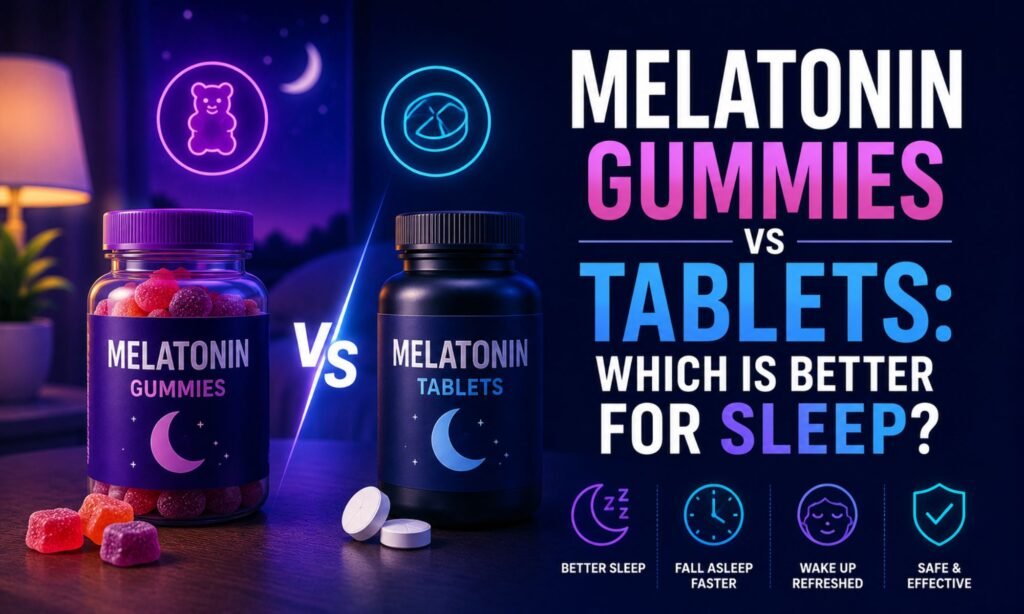
Melatonin comes in many forms, including gummies and tablets, but neither is automatically better for sleep. The more important factors are the amount of melatonin, formulation, timing, ingredients, product quality, and your individual response. Gummies may be easier to take, while tablets may offer different formulations or fewer added ingredients. In most cases, the question is less about gummy versus tablet and more about which specific product and formulation make sense for you.
Table of Contents
Gummies or Tablets: Which Is Better?
There is no universal winner.
A melatonin gummy and a melatonin tablet can both provide the same active ingredient, but they may differ in how they are formulated, how much melatonin they contain, and what other ingredients are included.
Gummies are often easier to chew and may be more appealing if you dislike swallowing tablets.
Tablets may be preferable if you want a simpler product, dislike sweet flavors, or want a particular release formulation.
So if you are standing in front of a shelf wondering which one to choose, don’t assume that the gummy is more effective simply because it looks more modern or tastes better.
The specific product matters more than its shape.
What Is the Difference Between a Melatonin Gummy and a Tablet?
At first glance, the difference seems simple: one is chewed and the other is swallowed.
But there is an important distinction that often gets overlooked.
A gummy or tablet describes the physical form. Immediate-release or extended-release describes the formulation.
Those are not the same thing.
Melatonin Gummies
Gummies are chewable supplements that usually contain melatonin along with ingredients that provide their taste, texture, color, and shape.
Depending on the product, these may include:
- Sugar
- Sugar alcohols or alternative sweeteners
- Flavorings
- Coloring agents
- Gelatin or pectin
- Other inactive ingredients
Their biggest practical advantage is convenience.
If swallowing tablets is difficult or unpleasant, a gummy may simply be easier to use.
That does not make it medically superior.
Melatonin Tablets
Tablets are generally swallowed with water, although some are designed to be chewed, dissolved, or allowed to disintegrate in the mouth.
They can also come in different formulations, including:
- Immediate-release
- Prolonged-release or extended-release
- Chewable
- Dissolvable
- Other specialized formulations
That means comparing “a gummy” with “a tablet” without knowing the formulation can be misleading.
Melatonin Gummies vs Tablets: Side-by-Side
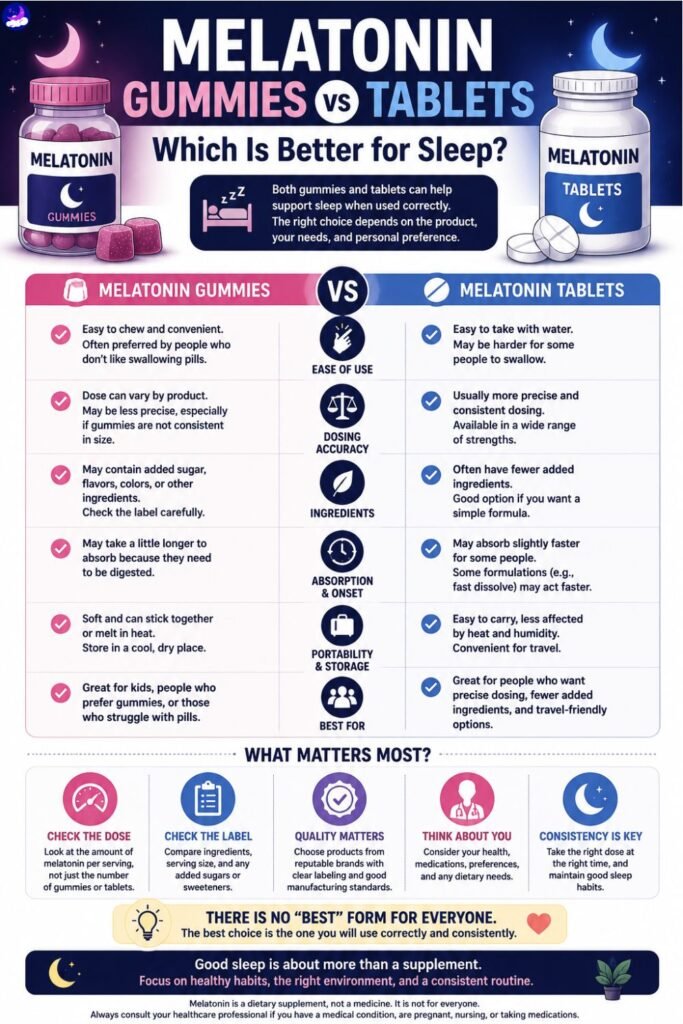
| Feature | Gummies | Tablets |
|---|---|---|
| Ease of taking | Usually easy to chew | Usually swallowed |
| Taste | Often flavored | Often little or no flavor |
| Added ingredients | May contain sugars, sweeteners and flavors | Varies by product |
| Dose per unit | Varies | Varies |
| Release options | Product-specific | Immediate- and prolonged-release options may be available |
| Convenience | Useful for people who dislike tablets | Useful for people comfortable swallowing tablets |
| Accidental overuse | May be easier to consume casually because some resemble candy | Generally less candy-like |
There is no reliable rule that gummies are faster, stronger, safer, or better absorbed than tablets.
The actual formulation and product matter.
Do Melatonin Gummies Work Faster Than Tablets?
This is one of the most common claims you will see online.
The short answer is:
Not necessarily.
How quickly melatonin reaches the bloodstream depends on the specific formulation, the amount taken, and individual factors.
A gummy may have a particular formulation that affects its absorption, while a tablet may be designed to release melatonin quickly or gradually.
So it would be misleading to say that gummies always work faster.
The same applies to tablets.
A conventional immediate-release tablet and an extended-release tablet may behave very differently even though both are tablets.
A systematic review of melatonin pharmacokinetics found that formulation and dose can substantially affect melatonin’s pharmacokinetic profile. However, the available evidence was not sufficient to recommend one specific formulation as universally superior for particular sleep or circadian disorders.
So the better question is not:
“Is a gummy faster?”
It is:
“What formulation does this particular product use?”
Also Read: Our Melatonin Guide | Circadian Rhythm and Melatonin | Your Body's Natural Melatonin Production
Which Is Absorbed Better?
Again, there is no simple winner.
Gummies are not automatically absorbed better than tablets.
Melatonin has relatively low and variable oral bioavailability, and the way it is formulated can affect how quickly and how much reaches the bloodstream.
For example, immediate-release and extended-release formulations can produce very different blood-level patterns.
In a randomized crossover study of healthy adults, an extended-release melatonin formulation produced a later peak and maintained melatonin levels for longer than an immediate-release formulation.
That does not mean extended-release is automatically better.
It simply shows why formulation can matter more than physical form.
A systematic review similarly concluded that different formulations and doses can produce different pharmacokinetic profiles, but the evidence was not strong enough to identify one universally best formulation for every sleep problem.
So be cautious when you see claims such as:
“Gummies absorb better.”
or:
“Tablets are stronger.”
Those statements are too broad.
Does the Dose Matter More Than the Form?
For many people, this is actually the more useful question.
It is easy to spend time comparing gummies and tablets while overlooking how much melatonin the product actually contains.
A gummy may contain a certain amount per gummy but list two gummies as the serving size.
Another product may contain a different amount in one tablet.
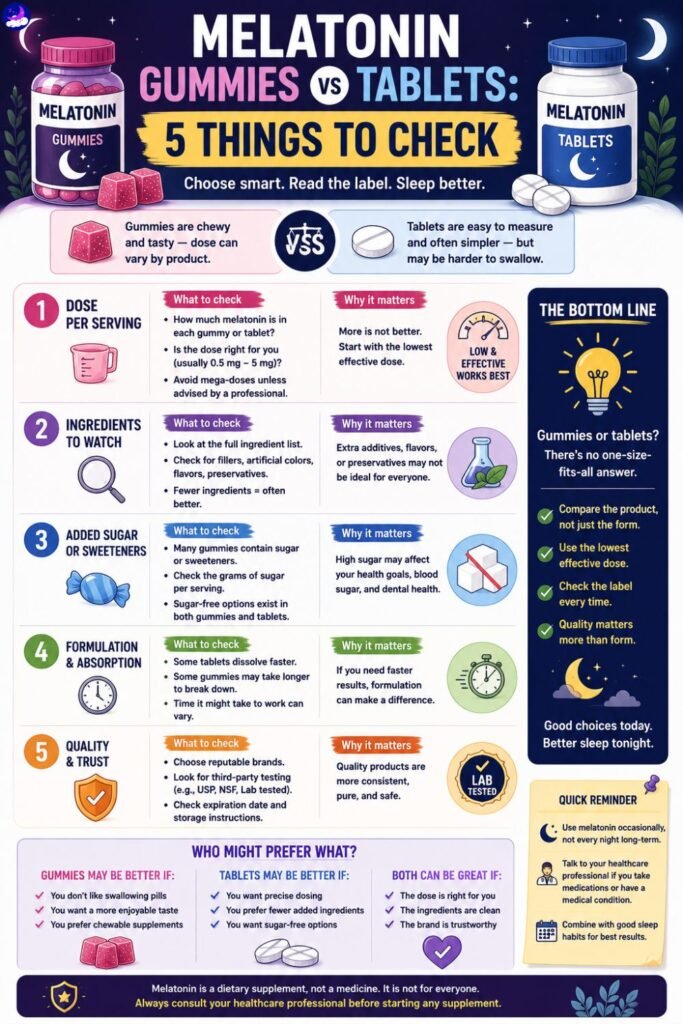
Always check:
- Amount of melatonin per unit
- Serving size
- Number of units per serving
- Release formulation
- Other active ingredients
And remember:
More melatonin is not automatically better for sleep.
The appropriate amount depends on why melatonin is being used, the product, the person, and other factors. For detailed information about dosing, see:
Also Read: When to take Melatonin | Can you take Melatonin everynight? | Melatonin Addiction | Can you overdose on Melatonin
The key point here is simple:
The amount matters regardless of whether you take melatonin as a gummy or tablet.
Are Melatonin Gummies Less Reliable Than Tablets?
Not necessarily.
The concern is not that gummies are inherently unreliable.
The bigger issue is that dietary supplements can sometimes contain amounts that differ from their labels, and this has been documented in studies of melatonin products.
A 2017 study of 31 commercial melatonin supplements found substantial variation between the labeled and measured melatonin content, including variation between different lots of the same product.
A 2023 JAMA study looked specifically at 25 melatonin gummy products sold in the United States. The researchers found measured melatonin amounts ranging from 74% to 347% of the labeled quantity. Only 3 of the 25 products were within 10% of the amount stated on the label.
That is an important finding, but it needs to be interpreted carefully.
The study was small and limited to gummies sold in the United States. It does not prove that all gummies are inaccurately labeled or that tablets are always more reliable.
More recent U.S. testing of 110 melatonin-containing dietary supplements marketed toward children also found substantial variation, with measured melatonin content ranging from 0% to 667% of the labeled amount. However, these products were specifically marketed toward children, so the findings should not be generalized to every adult melatonin product.
The practical lesson is not “avoid gummies.”
It is:
Pay attention to product quality and labeling rather than assuming that the physical form tells you how reliable the product is.
What About Sugar, Sweeteners and Other Ingredients?
One of the more obvious differences between many gummies and tablets is the ingredient list.
Gummies often need ingredients that make them pleasant to chew and taste.
Depending on the product, this may include:
- Sugar
- Sugar alcohols
- Alternative sweeteners
- Natural or artificial flavors
- Coloring agents
- Gelatin
- Pectin
That does not automatically make gummies unhealthy.
It simply means you should know what you are taking.
Tablets also contain inactive ingredients. These may include binders, fillers, coatings, or coloring agents.
So rather than asking:
“Are gummies full of additives?”
a better question is:
“What is actually in this particular product?”
If you have a dietary restriction, food sensitivity, or simply prefer fewer additional ingredients, check the full ingredient list before buying.
Also Read: Our Melatonin Dosage Guide | Melatonin Side Effects | Melatonin Drug Interactions
Which Is Better for People Who Have Trouble Swallowing Pills?
For someone who dislikes swallowing tablets, a gummy may simply be more convenient.
That is a perfectly reasonable reason to choose one.
There is no medical advantage in forcing yourself to swallow a tablet if an appropriate chewable formulation is easier for you to take correctly.
However, convenience should not mean treating gummies like ordinary sweets.
They still contain an active ingredient.
And because some flavored gummies may look and taste more like candy than a conventional tablet, they should be stored carefully.
This is particularly important in households with children.
Also Read: Melatonin For Jetlag | Melatonin For Shift workers
Are Gummies More Tempting to Take Than Tablets?
There is a practical difference here.
A conventional tablet generally looks like a medicine or supplement.
Some flavored gummies may look and taste more like candy.
For an adult, that may simply make the product more pleasant to use.
But it can also make casual extra dosing easier.
Someone may think:
“One more gummy probably won’t matter.”
Or they may forget that they already took one.
That matters because different products can contain very different amounts of melatonin per gummy.
The same principle applies to every melatonin product:
Follow the product directions rather than taking another dose simply because you do not feel sleepy yet.
If you accidentally take too much, see:
Also Read: Melatonin for Older Adults | Melatonin for Pregnant Women | Melatonin for Kids.
Are Melatonin Gummies More Likely to Cause Side Effects?
There is no good evidence that the gummy format itself causes more melatonin side effects.
Melatonin can cause unwanted effects such as:
- Drowsiness
- Headache
- Dizziness
- Nausea
The likelihood can depend on the amount taken, individual sensitivity, timing, and other medicines or ingredients.
A gummy does not automatically cause more side effects simply because it is a gummy.
However, if a gummy contains other active ingredients, those ingredients may also contribute to how you feel.
If you develop an unexpected reaction, check the complete ingredient list, not just the melatonin amount.
[Also Read: Melatonin Side Effects]
What About Sugar-Free Gummies?
Sugar-free does not automatically mean better.
Sugar-free gummies may use sugar alcohols or alternative sweeteners to provide sweetness.
Some people tolerate these well, while others may experience digestive symptoms with certain sugar alcohols.
So if you choose a sugar-free product, check what has been used instead of sugar.
There is no need to assume that a sugar-free gummy is automatically healthier than a conventional gummy or tablet.
What About Extended-Release or Time-Release Melatonin?
This is where the comparison becomes more interesting.
Some products are designed to release melatonin relatively quickly, while others release it more gradually over a longer period.
These differences can affect how quickly blood levels rise and how long they remain elevated.
Research comparing immediate- and extended-release melatonin has demonstrated differences in peak concentration, time to peak, and duration of exposure.
But this is not really a gummy-versus-tablet issue.
It is a formulation issue.
An extended-release tablet is not automatically better than an immediate-release gummy.
And an immediate-release gummy is not automatically better than a tablet.
The intended use and the actual formulation matter.
Melatonin Gummies May Suit You If…
A gummy may be a practical choice if:
- You dislike swallowing tablets
- You prefer a chewable format
- You have checked the amount per gummy
- You are comfortable with the additional ingredients
- The product has clear labeling
- You have a reason to prefer that formulation
None of these makes gummies medically superior.
They simply make the format more convenient for some people.
Also Read: Foods Rich in Melatonin | Blue Light and Melatonin
Melatonin Tablets May Suit You If…
A tablet may suit you better if:
- You prefer a simpler formulation
- You want to avoid added sugar or flavoring
- You are comfortable swallowing tablets
- You want a particular release formulation
- You prefer fewer additional ingredients
- You find tablets easier to use consistently
Again, this does not make tablets universally better.
The right choice depends on the specific product and your circumstances.
What Matters More Than Gummies vs Tablets?
This is probably the most useful way to approach the decision.
When choosing a melatonin product, the physical form should be only one part of the decision.
1. The Amount
Know how much melatonin is actually contained in one gummy or tablet and what the serving size means.
2. Timing
Melatonin is closely connected to the body’s biological clock, so when it is taken can matter.
[Also Read: Best Time to Take Melatonin]
3. Formulation
Check whether it is immediate-release, prolonged-release, chewable, dissolvable, or another formulation.
4. Product Quality
Look for clear labeling and a manufacturer with appropriate quality-control practices.
5. Ingredients
Check what else is included, particularly if you have dietary restrictions or sensitivities.
6. Your Individual Response
One person may tolerate a particular product well while another experiences unwanted effects.
7. Why You Are Taking Melatonin
The most appropriate formulation may depend on whether melatonin is being used for a particular circadian timing problem, occasional sleep difficulty, or another reason.
The physical form is only one piece of the puzzle.
Frequently Asked Questions
Are melatonin gummies better than tablets?
Not necessarily. Both can provide melatonin. Gummies may be easier to take, while tablets may offer simpler formulations or different release options. The specific product, amount, timing, and formulation matter more than the physical form alone.
Do gummies work faster than melatonin tablets?
There is no reliable rule that gummies work faster. Absorption depends on the specific formulation, not simply whether the product is a gummy or tablet.
Are melatonin gummies stronger?
No. A gummy is not inherently stronger than a tablet. The amount of melatonin per serving determines the dose, while the formulation influences how melatonin is released and absorbed.
Are melatonin gummies safe for adults?
Melatonin is generally well tolerated by many adults when used appropriately, but side effects can occur. The amount, ingredients, other medicines, product quality, and individual circumstances all matter.
Can I switch from melatonin gummies to tablets?
Often, an adult can switch between formulations, but the products may differ in amount, release characteristics, and other ingredients. Compare the labels rather than assuming that one gummy is equivalent to one tablet.
[Also Read: Melatonin Drug Interactions]
Bottom Line
There is no universal winner in the melatonin gummies vs tablets debate.
For most adults, both forms can provide melatonin, but the specific formulation matters more than whether the product is chewable or swallowed.
Gummies may be the more convenient choice if you dislike swallowing tablets.
Tablets may appeal to people who prefer simpler formulations, fewer flavoring ingredients, or a particular release type.
Neither form is automatically stronger, faster, safer, or better absorbed.
Instead of asking:
“Which form is better?”
a more useful question is:
“Which product provides an appropriate amount, has a formulation I understand, comes from a reputable source, and fits how I intend to use melatonin?”
That approach is more useful than simply choosing the product that looks or tastes better.
And remember, the gummy or tablet is only the delivery form.
The amount, timing, formulation, product quality, ingredients, and reason for using melatonin may matter much more.
Also Read: Melatonin and Weird Dreams | Melatonin Myths and Facts | Benefits of Melatonin beyond sleep.
References
- Moroni I, Garcia-Bennett A, Chapman J, Grunstein RR, Gordon CJ, Comas M. Pharmacokinetics of exogenous melatonin in relation to formulation, and effects on sleep: A systematic review. Sleep Medicine Reviews. 2021;57:101431.
PubMed — Melatonin Formulation and Pharmacokinetics Systematic Review - Cohen PA, Avula B, Wang Y, Katragunta K, Khan I. Quantity of Melatonin and CBD in Melatonin Gummies Sold in the US. JAMA. 2023;329(16):1401–1402.
JAMA — Melatonin Gummy Labeling Study - Erland LAE, Saxena PK. Melatonin Natural Health Products and Supplements: Presence of Serotonin and Significant Variability of Melatonin Content. Journal of Clinical Sleep Medicine. 2017;13(2):275–281.
PubMed — Melatonin Supplement Variability Study - Pawar RS, Coppin JP, Khanna S, Parker CH. A Survey of Melatonin in Dietary Supplement Products Sold in the United States. Drug Testing and Analysis. 2025;17(8):1176–1185.
PubMed — U.S. Melatonin Supplement Content Survey - A Randomized, Double-Blind, Crossover Study to Investigate the Pharmacokinetics of Extended-Release Melatonin Compared to Immediate-Release Melatonin in Healthy Adults. 2023.
PubMed — Extended-Release vs Immediate-Release Melatonin - Comparative Pharmacokinetics of Sustained-Release versus Immediate-Release Melatonin Capsules in Fasting Healthy Adults. Pharmaceutics. 2024;16(10):1248.
PubMed — Sustained-Release vs Immediate-Release Melatonin