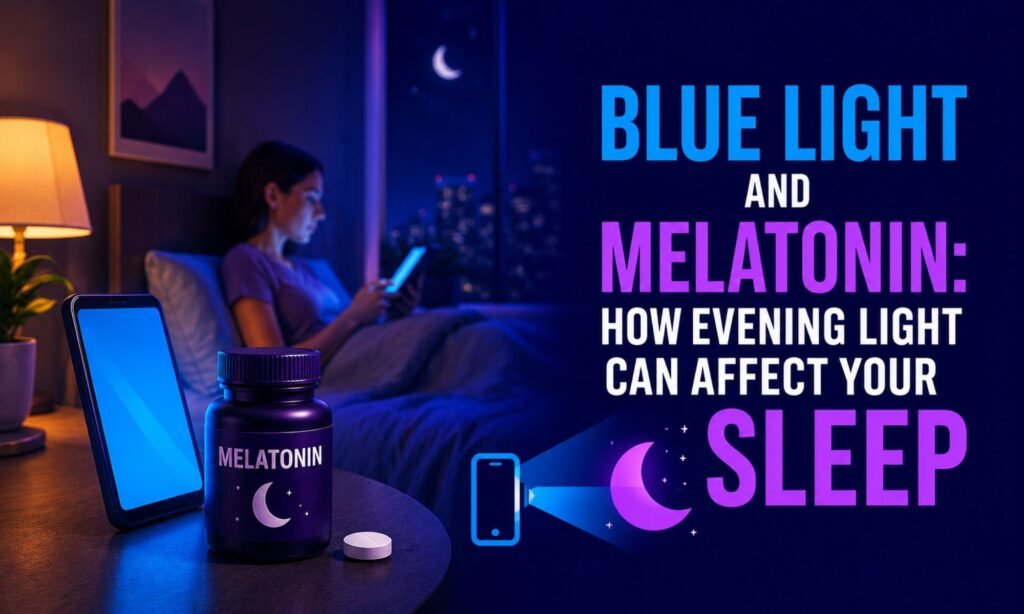
Blue light and melatonin will affect your sleep, particularly when you are exposed to bright light in the evening. Light entering your eyes sends signals to the circadian clock, which helps determine when melatonin should rise and fall. Blue wavelengths are especially effective at influencing this system, but brightness, timing, duration, and individual sensitivity also matter.
Table of Contents
Why Blue Light Matters for Sleep
Blue light has become one of the most talked-about sleep topics. You may have heard that your phone “blocks melatonin” at night or that wearing blue-light-blocking glasses is the key to sleeping better.
There is some truth behind these claims, but the science is more nuanced than the headlines suggest.
Light is one of the strongest signals that helps keep your circadian system synchronized with the day-night cycle. During the day, light helps your brain recognize that it is daytime and supports alertness. As evening arrives, the body normally begins preparing for biological night, including a rise in melatonin.
Bright light at the wrong time can interfere with this process.
Blue light deserves particular attention because the circadian system is especially sensitive to shorter wavelengths. But blue light itself is not harmful or something you need to avoid during the day. Natural daylight contains plenty of blue light, and daytime light is important for keeping your body clock properly timed.
The real question is not simply, “Is there blue light?”
It is when you are getting the light, how bright it is, and how long you are exposed to it.
Does Blue Light Reduce Melatonin?
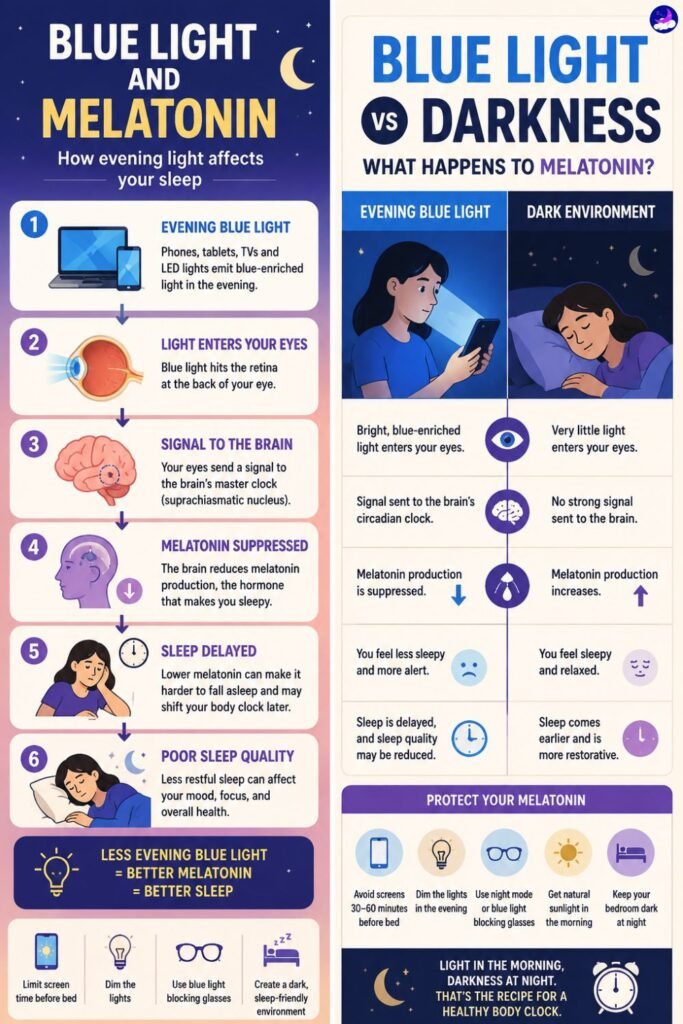
Yes. Light can suppress melatonin, and shorter-wavelength light can be particularly effective at doing so. This is most relevant during the evening and biological night, when melatonin would normally be increasing.
However, the effect is not determined by color alone. Brightness, duration, timing, distance from the light source, wavelength, and individual sensitivity all influence the response.
Screens are one possible source of evening light exposure. Controlled studies have found that using light-emitting electronic devices before bed can suppress melatonin, delay circadian timing, and affect sleep-related outcomes.
That does not mean everyone who checks their phone at night will develop a sleep problem.
Real-world exposure varies greatly, and what you are doing on the device can matter as well as the light coming from it.
Also Read: Foods Rich in Melatonin
What Is Blue Light?
Blue light is simply one part of the visible light spectrum.
You encounter it naturally throughout the day, with sunlight being one of the major sources. Artificial sources include LED lights, smartphones, tablets, computer monitors, televisions, and some e-readers.
So there is nothing inherently unhealthy about blue light.
Your body actually needs daytime light. It helps the brain distinguish day from night, supports alertness, and provides an important timing signal for the circadian system.
The concern begins when a normally useful daytime signal reaches the body at the wrong biological time.
A simple way to think about it is:
Blue light is not automatically the problem. The timing of light exposure is what matters most.
How Does Light Affect Melatonin?
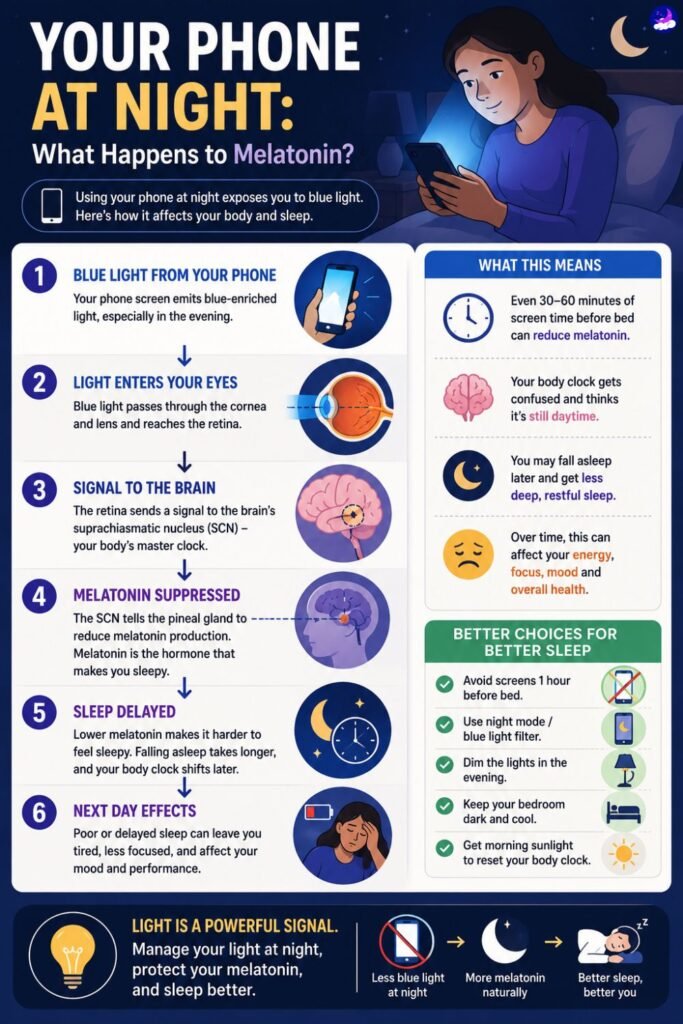
The connection between light and melatonin starts in the eyes.
Your eyes contain specialized light-sensitive cells that do more than help you see. Some of these cells send information directly to the brain’s circadian system.
The basic pathway is:
Light → eyes → light-sensitive retinal cells → SCN → pineal gland → melatonin
The suprachiasmatic nucleus (SCN) acts as the central circadian clock. It receives information about the light-dark environment and helps coordinate the body’s daily rhythms.
During the day, light reinforces daytime timing. As evening arrives and the biological night begins, the normal nighttime melatonin rhythm develops.
When bright light reaches the eyes during the biological night, it can interfere with that signal and suppress melatonin production.
This is a normal biological response. The issue is not that light is damaging the body; it is that light at the wrong time can send the circadian system the wrong message about what time of day it is.
Also Read: Our Melatonin Guide | Circadian Rhythm and Melatonin | Your Body's Natural Melatonin Production
Why Is Blue Light Important at Night?
Not all wavelengths of light affect the circadian system equally.
The retina contains specialized cells called intrinsically photosensitive retinal ganglion cells (ipRGCs). These cells contain a light-sensitive pigment called melanopsin and play an important role in sending environmental light information to the circadian clock.
They are particularly sensitive to shorter-wavelength light.
You do not need to remember the terminology. The important idea is much simpler:
Your eyes are not just cameras. They also act as sensors for your body clock.
When these cells detect light during the biological night, they send signals to the SCN. This can reduce melatonin production and influence the timing of the circadian system.
That is one reason blue-enriched light can be particularly relevant in the evening.
Still, it would be inaccurate to say that only blue light affects the circadian system. The biological response depends on the characteristics of the light as a whole and, importantly, when the exposure occurs.
Also Read: When to take Melatonin | Can you take Melatonin everynight? | Melatonin Addiction
Do Phones and Tablets Really Affect Melatonin?
This is where the science becomes particularly relevant to everyday life.
Researchers have conducted controlled studies examining what happens when people use light-emitting electronic devices in the evening.
In a well-known randomized study, participants read either a light-emitting e-book or a printed book before bedtime. Those using the electronic device took longer to fall asleep, had lower evening melatonin levels, experienced a later circadian phase, and were less alert the following morning.
Another study examined unrestricted evening use of a light-emitting tablet. Participants using the tablet experienced later bedtimes, later melatonin onset, delayed sleep onset, and reduced next-morning alertness compared with those reading printed material.
These studies provide good evidence that evening exposure to light-emitting devices can affect melatonin and sleep timing.
But there is an important limitation.
Laboratory studies carefully control things such as brightness, duration, distance, timing, and surrounding light. Real-life phone use is much less predictable.
Checking a dim phone for ten minutes is not the same exposure as watching videos on a bright tablet for two hours in a dark bedroom.
So the research supports a potential effect, but it does not justify saying that every person who uses a phone before bed will experience significant sleep disruption.
Also Read: Melatonin for Older Adults | Melatonin for Pregnant Women | Melatonin for Kids.
Is Blue Light the Only Problem With Screens?
No. This is an important part of the story.
A screen can affect sleep through light and behavior.
Think about what happens when you pick up your phone at 11 PM. You might start by checking one message and end up scrolling through social media, watching videos, reading the news, playing a game, or answering work messages.
The screen is providing light, but your brain is also receiving stimulation.
Nighttime screen use can involve:
- Mental stimulation
- Social media
- Gaming
- Work-related stress
- Emotionally stimulating content
- Repeated notifications
- Delayed bedtime
- Habitual scrolling
Sometimes the biggest problem is not the light. It is simply that the phone keeps you awake for another hour.
This is why the sleep effect of nighttime screen use is better understood as a combination of light exposure, mental stimulation, and delayed sleep timing.
Changing the color of the screen may reduce some light-related effects, but it cannot solve the behavioral side of the problem.
Does Night Mode or Warm Screen Mode Help?
Most modern phones, tablets, and computers offer some form of night mode. Depending on the device, it may be called Night Shift, Night Light, Eye Comfort, or something similar.
These settings generally make the display warmer and reduce some shorter-wavelength light.
There is a reasonable biological basis for this approach, but it is easy to expect too much from it.
A warmer screen is still a screen.
Brightness still matters. Duration still matters. And what you are doing on the device still matters.
Research examining Apple’s Night Shift feature found that changing the spectral composition of the display without also changing brightness was not enough to prevent melatonin suppression under the study conditions.
So night mode may be useful, but it should not be treated as a guarantee that nighttime screen use has no effect on sleep.
A more sensible approach is to combine a warmer display with lower brightness and less screen use as bedtime approaches.
Do Blue-Light-Blocking Glasses Work?
Blue-light-blocking glasses are designed to filter some shorter wavelengths before they reach the eyes.
The idea sounds straightforward: if shorter-wavelength light can influence the circadian system, reducing that exposure in the evening might reduce its effect on melatonin and sleep.
The research, however, is not completely consistent.
Systematic reviews have found uncertain or mixed evidence regarding whether blue-light-filtering lenses meaningfully improve sleep outcomes. Studies have differed in their lens designs, participants, exposure conditions, and outcome measures.
Some research has suggested possible benefits in particular situations, but the evidence is not strong enough to say that everyone needs blue-light-blocking glasses for better sleep.
They may be useful for some people, particularly when reducing evening light exposure is difficult. But they should not be presented as a proven treatment for insomnia.
If someone already uses them and finds them helpful, there is little reason to assume that wearing them is harmful. But there are simpler and more fundamental steps to consider first, such as reducing unnecessary evening brightness and keeping a regular sleep schedule.
How Much Evening Blue Light Is Too Much?
This sounds like it should have a simple answer.
It doesn’t.
There is no universal amount of evening blue light that guarantees a sleep problem.
The effect depends on several factors:
- Brightness
- Duration
- Distance from the eyes
- Wavelength
- Time of exposure
- Individual sensitivity
- Existing circadian timing
A bright screen held close to your face for two hours in a dark room is very different from briefly checking a dim phone.
Timing matters too. Light received in the middle of the day does not have the same biological meaning as similar light received late at night.
That is why rigid advice such as “never use a screen for more than X minutes before bed” can give a false impression of precision.
There is no single screen-time limit that guarantees good sleep for everyone.
Also Read: Can you overdose on Melatonin | Melatonin gummies vs Tablets
Blue Light During the Day Is Different
This distinction is easy to miss.
If blue light were inherently harmful, sunlight would be a problem. It isn’t.
Daytime light is an important signal for the circadian system. It helps reinforce daytime timing and supports normal alertness.
The goal is therefore not to avoid blue light throughout the day.
Instead, think about getting stronger light during the day and less unnecessary bright light at night.
Morning and daytime light help establish a clear daytime signal. As evening arrives, reducing excessive brightness helps create a stronger contrast between day and night.
This is also why spending most of the day in dim indoor lighting and then sitting under bright artificial light late at night may provide weaker day-night signals to the circadian system.
You do not need to live in darkness after sunset. The goal is simply to give your body a clearer difference between day and night.
What Happens If You Use Your Phone Before Bed?
A typical late-night phone session can involve several things at once:
Bright screen + close viewing + prolonged use + stimulating content + delayed bedtime
The light may influence melatonin and circadian signaling. The content may keep the brain alert. The device may make it easy to lose track of time. Eventually, bedtime gets pushed later than planned.
That does not mean a quick phone check before bed is automatically harmful.
Checking a message for a few minutes at low brightness is very different from spending two hours scrolling in a dark bedroom.
So instead of asking only:
“Did I use my phone?”
a better question is:
“How much light and stimulation did I get, and did it interfere with my usual bedtime?”
How Long Before Bed Should You Reduce Bright Light?
You will often hear advice such as “stop using screens one hour before bed.”
That can be a useful practical rule for some people, but it is not a biological law that applies to everyone.
The ideal timing depends on your sleep schedule, circadian timing, the brightness of the environment, and your individual sensitivity to light.
The broader principle is more useful than a fixed number:
Give your body a gradual transition from a bright daytime environment to a darker evening environment.
If you normally go to bed at 11 PM, reducing bright and stimulating screen use as bedtime approaches is a reasonable place to start.
Some people may benefit from making that change earlier. Others may notice little difference from brief evening screen use.
Also Read: Melatonin For Jetlag | Melatonin For Shift workers
Practical Ways to Reduce Evening Light Exposure
You do not need to create a completely screen-free evening to support your circadian rhythm.
A few realistic changes can reduce unnecessary evening light:
- Dim indoor lighting as the evening progresses.
- Lower your phone or tablet brightness.
- Use a warmer display setting if you find it comfortable.
- Avoid holding very bright screens close to your face.
- Reduce unnecessary screen use as bedtime approaches.
- Keep the bedroom reasonably dark while sleeping.
- Get plenty of natural light during the day.
- Put your phone away when you do not actually need it.
That last point can be surprisingly useful.
If your phone is sitting beside your pillow, it is much easier to check one notification, then another, and then another.
You do not necessarily need to optimize the exact color temperature of your screen if you can simply reduce how often you pick it up.
What If You Need to Use Screens at Night?
Not everyone can stop using screens in the evening.
Students may need to study. Office workers may have late-night tasks. Parents may need to stay available. Some people work night shifts and have no choice but to spend their working hours under artificial lighting.
In these situations, harm reduction is more realistic than perfection.
You can try:
- Lowering screen brightness
- Using warmer display settings
- Taking breaks from the screen
- Turning off unnecessary notifications
- Choosing less stimulating content near bedtime
- Moving the screen farther away when practical
- Using dimmer room lighting
- Keeping your sleep schedule as consistent as possible
For night-shift workers, the situation is more complicated because the work schedule itself may conflict with the body’s biological night.
In that situation, simply saying “avoid screens before bed” may miss the bigger issue. The broader pattern of light exposure, work timing, sleep timing, and circadian adaptation matters more.
What Does the Research Really Tell Us?
The overall evidence supports a fairly clear conclusion: light can affect melatonin and circadian timing, particularly when exposure occurs during the biological night.
Shorter-wavelength light is especially effective at activating the retinal pathways involved in circadian regulation. Controlled studies of evening electronic-device use have found melatonin suppression and changes in circadian timing and sleep-related outcomes.
But there is an important difference between what happens in a controlled laboratory experiment and what happens in everyday life.
People use different devices at different brightness levels, for different lengths of time, and for very different activities. Individual responses also vary.
Another point is easy to overlook: melatonin suppression is not the same as guaranteed poor sleep.
A measurable change in melatonin does not automatically mean that a person will develop insomnia or experience meaningful harm.
Research on interventions such as night mode and blue-light-blocking glasses is also mixed. These approaches may reduce some short-wavelength exposure, but they do not remove every biological or behavioral effect of nighttime screen use.
The practical message is therefore simple:
Get plenty of light during the day, avoid unnecessarily bright light late at night, and give your body a reasonably consistent sleep schedule.
Also Read: Our Melatonin Dosage Guide | Melatonin Side Effects | Melatonin Drug Interactions
Frequently Asked Questions
Does blue light completely stop melatonin?
No. Blue light does not simply switch melatonin off. Evening light can suppress melatonin, but the effect depends on brightness, timing, duration, wavelength, and individual sensitivity.
Does dark mode reduce blue light?
Dark mode changes the appearance of the screen, but it does not necessarily eliminate short-wavelength light. Its effect depends on the actual light output of the device and how it is being used.
Is phone use before bed bad for sleep?
It can be, particularly when the screen is bright, used for a long time, or combined with stimulating content and delayed bedtime. Brief phone use does not automatically cause meaningful sleep disruption in everyone.
Do blue-light glasses really work?
The evidence is mixed. Some studies suggest possible benefits, but systematic reviews have found uncertain or inconsistent effects on sleep. They should not be considered a guaranteed solution.
Is blue light from sunlight good or bad?
Daytime blue light is a normal and useful part of sunlight. It helps synchronize the circadian system and support daytime alertness. The concern is mainly excessive or poorly timed exposure during the evening and biological night.
Should I avoid my phone one hour before bed?
Reducing bright and stimulating screen use before bed is a reasonable strategy, but there is no universal one-hour rule that works equally well for everyone.
Does blue light affect everyone the same way?
No. People differ in their sensitivity to light, circadian timing, age, sleep schedule, and other factors that can influence the response.
Does reducing blue light improve sleep quality?
It may help in some situations, particularly when evening light exposure is substantial. But sleep quality depends on many factors, so reducing blue light alone is not guaranteed to solve a sleep problem.
Bottom Line
Blue light is not inherently bad. Blue-rich daylight is an important signal for your circadian system, and avoiding it during the day would make little biological sense.
The bigger issue is timing.
When bright light reaches your eyes during the evening or biological night, it can signal to the circadian system that it is still daytime. This can suppress melatonin and, depending on the timing and intensity of exposure, influence when your body is ready for sleep.
Screens are one possible source of nighttime light, but they are only part of the picture. What you are doing on the screen, how long you stay on it, and whether it pushes your bedtime later can all matter.
You do not need to fear blue light or eliminate screens completely.
A more realistic approach is:
MORE LIGHT DURING THE DAY
LESS UNNECESSARY BRIGHT LIGHT AT NIGHT
A CONSISTENT SLEEP SCHEDULE
If you need to use a screen in the evening, lower the brightness, consider a warmer display setting, reduce unnecessary use, and avoid highly stimulating content close to bedtime.
The goal is not to create a perfectly screen-free evening.
It is to give your body clock a clearer difference between day and night.
Also Read: Melatonin and Weird Dreams | Melatonin Myths and Facts | Benefits of Melatonin beyond sleep.
References
- Chang AM, Aeschbach D, Duffy JF, Czeisler CA. Evening use of light-emitting eReaders negatively affects sleep, circadian timing, and next-morning alertness. Proceedings of the National Academy of Sciences. 2015;112(4):1232–1237. PubMed: https://pubmed.ncbi.nlm.nih.gov/25535358/
- Heath M, Sutherland C, Bartel K, Gradisar M. Unrestricted evening use of light-emitting tablet computers delays self-selected bedtime and disrupts circadian timing and alertness. Sleep. 2018. PubMed: https://pubmed.ncbi.nlm.nih.gov/29845764/
- Nagare R, Plitnick B, Figueiro MG. Does the iPad Night Shift mode reduce melatonin suppression? Lighting Research & Technology. 2019;51(3):373–383. PubMed: https://pubmed.ncbi.nlm.nih.gov/31191118/
- Lawrenson JG, Hull CC, Downie LE. The effect of blue-light blocking spectacle lenses on visual performance, sleep, and macular health in adults: a systematic review. Cochrane Database of Systematic Reviews. 2023. PubMed: https://pubmed.ncbi.nlm.nih.gov/37593770/
- Singh S, et al. Interventions to reduce short-wavelength (“blue”) light exposure at night and their effects on sleep: systematic review and meta-analysis. Sleep Advances. 2023. PubMed: https://pubmed.ncbi.nlm.nih.gov/37192881/
- Hatori M, Gronfier C, Van Gelder RN, et al. Global rise of potential health hazards caused by blue light-induced circadian disruption in modern society. NPJ Digital Medicine. 2017. PubMed: https://pubmed.ncbi.nlm.nih.gov/30311830/