Melatonin is surrounded by common myths. It is not simply a sleeping pill; it mainly helps regulate circadian rhythm and sleep timing.
More melatonin does not necessarily mean better sleep, and it can cause side effects or interact with medicines.
Although naturally produced by the body, melatonin is not completely risk-free. Its benefits depend on the right dose, timing, and individual circumstances. Understanding the evidence helps separate science from marketing claims.
Melatonin myths vs facts: Learn what science says about sleep timing, dosage, side effects, interactions, vivid dreams, and addiction.
Table of Contents
Melatonin has gone from a relatively obscure hormone to one of the most talked-about sleep supplements. It is now sold as tablets, gummies, capsules and part of countless products marketed for better sleep. With that popularity has come a lot of confusion. Some claims are based on real science, while others take a small piece of research and stretch it much further than the evidence allows.
You may have heard that melatonin is basically a natural sleeping pill, that more works better, that it is addictive, or that it can completely reset your body clock. You may also have seen claims that it is completely safe simply because the body makes it naturally.
The reality is more interesting.
Melatonin can be useful for some sleep and circadian problems, but many popular claims about it are oversimplified. Let’s look at what the science actually says.
What Should You Know About Melatonin?
Melatonin is a hormone and an important circadian timing signal, not simply a conventional sleeping pill. It may help with problems such as jet lag and some shift-work-related sleep difficulties, and it may modestly improve how quickly some people with insomnia fall asleep.
However, it does not work equally well for every type of insomnia. More melatonin is not necessarily better, and being a natural hormone does not make supplemental melatonin completely risk-free. Melatonin appears relatively safe for many people when used short term, but its long-term safety has not been established.
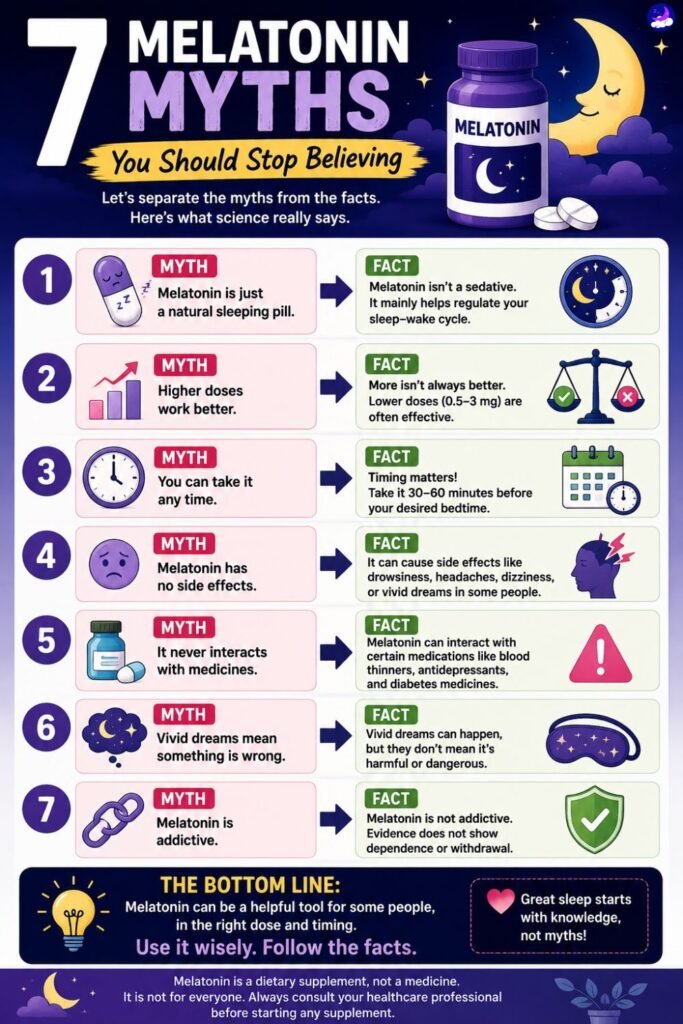
Myth 1: Melatonin Is Basically a Natural Sleeping Pill
This is probably the most common misunderstanding.
People take melatonin at night, some feel sleepy afterward, and the supplement is sold in the sleep aisle. It is easy to conclude that melatonin works like a conventional sleeping pill.
But that is not really how melatonin works.
Melatonin is a hormone produced by your body mainly in response to darkness. One of its most important functions is to provide a signal that helps coordinate the body’s internal clock with the light-dark cycle.
That timing signal can help align sleep with the body’s biological night, but melatonin is not simply a sedative that switches the brain off.
This distinction helps explain why melatonin may be useful for someone whose sleep schedule is out of alignment but less useful for someone whose insomnia is driven mainly by anxiety, pain, medication effects or another sleep disorder.
What to Remember
Think of melatonin more as a “biological night” signal than a knockout drug.
Also Read: Our Melatonin Guide | Circadian Rhythm and Melatonin | Your Body's Natural Melatonin Production
Myth 2: More Melatonin Means Better Sleep
It sounds logical: if a small amount helps, a larger amount should help even more.
Melatonin does not necessarily work that way.
Clinical research does not show a simple more-is-better relationship in which increasing melatonin reliably produces better sleep. The effects also depend on why melatonin is being used and when it is taken.
Higher amounts may increase unwanted effects without necessarily providing additional benefit. Reported side effects include sleepiness, headache, dizziness and nausea.
Timing matters too.
When melatonin is being used to influence the circadian clock, taking it at the wrong time may produce a different effect from taking it at the biologically appropriate time.
So if melatonin does not seem to be helping, simply taking more is not necessarily the answer.
What to Remember
Melatonin is not a “the more, the better” supplement. The right approach depends on why it is being used, when it is taken and how the individual responds.
Myth 3: Melatonin Works for Everyone With Insomnia
This claim is easy to understand because insomnia is often described as if it were one condition.
It isn’t.
People can have trouble sleeping for very different reasons.
Stress, anxiety, pain, medications, irregular schedules, poor sleep habits, sleep apnea, restless legs and circadian rhythm problems can all contribute to poor sleep.
Melatonin may be useful for some circadian-related sleep problems and may modestly improve sleep onset in some people, but it is not a universal treatment for chronic insomnia.
A 2023 systematic review and meta-analysis found that melatonin and ramelteon could improve some insomnia outcomes, but the overall effects were limited and the evidence varied between outcomes and studies.
NCCIH also notes that clinical practice guidelines have recommended against using melatonin routinely for chronic insomnia because the evidence has not been strong enough.
What to Remember
Melatonin may help some people with some sleep problems. It does not treat every cause of insomnia.
Also Read: Our Melatonin Dosage Guide | Melatonin Side Effects | Melatonin Drug Interactions
Myth 4: Melatonin Resets Your Body Clock Immediately
“Reset your body clock” sounds simple, especially in advertisements.
But your circadian rhythm is not a switch that can be flipped with one tablet.
Melatonin can provide a timing signal to the circadian system. Research has shown that appropriately timed melatonin can shift the timing of human circadian rhythms, but the direction and size of that shift depend heavily on when melatonin is taken.
And melatonin is only one part of the system.
Light exposure is another major signal that helps set the body’s biological clock.
This is why taking melatonin at a random time and expecting an immediate circadian reset is unrealistic.
What to Remember
Melatonin can help shift circadian timing, but timing matters and changes do not necessarily happen after one dose.
Myth 5: Melatonin Is Addictive
This concern often comes from comparing melatonin with prescription sleeping medicines or other substances that can cause dependence.
But addiction, dependence, tolerance and psychological reliance are not the same thing.
Addiction involves compulsive use and continued use despite harm.
Dependence means the body has adapted to a substance so that stopping it may cause withdrawal symptoms.
Tolerance means that increasing amounts may be needed to produce the same effect.
Psychological reliance is different again. Someone may begin to feel that they cannot sleep without performing a particular bedtime routine, even when the substance itself is not causing addiction.
Current evidence does not suggest that melatonin has the typical addictive properties associated with drugs of abuse. Some clinical studies of prolonged-release melatonin have also found no clear evidence of withdrawal or rebound insomnia. However, this does not mean that every person needs to take melatonin indefinitely without reviewing whether it is still useful.
What to Remember
Melatonin is not generally considered addictive, but that is different from saying that a person cannot become psychologically reliant on a bedtime routine that includes it.
[Also Read: Is Melatonin Addictive?]
Myth 6: You Cannot Have Side Effects Because Melatonin Is Natural
“Natural” is one of the most powerful words in supplement marketing.
It is also one of the most misleading when used as a synonym for “risk-free.”
Your body naturally produces melatonin, but a supplement exposes the body to an additional amount at a particular time. That can create a different pattern from the melatonin your body would normally produce on its own.
Some people experience drowsiness, headache, dizziness or nausea after taking melatonin. Short-term use appears relatively safe for many people, but the long-term safety of supplementation has not been established.
That does not mean melatonin is dangerous.
It means that natural and harmless are not the same thing.
Even substances produced naturally by the body can have different effects depending on amount, timing and individual circumstances.
What to Remember
Melatonin can have side effects even though your body naturally makes it.
[Also Read: Melatonin Side Effects]
Myth 7: Melatonin Is Safe in Any Amount
This is another version of the “natural means harmless” argument.
It is not accurate.
The amounts used in supplements can be considerably different from the amounts naturally circulating in the body, and researchers do not have enough evidence to define the long-term safety of every supplemental amount and formulation.
There is another issue: supplement labels are not always a perfect guarantee of what is actually inside the product.
NCCIH highlights a study in which 22 of 25 tested melatonin gummy products were inaccurately labeled. One contained no detectable melatonin, while the others contained between 74% and 347% of the labeled amount.
This does not mean that every melatonin gummy is inaccurately labeled. It shows that product consistency cannot simply be assumed.
Children are another special concern because accidental ingestion of melatonin products, particularly gummies, can result in significant exposures.
What to Remember
There is no scientific basis for saying that any amount of melatonin is automatically safe.
Also Read: When to take Melatonin | Can you take Melatonin everynight? | Melatonin Addiction | Can you overdose on Melatonin
Myth 8: Melatonin Stops Your Body From Making Its Own Melatonin
This is a common fear among people who have been taking melatonin regularly.
The concern is understandable: if you supply a hormone from outside, perhaps the body will stop producing it.
Current human evidence does not support the idea that melatonin supplementation permanently shuts down the body’s natural melatonin production.
Human research has found that supplemental melatonin can influence the timing of the body’s circadian rhythm, but that is different from permanently switching off endogenous melatonin production.
That distinction matters.
A temporary or reversible change in hormone timing is not the same thing as the body losing its ability to produce the hormone.
What to Remember
Current evidence does not show that melatonin supplementation permanently switches off your body’s natural melatonin production.
Myth 9: Melatonin Always Causes Weird Dreams or Nightmares
Some people notice more vivid dreams after taking melatonin.
Others report unusual dreams or nightmares.
That experience can be real without meaning that melatonin inevitably causes it.
Dream vividness and dream recall are influenced by many factors, including sleep duration, awakenings during the night, stress, medications and individual differences.
If someone wakes more frequently during or shortly after dreaming, they may simply remember more dreams.
Some people may notice vivid dreams after taking melatonin, but research does not show that melatonin universally causes nightmares.
What to Remember
Vivid dreams can happen with melatonin, but they are not an inevitable or universal side effect.
Also Read: Melatonin For Jetlag | Melatonin For Shift workers
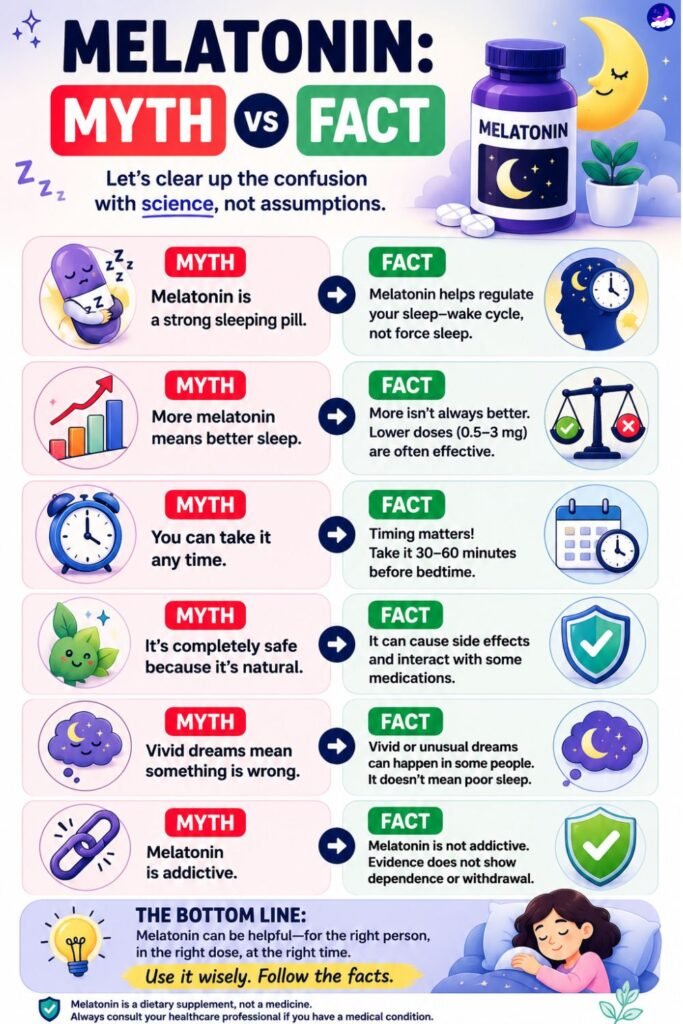
Myth 10: Melatonin Gummies Are Better Than Tablets
Gummies have become extremely popular because they are easy to take and often taste more like candy than medicine.
But convenience is not the same thing as superiority.
A gummy and a tablet can contain the same active ingredient, but products can differ in:
- Melatonin amount
- Other ingredients
- Release characteristics
- Product quality
- Sugar or sweeteners
- Ease of accidental ingestion
There is no scientific rule saying that gummies work better than tablets.
Product accuracy can also be an issue with gummies, as the labeling study mentioned above demonstrates. But that does not mean every gummy is unreliable.
The more useful question is not “gummy or tablet?”
It is:
“What exactly is in the product, how much melatonin does it contain, and is the formulation appropriate for the intended use?”
What to Remember
Neither form is automatically superior. The formulation, actual melatonin content, other ingredients and product quality matter more than whether the supplement happens to be a gummy or tablet.
Also Read: Melatonin for Older Adults | Melatonin for Pregnant Women | Melatonin for Kids
Myth 11: Melatonin Is Automatically Safe During Pregnancy
This is one myth where extra caution is important.
The claim can sound reassuring because melatonin is naturally present during pregnancy. Maternal melatonin changes during pregnancy and can cross the placenta.
But natural melatonin and supplemental melatonin are not the same exposure.
Current human evidence on supplemental melatonin during pregnancy remains limited. Some studies have not identified a clear major safety concern, but there are not enough high-quality studies to say that supplemental melatonin is proven completely safe during pregnancy.
This is an important example of how a true statement can become misleading when taken too far.
“Melatonin is naturally present during pregnancy” is true.
“Therefore, taking a melatonin supplement during pregnancy is automatically safe” does not follow.
What to Remember
Pregnancy changes the evidence standard. Natural melatonin is part of normal physiology, but supplemental melatonin should not be assumed to be risk-free.
Also Read: Melatonin For Jetlag | Melatonin For Shift workers
Myth 12: Melatonin Is Only Useful for Falling Asleep
This myth comes from thinking of melatonin purely as a sleep aid.
But melatonin’s role is broader.
Its more important role is as a circadian timing signal, which is why it has been studied for problems such as jet lag and some shift-work-related sleep difficulties. NCCIH notes that evidence supports potential benefits for both situations, although results vary by condition and study.
This is one reason timing matters so much.
The same supplement can be used for very different purposes, and the timing used for one purpose may not be the same as the timing used for another.
What to Remember
Melatonin is not just about making you sleepy. Its broader role is as a circadian timing signal in the right circumstances.
Also Read: When to take Melatonin | Can you take Melatonin everynight? | Melatonin Addiction
What Science Actually Says About Melatonin
After stripping away the myths, the picture is fairly straightforward.
Melatonin is neither a miracle supplement nor a useless one.
It is a biological hormone with effects on sleep and circadian timing, and research supports useful roles in some specific situations. But the size of the benefit depends heavily on what problem is being treated.
Instead of asking only:
“Does melatonin work?”
a better scientific question is:
“When, why, for whom and under what circumstances does melatonin help?”
The answer can change depending on:
- The sleep problem
- Circadian timing
- Amount used
- Formulation
- Age
- Pregnancy status
- Other medicines
- Individual response
For example, evidence supporting melatonin for jet lag cannot automatically be used to claim that it cures chronic insomnia. Likewise, evidence from a particular prolonged-release product cannot automatically be applied to every gummy or tablet.
That is one of the biggest problems with online melatonin claims:
A small piece of evidence gets turned into a universal statement.
Also Read: Melatonin for Older Adults | Melatonin for Pregnant Women | Melatonin for Kids.
How to Read Melatonin Claims Online
The next time you see a strong claim about melatonin, pause before accepting it.
Be especially cautious when a product or website says:
- “Clinically proven”
- “100% safe”
- “Natural cure”
- “Works instantly”
- “No side effects”
- “Doctors don’t want you to know”
- “More powerful”
- “Best dose”
These phrases may sound scientific, but they do not tell you what was actually studied.
Instead, ask a few simple questions.
Was the research done in humans?
A laboratory or animal study can be useful, but it does not automatically establish what happens in people.
Was it a randomized controlled trial or a systematic review?
These study designs can provide stronger evidence than testimonials or uncontrolled observations, although the quality of the individual study still matters.
Who was studied?
Results in older adults, children, pregnant women, shift workers and healthy young adults cannot automatically be mixed together.
What formulation was tested?
Immediate-release and prolonged-release melatonin are not necessarily interchangeable.
How much was used and for how long?
A short study cannot automatically prove long-term safety.
Was the claim based on research or a testimonial?
A person’s experience can be genuine and worth listening to, but an anecdote is not the same as controlled scientific evidence.
Does the claim actually match the study?
This may be the most important question.
A study might show that melatonin reduced sleep-onset time by a modest amount.
A headline may turn that into:
“Melatonin fixes insomnia.”
Those are not the same statement.
Also Read: Can you overdose on Melatonin | Melatonin gummies vs Tablets
Frequently Asked Questions
Is melatonin really safe?
Melatonin appears relatively safe for many people when used short term, but “safe” does not mean risk-free. Side effects are possible, and the long-term safety of supplementation has not been established.
Is melatonin addictive?
Current evidence does not suggest that melatonin has the typical addictive properties of drugs of abuse. However, someone may still become psychologically reliant on a particular bedtime routine that includes melatonin.
Does more melatonin work better?
Not necessarily. Melatonin does not follow a simple more-is-better rule, and taking more may increase unwanted effects without providing additional benefit.
Does melatonin stop natural production?
Current human evidence does not show that melatonin supplementation permanently shuts down the body’s natural melatonin production. Changes in circadian timing are different from permanent suppression.
Can melatonin cure insomnia?
No. Melatonin may help some aspects of sleep in some people, but it is not a universal cure for insomnia. The underlying cause of the insomnia matters.
Does melatonin cause nightmares?
Not everyone experiences this. Some people report vivid dreams or nightmares, but dreams are influenced by many factors, and melatonin does not universally cause these effects.
Also Read: Foods Rich in Melatonin | Blue Light and Melatonin
Bottom Line
Melatonin is neither a miracle sleep cure nor something that should automatically be feared.
It is a hormone produced naturally by the body and an important circadian timing signal. It can be useful in certain situations, particularly when sleep timing or circadian rhythms are involved.
But many popular claims go too far.
Melatonin does not automatically knock everyone out. More is not necessarily better. It does not cure every type of insomnia, and being natural does not make it completely risk-free. Current evidence also does not support the idea that supplementation permanently shuts down the body’s own melatonin production.
The most useful way to think about melatonin is not as a magic sleep pill, but as one tool whose usefulness depends on the problem, timing, formulation and person using it.
So the next time you see a bold claim about melatonin, don’t judge it by the confidence of the headline or a stranger’s experience online.
Ask a better question:
What did the research actually study—and does that evidence really support the claim?
That simple habit can help you separate melatonin science from melatonin marketing.
Also Read: Melatonin and Weird Dreams | Benefits of Melatonin beyond sleep.
References
- National Center for Complementary and Integrative Health (NCCIH). Sleep Disorders and Complementary Health Approaches: Usefulness and Safety.
NCCIH — Sleep Disorders and Complementary Health Approaches - National Center for Complementary and Integrative Health (NCCIH). Melatonin: What You Need To Know.
NCCIH — Melatonin: What You Need To Know - Maruani J, Reynaud E, Chambe J, et al. Efficacy of melatonin and ramelteon for the acute and long-term management of insomnia disorder in adults: A systematic review and meta-analysis. Journal of Sleep Research. 2023;32(6):e13939.
PubMed — Melatonin and Ramelteon Systematic Review and Meta-analysis - Lewy AJ, Bauer VK, Ahmed S, et al. The human phase response curve to melatonin is about 12 hours out of phase with the PRC to light. Chronobiology International. 1998;15(1):71–83.
PubMed — Human Melatonin Phase Response Curve - Rajaratnam SMW, Dijk DJ, Middleton B, et al. Melatonin phase-shifts human circadian rhythms with no evidence of changes in the duration of endogenous melatonin secretion. Journal of Clinical Endocrinology & Metabolism. 2003;88(9):4303–4309.
PubMed — Melatonin and Circadian Rhythm Timing - Cavallo A, et al. The amplitude of endogenous melatonin production is not affected by melatonin treatment in humans. Biological Signals and Receptors. 1997.
PubMed — Endogenous Melatonin and Supplementation - American Academy of Sleep Medicine. Clinical Practice Guideline for the Pharmacologic Treatment of Chronic Insomnia in Adults. Journal of Clinical Sleep Medicine. 2017;13(2):307–349.
PubMed — AASM Chronic Insomnia Pharmacologic Guideline