Pregnancy can make sleep difficult, and melatonin may seem like a simple solution. But there is an important difference between the melatonin your body naturally produces during pregnancy and melatonin taken as a supplement. Natural melatonin is part of normal pregnancy biology, while supplemental melatonin has not been studied well enough to establish that it is completely safe.
Current human research is somewhat reassuring, but limited. So the most accurate answer is not simply “safe” or “unsafe”: the available studies have not identified a clear major safety signal, but there is still not enough evidence to call supplemental melatonin proven safe during pregnancy
Table of Contents
Your Body Naturally Makes More Melatonin During Pregnancy
Before discussing melatonin supplements, it helps to understand what happens to melatonin naturally during pregnancy.
Melatonin is a hormone produced mainly during darkness. It helps regulate the body’s circadian rhythm, the internal timing system that influences sleep and wakefulness.
Pregnancy changes this system.
Maternal melatonin levels generally increase during pregnancy, with levels appearing to be highest later in pregnancy and returning toward pre-pregnancy levels after delivery.
This is endogenous melatonin—the melatonin your own body produces.
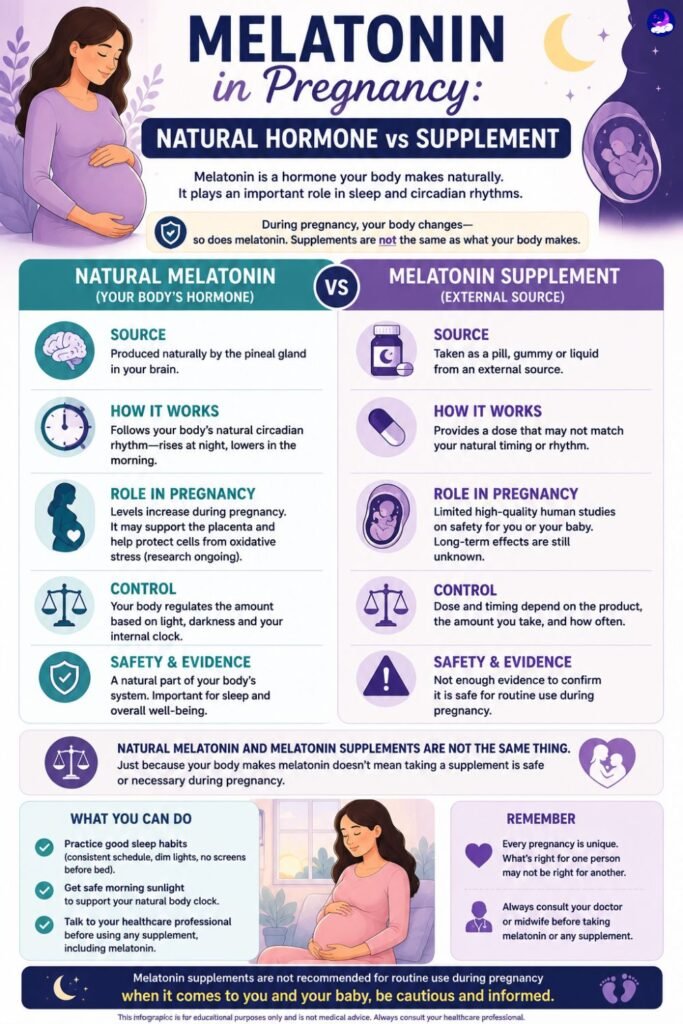
That is different from taking a melatonin supplement.
Your natural melatonin release follows a biological rhythm, rising mainly at night. A supplement introduces an additional amount from outside the body at a particular time and dose.
That distinction is important because the fact that natural melatonin is present and biologically important during pregnancy does not automatically mean that taking extra melatonin is beneficial or risk-free.
The two questions require different evidence.
Also Read: Our Melatonin Guide | Your Body's Natural Melatonin Production
Why Is Melatonin Important During Pregnancy?
Melatonin does more than signal that it is nighttime.
During pregnancy, maternal melatonin appears to be part of the communication between the mother’s biological clock and the developing fetus.
Melatonin can cross the placenta, allowing maternal nighttime signals to reach the developing fetus. Researchers believe this may help provide information about the mother’s day-night cycle while fetal circadian systems are developing.
Melatonin also has biological effects beyond circadian signaling, including antioxidant and cellular effects. These properties are one reason researchers are interested in its possible role in pregnancy and fetal development.
But this needs an important qualification.
A biological role for natural melatonin does not prove that taking supplemental melatonin improves pregnancy or fetal health.
Researchers are still trying to understand exactly how maternal melatonin contributes to pregnancy and fetal development.
Also Read: Foods Rich in Melatonin | Blue Light and Melatonin
Why Is Supplemental Melatonin Different?
When your body produces melatonin naturally, it does so as part of a carefully timed biological rhythm.
A supplement is different.
The amount entering the body depends on factors such as:
- Dose
- Timing
- Formulation
- Absorption
- Duration of exposure
A supplement can temporarily produce melatonin levels that differ from the body’s normal nighttime pattern.
That does not automatically mean that supplemental melatonin is harmful.
It simply means that natural exposure and supplemental exposure are not interchangeable.
This is one reason pregnancy researchers cannot look at the fact that melatonin naturally rises during pregnancy and conclude that taking a supplement must therefore be safe.
What Does Human Research Say About Melatonin During Pregnancy?
This is probably the most important part of the article.
The available human evidence is limited but somewhat reassuring.
A 2022 scoping review examined human studies of melatonin use during pregnancy and breastfeeding. It identified 15 studies, including case reports, cohort studies, and clinical trials. Importantly, the researchers found a lack of randomized controlled trials specifically examining melatonin for sleep disorders during pregnancy.
In fact, insomnia was not the primary outcome in any of the pregnancy studies included in the review.
The review reported that clinical trials in which melatonin was used during pregnancy or breastfeeding for other medical conditions had not suggested major safety concerns or adverse events. However, the authors also emphasized the need for better studies specifically examining melatonin for sleep problems during pregnancy.
That distinction matters.
The evidence does not mean:
“Researchers have proven melatonin is safe during pregnancy.”
It means:
“Studies conducted so far have not identified a clear major safety problem, but the evidence is not large or strong enough to rule out every possible risk.”
The studies also vary considerably.
Researchers have looked at melatonin in different situations, with different amounts, at different stages of pregnancy, and for different medical purposes.
A study of melatonin used around labor, for example, cannot be treated as equivalent to a study of someone taking an over-the-counter supplement every night for insomnia during the first trimester.
Those situations require separate interpretation.
Does Melatonin Increase the Risk of Miscarriage?
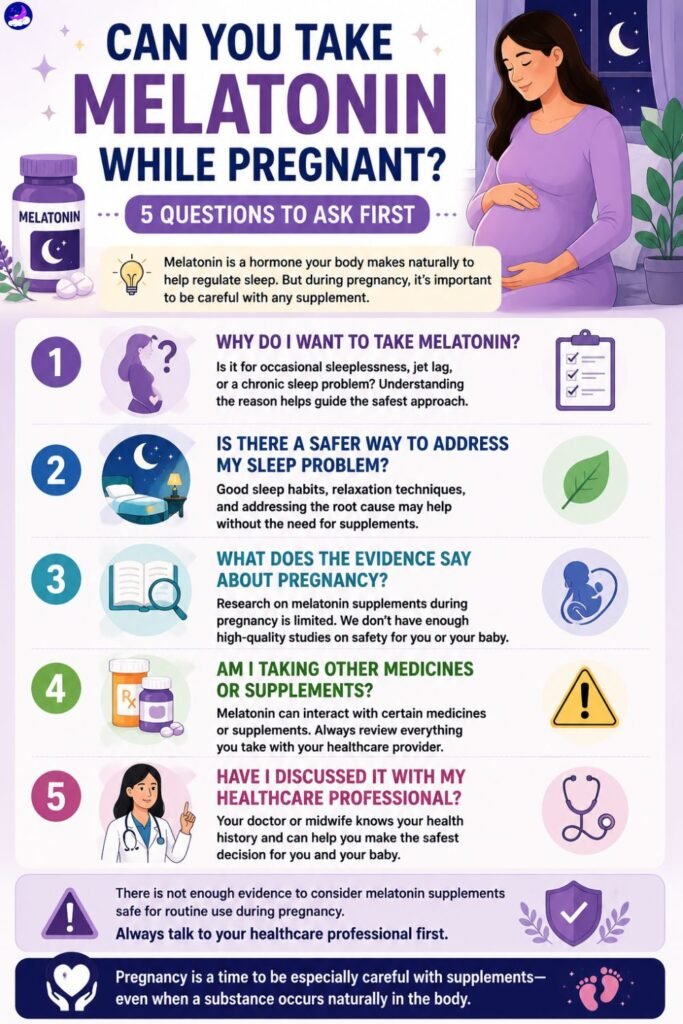
This is understandably one of the first questions many people have.
Current human evidence has not shown a clear increase in miscarriage associated with melatonin exposure. MotherToBaby notes that studies involving melatonin use for infertility have not shown an increased chance of miscarriage.
However, this needs to be interpreted carefully.
Miscarriage is common and can happen for many different reasons. A study showing no increased risk does not prove that an exposure can never contribute to pregnancy loss.
It also matters that some of the available evidence comes from women receiving melatonin in the context of infertility treatment rather than people taking melatonin specifically for sleep during an established pregnancy.
So the most accurate wording is:
Available studies have not demonstrated a clear increased risk of miscarriage, but the evidence is limited.
That is very different from saying:
“Melatonin cannot cause miscarriage.”
The second statement goes beyond what the research can tell us.
Does Melatonin Cause Birth Defects?
The few human studies available have not suggested an increased risk of birth defects, but researchers still do not know whether melatonin could increase that risk because pregnancy-specific data remain limited.
This is an important scientific distinction.
No evidence of an increased risk is not the same as proof that there is no risk.
Every pregnancy has a background chance of birth defects, even when there is no known medication or supplement exposure.
Researchers therefore need sufficiently large and well-designed studies to determine whether an exposure changes that background risk.
So far, the available human evidence is reassuring, but it is not strong enough to provide a guarantee.
Could Melatonin Affect the Baby’s Growth or Development?
This is another area where the evidence has important gaps.
Researchers would ideally want to know whether prenatal melatonin exposure affects outcomes such as:
- Birth weight
- Fetal growth
- Preterm birth
- Stillbirth
- Newborn health
- Child development
- Long-term learning and behavior
For some of these outcomes, the problem is not that research has demonstrated no risk.
There simply have not been enough studies to answer the question.
For example, MotherToBaby notes that studies have not been done to determine whether melatonin supplements increase the chance of low birth weight. It also states that studies have not been done to determine whether prenatal melatonin exposure affects later behavior or learning.
This is an important concept:
An absence of evidence is not the same as evidence of absence.
It would therefore be wrong to say:
“Melatonin harms fetal development.”
But it would also be premature to say:
“Melatonin has been proven to have no effect on fetal development.”
For several long-term outcomes, we simply do not have enough data.
Also Read: Melatonin for Older Adults | Melatonin for Kids.
What About Preterm Birth and Other Pregnancy Complications?
This area is particularly interesting because some studies have investigated melatonin for conditions that can complicate pregnancy.
MotherToBaby describes a study in women with polycystic ovary syndrome who received 3 mg of melatonin along with other treatment.
The study suggested possible improvements in several pregnancy outcomes, including preeclampsia, fetal growth restriction, preterm birth, and stillbirth.
However, this was a specific clinical population receiving melatonin alongside other treatment, so the findings cannot be used to recommend routine melatonin supplementation during pregnancy.
This is an important example of why research context matters.
A supplement being studied as part of a medical intervention for a specific high-risk pregnancy is very different from taking an over-the-counter melatonin product to help with ordinary pregnancy insomnia.
The results of one cannot automatically be applied to the other.
Also Read: Our Melatonin Dosage Guide | Melatonin Side Effects | Melatonin Drug Interactions
What About the Baby’s Brain and Circadian Development?
Researchers are particularly interested in melatonin because the developing fetus is exposed to the mother’s biological timing signals.
Maternal melatonin crosses the placenta, and this provides the developing fetus with information about the mother’s light-dark cycle.
Animal research has also suggested that melatonin may have antioxidant and neuroprotective effects during development.
This has led to research into whether melatonin could potentially be useful in pregnancies at risk of complications such as preterm birth or fetal brain injury.
But this is where it is essential to separate research interest from clinical recommendation.
The fact that researchers are studying melatonin as a possible therapeutic agent does not mean pregnant people should take it on their own.
A Cochrane review evaluating melatonin for fetal neuroprotection found insufficient evidence to guide clinical practice.
So even if the biological theory is interesting, clinical evidence still matters more than biological plausibility.
What Do Animal Studies Tell Us?
Animal studies have generated some of the questions surrounding prenatal melatonin exposure.
Researchers have investigated melatonin in pregnant animals to understand its effects on fetal development, inflammation, oxidative stress, and the developing nervous system.
Some experimental studies have reported potentially beneficial effects, while other findings have raised questions that researchers continue to investigate.
But these findings cannot be translated directly into human pregnancy risk.
The dose, timing, metabolism, pregnancy biology, and developmental stages can differ substantially between species.
For that reason, animal studies should mainly be viewed as evidence that helps researchers decide which questions need to be studied in humans, rather than as proof that a particular outcome will happen in a pregnant person.
Could Melatonin Help With Pregnancy-Related Insomnia?
Sleep problems are common during pregnancy.
But pregnancy-related insomnia can have many causes, including:
- Physical discomfort
- Hormonal changes
- Anxiety or stress
- Heartburn or reflux
- Frequent urination
- Restless legs symptoms
- Changing sleep schedules
- Difficulty finding a comfortable sleeping position
That makes pregnancy insomnia different from simply having low melatonin.
The evidence specifically supporting melatonin as a treatment for pregnancy-related insomnia is limited. The 2022 human scoping review found no pregnancy study in which insomnia was the primary outcome.
So although melatonin may seem like a logical option, research has not established it as a routine treatment for insomnia during pregnancy.
Depending on the cause, non-drug approaches and treatment of the underlying problem may be more appropriate than adding a supplement.
If sleep problems persist, it may be more useful to identify what is actually disturbing sleep rather than automatically reaching for melatonin.
Is Melatonin Better Than Sleeping Pills During Pregnancy?
There is no simple answer.
It can be tempting to think:
“Melatonin is natural, so it must be safer than a sleeping medicine.”
That conclusion is not justified.
“Natural” does not automatically mean safe during pregnancy.
Different prescription and non-prescription medicines have different amounts of pregnancy-specific evidence. In some situations, a medication may actually have a better-established safety profile during pregnancy than a supplement that has been studied very little.
That does not mean that a particular sleeping medicine should be preferred.
It means that the decision should be based on the specific condition, pregnancy stage, available evidence, and individual circumstances.
Melatonin should not be treated as a risk-free alternative simply because it is sold as a supplement.
What If I Took Melatonin Before I Knew I Was Pregnant?
This is an especially important question because pregnancy is often recognized several weeks after conception.
If you took melatonin before realizing you were pregnant, do not assume that harm has occurred.
The few human studies available so far have not suggested an increased risk of birth defects, and studies involving melatonin use for infertility have not shown an increased miscarriage risk.
That is reassuring, but it is not the same as proving that every exposure is risk-free.
The sensible next step is to tell your healthcare professional about the exposure.
If possible, provide:
- The product name
- The amount taken
- How often you took it
- Approximately when you took it
- How many weeks pregnant you may have been
This information can help your healthcare professional put the exposure into context.
And if you take other prescribed medicines, do not abruptly stop them because of a pregnancy concern without medical advice.
Should You Stop Melatonin After Finding Out You’re Pregnant?
There is no universal instruction that applies to every person.
Once pregnancy is known, the risk-benefit discussion changes.
If melatonin was being used for occasional sleep difficulty, a healthcare professional may approach the situation differently from someone taking it for a specific medical reason under supervision.
The decision can depend on:
- Why melatonin was being used
- How long it has been used
- The pregnancy stage
- Other medicines
- Medical conditions
- The specific product and ingredients
This is one situation where it is better to ask a healthcare professional than to rely on a general internet rule.
Also Read: When to take Melatonin | Can you take Melatonin everynight? | Melatonin Addiction
What About Melatonin Gummies During Pregnancy?
A gummy is still a supplement.
Some melatonin gummies contain additional ingredients such as:
- Sugar
- Sweeteners
- Flavors
- Coloring agents
- Herbal ingredients
- Other active ingredients
That makes the ingredient list particularly important during pregnancy.
If you are considering any supplement, check everything listed in the ingredients panel, not just the amount of melatonin shown on the front of the package.
This is particularly relevant because supplements are regulated differently from prescription medicines, and pregnancy-specific evidence for many supplement products is limited.
[Also Read: Melatonin Gummies vs Tablets]
What Does the Evidence NOT Tell Us Yet?
The biggest limitation in the evidence is not a clear signal of harm.
It is how little pregnancy-specific research we actually have.
Researchers still do not have enough high-quality data about:
- Routine melatonin use for insomnia during pregnancy
- Large numbers of pregnant participants
- Different doses and formulations
- Exposure during different stages of pregnancy
- Low birth weight
- Some pregnancy and newborn outcomes
- Long-term child development
- Long-term, regular over-the-counter use
The 2022 scoping review found only 15 human studies across pregnancy and breastfeeding and emphasized the lack of randomized controlled trials examining melatonin specifically for sleep disorders during pregnancy.
More recent research has added information, but it has not filled all of these gaps.
For example, a randomized trial published in 2024 studied melatonin as an adjunct during induction of labor, not as a routine sleep supplement.
The trial did not show a reduction in cesarean birth and reported differences in some neonatal outcomes, but the study was stopped early and its design does not allow the results to establish the safety or risk of everyday melatonin use for pregnancy-related insomnia.
This is exactly why pregnancy research needs careful interpretation.
A study can provide useful information without answering the question a reader is actually asking.
Also Read: Can you overdose on Melatonin | Melatonin gummies vs Tablets
What Should You Discuss With Your Healthcare Professional?
If you are considering melatonin during pregnancy, a short conversation with your healthcare professional can help put the decision into context.
You may want to discuss:
- Why you want to use melatonin
- How long you have been having sleep problems
- Your current medicines
- Other supplements you take
- How far along the pregnancy is
- Any medical conditions
- The exact melatonin product
- The amount and frequency of use
- Any previous side effects
This is not about making melatonin sound dangerous.
It is about recognizing that pregnancy changes the standard for evidence and caution.
A supplement that might be reasonable for an otherwise healthy non-pregnant adult may need a different risk-benefit assessment during pregnancy.
Also Read: Melatonin and Weird Dreams | Melatonin Myths and Facts | Benefits of Melatonin beyond sleep.
Frequently Asked Questions
Is melatonin safe during pregnancy?
The available human evidence is reassuring but limited. The few human studies available have not suggested an increased chance of birth defects, and studies involving melatonin use for infertility have not shown an increased chance of miscarriage. However, researchers do not yet have enough evidence to establish complete safety during pregnancy.
Can melatonin cause miscarriage?
Current studies have not shown an increased risk of miscarriage associated with melatonin exposure, although the evidence is limited and much of it comes from infertility-related use rather than routine treatment of pregnancy-related insomnia.
Does melatonin cause birth defects?
The few human studies available have not suggested an increased risk of birth defects, but researchers still do not know whether melatonin could increase that risk because the pregnancy data remain limited.
What if I took melatonin before knowing I was pregnant?
Do not assume that harm has occurred. Tell your healthcare professional what product you used, how much you took, how often you took it, and approximately when. Current human evidence has not identified a clear major safety signal.
Can melatonin help pregnancy-related insomnia?
It is possible that melatonin could affect sleep, but there is not enough pregnancy-specific evidence to recommend it routinely for insomnia during pregnancy. The 2022 human scoping review found no included pregnancy study in which insomnia was the primary outcome.
Should I stop taking melatonin if I become pregnant?
There is no universal rule. Discuss the situation with your healthcare professional, who can consider why you were taking it, your pregnancy stage, other medicines, medical conditions, and the specific product.
Is melatonin safer than sleeping pills during pregnancy?
Not automatically. Natural does not mean risk-free, and some medicines have more pregnancy-specific safety information than supplements. Treatment decisions should be individualized.
Bottom Line: What Does the Research Really Say?
Your body naturally produces melatonin during pregnancy, and maternal melatonin appears to play important roles in circadian signaling and pregnancy biology.
But that does not mean that taking melatonin supplements during pregnancy is automatically safe or necessary.
The human evidence available so far is reassuring in some respects. The few human studies have not suggested an increased risk of birth defects, and studies of melatonin use for infertility have not shown an increased risk of miscarriage.
At the same time, the evidence remains limited. We do not have enough large, pregnancy-specific studies to establish the safety of routine supplemental melatonin for insomnia, particularly across different amounts, formulations, pregnancy stages, and long-term child outcomes.
So the most scientifically honest answer is:
Current human evidence has not established that melatonin supplementation causes major pregnancy harms, but it is also not sufficient to establish that supplemental melatonin is proven safe during pregnancy.
If you are considering melatonin while pregnant, discuss it with your healthcare professional.
And if you took melatonin before realizing you were pregnant, do not panic or assume that the pregnancy has been harmed. Instead, share the exposure details with your healthcare professional so they can assess the situation in context.
References
- MotherToBaby. Melatonin. May 1, 2026.
MotherToBaby — Melatonin and Pregnancy - Vine T, Brown GM, Frey BN. Melatonin use during pregnancy and lactation: A scoping review of human studies. Brazilian Journal of Psychiatry. 2022;44(3):342–348.
PubMed — Melatonin Use During Pregnancy and Lactation - Nakamura Y, et al. Melatonin and pregnancy in the human. Reproductive Toxicology.
PubMed — Melatonin and Pregnancy in Humans - McCarthy R, et al. Melatonin for women in pregnancy for neuroprotection of the fetus. Cochrane Database of Systematic Reviews. 2016.
PubMed — Melatonin for Fetal Neuroprotection - Quach D, et al. A double-blind, randomized, placebo-controlled trial of melatonin as an adjuvant agent for induction of labor: The MILO trial. Acta Obstetricia et Gynecologica Scandinavica. 2024.
MILO Trial — Melatonin During Induction of Labor - Domínguez Rubio AP, et al. Melatonin prevents experimental preterm labor and increases offspring survival. Journal of Pineal Research. 2014.
PubMed — Experimental Melatonin and Preterm Labor Study - Lee JY, et al. Administration of melatonin for prevention of preterm birth and fetal brain injury associated with premature birth in a mouse model. 2019.
PubMed — Prenatal Melatonin Animal Study