Melatonin is not generally considered addictive. Current evidence does not show the typical pattern of craving, loss of control, physical dependence, or escalating tolerance seen with many addictive medicines. However, some people may feel reliant on melatonin for sleep, especially if an underlying sleep problem is still present.
Table of Contents
What Does “Addiction” Actually Mean?
The word addiction is often used loosely.
If someone takes melatonin every night, they may say, “I’m addicted to it.” But regular use alone does not mean addiction. So, another question arise: if you don’t take melatonin after using it, then will you not fall asleep?
Then the question to be asked is: “Is Melatonin Addictive Supplement ?”
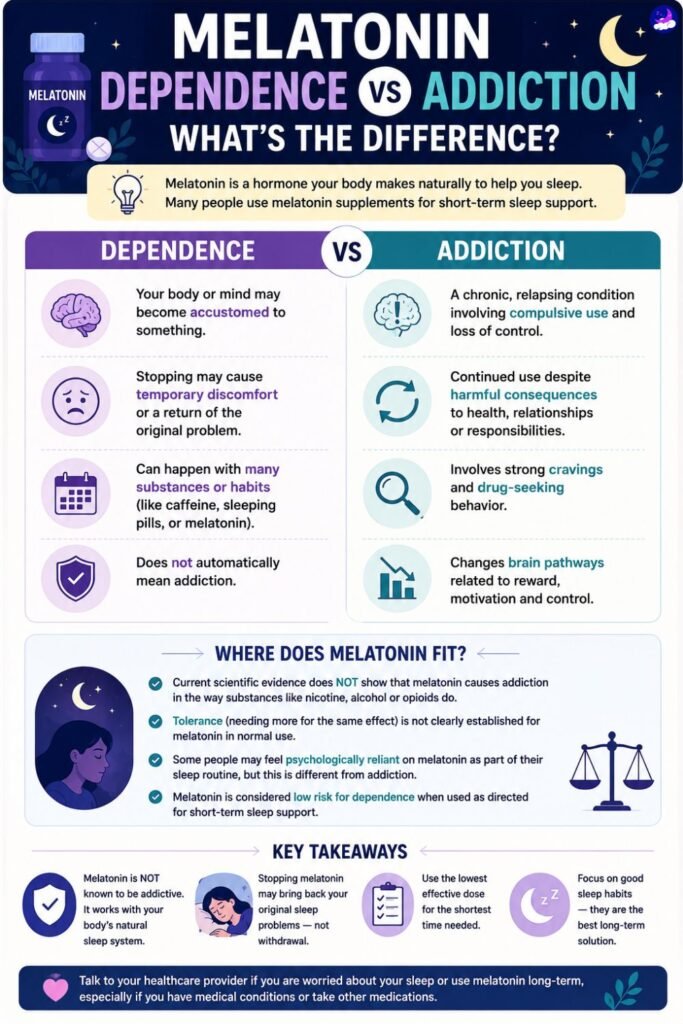
In medicine, addiction involves a pattern of compulsive use and loss of control. A person may continue using a substance despite knowing that it is causing harm, experience strong cravings, or repeatedly try to stop and find that they cannot.
Common features of addiction include:
- Compulsive use
- Craving
- Loss of control
- Continued use despite harm
- Repeated difficulty stopping despite wanting to stop
Simply taking something every night does not meet that definition.
For example, a person may take melatonin at bedtime because they believe it helps them sleep. They may prefer not to skip it, but that is very different from compulsively seeking the substance, taking increasingly larger amounts, or continuing despite serious harm.
This distinction matters because habitual use and addiction are not the same thing.
Addiction vs Dependence vs Tolerance
These terms are often mixed together, but they describe different things.
| Term | What it means |
|---|---|
| Addiction | Compulsive use, craving, loss of control, and continued use despite harm |
| Physical dependence | The body adapts to a substance and may produce symptoms when it is stopped |
| Tolerance | Increasing amounts are needed to produce the same effect |
| Withdrawal | Symptoms that occur after stopping a substance the body has adapted to |
| Psychological reliance | Feeling that you need something in order to sleep or feel comfortable |
A person can experience dependence without addiction, and someone can develop a strong psychological reliance on a bedtime routine without being physically dependent on the substance involved.
This is particularly important with melatonin.
Someone might say:
“I can’t sleep unless I take melatonin.”
That tells us they are having difficulty sleeping without it. It does not, by itself, prove addiction or physical dependence.
Why Melatonin Is Different From Many Sleeping Medicines
Melatonin is different from many traditional sleeping medicines because it is a hormone naturally produced by the body.
Its role is closely linked to the body’s biological night and circadian timing. Melatonin supplements can add to that signal, depending on when they are taken.
Many prescription sedative or hypnotic medicines work through different pathways and can have a much more direct effect on brain activity.
Some medicines, particularly certain benzodiazepines and other sedative-hypnotic drugs, have well-established risks of tolerance, physical dependence and withdrawal when used regularly.
That does not mean every prescription sleeping medicine is addictive, or that melatonin is completely risk-free.
The pharmacology is simply different.
Melatonin should therefore not be described as “just another sleeping pill.”
Also Read: Our Melatonin Guide | Your Body's Natural Melatonin Production
Does Melatonin Cause Physical Dependence?
Current evidence has not demonstrated the typical physical dependence pattern associated with many dependence-forming drugs.
Clinical studies have examined what happens when melatonin is discontinued after regular use. In studies of prolonged-release melatonin, researchers have not found a typical withdrawal syndrome or evidence of a progressive need for more of the substance. (PubMed)
One longer-term study followed adults with insomnia who used prolonged-release melatonin for up to 12 months. The researchers found no evidence of tolerance, withdrawal symptoms, rebound insomnia, or suppression of the body’s own melatonin production after discontinuation. (PubMed)
That is reassuring, but it does not prove that every person will have exactly the same experience.
Long-term melatonin research remains less extensive than research on many established medicines. NCCIH also notes that while melatonin appears relatively safe in the short term, its long-term safety has not been fully established. (NCCIH)
So the most accurate conclusion is:
Melatonin has not been shown to produce the classic physical dependence pattern seen with many sedative drugs, but very long-term effects are not completely understood.
Also Read: Melatonin for Older Adults | Melatonin for Pregnant Women | Melatonin for Kids.
Does Melatonin Cause Tolerance?
Tolerance means that the same amount of a substance gradually produces less of an effect, leading someone to increase the dose to get the previous result.
For example, a person might initially need one tablet but later feel that they need two or three tablets to get the same effect.
That is a familiar concern with some sedative medicines.
With melatonin, however, research has not demonstrated a clear, classic tolerance pattern.
The prolonged-release melatonin study mentioned earlier found no evidence of tolerance during up to 12 months of treatment. (PubMed)
That does not mean someone will never feel that melatonin is “not working as well.”
Sleep itself is influenced by many factors.
Stress, changing schedules, illness, caffeine, alcohol, travel, poor sleep habits and an untreated sleep disorder can all make sleep more difficult.
A person may therefore interpret worsening sleep as “melatonin tolerance” when something else has changed.
This is why increasing the dose should not automatically be the response to poorer sleep.
More melatonin is not necessarily better.
Also Read: Our Melatonin Dosage Guide | Melatonin Side Effects | Melatonin Drug Interactions
Can You Get Addicted to Taking Melatonin Every Night?
Taking melatonin every night and being addicted to melatonin are not the same thing.
Some people use melatonin regularly because they have a consistent reason for taking it. Others gradually develop a strong association between taking melatonin and going to sleep.
For example, someone might begin thinking:
“I took melatonin, so now I can sleep.”
Over time, this can become part of a powerful bedtime routine.
If they forget their melatonin one night, they may become anxious and start worrying that they will not sleep.
That experience can feel like dependence.
But it may actually be psychological reliance or conditioned sleep behavior, rather than physical addiction.
Other reasons someone may feel unable to sleep without melatonin include:
- An untreated sleep problem
- An irregular sleep schedule
- Circadian timing problems
- Anxiety about sleep
- A strong bedtime habit
- Expectations that melatonin is necessary for sleep
The experience is real even if the underlying mechanism is not addiction.
Also Read: Foods Rich in Melatonin | Blue Light and Melatonin
What Happens If You Stop Taking Melatonin?
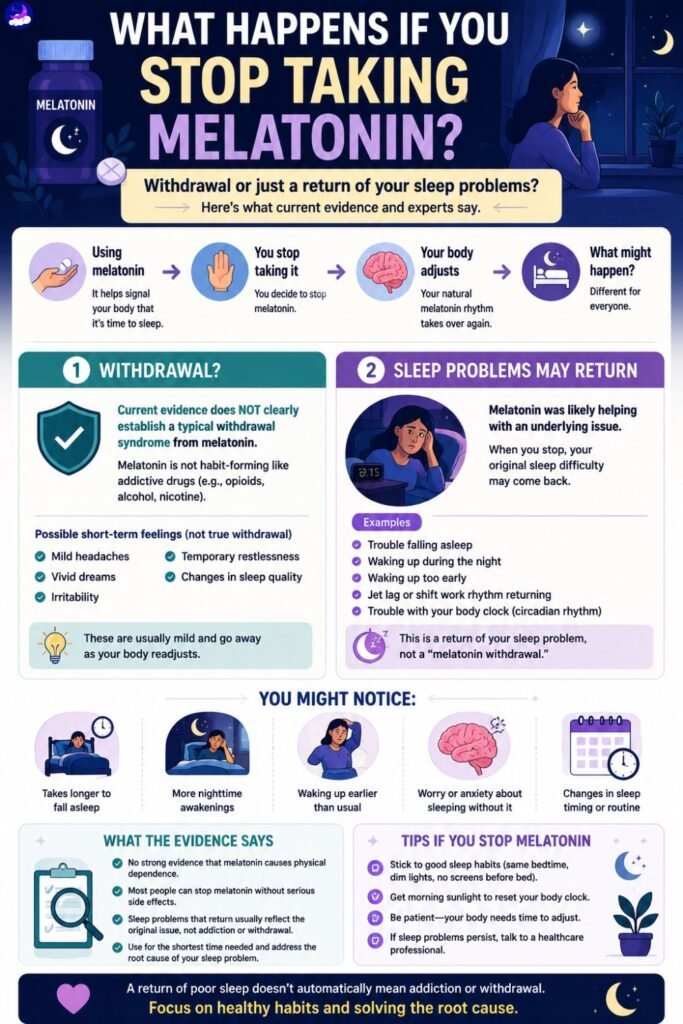
For most adults, stopping melatonin is not expected to produce a classic withdrawal syndrome.
However, that does not mean everyone will notice absolutely no change.
Imagine that melatonin has been helping someone fall asleep more easily.
They stop taking it.
If their original sleep problem is still present, they may have difficulty sleeping again.
That can easily lead to the thought:
“Melatonin withdrawal is causing my insomnia.”
But there is another possibility.
The original problem may simply have returned.
This distinction is one of the most important points in understanding melatonin.
If melatonin was helping someone with a sleep problem, stopping it may make that problem more noticeable. A return of insomnia is not automatically evidence of withdrawal.
Studies of prolonged-release melatonin have not found evidence of a typical withdrawal syndrome after discontinuation. (PubMed)
Does Melatonin Cause Withdrawal Symptoms?
Current evidence has not demonstrated a typical withdrawal syndrome with melatonin comparable to that seen with some sedative or hypnotic medicines.
In studies where melatonin treatment was stopped, researchers have not found the characteristic pattern of withdrawal symptoms associated with dependence-forming drugs.
For example, a long-term study of prolonged-release melatonin found no withdrawal symptoms after treatment was discontinued. (PubMed)
Another study in older adults also found no evidence of withdrawal effects or rebound insomnia after stopping prolonged-release melatonin. (PubMed)
Still, these studies do not mean that every person will feel exactly the same after stopping.
A person may notice:
- More difficulty falling asleep
- Anxiety about sleeping
- A change in bedtime routine
- Return of the sleep problem that existed before melatonin
- Less confidence about sleeping without the supplement
These experiences should not automatically be labeled withdrawal.
True Withdrawal vs Return of the Original Problem
Withdrawal occurs when the body has adapted to a substance and stopping it produces a characteristic withdrawal syndrome.
Return of the original sleep problem means the condition that existed before treatment becomes noticeable again.
The two can feel similar to the person experiencing them.
But medically, they are different.
Can You Get Rebound Insomnia After Stopping Melatonin?
Rebound insomnia means that sleep becomes temporarily worse than it was before treatment after a sleep medicine is stopped.
This is well recognized with some sedative and hypnotic medicines.
Melatonin has not shown the same typical rebound-insomnia pattern.
In a study of prolonged-release melatonin used for up to 12 months, researchers found no evidence of rebound insomnia after discontinuation. (PubMed)
Similarly, a randomized study in adults aged 55 and older found no evidence of rebound insomnia after stopping prolonged-release melatonin. (PubMed)
That is reassuring.
However, if someone already has insomnia, stopping a treatment that was helping them may still result in poorer sleep.
That does not necessarily mean melatonin caused the problem.
It may simply mean that the underlying sleep difficulty is still there.
Why Do Some People Feel They Cannot Sleep Without Melatonin?
This is probably the most misunderstood part of the subject.
A person can genuinely feel that they need melatonin to sleep without being addicted to it.
Several things may contribute.
Psychological Association
If you have taken melatonin every night for months, your brain may begin to associate the supplement with bedtime and sleep.
Bedtime Habit
Taking something at the same time every night can become part of a familiar routine.
Breaking that routine may feel uncomfortable even when there is no physical dependence.
Anxiety About Sleep
People with insomnia often worry about not sleeping.
If melatonin has become part of their strategy, they may become anxious when it is unavailable.
That anxiety itself can make falling asleep harder.
The Original Sleep Problem
Perhaps melatonin never solved the underlying issue.
It simply helped make sleep easier.
If the original problem is still present, stopping melatonin may reveal it again.
Circadian Timing
Someone with a delayed sleep schedule, shift work, jet lag or another circadian problem may still have a timing issue that needs to be addressed.
So when someone says:
“I cannot sleep without melatonin,”
the right response is not to dismiss them.
The better question is:
“What was making sleep difficult in the first place?”
Is Melatonin Less Addictive Than Sleeping Pills?
It is reasonable to say that melatonin has a different dependence profile from many traditional sedative medicines.
Certain benzodiazepines and other sedative-hypnotic medicines can produce tolerance and physical dependence, and stopping them abruptly after regular use can cause clinically important withdrawal symptoms.
Melatonin does not appear to produce the same typical pattern.
However, avoid turning this into:
“Melatonin is safe and sleeping pills are dangerous.”
That would be an oversimplification.
Prescription sleep medicines are a broad group. Their risks vary depending on the drug, dose, duration of treatment and the individual taking it.
Likewise, melatonin is not completely risk-free.
The better conclusion is:
Melatonin generally does not have the same addictive and dependence-forming profile as many sedative-hypnotic medicines, but it should still be used thoughtfully.
What Does Long-Term Research Tell Us?
This is where we need to be particularly careful.
The evidence available so far is generally reassuring, but it is not extensive enough to say that continuous melatonin use for many years has been proven completely safe.
Some studies have followed adults for up to a year or longer, but the evidence base becomes much thinner as follow-up extends further.
The results have generally not shown a major signal of physical dependence, tolerance or withdrawal.
For example, the 6–12 month prolonged-release melatonin study found no evidence of tolerance, withdrawal, rebound insomnia or suppression of endogenous melatonin production. (PubMed)
But researchers still have less information about very long-term continuous use in healthy adults than they would like.
NCCIH similarly states that melatonin appears relatively safe for short-term use, while long-term safety has not been established. (NCCIH)
This is an important distinction:
Reassuring evidence is not the same as proof of lifelong safety.
If someone has been taking melatonin regularly for years, it makes sense to occasionally reassess the reason for using it rather than simply assuming that it must continue indefinitely.
What About Children and Teenagers?
Children and teenagers should not be treated simply as smaller adults when it comes to melatonin.
There is some evidence that melatonin can help certain sleep problems in children and adolescents, but long-term safety data are much more limited than in adults. NCCIH notes that there are uncertainties about prolonged use in young people, including possible effects related to hormonal development. (NCCIH)
That does not mean melatonin is known to be dangerous for children.
It means the evidence is not strong enough to support casual long-term use without considering why the child is having trouble sleeping.
Parents should therefore discuss regular melatonin use with a healthcare professional, particularly when it is being used for an extended period.
[Also Read: Too Much Melatonin? Sleep Gummies in Kids]
Do You Need to Taper Melatonin?
Melatonin is not generally treated like medicines that require tapering to prevent a withdrawal syndrome.
There is therefore no universal tapering schedule that every person needs to follow.
In clinical studies, people have stopped prolonged-release melatonin without evidence of a typical withdrawal syndrome or rebound insomnia. (PubMed)
That said, your individual situation still matters.
If you have been using melatonin for a long time because of persistent insomnia, stopping it may make the underlying sleep problem more obvious.
In that situation, the useful question is not simply:
“How do I taper melatonin?”
It is:
“What can I do about the sleep problem that made me start taking melatonin?”
If you are worried about stopping after prolonged use, particularly if you take other medicines or have another medical condition, discussing the change with a healthcare professional is sensible.
Also Read: When to take Melatonin | Can you take Melatonin everynight?
When Should You Talk to a Doctor?
You do not need to see a doctor simply because you take melatonin regularly.
However, medical advice is worth considering if:
- You feel unable to sleep without melatonin
- You have used it for a prolonged period and are worried about stopping
- Your insomnia is persistent
- You are repeatedly increasing the amount you take
- You have significant daytime sleepiness
- You take several prescription medicines
- You have an important medical condition
- You are pregnant or breastfeeding
- You are considering regular melatonin for a child
The goal is not to frighten you away from melatonin.
It is to make sure that melatonin is addressing an appropriate problem and not masking another one.
If insomnia continues despite having enough opportunity to sleep, the underlying condition may need proper evaluation. For chronic insomnia, behavioral treatment such as cognitive behavioral therapy for insomnia (CBT-I) has a stronger evidence base than simply relying on a supplement. (NCCIH)
Common Myths About Melatonin Addiction
Myth: If I take melatonin every night, I am addicted.
Reality: Regular use alone does not meet the definition of addiction. Addiction involves patterns such as compulsive use, loss of control and continued use despite harm.
Myth: My body becomes dependent on melatonin because it is a hormone.
Reality: Current evidence has not demonstrated the classic physical dependence pattern associated with many dependence-forming drugs.
Myth: I need a higher dose because I have become tolerant.
Reality: There is no clear evidence of a typical tolerance pattern with melatonin. Poorer sleep can have many other causes, and increasing the dose is not automatically the answer.
Myth: Stopping melatonin causes dangerous withdrawal.
Reality: Melatonin is not generally associated with a classic withdrawal syndrome. Studies of prolonged-release melatonin have not found typical withdrawal symptoms after discontinuation. (PubMed)
Myth: If I cannot sleep after stopping melatonin, I am addicted.
Reality: Your original sleep problem may have returned, or you may have become psychologically accustomed to your bedtime routine. That is different from addiction.
Myth: Melatonin is completely harmless because the body makes it naturally.
Reality: Melatonin appears relatively safe for short-term use in many adults, but long-term safety is not fully established, and supplements can interact with medicines or have other risks. (NCCIH)
Also Read: Can you overdose on Melatonin | Melatonin gummies vs Tablets
How to Stop Relying on Melatonin for Sleep
If you want to stop using melatonin, the most useful approach is to look at why you started taking it.
If the original problem was occasional difficulty sleeping, you may find that your sleep improves once the situation that triggered the problem has passed.
If you have developed chronic insomnia, simply removing melatonin may not solve the problem.
Instead, consider the factors that support normal sleep:
- Keep a consistent sleep schedule
- Create a comfortable sleep environment
- Use light at appropriate times
- Develop a predictable bedtime routine
- Address anxiety around sleep
- Look for an irregular or delayed sleep schedule
- Consider whether an underlying sleep disorder is present
You do not need to turn this into a complicated sleep program.
The first step is understanding what is actually interfering with your sleep.
If chronic insomnia is the problem, evidence-based treatment such as CBT-I may be more useful than continually adding or increasing sleep supplements. (NCCIH)
Also Read: Melatonin For Jetlag | Melatonin For Shift workers
Frequently Asked Questions
Can melatonin become addictive?
Current evidence does not show melatonin to have the typical addictive profile associated with drugs that cause compulsive use, craving and loss of control. Regular use alone does not mean addiction.
Can you become physically dependent on melatonin?
Current evidence has not demonstrated the classic physical dependence pattern associated with many sedative or dependence-forming medicines. However, long-term research is not extensive enough to prove that every possible effect is known.
Does melatonin cause tolerance?
There is no clear evidence of a typical tolerance pattern in which people progressively need larger amounts to obtain the same effect. One longer-term study found no evidence of tolerance during up to 12 months of prolonged-release melatonin treatment. (PubMed)
Can you stop melatonin suddenly?
Melatonin generally does not require a routine taper to prevent withdrawal. Studies of prolonged-release melatonin have not found a typical withdrawal syndrome after discontinuation. (PubMed)
Will I get withdrawal symptoms if I stop melatonin?
A classic withdrawal syndrome is not generally expected. If your sleep becomes worse after stopping, your original sleep problem may have returned rather than the body going through withdrawal.
Can melatonin cause rebound insomnia?
Research has not shown the typical rebound-insomnia pattern associated with some sedative medicines. However, someone with an existing sleep problem may notice poorer sleep after stopping because the original problem is still present. (PubMed)
Can I take melatonin every night without becoming addicted?
Regular nightly use does not automatically mean addiction. However, if you need melatonin every night for a prolonged period, it is worth reviewing why you still need it and whether an underlying sleep problem should be addressed.
Is melatonin safer than sleeping pills?
Melatonin has a different dependence profile from many traditional sedative-hypnotic medicines and does not appear to produce the same typical pattern of addiction and withdrawal. But it is not correct to say that melatonin is automatically safer than every sleeping medicine. The risks depend on the specific medicine and the person taking it.
[Also Read: Melatonin Drug Interactions]
Bottom Line
Melatonin is not generally considered an addictive substance. Current evidence does not show the typical pattern of compulsive use, loss of control, physical dependence, or escalating tolerance associated with many dependence-forming sedative medicines.
Someone may still feel that they cannot sleep without melatonin because of a strong bedtime habit, anxiety about sleep, or an underlying sleep problem. That experience is real, but it does not necessarily mean addiction.
Research on prolonged-release melatonin has found no evidence of typical tolerance, withdrawal symptoms, rebound insomnia, or suppression of the body’s own melatonin production after discontinuation in the studies available. (PubMed)
At the same time, evidence on very long-term continuous use remains limited. NCCIH considers melatonin relatively safe for short-term use in many people but notes that long-term safety has not been fully established. (NCCIH)
So if you have been taking melatonin regularly, there is usually no reason to panic about addiction.
Also Read: Melatonin and Weird Dreams | Melatonin Myths and Facts | Benefits of Melatonin beyond sleep.
Instead, ask a more useful question:
Why am I taking melatonin, and is it still helping me?
If you have persistent insomnia or another sleep problem, addressing the underlying cause may be more useful than simply continuing melatonin indefinitely.
Regular use is not automatically addiction.
And needing help with sleep does not mean you have done anything wrong.
The goal is simply to understand what your sleep needs—and whether melatonin is still the right tool for the job.
[Also Read: Melatonin Explained]
[Also Read: Can You Take Melatonin Every Night?]
[Also Read: How Melatonin Works]
References
- Wade AG, Ford I, Crawford G, et al. Prolonged-release melatonin for insomnia – an open-label long-term study of efficacy, safety, and withdrawal. Current Medical Research and Opinion. 2011;27(9):1943–1951.
PubMed — Long-Term Melatonin, Tolerance and Withdrawal Study - Wade AG, Crawford G, Ford I, et al. Prolonged-release melatonin improves sleep quality and morning alertness in insomnia patients aged 55 years and older and has no withdrawal effects. Sleep Medicine. 2007;8(7–8):713–720.
PubMed — Melatonin and Withdrawal Effects in Older Adults - Besag FMC, Vasey MJ, Lao KSJ, Wong ICK. Adverse Events Associated With Melatonin for the Treatment of Primary or Secondary Sleep Disorders: A Systematic Review. CNS Drugs. 2019;33:1167–1186.
PubMed — Melatonin Adverse Events Systematic Review - NCCIH. Sleep Disorders and Complementary Health Approaches: Usefulness and Safety. National Center for Complementary and Integrative Health, NIH.
NCCIH — Sleep Disorders and Complementary Health Approaches - NCCIH. Melatonin: What You Need To Know. National Center for Complementary and Integrative Health, NIH.
NCCIH — Melatonin: What You Need To Know - NCCIH. Use of Natural Products by Children: What the Science Says. National Center for Complementary and Integrative Health, NIH.
NCCIH — Melatonin in Children and Adolescents - Menczel Schrire Z, Phillips CL, Chapman JL, et al. Safety of higher doses of melatonin in adults: A systematic review and meta-analysis.
PubMed — Safety of Higher-Dose Melatonin