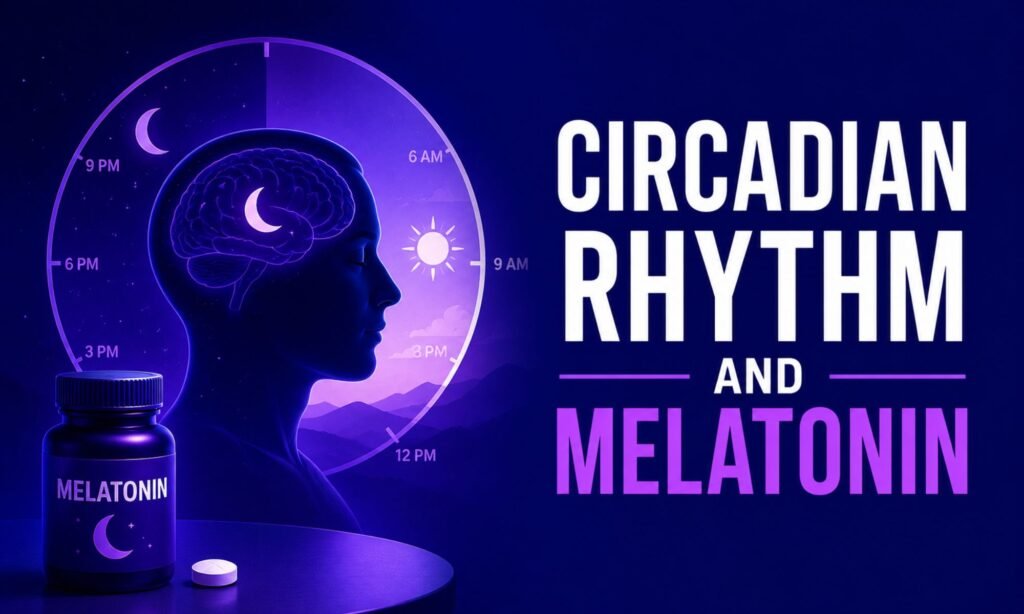
Circadian rhythm and melatonin are closely connected and work together to regulate sleep timing. Your circadian rhythm acts as the body’s internal clock, while melatonin signals that it is biological night. Light exposure helps set this clock and influences when melatonin rises and falls, helping your body know when it is time to sleep and wake up.
Table of Contents
Your body does not decide when to sleep based on tiredness alone. There is another system working in the background, keeping track of the time of day and helping your body know when it should be awake and when it should prepare for sleep.
This system is your circadian rhythm.
Melatonin is closely tied to this rhythm. As evening arrives and light levels fall, the circadian system normally signals the pineal gland to increase melatonin production. Melatonin then provides an important message to the body: it is biological night.
That does not mean melatonin is the body’s master sleep switch. It is one part of a much larger timing system.
Once you understand that relationship, several things that seem confusing about sleep start to make more sense. Why does bright light at night affect sleep?
Why can jet lag leave you wide awake at the wrong time? Why can someone feel exhausted but still not feel sleepy? And why does the timing of melatonin matter?
The answer begins with your body clock.
Also Read: Our Melatonin Guide | Your Body's Natural Melatonin Production
How Are Circadian Rhythm and Melatonin Connected?
The circadian rhythm is the body’s roughly 24-hour timing system. It helps organize sleep and wakefulness, body temperature, hormone activity, alertness, metabolism, and many other processes.
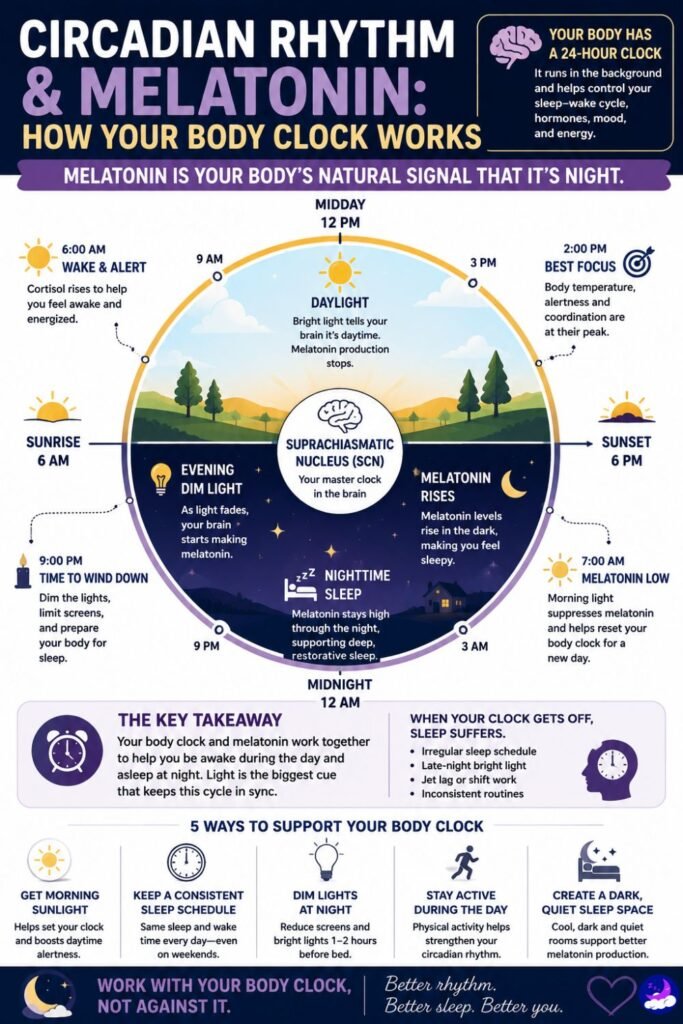
At the center of this system is a small area of the brain called the suprachiasmatic nucleus (SCN). The SCN receives information about light and darkness and uses those signals to help keep the body’s internal clock aligned with the outside world.
As evening approaches and light decreases, the circadian system normally signals the pineal gland to increase melatonin production. Melatonin then acts as an important signal of biological night.
So, although circadian rhythm and melatonin are closely connected, they are not the same thing.
A useful way to picture the relationship is:
Light and darkness → body clock → SCN → melatonin rhythm → nighttime signaling → sleep timing
The body clock provides the timing. Melatonin is one of the signals that helps communicate that timing to the rest of the body.
Also Read: Foods Rich in Melatonin | Blue Light and Melatonin
What Is the Circadian Rhythm?
The word circadian comes from Latin words meaning “about a day.” Your circadian rhythm is a repeating biological pattern that operates on an approximately 24-hour cycle.
Sleep is probably the part of this rhythm you notice most. Your body tends to become more prepared for wakefulness during the day and more prepared for sleep during the biological night.
But the circadian system is doing much more than deciding when you feel sleepy.
It also helps coordinate:
- Body temperature
- Hormone release
- Alertness and attention
- Energy levels
- Metabolism
- Digestion
- Daily patterns of gene activity
- Other physiological processes
This is why calling it simply a “sleep clock” does not really do it justice.
Your body also contains clocks in different tissues and organs. These are sometimes called peripheral clocks. They need to remain reasonably coordinated with the central clock in the brain.
The timing of your circadian rhythm is not exactly the same as everyone else’s, either. Genetics, age, light exposure, daily routines, and other factors can influence whether someone naturally tends toward earlier or later sleep.
So when two people say, “I am a morning person” and “I am a night person,” there can be genuine biological differences behind those preferences.
What Is the Body Clock?
When people talk about the “body clock,” they are usually referring to the biological system that keeps track of time inside the body.
One of its most important components is the suprachiasmatic nucleus, or SCN.
The SCN is a small group of cells located in the hypothalamus. Despite its tiny size, it plays a major role in coordinating circadian timing throughout the body.
One of the most important pieces of information it receives is light.
Your eyes contain specialized cells that detect light and send information to the brain’s circadian system. The SCN uses this information to help determine where the body is in the day-night cycle.
During the day, light helps reinforce daytime timing. As darkness approaches, the pattern of circadian signaling changes.
The SCN then helps coordinate several processes, including the daily rhythm of melatonin production by the pineal gland.
It is helpful to think of the SCN as a central timekeeper, not as a simple sleep switch. It coordinates timing; it does not work in isolation.
Where Does Melatonin Fit Into the Body Clock?
This is the key connection between the two.
The simplified pathway looks like this:
BODY CLOCK
↓
SCN
↓
Signals the pineal gland
↓
Melatonin production changes
↓
Melatonin communicates nighttime information
The pineal gland produces melatonin according to a daily rhythm. Under normal conditions, melatonin levels are low during much of the biological day and rise during the biological night.
That makes melatonin an important output signal of the circadian system.
This point is worth getting right because melatonin is often given too much credit. It does not control the entire circadian rhythm. The circadian system involves the SCN, light input, neural pathways, peripheral clocks, hormones, and many other biological processes.
Melatonin is one important part of that system.
A simple way to remember it is:
The circadian rhythm is the timing system. Melatonin is one of the signals produced by that system.
Why Does Melatonin Rise at Night?
Under normal conditions, melatonin follows a daily pattern.
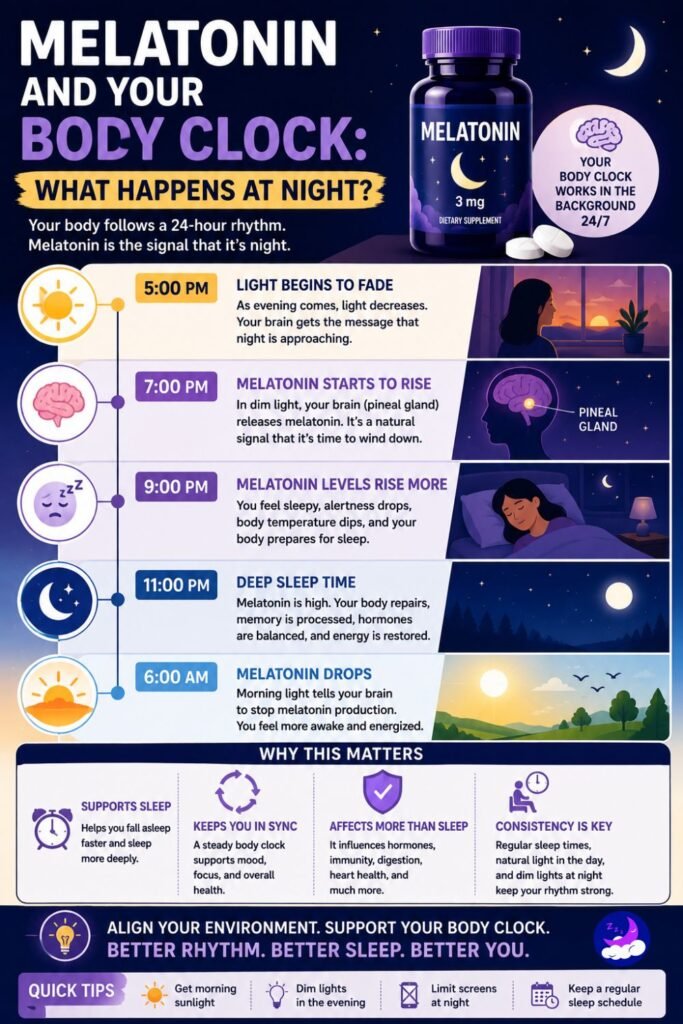
As the evening progresses, the amount of environmental light generally decreases. The circadian system recognizes this changing light-dark environment, and the pineal gland begins producing more melatonin.
Melatonin then remains elevated during much of the biological night before falling again toward morning.
There is no universal clock time when everyone’s melatonin starts rising. Your internal timing can be different from another person’s, and it can also change with age, light exposure, sleep schedule, and other factors.
So rather than thinking, “Melatonin always rises at 9 PM,” it is more accurate to think in terms of biological night.
The general pattern is:
Daytime → lower melatonin
Evening/biological night → rising melatonin
Night → higher melatonin
Morning/daylight → falling melatonin
Morning light then provides a strong signal that helps the circadian system transition toward daytime.
How Does Light Affect Melatonin?
Light is one of the most powerful environmental signals affecting the circadian system.
The pathway is fairly straightforward:
Light enters the eyes → circadian system receives the signal → SCN responds → melatonin production is suppressed
This is one reason light at night can matter for sleep.
But there is an important detail that often gets lost in discussions about phones and screens: not all light exposure has the same effect.
The impact depends on things such as:
- How bright the light is
- When you are exposed to it
- How long the exposure lasts
- How close the light source is
- The characteristics of the light
- Individual sensitivity
For example, a bright light close to your eyes can have a much stronger circadian effect than a dim light across the room.
What about evening light?
Bright light during the evening or biological night can suppress melatonin and, depending on its timing, influence the timing of the circadian clock.
This is why very bright environments late at night are not ideal for someone trying to maintain an earlier sleep schedule.
But it would be an exaggeration to say that using a phone at night automatically causes serious sleep problems.
Real-life exposure is more complicated, and the person’s overall light environment, timing, duration, and individual circumstances all matter.
Why is morning light important?
Morning light is another important piece of the puzzle.
Exposure to light at the appropriate time helps synchronize the circadian system with the 24-hour day. In clinical settings, carefully timed light exposure is also used to help manage some circadian rhythm disorders.
The bigger lesson is simple: your body clock pays attention to when you receive light, not just how much light you receive.
Melatonin Is a Signal of Biological Night
One of the easiest ways to understand melatonin is to think of it as a message about biological night.
It does not simply switch sleep on.
This distinction matters because sleep depends on more than one process.
One of those processes is sleep pressure. The longer you remain awake, the stronger your biological drive for sleep generally becomes.
The circadian system is different. It helps determine when your body is biologically more prepared for sleep or wakefulness.
Melatonin fits into this second system.
You can therefore think about three related but different ideas:
| System | What it does |
|---|---|
| Sleep pressure | Builds during time awake and creates a drive for sleep |
| Circadian rhythm | Organizes biological timing across roughly 24 hours |
| Melatonin | Provides an important signal associated with biological night |
This helps explain a common experience: you can be completely exhausted and still have trouble falling asleep at the time you want.
Why?
Because being tired and being biologically ready for sleep are not always the same thing. A delayed body clock is one possible reason.
Circadian Rhythm vs Melatonin: What Is the Difference?
The two are closely related, but they should not be treated as interchangeable.
| Circadian Rhythm | Melatonin | |
|---|---|---|
| What is it? | A biological timing system | A hormone and nighttime signal |
| Main control | Coordinated by the SCN and other biological clocks | Produced mainly by the pineal gland under circadian control |
| Major influences | Light-dark cycle and other timing cues | Circadian timing and light exposure |
| Role in sleep | Helps determine when the body is biologically prepared for sleep and wakefulness | Signals biological night and supports appropriate timing |
| Effect of light | Light helps synchronize the clock | Light can suppress melatonin production |
| Melatonin supplements | Can influence circadian timing when appropriately timed | Add melatonin directly to the system |
If you remember only one thing from this table, make it this:
Your circadian rhythm is the clock. Melatonin is one of the signals produced by that clock.
Why Timing Matters When Taking Melatonin
This is where melatonin becomes a little more complicated.
People often ask whether melatonin “works” without considering when it is taken. For circadian timing, that question is incomplete.
Melatonin can provide a nighttime signal, but it can also influence the timing of the circadian system. The direction and size of that effect depend, in part, on when melatonin is taken relative to the person’s internal circadian phase.
That means taking melatonin at a random time is not the same as deliberately using it to influence a body clock.
There is a difference between:
- Providing a nighttime signal
- Trying to shift circadian timing
The second is much more dependent on timing.
Research on the human melatonin phase-response relationship shows that melatonin can shift circadian timing differently depending on when it is administered.
This is one reason there is no single timing rule that works for every circadian problem.
Also Read: Our Melatonin Dosage Guide | Melatonin Side Effects | Melatonin Drug Interactions
This article is not intended to provide an individual melatonin treatment schedule. If the problem involves a persistent delayed sleep schedule, unusual work hours, or another circadian disorder, individualized advice may be appropriate.
Can Melatonin Reset Your Body Clock?
The short answer is it can influence your body clock, but it is not a universal reset button.
Melatonin can shift circadian timing when it is given at an appropriate point in the circadian cycle. The timing of the dose matters, and the effect is not simply the same at every hour of the day.
Light matters too.
In fact, appropriately timed light exposure is one of the strongest tools available for shifting circadian timing. Depending on the desired direction of the shift, morning or evening light may be useful.
This is why simply taking melatonin whenever you happen to remember it is not necessarily going to reset a delayed sleep schedule.
The body clock responds to timed biological signals.
Melatonin is one of those signals. Light is another.
Daily routines provide additional timing information.
The most effective approach therefore depends on the actual circadian problem rather than the assumption that everyone needs more melatonin.
Also Read: When to take Melatonin | Can you take Melatonin everynight? | Melatonin Addiction
Circadian Rhythm and Jet Lag
Jet lag is one of the clearest examples of a circadian mismatch.
When you cross several time zones, the clock on the wall changes much faster than your internal body clock.
You may arrive somewhere where it is nighttime, while your brain is still operating according to the daytime of the place you left.
That creates a temporary mismatch between:
- Your internal body clock
- The local clock
- Light exposure
- Sleep timing
- Daily activity
This is why you may feel sleepy in the middle of the local afternoon or wide awake at the local bedtime.
Your body has not yet fully adjusted to the new time zone.
Over time, exposure to the new light-dark cycle helps the circadian system shift toward local time. Melatonin can also influence circadian adaptation when used appropriately, but timing matters.
The important point is that jet lag is not simply a problem of “low melatonin.” It is a timing mismatch between the internal clock and the external environment.
Also Read: Can you overdose on Melatonin | Melatonin gummies vs Tablets
Circadian Rhythm and Shift Work
Shift work creates a different kind of circadian challenge.
Instead of traveling across time zones, a person may repeatedly ask their body to be awake during the biological night and sleep during the biological day.
That can create a conflict between:
Work schedule
Light exposure
Sleep schedule
Internal circadian timing
Melatonin rhythm
For example, a night-shift worker may be working under bright lights at a time when the circadian system is naturally promoting nighttime biology. Later, when the worker goes home and tries to sleep during daylight hours, the environment is sending strong daytime signals.
The result can be a difficult mismatch.
This is also why shift-work sleep problems cannot always be solved simply by taking melatonin.
The underlying issue is often the conflict between the person’s required schedule and the timing signals reaching their circadian system.
Some people adapt better than others, while repeated or rotating shifts can make adaptation particularly difficult.
What Can Disrupt the Circadian Rhythm?
Your circadian system is designed to respond to the environment, so changes in that environment can affect its timing.
Common disruptors include:
- Irregular sleep and wake times
- Jet lag
- Night-shift work
- Bright light at night
- Too little daytime light
- Large differences between weekday and weekend schedules
- Social schedules that conflict with biological timing
Not every late night causes a meaningful circadian problem.
Occasionally sleeping late or staying up later than usual is normal. The concern is more about persistent or repeated misalignment that begins to interfere with sleep, alertness, work, school, or daily life.
That distinction is important because people sometimes describe any poor night’s sleep as a “disrupted body clock.” Circadian disorders are more specific than that.
Also Read: Melatonin for Older Adults | Melatonin for Pregnant Women | Melatonin for Kids.
How Can You Support a Healthy Circadian Rhythm?
You do not need a complicated routine to give your body clock better timing signals.
A few consistent habits can help reinforce the day-night pattern:
- Keep your sleep and wake times reasonably consistent.
- Get regular daytime light exposure, especially during the earlier part of the day when practical.
- Avoid very bright light late at night when you are trying to maintain an earlier sleep schedule.
- Keep your daily routine reasonably predictable.
- Stay physically active regularly.
- Avoid very large differences between weekday and weekend sleep timing.
The goal is not perfection.
Your circadian system is receiving information from your environment every day. Consistent timing gives it clearer information about when daytime begins and when nighttime should occur.
This is much more useful than thinking of circadian health as a long checklist of sleep-hygiene rules.
Also Read: Melatonin For Jetlag | Melatonin For Shift workers
What Happens When Melatonin and the Body Clock Get Out of Sync?
When someone has a circadian timing problem, it is tempting to blame everything on melatonin.
But “low melatonin” is not always the problem.
A person may:
- Feel tired but not sleepy at the desired bedtime
- Become sleepy at an inconvenient time
- Struggle to wake up in the morning
- Feel poorly alert after waking
- Gradually drift toward a later sleep schedule
Consider someone whose natural sleep period has shifted much later. They may lie in bed at 10 PM because they believe they should be sleeping, but their circadian system may not yet be promoting sleep strongly.
By morning, they may have considerable difficulty waking.
The problem is not necessarily that the person has no melatonin. The timing of the entire circadian system may be misaligned with the schedule they are trying to follow.
That is an important distinction.
Sometimes the question is not “How can I make myself sleep?”
It is “Is my body clock expecting me to sleep at this time?”
Frequently Asked Questions
Is melatonin part of the circadian rhythm?
Yes. Melatonin is an important hormonal output of the circadian system. Its daily rise and fall provides information about biological night
Does melatonin control the body clock?
No. Melatonin does not control the entire circadian system. The SCN is the central circadian pacemaker, while melatonin is one of the important signals associated with the system. Melatonin can also influence circadian timing when appropriately timed.
Does light really reduce melatonin?
Yes. Light exposure, particularly during the biological night, can suppress melatonin production. The effect depends on factors such as brightness, timing, duration, wavelength, and individual sensitivity.
Does morning sunlight increase melatonin at night?
Not directly. Morning light helps synchronize the circadian clock with the 24-hour day. When the clock is properly aligned, it can then produce its normal nighttime melatonin rhythm.
Can melatonin reset a delayed sleep schedule?
Melatonin can influence circadian timing, but it is not a guaranteed reset button. Its effect depends partly on when it is taken relative to the person’s internal circadian phase. Light exposure and daily scheduling also matter.
What happens to melatonin during jet lag?
Your melatonin rhythm initially remains more closely aligned with your previous time zone. As your circadian system adjusts to the new light-dark cycle, the timing of melatonin gradually shifts as well.
Does staying up late change your melatonin rhythm?
Repeated late nights can contribute to changes in circadian timing, particularly when combined with late-night light exposure and irregular schedules. The extent of the effect varies between people.
Is low melatonin the reason I cannot sleep?
Not necessarily. Sleep problems can have many causes, including circadian timing, sleep pressure, stress, medical conditions, medications, and sleep disorders. Difficulty sleeping should not automatically be blamed on low melatonin.
Bottom Line
The easiest way to understand the relationship between circadian rhythm and melatonin is to stop thinking of them as two separate systems.
Your circadian rhythm is the body’s timing system.
The SCN is the central clock that helps coordinate that system.
Light is one of the strongest signals that keeps the clock aligned with the outside world.
As biological night approaches, the circadian system normally promotes an increase in melatonin, which provides an important signal that it is nighttime.
That signal helps coordinate nighttime biology, but melatonin does not simply switch sleep on.
This is also why timing matters. Light exposure, melatonin, sleep, wakefulness, and daily routines all provide timing information to the body.
When those signals are reasonably aligned, sleep tends to occur at a biologically appropriate time. When they are repeatedly out of sync, sleep can become much harder.
So the practical takeaway is simple:
The body clock determines the timing. Melatonin helps communicate biological night. Light helps set the clock.
Understanding that relationship is much more useful than thinking of melatonin as simply a sleeping pill or a universal solution for every sleep problem.
Also Read: Melatonin and Weird Dreams | Melatonin Myths and Facts | Benefits of Melatonin beyond sleep.
References
- National Heart, Lung, and Blood Institute (NHLBI). How Sleep Works: Your Sleep/Wake Cycle. National Institutes of Health.
NHLBI — Your Sleep/Wake Cycle - National Heart, Lung, and Blood Institute (NHLBI). Circadian Rhythm Disorders. National Institutes of Health.
NHLBI — Circadian Rhythm Disorders
— Supports the discussion of circadian misalignment, sleep-wake timing, environmental cues, jet lag, and shift work. - National Heart, Lung, and Blood Institute (NHLBI). Circadian Rhythm Disorders: Treatment. National Institutes of Health.
NHLBI — Treatment of Circadian Rhythm Disorders - Lewy AJ, Bauer VK, Ahmed S, et al. The human phase response curve (PRC) to melatonin is about 12 hours out of phase with the PRC to light. Chronobiology International. 1998;15(1):71–83. doi:10.3109/07420529808998671.
PubMed — Lewy et al., 1998 - National Center for Biotechnology Information (NCBI). Melatonin. StatPearls.
NCBI Bookshelf — Melatonin - Czeisler CA, Gooley JJ. Sleep and circadian rhythms in humans. Cold Spring Harbor Symposia on Quantitative Biology. 2007;72:579–597.
PubMed — Sleep and Circadian Rhythms in Humans