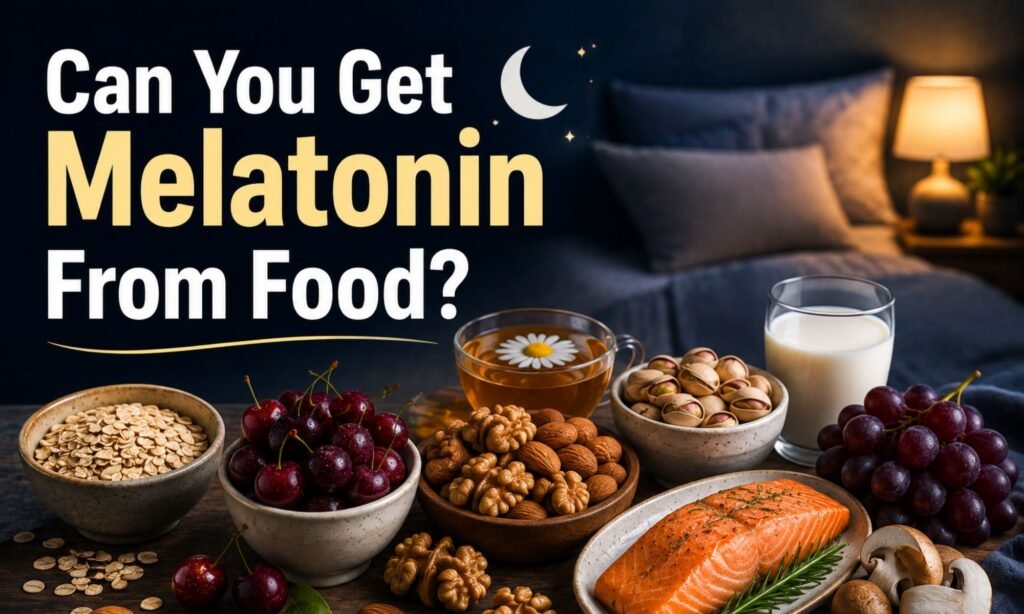
Yes, you can get melatonin from food. But the more important question is whether the melatonin you eat is absorbed, raises melatonin levels in the body, and actually improves sleep. Current research suggests it may, but the evidence is still limited and inconsistent.
Table of Contents
What Does “Melatonin From Food” Actually Mean?
When we think about melatonin, we usually think about the hormone produced by our own body or the melatonin found in supplements.
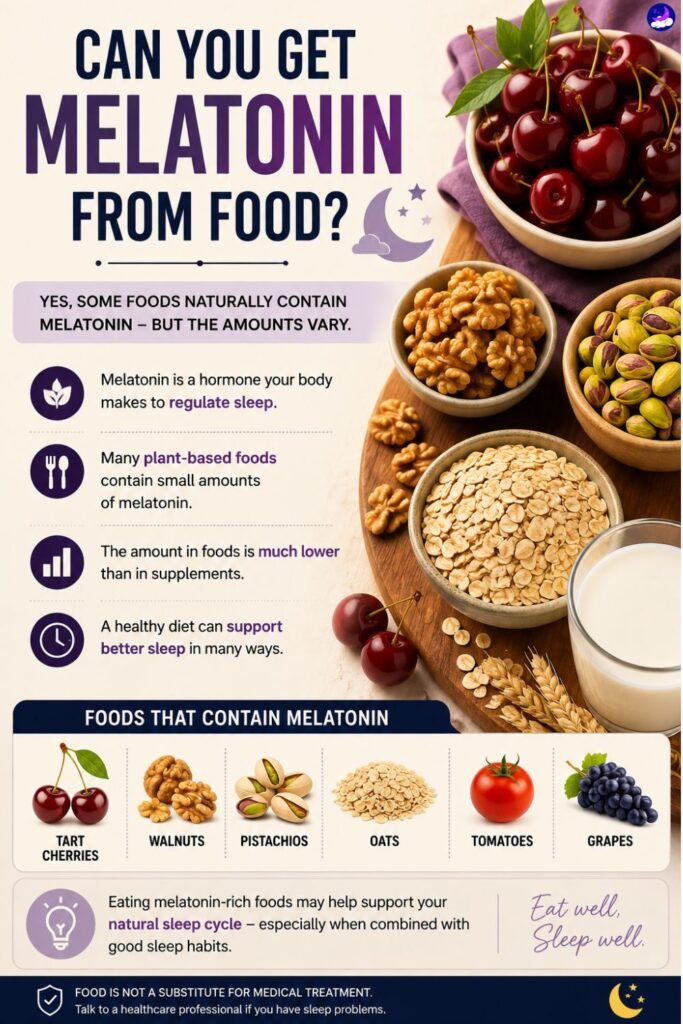
But melatonin also occurs naturally in foods.
Plants, animals and other living organisms can produce melatonin, which means small amounts can enter our diet through ordinary foods. Researchers have detected melatonin in many types of plant and animal foods.
However, there is an important distinction:
Finding melatonin in a food does not automatically mean that eating that food will improve your sleep.
That is because several different questions need to be answered:
Is melatonin present in the food?
↓
Can your digestive system absorb it?
↓
Does it increase melatonin in your circulation?
↓
Does that change your sleep or circadian rhythm?
Research has investigated all of these questions, but the evidence is not equally strong for each one.
And this is where the story becomes much more interesting than simply making a list of foods.
Also Read: Our Melatonin Guide | Circadian Rhythm and Melatonin | Your Body's Natural Melatonin Production
Can Your Body Absorb Melatonin From Food?
There is evidence that dietary melatonin can be absorbed and that eating certain melatonin-containing foods can influence melatonin-related measurements in humans.
Some studies have reported increases in circulating melatonin or in 6-sulfatoxymelatonin, a major urinary metabolite used as an indicator of melatonin production and exposure.
However, absorption is not the same thing as a proven sleep benefit.
A person could consume a food containing melatonin, show a measurable change in a biological marker, and still experience little or no noticeable improvement in sleep.
This distinction is extremely important.
A 2024 review concluded that melatonin content in foods can vary substantially and that, although dietary interventions involving melatonin-containing foods have reported health benefits, there is not enough evidence to say that melatonin itself is responsible for those benefits.
Take-Home Message
Melatonin from food can be biologically relevant, but a measurable increase in melatonin does not automatically mean better sleep.
What Happens to Melatonin After You Eat It?
Food-derived melatonin enters a much more complicated system than a melatonin tablet.
Once you eat a food, it is digested and its components are absorbed and metabolized. The amount of melatonin that ultimately reaches the circulation depends on several factors.
These may include:
- The amount of melatonin originally present
- The type of food
- The food matrix
- Processing and preparation
- Digestion and absorption
- Individual metabolism
- Timing of consumption
- The person’s existing circadian rhythm
This makes dietary melatonin difficult to measure in the same way as supplemental melatonin.
A supplement can be labeled with a specific amount of melatonin. A food generally cannot provide the same level of precision.
For example, the melatonin content of a particular plant food can vary according to variety, growing conditions, origin, processing, heat treatment and laboratory measurement method.
So even if two samples of the same food are tested, they may not contain exactly the same amount.
Also Read: Our Melatonin Dosage Guide | Melatonin Side Effects | Melatonin Drug Interactions
Does Melatonin From Food Increase Melatonin Levels?
Sometimes, according to human studies.
Several dietary studies have reported changes in circulating melatonin or urinary melatonin metabolites after consumption of melatonin-containing foods.
The evidence is particularly interesting because some studies have found biological changes after foods such as cherry products and other plant foods were consumed.
But there is an important limitation.
Researchers cannot always determine whether the change came from the melatonin already present in the food.
Foods contain many biologically active compounds.
For example, some foods provide:
- Melatonin
- Tryptophan
- Serotonin
- Polyphenols
- Antioxidants
- Vitamins and minerals
- Other plant compounds
Some of these compounds could influence sleep or melatonin metabolism independently.
Therefore:
An increase in melatonin after eating a food does not prove that the food’s melatonin was solely responsible.
That is one of the biggest evidence gaps in this field.
Does Melatonin From Food Actually Improve Sleep?
This is the question that matters most to people.
And the answer is:
It may help in some circumstances, but we do not yet have strong enough evidence to say that dietary melatonin reliably improves sleep.
A 2026 scoping review examined human research specifically on melatonin-containing foods and sleep. It included 19 studies, consisting of 14 interventional studies and 5 observational studies.
The review found promising results from some food-based interventions.
Some studies reported improvements in measures such as:
- Sleep quality
- Sleep duration
- Sleep efficiency
- Sleep timing
- Circadian alignment
But the results were heterogeneous.
In other words, the studies did not all point in exactly the same direction.
The researchers also identified substantial differences in:
- Food used
- Amount consumed
- Timing
- Duration of intervention
- Participant characteristics
- Melatonin exposure
- Sleep measurement methods
These differences make it difficult to determine exactly how much dietary melatonin is needed, which foods work best, or who is most likely to benefit.
Take-Home Message
Some food-based interventions show promising sleep results, but the evidence is not strong enough to treat dietary melatonin as a predictable sleep treatment.
Why Better Sleep Cannot Automatically Be Blamed on Melatonin?
Suppose someone eats a particular food every evening and then sleeps better.
It would be tempting to say:
“The melatonin in that food improved their sleep.”
But scientifically, that conclusion may be too simple.
The food could contain several compounds that influence sleep.
It might also improve sleep indirectly by replacing a less healthy evening snack, improving overall diet quality, or providing nutrients involved in normal metabolism.
Even the act of establishing a regular evening eating pattern could influence behavior and sleep timing.
This is why controlled research is important.
The 2024 review specifically noted that health improvements seen after consuming foods containing melatonin cannot necessarily be attributed to the melatonin itself.
The newer 2026 scoping review also found that although some studies reported favorable sleep outcomes, the overall evidence remained heterogeneous.
So the scientifically responsible statement is:
Food-derived melatonin may contribute to sleep-related effects, but it is not yet possible to separate its effects confidently from the other components of the food.
Also Read: Melatonin For Jetlag | Melatonin For Shift workers
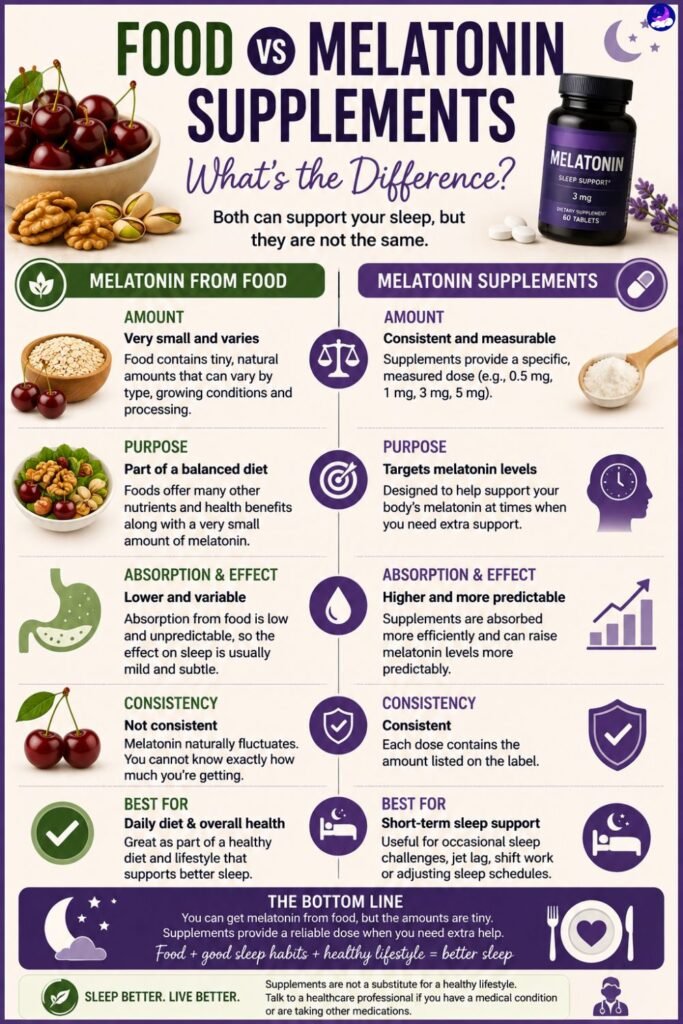
Why Dietary Melatonin Is Not the Same as a Melatonin Supplement?
This is an important distinction.
A melatonin supplement is designed to deliver a relatively defined amount of melatonin.
Food is different.
The amount of melatonin in a food can vary substantially, and you cannot usually calculate your exact dietary melatonin intake from a normal meal.
That means:
Food melatonin = variable exposure
while
Supplemental melatonin = relatively defined exposure
This doesn’t mean that supplements are automatically better.
It simply means they serve different purposes and should not be treated as interchangeable.
A person eating a balanced diet is not necessarily getting a predictable “dose” of melatonin every evening.
And someone taking a melatonin supplement should not assume that eating a food containing melatonin will produce the same effect.
Take-Home Message
Melatonin-containing foods and melatonin supplements are not equivalent sources of melatonin.
Why Is the Amount of Melatonin in Food So Difficult to Measure?
One reason the internet is full of conflicting information about dietary melatonin is that food composition is not fixed.
Several factors can change the amount researchers measure.
Food variety
Different varieties of the same plant can contain different amounts of melatonin.
Growing conditions
Environmental conditions can affect plant chemistry, including compounds involved in stress responses and biological rhythms.
Harvesting
The stage and timing of harvesting can influence the chemical composition of plant foods.
Processing
Drying, heating, fermentation and other processing methods can alter melatonin concentrations.
Storage
The way food is stored may also affect its chemical composition.
Laboratory methods
Different analytical techniques can produce different measurements.
A 2024 review emphasized that the variety, origin, heat treatment, processing and analytical method can all influence reported melatonin concentrations.
This is one reason why I would be cautious about online charts that claim:
“Food X contains exactly X amount of melatonin.”
The number may not apply to every variety, serving or preparation.
Does More Dietary Melatonin Mean Better Sleep?
No.
This is one of the most important points to remember.
Even if one food has a higher measured melatonin concentration than another, that does not prove it will produce a greater improvement in sleep.
There is currently no established rule saying:
More melatonin in food = better sleep.
The relationship could depend on:
- Absorption
- Timing
- Circadian phase
- Individual metabolism
- Other compounds in the food
- Baseline sleep quality
- The amount consumed
The 2026 scoping review specifically identified a lack of consistent information about melatonin dose and dose-response relationships across the available studies.
That means we cannot yet create a reliable food-based melatonin dosing chart for sleep.
Also Read: Melatonin for Older Adults | Melatonin for Pregnant Women | Melatonin for Kids
Can Food Provide Enough Melatonin to Replace a Supplement?
At present, there is not enough evidence to recommend dietary melatonin as a replacement for melatonin supplements when supplementation is specifically being considered for a sleep-related problem.
The problem isn’t simply that foods contain “too little” melatonin.
The bigger issue is that the effective dietary dose has not been established.
Researchers still don’t know:
- How much dietary melatonin is consistently absorbed
- How much reaches circulation
- How much reaches relevant tissues
- How much is needed to influence sleep
- Whether timing changes the response
- Which foods provide the most reliable physiological effect
Until those questions are better answered, it would be inappropriate to treat a food as a natural equivalent of a standardized supplement.
That does not make food unimportant.
It simply means food and supplementation should not be confused.
What Role Does Tryptophan Play?
There is another reason the relationship between food and melatonin is complicated.
Your body can make melatonin from tryptophan, an amino acid obtained through the diet.
The simplified pathway is:
Tryptophan → Serotonin → N-acetylserotonin → Melatonin
This makes dietary tryptophan relevant to melatonin biology.
However, eating a tryptophan-containing food does not mean that all of its tryptophan will become melatonin.
Tryptophan is needed for several biological processes, and its metabolism is tightly regulated.
So it is better to think of dietary tryptophan as one of the building blocks involved in melatonin production, rather than as a direct melatonin booster.
This distinction is important because articles about sleep nutrition often oversimplify the pathway.
What About Serotonin in Food?
Some foods also contain serotonin.
Because serotonin is part of the pathway involved in melatonin synthesis, it is sometimes suggested that eating serotonin-containing foods will automatically increase melatonin.
That is too simplistic.
The amount of serotonin in a food, digestion, absorption, metabolism and the body’s own regulation all matter.
Therefore, we should not make a direct claim such as:
“Eat serotonin-rich foods and your melatonin will increase.”
The evidence does not support such a straightforward relationship.
Also Read: Foods Rich in Melatonin | Blue Light and Melatonin
Can Food Influence Your Natural Melatonin Rhythm?
Possibly, but food is only one part of the picture.
Your body’s own melatonin production is strongly controlled by the circadian system and the light-dark cycle.
Melatonin normally rises during the biological night and falls during the day.
This means that even if dietary melatonin enters your body, its effects occur within an existing circadian system.
Your:
- Evening light exposure
- Morning light exposure
- Sleep schedule
- Circadian timing
- Daily activity
- Diet
- Overall health
can all interact with sleep.
So eating a food containing melatonin should not be viewed as the primary way to control your body’s melatonin rhythm.
Does the Timing of Food Matter?
Possibly.
The timing of dietary intake is one of the areas researchers are still investigating.
The 2026 scoping review found considerable variation in when foods were consumed across studies. Some interventions were designed around evening consumption, while others used different schedules.
Because melatonin is strongly linked to circadian timing, the timing of food consumption may matter.
But we currently do not have enough evidence to recommend a universal rule such as:
“Eat a melatonin-containing food exactly one hour before bed.”
That would be more precise than the research allows.
A better approach is to focus on an overall healthy eating pattern and a consistent sleep schedule.
What Does the Research Say About Sleep Quality?
The newest evidence is more encouraging than older reviews might suggest—but it still needs to be interpreted carefully.
The 2026 scoping review found that some human studies involving foods containing melatonin reported improvements in sleep quality, sleep duration and sleep efficiency. Some observational studies also found associations with circadian alignment and reduced social jetlag.
But the researchers emphasized several limitations.
The studies differed in:
- Participants
- Food sources
- Amount consumed
- Timing
- Duration
- Sleep assessment methods
- Whether melatonin exposure was actually measured
Some studies used subjective questionnaires, while others used objective methods such as actigraphy.
These differences make it difficult to combine the results into a single conclusion.
Therefore, the evidence is best described as:
Promising, but not yet definitive.
That is a much more accurate description than either:
“Melatonin foods don’t work.”
or
“Melatonin-rich foods improve sleep.”
Could Other Compounds Be Responsible?
Absolutely.
This may be one of the most important explanations for why food-based sleep research is difficult to interpret.
A whole food is a complex biological mixture.
It can contain melatonin along with:
- Polyphenols
- Flavonoids
- Antioxidants
- Tryptophan
- Serotonin
- Vitamins
- Minerals
- Fiber
- Fatty acids
- Other plant compounds
Some of these may influence inflammation, oxidative stress, metabolism or other processes associated with sleep.
The 2026 review specifically noted that the sleep-related effects of melatonin-containing foods may involve multiple mechanisms, rather than melatonin acting alone.
This is why it would be misleading to take a positive study of a particular food and conclude that the food’s melatonin is solely responsible.
What We Still Don’t Know
Despite growing research, several important questions remain unanswered.
1. What is the effective dietary dose?
There is no established amount of food-derived melatonin that reliably improves sleep.
2. How much is absorbed?
Researchers can measure changes in blood or urine, but absorption and biological effects are not always equivalent.
3. Does timing change the effect?
Probably worth investigating, but there is not enough evidence for a universal dietary timing recommendation.
4. Which foods are most effective?
Only a relatively small number of foods have been tested in controlled human sleep studies.
The 2026 review specifically noted that many potential dietary sources remain under-researched.
5. Is melatonin actually the main active component?
We don’t know.
Other compounds in the food may contribute substantially to any observed effect.
6. Who benefits most?
Some studies have reported stronger effects in people with sleep disturbances or older adults, but the evidence is not sufficient to identify a specific group that will reliably benefit.
These gaps are why more controlled human trials are needed.
So, Should You Try to Get Melatonin From Food?
There is no reason to avoid nutritious foods simply because they contain melatonin.
In fact, foods naturally containing melatonin can fit comfortably into a healthy diet.
But I would not recommend approaching food as though you are trying to calculate a nightly melatonin dose.
Instead, think of it this way:
Choose nutritious foods → maintain a balanced diet → support your overall sleep health.
If a particular food is also a source of melatonin, that may be an interesting additional feature.
But it does not need to become the entire reason you eat that food.
Food Melatonin vs Supplement Melatonin
| Feature | Melatonin from food | Melatonin supplement |
|---|---|---|
| Amount of melatonin | Variable | More precisely defined |
| Food matrix | Complex whole food | Concentrated formulation |
| Dose control | Difficult | Easier |
| Research on sleep | Growing but limited | Much larger evidence base for specific uses |
| Other compounds | Many | Depends on formulation |
| Predictability | Relatively low | Generally higher |
| Can it be treated as a precise dose? | No | More readily |
This table captures the most important distinction.
Food-derived melatonin is a nutritional exposure. A supplement is a deliberate melatonin intervention.
They should not be treated as the same thing.
The Bottom Line
Yes, you can get melatonin from food.
Researchers have detected melatonin in many foods, and human studies suggest that eating some melatonin-containing foods can influence melatonin-related biological markers. More recent research also suggests that certain food interventions may improve aspects of sleep.
But that does not mean that every food containing melatonin will improve sleep.
We still don’t know exactly how much dietary melatonin is absorbed, what dose is biologically meaningful, how much of the sleep effect comes from melatonin itself, or which foods provide the most reliable benefit.
The evidence is therefore best described as promising but still developing.
The practical message is simple:
Eat a healthy diet for overall health and sleep—not because you need to chase a specific amount of melatonin from food.
And if you’re interested in which foods actually contain melatonin, that’s a different question. Our detailed guide covers the foods themselves, while this article focuses on what happens after you eat them and what the research actually shows.
Also Read: Foods Rich in Melatonin | Blue Light and Melatonin
Frequently Asked Questions
Can you get melatonin from food?
Yes. Melatonin occurs naturally in a variety of foods. However, the amount can vary considerably depending on the food, variety, growing conditions, processing and measurement method.
Does eating melatonin increase your body's melatonin?
Some human studies suggest that consuming melatonin-containing foods can increase circulating melatonin or urinary melatonin metabolites. However, the response is not predictable, and the increase cannot always be attributed solely to the melatonin in the food.
Can melatonin from food help you sleep?
Possibly. Some recent studies have reported improvements in sleep outcomes, but the evidence remains heterogeneous. More research is needed to determine whether melatonin itself is responsible for those effects.
Is melatonin from food the same as taking a supplement?
The molecule is the same, but the delivery and amount are very different. Food provides a variable amount of melatonin within a complex food matrix, while supplements are designed to provide a more defined amount.
Can food replace melatonin supplements?
There is currently not enough evidence to recommend food-derived melatonin as a predictable replacement for supplemental melatonin when supplementation is specifically being considered.
Does more melatonin in food mean better sleep?
No. A higher measured melatonin concentration does not automatically translate into a greater sleep benefit. Researchers have not established a reliable dietary dose-response relationship.
Is dietary melatonin safe?
The small amounts naturally present in ordinary foods are generally part of the food itself. Safety considerations are therefore usually related to the food, allergies, dietary restrictions or individual health conditions rather than the naturally occurring melatonin alone.
References
- Muñoz-Jurado A, Escribano BM. Presence of melatonin in foods of daily consumption: The benefit of this hormone for health.Food Chemistry. 2024;458:140172.
- Nisar T, et al. Effectiveness of Melatonin-Containing Foods on Promoting Sleep: A Scoping Review.Food Science & Nutrition. 2026.
- Meng X, et al. Mediterranean Diet and Melatonin: A Systematic Review.Antioxidants. 2023;12:264.
- Peuhkuri K, Sihvola N, Korpela R. Dietary Sources and Bioactivities of Melatonin
- .Journal of Food Science. 2019. Influence of Dietary Sources of Melatonin on Sleep Quality: A Review.Journal of Food Science. 2020.