
Vitamin D and sleep appear to be connected, but the relationship is more complicated than simply taking a vitamin D supplement and sleeping better.
Research has found that people with lower vitamin D levels are more likely to report poor sleep, and several clinical trials suggest that vitamin D supplementation may improve sleep quality.
However, results are not consistent for sleep duration, falling asleep faster, insomnia, or other sleep disorders. Vitamin D is important for overall health, but it should not be treated as a proven sleep medicine.
Table of Contents
What Is Vitamin D and Why Does It Matter for Sleep?
Vitamin D is a fat-soluble vitamin involved in bone health, calcium regulation, muscle function and several processes throughout the body. Your body can make vitamin D when ultraviolet B (UVB) radiation from sunlight reaches the skin. It can also come from certain foods, fortified foods and supplements.
Vitamin D itself is not immediately active. It is converted in the liver to 25-hydroxyvitamin D [25(OH)D], the main form measured in a blood test. It is then converted mainly in the kidneys into the active hormone 1,25-dihydroxyvitamin D (calcitriol).
Why might this matter for sleep?
Vitamin D receptors are found in several tissues, including areas of the brain involved in sleep and circadian regulation. Researchers have also proposed connections between vitamin D, melatonin, inflammation and pain.
These biological links make vitamin D and sleep an interesting area of research. But a plausible mechanism does not automatically mean that taking more vitamin D will improve sleep.
That distinction is important.
Vitamin D and Sleep: What Does the Research Show?
The research can broadly be divided into two types:
- Observational studies, which look at whether vitamin D status and sleep are associated.
- Randomized controlled trials, which test whether vitamin D supplementation actually changes sleep outcomes.
The second type provides stronger evidence for whether supplementation can help.
One 2018 systematic review and meta-analysis included nine observational studies involving 9,397 participants. Lower vitamin D levels were associated with a greater risk of poor sleep quality, short sleep duration, sleepiness and sleep disorders. However, the authors emphasized that more high-quality prospective studies and randomized trials were needed.
More importantly, a 2022 systematic review and meta-analysis examined 19 intervention studies, including 13 randomized controlled trials. Vitamin D supplementation produced a statistically significant improvement in Pittsburgh Sleep Quality Index (PSQI) scores compared with placebo, with moderate certainty of evidence. However, findings for sleep-related impairment, sleep difficulties, diagnosed sleep disorders, sleepiness and restless legs syndrome were inconsistent.
Another 2022 systematic review and meta-analysis included five studies and also found an improvement in sleep quality with vitamin D supplementation, although the small number of studies and variation between them limit how confidently we can generalize the result.
What We Know So Far
| Question | What the evidence suggests |
|---|---|
| Is low vitamin D associated with poor sleep? | Yes, observational studies suggest an association. |
| Can vitamin D supplementation improve sleep quality? | Possibly. Several trials and meta-analyses are encouraging. |
| Does vitamin D increase sleep duration? | Not established. |
| Does it help you fall asleep faster? | Evidence is inconsistent. |
| Does vitamin D treat insomnia? | Not established. |
| Does it treat sleep apnea? | No evidence supports using it as a treatment. |
| Is there a specific vitamin D dose for sleep? | No established sleep-specific dose. |
| Should everyone with poor sleep take vitamin D? | No. |
Vitamin D and Sleep: Take-Home Message
Vitamin D may improve sleep quality, but the evidence does not show that it is a proven treatment for insomnia or every type of sleep problem.
Also Read:
Can Vitamin D Improve Sleep Quality?
This is where the evidence is most interesting.
The 2022 systematic review of intervention studies found that vitamin D supplementation improved PSQI scores compared with placebo. PSQI is a commonly used questionnaire that measures several aspects of sleep quality, including difficulty falling asleep, sleep duration and sleep disturbances.
This does not mean that vitamin D will necessarily make everyone sleep better.
For example, another randomized controlled trial analyzed 189 vitamin-D-insufficient adults. Participants received either vitamin D or placebo for four months. The researchers found no significant difference between the groups in sleep duration, daytime sleepiness or insomnia symptoms.
This is a useful reminder that a nutrient can be associated with sleep and still fail to improve sleep when given as a supplement in a particular population.
The most reasonable conclusion at present is:
Vitamin D supplementation may improve subjective sleep quality in some people, but the benefit is not universal and is not yet predictable.
Does Vitamin D Deficiency Cause Poor Sleep?
Not necessarily.
This is one of the most important distinctions when discussing vitamin D deficiency and sleep.
Observational studies show an association between lower vitamin D status and poorer sleep. But people with low vitamin D may also differ in many other ways.
For example, vitamin D status can be influenced by:
- Limited outdoor activity
- Obesity
- Age
- Diet
- Chronic illness
- Physical activity
- Sun exposure
- Certain medications
Some of these factors can independently affect sleep.
Therefore, finding a low vitamin D level in someone with insomnia does not prove that vitamin D deficiency is the cause of the insomnia.
The relationship may be partly biological, partly related to lifestyle, or influenced by other health conditions.
Vitamin D and Sleep: Take-Home Message
Low vitamin D and poor sleep can occur together, but an association does not prove that vitamin D deficiency is the cause of poor sleep.
Also Read:
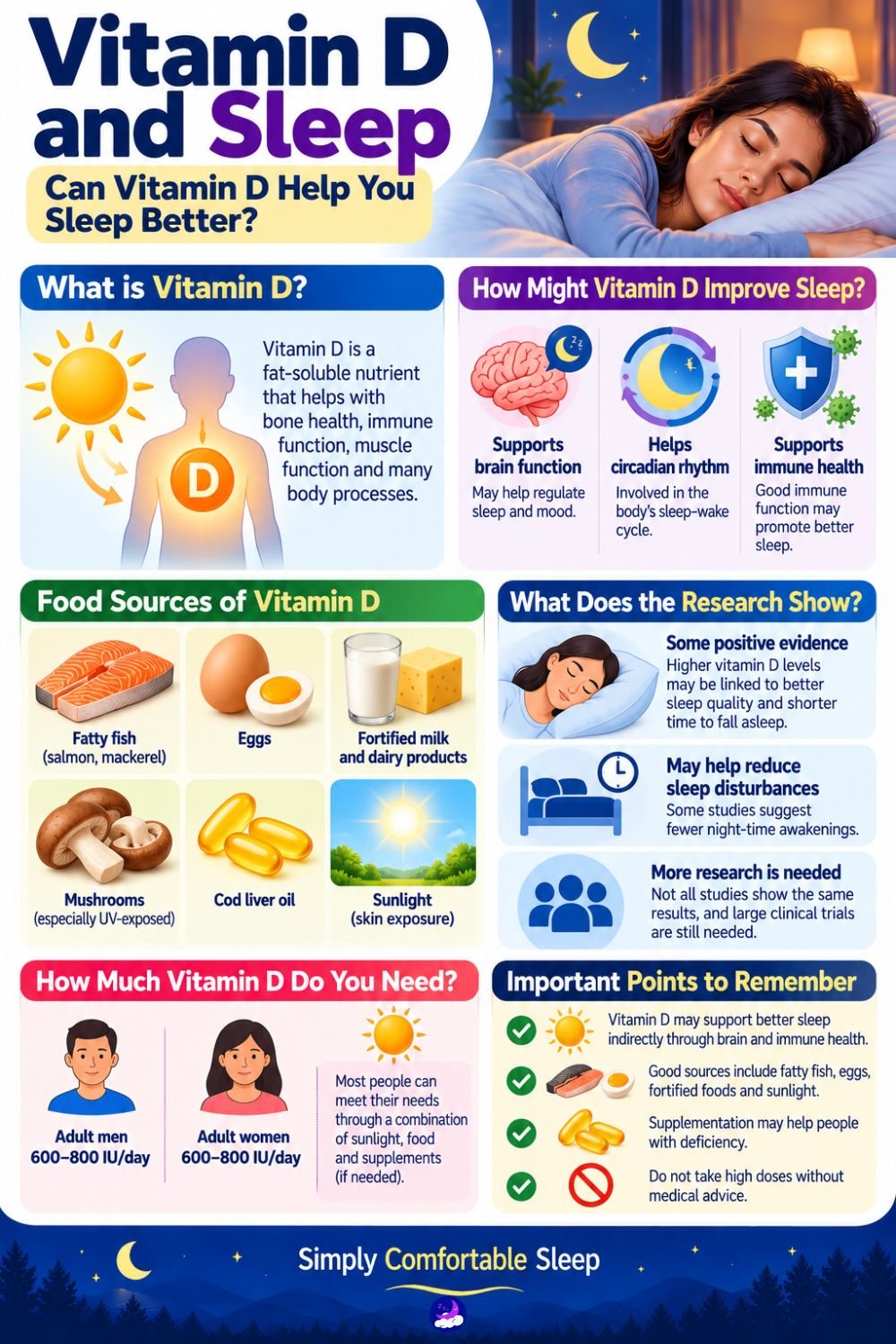
How Could Vitamin D Affect Sleep?
Researchers have proposed several possible pathways linking vitamin D with sleep. These mechanisms are biologically plausible, but they should not be confused with proven clinical effects.
Vitamin D and the Brain
Vitamin D receptors and vitamin D-related enzymes are present in the brain.
This has led researchers to investigate whether vitamin D may influence brain processes involved in sleep, mood and circadian regulation.
However, the exact role of vitamin D in human sleep regulation is still being worked out.
Vitamin D, Melatonin and the Circadian Rhythm
Melatonin is one of the body’s major signals for nighttime. Its production normally increases in the evening as the body prepares for sleep.
Because vitamin D receptors and vitamin D-related pathways have been identified in tissues involved in circadian regulation, researchers have proposed a connection between vitamin D and melatonin.
But this does not mean that vitamin D works like a melatonin supplement.
There is currently no established recommendation to take vitamin D specifically to increase nighttime melatonin.
Vitamin D, Pain and Inflammation
Pain can make it harder to fall asleep, cause nighttime awakenings and reduce overall sleep quality.
Vitamin D is involved in several biological pathways related to muscle and bone health and immune regulation. This has led researchers to investigate whether correcting low vitamin D might indirectly influence sleep in people whose sleep is affected by musculoskeletal problems or other factors.
Again, this is a possible pathway rather than proof that vitamin D is a sleep treatment.
How Vitamin D Could Affect Sleep: Take-Home Message
Vitamin D has plausible biological connections with the brain, circadian rhythms, melatonin and inflammation, but these mechanisms do not yet prove that more vitamin D means better sleep.
Also Read:
Can Vitamin D Help You Sleep Longer?
There is not enough evidence to say that it reliably does.
Some observational research has found that lower vitamin D levels are associated with shorter sleep duration. The 2018 meta-analysis, for example, found an association between vitamin D deficiency and short sleep duration.
But randomized supplementation trials have not consistently shown that taking vitamin D increases the amount of sleep people get.
The 2022 intervention review concluded that the effects of vitamin D supplementation on sleep quantity remain uncertain.
So if you already sleep six hours a night, taking vitamin D should not be expected to automatically turn that into seven or eight hours.
Can Vitamin D Help You Fall Asleep Faster?
This is also uncertain.
Sleep latency—the amount of time it takes to fall asleep—is one of the outcomes researchers have examined, but studies have not produced consistent results.
If you regularly spend a long time awake before falling asleep, it is better to look at the common causes of prolonged sleep latency rather than assuming that vitamin D is the missing piece.
These can include:
- An irregular sleep schedule
- Evening caffeine
- Bright light exposure at night
- Anxiety or stress
- Excessive screen use
- Restless legs syndrome
- Poor sleep environment
- Chronic pain
- Insomnia disorder
- Circadian rhythm problems
Vitamin D may be relevant if you have a genuine deficiency or inadequate intake, but it is not an established sleep-onset treatment.
Vitamin D and Sleep Disorders
Vitamin D has been studied in several sleep disorders, but the evidence should be interpreted carefully.
Obstructive Sleep Apnea
Studies have found an association between vitamin D status and obstructive sleep apnea (OSA). A 2018 systematic review and meta-analysis examined 14 studies involving 4,937 participants and investigated the relationship between vitamin D levels and OSA.
However, an association does not establish that vitamin D deficiency causes OSA, nor does it mean that vitamin D supplementation can treat OSA.
If someone snores loudly, has witnessed pauses in breathing, wakes gasping or choking, or experiences significant daytime sleepiness, the priority should be proper evaluation for sleep apnea—not self-treatment with vitamin D.
Restless Legs Syndrome
Vitamin D has also been investigated in restless legs syndrome (RLS), but the evidence is not strong enough to recommend vitamin D as an established RLS treatment.
RLS has a much clearer relationship with iron status, particularly in appropriate clinical settings.
Also Read:
Vitamin D and Sleep Disorders: Take-Home Message
Vitamin D may be associated with some sleep disorders, but supplementation should not replace proper diagnosis and treatment.
Also Read:
How Much Vitamin D Do You Need?
Vitamin D requirements depend on age and life stage.
According to the U.S. National Institutes of Health Office of Dietary Supplements, the recommended dietary allowance for most adults is 600 IU (15 mcg) per day, increasing to 800 IU (20 mcg) per day after age 70.
| Age/Life stage | Recommended amount |
|---|---|
| Birth–12 months | 400 IU (10 mcg) |
| 1–70 years | 600 IU (15 mcg) |
| Adults over 70 | 800 IU (20 mcg) |
| Pregnancy | 600 IU (15 mcg) |
| Lactation | 600 IU (15 mcg) |
These are general nutritional recommendations, not doses specifically designed to improve sleep.
There is currently no established “vitamin D dose for better sleep.”
If someone has confirmed vitamin D deficiency, the appropriate treatment may be different from the routine daily requirement and should be based on clinical assessment.
Should You Check Your Vitamin D Level?
A blood test measures 25-hydroxyvitamin D [25(OH)D], which is the main marker used to assess vitamin D status.
It may be appropriate to test when there is a clinical reason to suspect deficiency or when a healthcare professional is evaluating a relevant condition or risk factor.
But testing everyone simply because they have poor sleep is not supported by current evidence.
The 2024 Endocrine Society guideline found insufficient evidence to recommend routine 25(OH)D screening in generally healthy people without an established indication. It also concluded that available clinical trial evidence does not allow a single blood-level threshold to be defined as predicting a meaningful benefit from vitamin D supplementation for disease prevention.
This is an important update because older articles often present a particular vitamin D blood level as universally “optimal.”
For sleep specifically, there is no established 25(OH)D target that guarantees better sleep.
Should You Take Vitamin D at Night?
Not necessarily.
There is no established evidence that taking vitamin D immediately before bed improves sleep.
Vitamin D is fat-soluble, so taking it with a meal that contains some fat can help absorption.
The most important thing is usually taking an appropriate amount consistently rather than trying to find a special bedtime window.
If your healthcare professional has prescribed vitamin D at a particular time, follow that recommendation.
Can You Get Enough Vitamin D From Food and Sunlight?
Vitamin D is unusual because the body can make it through sun exposure.
However, the amount produced depends on several factors, including:
- Skin pigmentation
- Geographic location
- Season
- Time of day
- Amount of skin exposed
- Age
- Clothing
- Sunscreen use
- Outdoor activity
Because these factors vary considerably, sunlight cannot be converted into one universal “X minutes of sun gives enough vitamin D” rule.
Food is another source, but naturally vitamin-D-rich foods are relatively limited.
Foods That Provide Vitamin D
Some useful sources include:
- Fatty fish such as salmon, sardines and mackerel
- Fish liver oils
- Egg yolks
- Beef liver
- UV-exposed mushrooms
- Fortified milk
- Fortified plant-based milk
- Some fortified cereals and other foods
Fortified foods can be particularly useful because natural dietary sources of vitamin D are limited.
Also Read:
Are Vitamin D Supplements Safe?
Vitamin D is essential, but more is not automatically better.
Excessive vitamin D supplementation can cause hypercalcemia, meaning too much calcium in the blood. Severe toxicity can lead to nausea, vomiting, weakness, excessive thirst and urination, kidney problems and other complications. Toxicity is generally caused by excessive supplement use rather than ordinary food intake or normal sun exposure.
For adults, the U.S. National Academies’ tolerable upper intake level is 4,000 IU (100 mcg) per day from all sources. This is a population-level upper limit, not a target intake.
Higher doses may sometimes be prescribed for treating documented deficiency, but this is different from taking high doses independently for sleep.
If you are already taking a vitamin D supplement, check the amount carefully. Some products contain much more vitamin D than the ordinary daily requirement.
Vitamin D and Calcium
Vitamin D increases intestinal calcium absorption, so the two nutrients are closely connected.
This does not mean that taking large amounts of both will produce better sleep.
Research on calcium and sleep is developing separately, and the evidence is still limited.
For most people, the goal should be adequate nutrition, not taking increasingly large doses of multiple supplements.
Vitamin D and Sleep: Take-Home Message
Correcting inadequate vitamin D is important, but high-dose vitamin D is not a shortcut to better sleep.
Also Read:
When Poor Sleep Probably Isn’t a Vitamin D Problem
Vitamin D deserves attention when deficiency or inadequate intake is a realistic possibility. But poor sleep has many other causes.
If you are sleeping badly despite having adequate nutrition, consider the bigger picture.
Your sleep may be affected by:
- An inconsistent bedtime
- Too much caffeine
- Alcohol near bedtime
- Bright light late in the evening
- Excessive screen exposure
- Stress or anxiety
- Chronic pain
- Depression or other mental health conditions
- Snoring or sleep apnea
- Restless legs syndrome
- Medications
- Shift work
- Jet lag
- An unsuitable sleep environment
- Chronic insomnia
This is why taking a vitamin D supplement without addressing the underlying sleep problem may not solve the problem.
For persistent insomnia, evidence-based behavioral treatment such as cognitive behavioral therapy for insomnia (CBT-I) has a much more direct role than simply adding a nutritional supplement.
So, Does Vitamin D Help You Sleep?
Possibly—but the answer depends on the person and the problem.
Research suggests that vitamin D supplementation may improve sleep quality, and several studies have found an association between lower vitamin D status and poorer sleep. The strongest intervention evidence currently points toward sleep quality rather than a reliable increase in sleep duration or a faster sleep onset.
At the same time, not every randomized trial has found a benefit. One trial involving vitamin-D-insufficient adults found no significant improvement in sleep duration, daytime sleepiness or insomnia symptoms after supplementation.
So the practical message is simple:
If you have vitamin D deficiency, correcting it is important for your health and may also benefit your sleep.
But if your vitamin D status is already adequate, taking extra vitamin D is not guaranteed to give you better sleep.
And there is currently no established vitamin D dose, bedtime schedule or blood level specifically designed to treat poor sleep.
Final Take-Home Message
Correct vitamin D deficiency, but don’t treat vitamin D as a sleeping pill. Good sleep usually requires looking at the whole picture.
Also Read:
Frequently Asked Questions
Can vitamin D help you sleep better?
Possibly. Several studies and meta-analyses suggest that vitamin D supplementation may improve sleep quality, but the evidence is not consistent enough to consider vitamin D a proven treatment for insomnia.
What is the best time to take vitamin D for sleep?
There is no established bedtime or nighttime advantage. Vitamin D can generally be taken at a convenient time, preferably with a meal containing some fat to support absorption.
Does vitamin D deficiency cause insomnia?
Not necessarily. Low vitamin D is associated with poor sleep in observational research, but this does not prove that deficiency causes insomnia.
Can vitamin D make you sleep longer?
There is currently not enough evidence to say that vitamin D reliably increases sleep duration.
Can vitamin D help with sleep apnea?
Vitamin D status has been associated with obstructive sleep apnea in observational research, but vitamin D supplements are not an established treatment for sleep apnea.
How much vitamin D should I take for better sleep?
There is no established sleep-specific vitamin D dose. The usual adult recommended intake is 600 IU daily up to age 70 and 800 IU daily after age 70, but treatment of confirmed deficiency may require a different regimen under medical supervision.
Should I take vitamin D if I have trouble sleeping?
Not simply because you have trouble sleeping. If you have risk factors for vitamin D deficiency or another clinical reason to assess your vitamin D status, discuss it with your healthcare professional.
Can I get vitamin D from food?
Yes, although relatively few foods naturally contain substantial amounts. Fatty fish, egg yolks, some mushrooms and fortified foods can contribute to vitamin D intake.
Does sunlight improve sleep because it increases vitamin D?
Sunlight has many effects on the body and circadian rhythm, so it would be too simplistic to attribute any sleep benefit solely to vitamin D. Daytime light exposure itself is an important signal for the body’s circadian clock.
Is more vitamin D better for sleep?
No. More is not automatically better. Excessive vitamin D can cause toxicity, and high-dose supplementation should not be used simply in the hope of improving sleep.
References
- Abboud M, et al. Vitamin D Supplementation and Sleep: A Systematic Review and Meta-Analysis of Intervention Studies. Nutrients. 2022;14(5):1076. PubMed
- Gao Q, et al. The Association between Vitamin D Deficiency and Sleep Disorders: A Systematic Review and Meta-Analysis. Nutrients. 2018;10(10):1395. PubMed
- Mirzaei-Azandaryani Z, et al. The effect of vitamin D on sleep quality: A systematic review and meta-analysis. Nutr Health. 2022;28(4):515-526. PubMed
- No improvement of sleep from vitamin D supplementation: insights from a randomized controlled trial. PubMed
- Demay MB, et al. Vitamin D for the Prevention of Disease: An Endocrine Society Clinical Practice Guideline. J Clin Endocrinol Metab. 2024;109(8):1907-1947. PubMed
- National Institutes of Health, Office of Dietary Supplements. Vitamin D — Fact Sheet for Health Professionals. NIH Office of Dietary Supplements
- Neighbors CLP, et al. Vitamin D and obstructive sleep apnea: a systematic review and meta-analysis. Sleep Med. 2018;43:100-108. PubMed