
Vitamin B6 and sleep are connected through several pathways involved in brain function and neurotransmitter production.
Vitamin B6 helps the body make neurotransmitters such as serotonin and GABA, while serotonin is part of the pathway that eventually produces melatonin. But this does not mean that taking extra B6 will automatically improve sleep.
Human research is limited, and the best-known randomized trial found that B6 increased dream recall rather than improving overall sleep. At present, there is not enough evidence to recommend vitamin B6 supplements as a treatment for poor sleep.
Table of Contents
What Is Vitamin B6 and Why Does It Matter?
Vitamin B6 is a group of related compounds that the body uses for many different functions. Its active coenzyme forms, particularly pyridoxal 5′-phosphate (PLP), are involved in more than 100 enzyme reactions, most of them related to metabolism and the use of proteins and amino acids. Vitamin B6 also contributes to normal brain development, immune function and hemoglobin formation.
Its connection with sleep is mainly related to the brain.
Vitamin B6 is involved in pathways that help produce or regulate several neurotransmitters, including:
- Serotonin
- GABA
- Dopamine
- Norepinephrine
Serotonin is particularly interesting because it is involved in the pathway that leads to melatonin, one of the body’s important signals for nighttime.
This gives vitamin B6 a plausible connection with sleep biology.
But there is an important distinction:
A nutrient can be necessary for a biological pathway without extra supplementation improving the final outcome.
The question, therefore, is not whether B6 is involved in sleep-related biology. It is whether taking more B6 actually helps people sleep better.
Vitamin B6 and Sleep: What Does the Research Show?
There are relatively few human studies specifically testing vitamin B6 as a sleep intervention.
One of the best-known studies was a randomized, double-blind, placebo-controlled trial involving 100 participants. Participants took 240 mg of vitamin B6 before bed for five nights. The researchers found that B6 significantly increased the amount of dream content participants could recall. However, it did not significantly affect dream vividness, bizarreness, colour or other sleep-related variables that were measured.
That finding is interesting, but it should not be interpreted as evidence that B6 improves sleep.
A separate small randomized intervention study examined vitamin B6 alone and in combination with another compound. Vitamin B6 alone did not demonstrate a clear improvement in sleep duration or sleep quality. This type of study also illustrates why evidence from multi-ingredient supplements cannot automatically be attributed to B6 itself.
What We Know So Far
| Question | What the evidence shows |
|---|---|
| Is vitamin B6 important for normal brain function? | Yes |
| Is B6 involved in serotonin and GABA metabolism? | Yes |
| Is B6 involved in pathways related to melatonin? | Yes |
| Can B6 increase dream recall? | Possibly |
| Does B6 improve sleep quality? | Not established |
| Does B6 help you fall asleep faster? | Not established |
| Does B6 increase total sleep time? | Not established |
| Does B6 treat insomnia? | Not established |
| Is high-dose B6 recommended for sleep? | No |
One particularly important point is that the 240 mg dose used in the dream study was a research dose, not a recommended sleep dose. It was also much higher than normal nutritional requirements.
Vitamin B6 and Sleep: Take-Home Message
Vitamin B6 supports normal brain and neurotransmitter function, but there is not enough evidence to say that taking extra B6 improves sleep.
Also Read:
How Could Vitamin B6 Affect Sleep?
The interest in vitamin B6 for sleep comes largely from its role in neurotransmitter metabolism.
Vitamin B6 and Serotonin
Vitamin B6 in its active PLP form acts as a cofactor for enzymes involved in neurotransmitter production.
One important reaction involves the conversion of 5-hydroxytryptophan (5-HTP) into serotonin.
Serotonin has many functions in the nervous system and is involved in sleep-wake regulation. It is also a precursor in the pathway that eventually produces melatonin.
This provides a reasonable biological explanation for why researchers have investigated B6 and sleep.
However, it does not mean that giving additional B6 to someone who already has adequate B6 status will necessarily increase serotonin or improve sleep.
Vitamin B6 and GABA
Vitamin B6 is also required for the activity of glutamate decarboxylase, the enzyme that converts glutamate into gamma-aminobutyric acid (GABA).
GABA is an inhibitory neurotransmitter that helps regulate activity in the nervous system.
Because GABA is involved in neural inhibition and relaxation, this pathway has also attracted interest in sleep research.
Again, the important distinction is between biological necessity and therapeutic benefit.
B6 is needed for the pathway. That does not prove that high-dose B6 supplementation improves sleep in people who already have enough B6.
Vitamin B6 and Melatonin
A simplified version of the relevant pathway is:
Tryptophan → 5-HTP → Serotonin → Melatonin
Vitamin B6 participates in the conversion of 5-HTP to serotonin.
This has led to claims that vitamin B6 can “increase melatonin.”
That claim goes further than the available clinical evidence.
There is currently no established recommendation to take B6 to increase nighttime melatonin or to use it as a substitute for melatonin.
How Vitamin B6 Could Affect Sleep: Take-Home Message
B6 is involved in serotonin, GABA and melatonin-related pathways, but these biological connections do not prove that extra B6 produces better sleep.
Also Read:
Vitamin B6 and Dreams
Dreaming is where the human evidence for B6 becomes particularly interesting.
A 2018 randomized controlled trial found that taking 240 mg of vitamin B6 before bed for five consecutive nights increased the amount of dream content participants remembered. However, it did not significantly increase dream vividness, bizarreness or colour, and it did not significantly change other sleep-related variables.
An earlier small study also investigated vitamin B6 and dream recall. It involved only 12 college students and tested 100 mg and 250 mg doses before bedtime. The researchers reported an increase in a composite measure of dream salience with the higher dose.
These findings are interesting, but they have important limitations:
- The studies were small.
- The doses were very high compared with normal nutritional requirements.
- The studies focused on dreaming rather than treating insomnia.
- Increased dream recall does not necessarily mean better sleep.
- These results do not establish a safe or effective dose for routine supplementation.
So if someone remembers more dreams after taking B6, that does not necessarily mean the vitamin has improved their sleep.
Vitamin B6 and Dreams: Take-Home Message
Vitamin B6 may increase dream recall, but more memorable dreams should not be confused with better sleep.
Also Read:
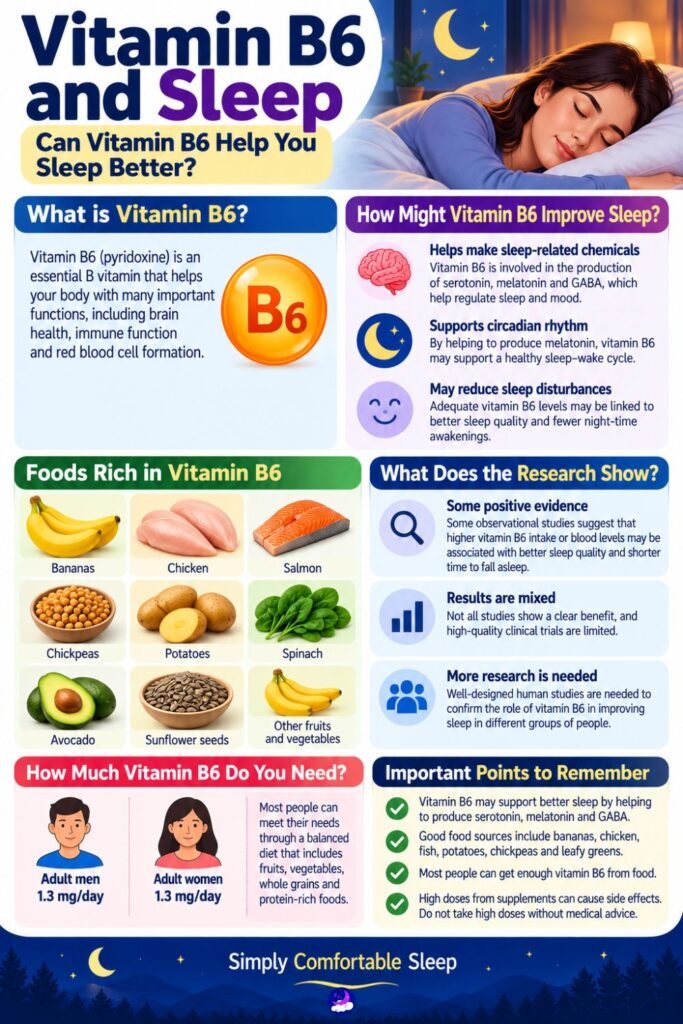
Can Vitamin B6 Deficiency Affect Sleep?
Vitamin B6 deficiency can affect the nervous system, but there is not enough evidence to say that mild B6 deficiency is a common cause of insomnia.
Significant vitamin B6 deficiency can be associated with neurological and other problems, including confusion, depression, dermatitis, anemia and abnormalities in immune function.
The important point is that correcting a genuine deficiency is different from taking extra B6 for sleep.
If someone is deficient, restoring adequate B6 intake is appropriate for overall health. Whether that correction specifically improves sleep will depend on the individual and the reason for their sleep problem.
Who May Be at Risk of Vitamin B6 Inadequacy?
Most people can obtain enough vitamin B6 from food, but certain situations can increase the risk of inadequate B6 status.
These include:
- Alcohol dependence
- Certain kidney diseases
- Malabsorption disorders
- Celiac disease
- Crohn’s disease
- Ulcerative colitis
- Certain genetic disorders
- Some medications
The NIH notes that plasma B6 levels can be lower in people with alcohol dependence, some kidney conditions, obesity and certain malabsorption disorders. Some medications, including certain antiepileptic drugs, can also affect vitamin B6 status.
A particularly important example is isoniazid, a medication used to treat tuberculosis. It can interfere with vitamin B6 metabolism, which is why pyridoxine may be prescribed in appropriate patients.
If there is a genuine risk of deficiency, the focus should be on identifying and correcting the problem rather than taking large doses for sleep.
How Much Vitamin B6 Do You Need?
Vitamin B6 requirements are relatively small.
According to the NIH Office of Dietary Supplements, adults aged 19–50 generally need 1.3 mg per day. Requirements increase somewhat after age 50 and during pregnancy and breastfeeding.
| Life stage | Recommended amount |
|---|---|
| Adults 19–50 years | 1.3 mg/day |
| Men 51+ years | 1.7 mg/day |
| Women 51+ years | 1.5 mg/day |
| Pregnancy | 1.9 mg/day |
| Breastfeeding | 2.0 mg/day |
These are nutritional requirements, not sleep-treatment doses.
There is currently no established daily amount of vitamin B6 specifically for improving sleep.
This distinction is especially important because some supplements contain 25, 50 or even 100 mg of B6—far more than the normal daily requirement.
More does not automatically mean better.
Can You Get Enough Vitamin B6 From Food?
For most people, food is the preferred way to obtain vitamin B6.
Vitamin B6 is naturally present in many foods, including:
- Fish
- Poultry
- Beef and organ meats
- Potatoes and other starchy vegetables
- Chickpeas
- Nuts
- Fortified cereals
- Bananas and other non-citrus fruits
The NIH identifies fish, beef liver and other organ meats, potatoes and other starchy vegetables, and non-citrus fruits among important food sources of vitamin B6.
Does Eating B6-Rich Food Improve Sleep?
Not necessarily.
A food can provide B6 without being a “sleep food.”
For example, fish provides vitamin B6 along with protein, omega-3 fatty acids and other nutrients. Potatoes provide B6 along with carbohydrate and other nutrients.
The overall dietary pattern matters more than searching for one food or one nutrient as a sleep treatment.
Also Read: Vitamins for Sleep | Nutrients for Sleep | Omega-3 and Sleep
Should You Take Vitamin B6 Before Bed?
There is no established benefit to taking vitamin B6 immediately before bed.
The idea largely comes from the dream studies, where B6 was given before bedtime. But those studies were designed to investigate dreaming and did not establish bedtime B6 as a treatment for insomnia or poor sleep.
If you need B6 because of a documented deficiency or a medical reason, take it according to your healthcare professional’s advice.
There is currently no evidence-based recommendation that someone with ordinary sleep problems should take B6 at night.
Can Too Much Vitamin B6 Be Harmful?
Yes.
This is one of the most important things to know before taking B6 supplements.
Because B6 is water-soluble, it is sometimes assumed that excess amounts are harmless. But long-term high-dose vitamin B6 supplementation can damage peripheral nerves.
Possible symptoms include:
- Tingling
- Numbness
- Burning sensations
- Reduced sensation
- Problems with balance or coordination
The NIH lists a tolerable upper intake level of 100 mg/day for adults. However, the European Food Safety Authority (EFSA) established a substantially lower adult upper limit of 12 mg/day in 2023, based on its assessment of evidence concerning peripheral neuropathy.
These different limits reflect differences in how the authorities evaluated the available evidence.
The important practical message is simple:
Do not use high-dose vitamin B6 routinely for sleep or dreams.
The 240 mg dose used in the well-known dream study was more than twice the current U.S. adult upper limit and should not be interpreted as a recommended dose.
People generally do not develop B6 toxicity from ordinary food intake. The concern is primarily excessive supplemental intake.
Vitamin B6 and Sleep: Take-Home Message
More vitamin B6 is not better. High-dose supplements can cause nerve damage, so routine high-dose B6 for sleep is not justified.
Also Read:
Vitamin B6 in Combination Sleep Supplements
Vitamin B6 is often included in products marketed for sleep, relaxation or dreams.
Such products may contain combinations of:
- Vitamin B6
- Magnesium
- Melatonin
- Other B vitamins
- Herbal ingredients
- Amino acids
The problem is that a study of a combination product cannot tell us what B6 alone does.
For example, if a supplement containing melatonin and B6 improves sleep, the improvement may be primarily related to melatonin—or to the combination of ingredients.
Therefore, evidence for a multi-ingredient sleep supplement should not automatically be presented as evidence that vitamin B6 itself improves sleep.
When Poor Sleep Probably Isn’t a Vitamin B6 Problem
If you are struggling with sleep, vitamin B6 deficiency should not be the first explanation unless there is a reason to suspect inadequate B6 status.
Sleep problems are much more commonly influenced by factors such as:
- Irregular sleep timing
- Caffeine
- Alcohol
- Stress
- Anxiety
- Evening light exposure
- Excessive screen use
- Chronic pain
- Sleep apnea
- Restless legs syndrome
- Shift work
- Circadian rhythm disorders
- Insomnia
If poor sleep continues for weeks or months, finding the underlying cause is usually more useful than adding another supplement.
For chronic insomnia, cognitive behavioral therapy for insomnia (CBT-I) is a much more direct evidence-based treatment approach than vitamin B6 supplementation.
So, Does Vitamin B6 Help You Sleep?
Not enough evidence yet.
Vitamin B6 is essential for normal metabolism and brain function. It participates in pathways involving serotonin, GABA and melatonin, giving it a plausible biological connection with sleep.
But human research has not shown that taking extra vitamin B6 reliably improves sleep quality, increases sleep duration or helps people fall asleep faster.
The most interesting evidence so far is that high-dose B6 may increase dream recall. However, remembering more dreams is not the same thing as sleeping better.
For most people, the practical goal should simply be to get enough vitamin B6 from a balanced diet.
If a genuine deficiency exists, correcting it is important. But taking high-dose B6 specifically for sleep is not supported by current evidence—and excessive supplementation can damage the nerves.
Final Take-Home Message
Get enough vitamin B6, but don’t take high doses expecting better sleep. The connection between B6 and sleep is biologically interesting, but the clinical evidence remains limited.
Also Read:
Frequently Asked Questions
Does vitamin B6 help you sleep?
There is currently not enough evidence to say that vitamin B6 supplementation reliably improves sleep. B6 is important for neurotransmitter metabolism, but that does not mean extra B6 improves sleep.
Does vitamin B6 increase melatonin?
Vitamin B6 participates in the pathway involved in serotonin production, and serotonin is a precursor to melatonin. However, there is not enough clinical evidence to say that B6 supplements reliably increase nighttime melatonin or improve sleep.
Does vitamin B6 make you sleepy?
Vitamin B6 is not a conventional sedative and is not established as a sleep-inducing supplement.
Should I take vitamin B6 before bed?
There is no established sleep benefit from taking B6 at bedtime. The bedtime dosing used in research was primarily related to studies of dreaming rather than an established treatment for poor sleep.
Can vitamin B6 make dreams more vivid?
The evidence is mixed. One randomized trial found that B6 increased the amount of dream content recalled, but it did not significantly increase dream vividness, bizarreness or colour.
How much vitamin B6 do adults need?
Adults aged 19–50 generally need 1.3 mg per day. The recommended amount increases to 1.7 mg for men over 50 and 1.5 mg for women over 50. Pregnancy and breastfeeding also increase requirements.
Can too much vitamin B6 be harmful?
Yes. Long-term excessive intake from supplements can cause peripheral neuropathy, including numbness, tingling and problems with coordination.
Can I get enough vitamin B6 from food?
Yes. Fish, poultry, organ meats, potatoes, other starchy vegetables, chickpeas, nuts and several fruits provide vitamin B6.
Is vitamin B6 good for insomnia?
Vitamin B6 is not an established treatment for insomnia. If insomnia persists, it is better to investigate the underlying cause and consider evidence-based treatments such as CBT-I.
Is vitamin B6 better than melatonin for sleep?
They are not equivalent. Vitamin B6 is a nutrient involved in many metabolic pathways, while melatonin is a hormone directly involved in signaling circadian night-time. B6 should not be considered a substitute for melatonin.
References
- National Institutes of Health, Office of Dietary Supplements. Vitamin B6 — Fact Sheet for Health Professionals. NIH Office of Dietary Supplements
- Aspy DJ, Madden NA. Effects of Vitamin B6 (Pyridoxine) and a B Complex Preparation on Dreaming and Sleep. Percept Mot Skills. 2018;125(3):451-462. PMID: 29665762. PubMed
- Ebben M, Lequerica A, Spielman A. Effects of pyridoxine on dreaming: a preliminary study. Percept Mot Skills. 2002;94(2):525-535. PMID: 11883552. PubMed
- National Institutes of Health, Office of Dietary Supplements. Vitamin B6 — Fact Sheet for Consumers. NIH Consumer Fact Sheet