Can vitamin C help you sleep better? Possibly, but the evidence is not strong enough to recommend vitamin C as a sleep supplement.
Recent observational studies have found that people with higher vitamin C levels or dietary intake may have fewer sleep problems, but these studies cannot prove that vitamin C itself improves sleep.
There is currently no established vitamin C dose, bedtime dose, or supplementation strategy for treating insomnia.
Table of Contents
Vitamin C and Sleep: What Does the Research Show?
Research on vitamin C and sleep is still limited compared with research on nutrients such as magnesium, iron and vitamin D.
The most interesting findings so far come from large observational studies.
A study of vitamin C blood levels and sleep
A 2024 study analyzed data from 3,227 adults participating in NHANES 2017–2018. Researchers compared serum vitamin C levels with whether participants had reported trouble sleeping.
After adjusting for potential confounding factors, higher serum vitamin C was associated with lower odds of reported trouble sleeping. The association was statistically significant, but the study was cross-sectional, meaning it cannot show that higher vitamin C caused better sleep.
This distinction matters.
People with higher vitamin C levels may also have healthier diets, greater fruit and vegetable intake, different lifestyles, or other characteristics that influence sleep.
A much larger UK Biobank study
A 2024 cohort study examined 68,221 participants from the UK Biobank.
Researchers found that vitamin C intake in the range of approximately 133–192 mg/day was associated with a lower risk of sleep disorders and sleep apnea compared with the reference group.
The study is interesting because of its large sample size and longitudinal design.
However, it was still an observational study based on dietary intake. It does not prove that increasing vitamin C intake prevents sleep disorders or that vitamin C supplements would produce the same result.
What do systematic reviews tell us?
A systematic review examining micronutrients and sleep found that the overall body of evidence was still relatively small. The authors concluded that more research was needed to understand dose-response relationships, long-term associations and the clinical importance of micronutrients for sleep.
More recent observational research has continued to find associations between vitamin C or antioxidant status and sleep, but this has not yet produced strong clinical evidence that vitamin C supplementation improves sleep.
The evidence at a glance
| Question | What the evidence shows |
|---|---|
| Is vitamin C essential for health? | Yes |
| Is vitamin C status associated with sleep? | Possibly |
| Is higher vitamin C intake associated with healthier sleep? | Possibly |
| Does vitamin C supplementation improve sleep? | Not established |
| Does vitamin C treat insomnia? | No established evidence |
| Is vitamin C deficiency a common cause of insomnia? | No |
| Is there a proven bedtime dose? | No |
| Are more clinical trials needed? | Yes |
The most important point is that association is not the same as treatment effect.
What We Know—and What We Don’t
- What we know: vitamin C is essential for normal health.
- What research suggests: vitamin C status may be associated with some sleep outcomes.
- What remains uncertain: whether increasing vitamin C intake actually improves sleep.
Randomized controlled trials are needed to answer that last question.
Vitamin C and Sleep: Take-Home Message
Vitamin C may be associated with healthier sleep, but current evidence does not show that vitamin C supplements reliably improve sleep.
Also Read:
What Is Vitamin C?
Vitamin C, also called ascorbic acid, is a water-soluble vitamin that the human body cannot produce.
It has several important functions, including:
- Making collagen
- Supporting wound healing
- Helping with normal immune function
- Supporting the production of certain neurotransmitters
- Helping the body absorb non-heme iron
- Acting as an antioxidant
- Supporting normal cellular function
Vitamin C is found naturally in many fruits and vegetables and is also added to some foods and dietary supplements.
These functions give researchers several reasons to investigate a possible connection between vitamin C and sleep.
But a biological connection does not automatically mean that taking extra vitamin C will improve sleep.
How Could Vitamin C Affect Sleep?
Researchers have proposed several possible pathways through which vitamin C status might be related to sleep.
The evidence for these mechanisms is much less certain than the evidence for vitamin C’s established nutritional functions.
Vitamin C and oxidative stress
Vitamin C is an important antioxidant.
Sleep and wakefulness are accompanied by changes in metabolic activity, and researchers have investigated whether oxidative balance might be involved in sleep regulation.
Some observational studies have found lower circulating antioxidant levels among people reporting sleep problems. Vitamin C was among the antioxidants showing an association in NHANES analyses.
However, this does not prove that taking antioxidant supplements improves sleep.
Vitamin C and brain function
Vitamin C is present in the brain and participates in several biochemical reactions, including processes involved in the production of certain neurotransmitters.
Because neurotransmitters are involved in sleep-wake regulation, this provides a possible biological link.
But the evidence does not currently allow us to say that increasing vitamin C intake directly changes these pathways in a way that improves insomnia.
Vitamin C, stress and sleep
Stress is a common contributor to poor sleep.
Vitamin C is involved in several physiological processes related to cellular and antioxidant function, so researchers have explored its relationship with stress and overall health.
Still, it would be too simplistic to say:
vitamin C → less stress → better sleep.
Sleep is influenced by many interacting factors, and vitamin C supplementation has not been established as a treatment for stress-related insomnia.
How Could Vitamin C Affect Sleep?: Take-Home Message
Vitamin C has biological roles that could connect it with sleep, but these mechanisms do not prove that supplementation improves sleep.
Also Read:
Can Vitamin C Deficiency Affect Sleep?
Severe vitamin C deficiency causes scurvy, a condition that can produce fatigue, weakness, poor wound healing, swollen or bleeding gums, bruising and other symptoms.
These symptoms can obviously affect how a person feels and functions and may make normal rest more difficult.
However, vitamin C deficiency is not an established common direct cause of insomnia.
Vitamin C deficiency itself is uncommon in people who consume a varied diet, although inadequate intake can occur in people with very limited food choices and certain other risk factors.
So if someone has persistent insomnia, vitamin C deficiency should not automatically be assumed to be the cause.
Who Is More Likely to Have Low Vitamin C?
Some people are more likely than others to have inadequate vitamin C intake.
| Group | Why risk may be higher |
|---|---|
| People with very limited diets | Low intake of fruits and vegetables |
| People who smoke | Smoking increases vitamin C requirements |
| People exposed to secondhand smoke | May have increased requirements |
| People with food insecurity | Limited access to varied foods |
| People with malabsorption | Reduced nutrient absorption |
| People with certain chronic conditions | Nutritional status may be affected |
| People with alcohol use disorder | Poor dietary intake may contribute |
People who smoke require 35 mg more vitamin C per day than nonsmokers according to U.S. dietary reference values.
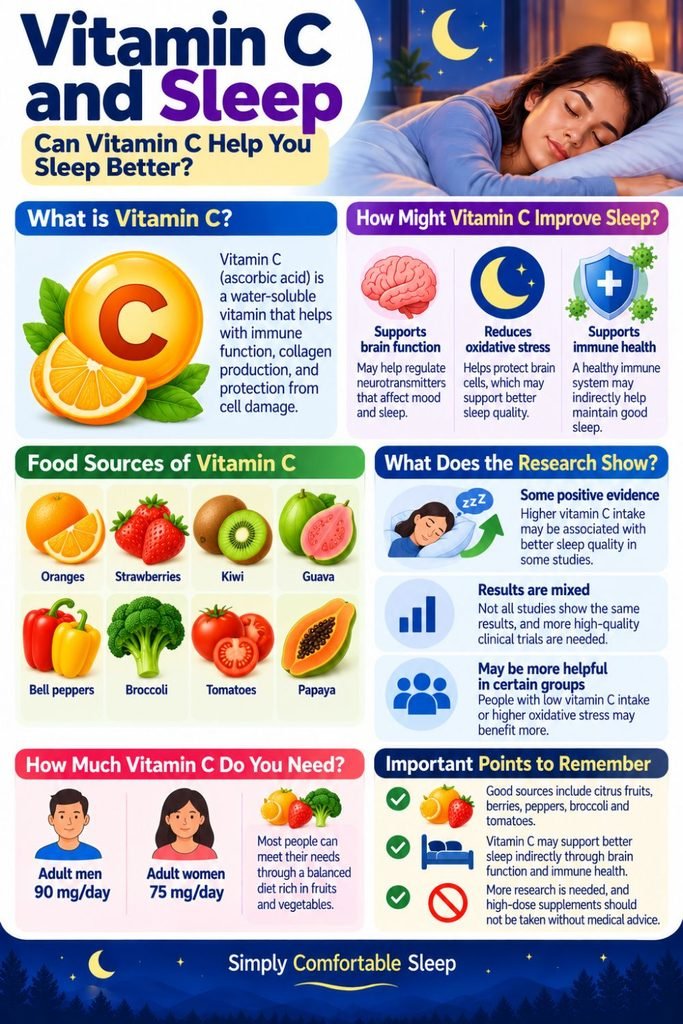
How Much Vitamin C Do You Need?
For adults, the recommended daily amounts are relatively modest.
| Life stage | Recommended intake |
|---|---|
| Adult men | 90 mg/day |
| Adult women | 75 mg/day |
| Pregnancy | 85 mg/day |
| Breastfeeding | 120 mg/day |
| People who smoke | 35 mg/day more than the standard recommendation |
These are nutritional requirements, not sleep-treatment doses.
There is currently no established dose such as 200 mg, 500 mg or 1,000 mg before bed for improving sleep.
What is the upper limit?
For adults, the U.S. tolerable upper intake level is 2,000 mg per day from all sources.
This is a safety limit, not a target.
Taking more vitamin C does not mean getting more sleep.
Can You Get Enough Vitamin C From Food?
For most people, food is an excellent way to obtain vitamin C.
Good sources include:
- Amla (Indian gooseberry)
- Guava
- Oranges
- Lemon
- Kiwi
- Strawberries
- Papaya
- Bell peppers
- Broccoli
- Cabbage
- Tomatoes
- Potatoes
A varied diet containing fruits and vegetables can provide substantial amounts of vitamin C.
For SCS readers, amla is particularly interesting because it is a familiar Indian food and can be a rich source of vitamin C.
But there is an important distinction.
A food containing vitamin C should not automatically be called a “sleep food.”
Eating guava, amla or an orange contributes to good nutrition. That does not mean eating it at bedtime will make you fall asleep faster.
If vitamin C has a role in sleep, it may be more related to overall nutritional adequacy and health than to the immediate effect of a single vitamin-C-rich food.
Also Read:
Should You Take Vitamin C Before Bed?
There is no established benefit to taking vitamin C immediately before bedtime.
Current evidence does not show that taking vitamin C at night:
- Makes you fall asleep faster
- Increases total sleep time
- Prevents nighttime awakenings
- Improves sleep efficiency
- Treats insomnia
If you take vitamin C because you need it nutritionally, there is no established requirement to take it at bedtime.
In fact, large doses can cause gastrointestinal symptoms such as diarrhea, nausea and abdominal cramps.
For someone trying to improve sleep, digestive discomfort is obviously not helpful.
Can Too Much Vitamin C Be Harmful?
Vitamin C has relatively low toxicity, but more is not necessarily better.
The adult upper limit is 2,000 mg per day from food, beverages and supplements combined.
Large supplemental doses can cause:
- Diarrhea
- Nausea
- Abdominal cramps
- Other gastrointestinal discomfort
There are also situations where high-dose supplementation deserves additional caution.
People with hereditary hemochromatosis, a condition in which the body accumulates too much iron, may be particularly vulnerable because high vitamin C intake can increase iron absorption and potentially worsen iron overload.
Vitamin C supplements can also interact with some medications or medical treatments, so people taking regular medication should discuss high-dose supplementation with their healthcare professional.
Vitamin C and Sleep: Take-Home Message
Meet your vitamin C needs, but there is no evidence that very high doses produce better sleep.
Also Read:
Vitamin C and Iron: An Interesting Connection
Vitamin C has an important nutritional relationship with iron.
It improves the absorption of non-heme iron, the form of iron found mainly in plant foods.
This is useful when a diet contains substantial amounts of plant-based iron.
Iron itself has a much more established connection with certain sleep problems, particularly restless legs syndrome (RLS).
That does not mean vitamin C treats RLS.
Rather, it shows why nutrients should sometimes be considered as part of the overall diet instead of as isolated supplements.
Also Read:
Vitamin C and Sleep Apnea: What Do We Know?
A large UK Biobank study found that dietary vitamin C intake was associated with a lower risk of sleep apnea.
This is an interesting finding, but it should not be interpreted as proof that vitamin C prevents or treats obstructive sleep apnea.
Sleep apnea is a medical sleep disorder that may require specific evaluation and treatment.
If someone snores loudly, has witnessed pauses in breathing, wakes up gasping or choking, or experiences significant daytime sleepiness, increasing vitamin C intake should not be used as a substitute for assessment.
When Poor Sleep Probably Isn’t a Vitamin C Problem
If you regularly have trouble falling asleep or staying asleep, vitamin C deficiency is unlikely to be the first explanation.
Poor sleep can have many causes, including:
- Chronic insomnia
- Obstructive sleep apnea
- Restless legs syndrome
- Circadian rhythm disorders
- Excess caffeine
- Alcohol
- Stress
- Anxiety
- Chronic pain
- Medication effects
- Irregular sleep schedules
- An unsuitable sleep environment
Nutrition still matters. A poor diet can contribute to overall health problems that affect sleep.
But taking a long list of supplements is not a substitute for identifying the actual cause of persistent sleep problems.
For chronic insomnia, cognitive behavioral therapy for insomnia (CBT-I) has substantially stronger evidence than vitamin C supplementation.
So, Does Vitamin C Help You Sleep?
Possibly—but the evidence is not strong enough to recommend vitamin C as a sleep supplement.
Recent observational studies have found associations between higher vitamin C blood levels or dietary intake and fewer sleep problems.
These findings make vitamin C and sleep an interesting area for further research.
But they do not establish that vitamin C supplementation improves sleep.
At present, there is no established:
- Sleep-specific vitamin C dose
- Bedtime vitamin C dose
- Supplementation protocol for insomnia
- Evidence-based vitamin C treatment for sleep apnea
- Proof that high-dose vitamin C produces better sleep
The practical approach is therefore simple:
Get enough vitamin C from a varied diet. Correct genuine deficiency when necessary. But don’t take high-dose vitamin C specifically to improve sleep.
If poor sleep continues despite reasonable sleep habits, look for the underlying cause rather than assuming that another supplement is the answer.
Final Take-Home Message
Vitamin C is essential for health, but it is not yet an established treatment for poor sleep or insomnia.
Also Read:
Frequently Adequate Questions
Does vitamin C help you sleep?
There is some observational evidence linking higher vitamin C intake or blood levels with fewer sleep problems, but there is not enough clinical evidence to conclude that vitamin C supplements improve sleep.
Can vitamin C deficiency cause insomnia?
Severe vitamin C deficiency can cause fatigue and other symptoms that may affect wellbeing, but vitamin C deficiency is not established as a common direct cause of insomnia.
Should I take vitamin C before bed?
There is no established sleep benefit from taking vitamin C at bedtime. There is also no established bedtime dose for sleep.
How much vitamin C do adults need?
Adult men generally need 90 mg/day, while adult women need 75 mg/day. The recommendation is higher during pregnancy and breastfeeding, and smokers need an additional 35 mg/day.
What foods are high in vitamin C?
Amla, guava, citrus fruits, kiwi, strawberries, bell peppers, broccoli, tomatoes and other fruits and vegetables provide vitamin C.
Can too much vitamin C affect sleep?
High doses can cause diarrhea, nausea and abdominal cramps, which could make sleep more uncomfortable. The adult upper limit is 2,000 mg/day from all sources.
Is vitamin C good for sleep apnea?
There is observational evidence linking higher dietary vitamin C intake with a lower risk of sleep apnea, but this does not establish vitamin C as a treatment or prevention strategy.
References
- National Institutes of Health, Office of Dietary Supplements. Vitamin C – Health Professional Fact Sheet. NIH ODS – Vitamin C, Health Professional Fact Sheet
- Wang S, Lai F, Zhao L, et al. Association between vitamin C in serum and trouble sleeping based on NHANES 2017–2018.Scientific Reports. 2024;14:9727. PMID: 38678062. PubMed – PMID 38678062
- Zhang Q, Qi X, Wang Z, Zhang D, Wang T. The Association Between Dietary Vitamin C and Sleep Disorders: A Cohort Study Based on UK Biobank. Nutrients. 2024;16(21):3661. PMID: 39519494. PubMed – PMID 39519494
- Ji X, Grandner MA, Liu J. The relationship between micronutrient status and sleep patterns: a systematic review.Public Health Nutrition. 2017;20(4):687–701. PMID: 27702409. PubMed – PMID 27702409
- National Institutes of Health, Office of Dietary Supplements. Vitamin C – Consumer Fact Sheet. NIH ODS – Vitamin C, Consumer Fact Sheet