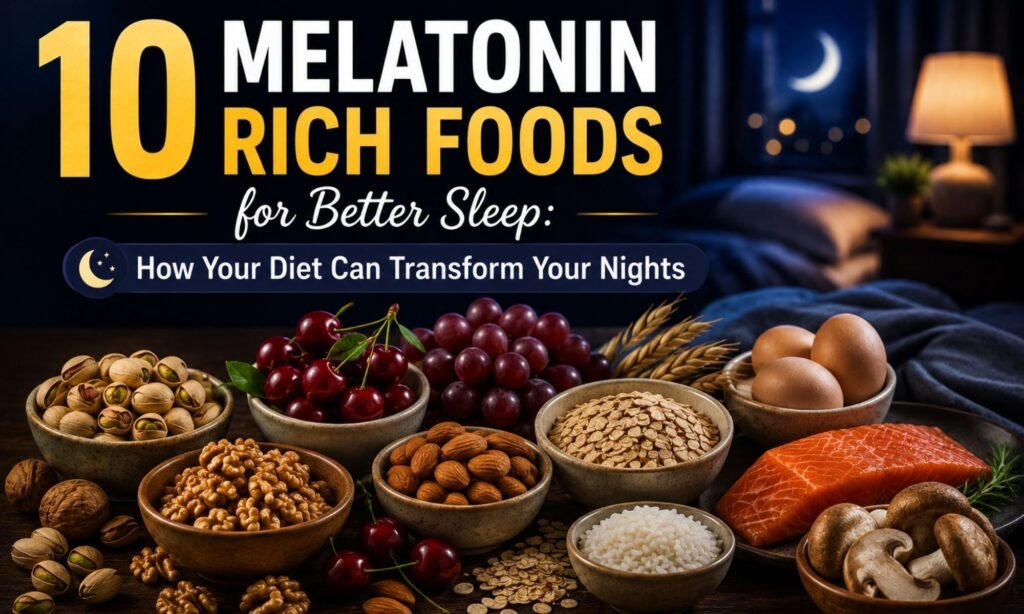
Some foods naturally contain melatonin and may support healthy sleep, but melatonin rich foods are not the same as melatonin supplements. Tart cherries, kiwifruit, tomatoes and almonds have some of the more interesting human research, but the overall evidence is still developing.
If you are looking for natural ways to support better sleep, adding nutritious foods to your diet can be worthwhile. But these foods should be viewed as part of a sleep-supportive diet, not as replacements for appropriate treatment when a genuine sleep disorder is present.
let’s discover 10 melatonin rich foods for better sleep and learn which ones are backed by human research.
Table of Contents
What Are Melatonin-Rich Foods?
When most people hear the word melatonin, they think of sleep supplements. But melatonin is actually a hormone your body produces naturally.
Your brain normally begins producing more melatonin as darkness arrives. This helps your body recognize that it is biological night and supports the timing of your circadian rhythm and sleep-wake cycle.
Interestingly, melatonin is not found only in humans.
Researchers have detected melatonin in a wide range of foods, including fruits, vegetables, grains, nuts, seeds, mushrooms, eggs, fish and dairy products.
That has led to an obvious question:
Can eating foods that contain melatonin help you sleep better?
The answer is more complicated than many websites make it sound.
A food may contain measurable melatonin without being proven to improve sleep.
The amount of melatonin found in a food can also vary considerably depending on:
- The variety or cultivar
- Growing conditions
- Harvesting time
- Storage
- Processing
- Food preparation
- The laboratory method used to measure melatonin
So you should be cautious when you see a list claiming that one food contains a specific amount of melatonin.
Those numbers are not always universal.
More importantly, melatonin content is not the same thing as proven sleep benefit. That distinction is central to understanding the science behind melatonin-rich foods.
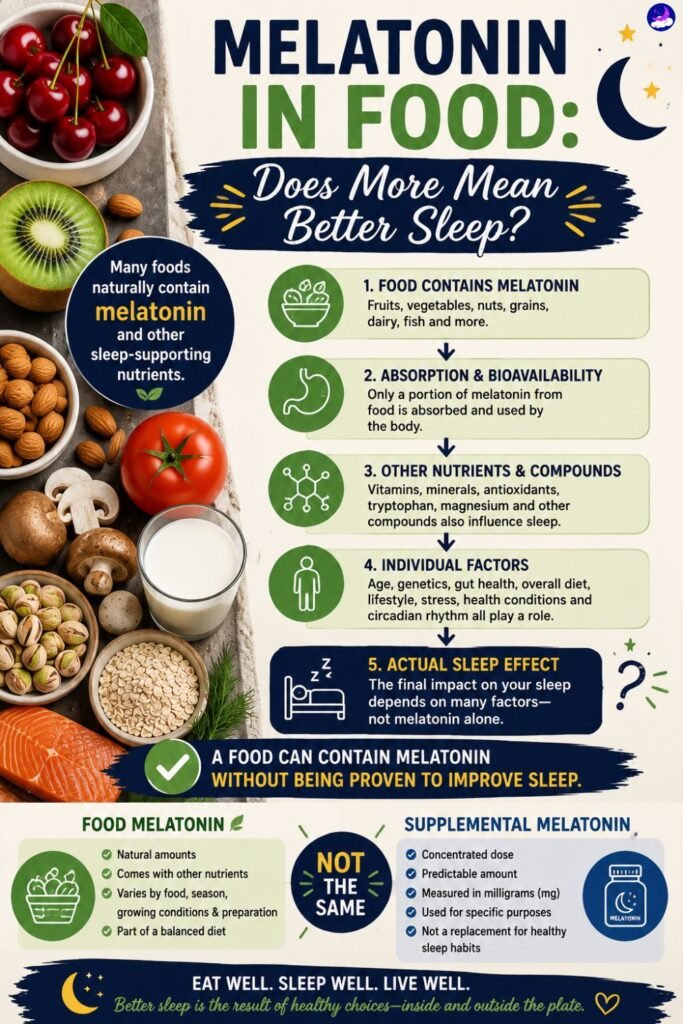
Can Eating Melatonin-Rich Foods Increase Melatonin in Your Body?
There is evidence suggesting that consuming some foods containing melatonin can influence melatonin-related markers in the body.
For example, studies involving tart cherry products have reported increases in melatonin or melatonin metabolites alongside changes in some sleep measures.
But this does not mean that every food containing melatonin will have the same effect.
There are several reasons.
The amount of melatonin in food is generally much smaller than the amount found in many melatonin supplements. The melatonin is also consumed together with carbohydrates, fats, proteins, vitamins, minerals and other plant compounds.
Digestion and absorption can further affect how much melatonin becomes available to the body.
There is therefore a major difference between these two statements:
“This food contains melatonin.”
and
“Eating this food improves sleep.”
The first can be established by laboratory testing.
The second requires human clinical research.
A 2026 scoping review is particularly useful here. Researchers identified 19 studies, including 14 intervention trials, examining melatonin-containing foods and sleep. The review found potentially beneficial effects from foods including Montmorency tart cherries, Jerte Valley cherries, tomatoes and kiwifruit, but the findings were heterogeneous.
The studies differed in participants, food amounts, timing, intervention duration and methods used to measure sleep.
So the evidence is interesting—but it is not strong enough to say that eating melatonin-rich foods is a proven treatment for insomnia.
Also Read: Our Melatonin Guide | Circadian Rhythm and Melatonin | Your Body's Natural Melatonin Production
Melatonin-Rich Foods: What Does the Evidence Actually Show?
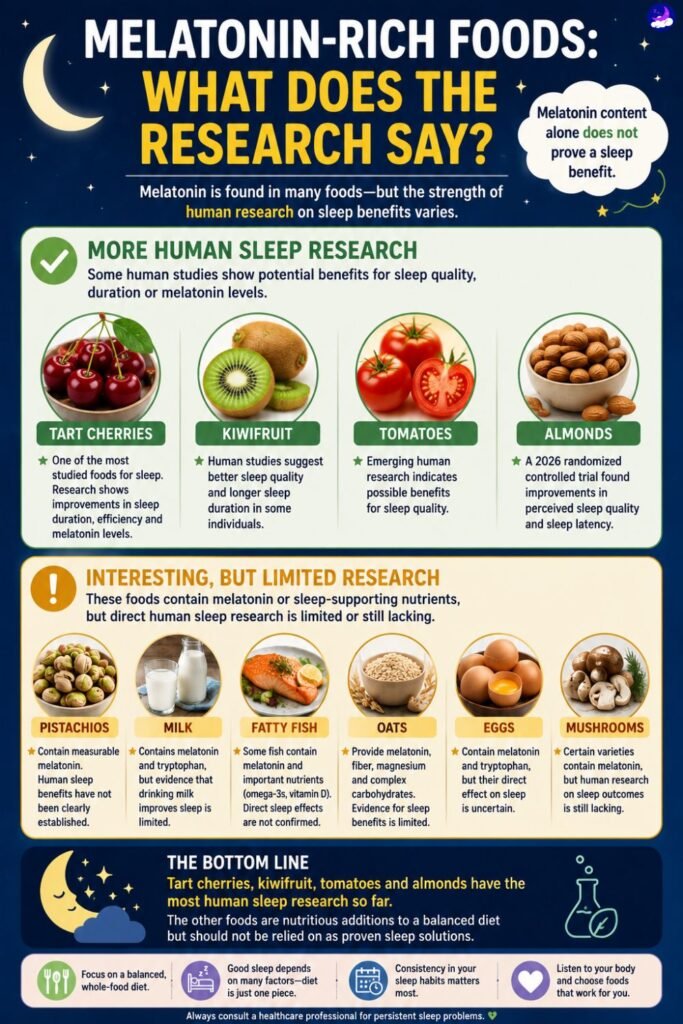
Before looking at individual foods, it helps to divide them into two groups.
Foods with direct human sleep research
Some foods have actually been tested in people for their effects on sleep.
These include foods such as:
- Tart cherries
- Kiwifruit
- Tomatoes
- Almonds
These foods are particularly interesting because researchers have gone beyond simply measuring their melatonin content.
Foods that contain melatonin but need more research
Other foods have measurable melatonin or biologically interesting nutrients but have much less direct evidence showing that eating them improves sleep.
These include foods such as:
- Pistachios
- Milk
- Eggs
- Fatty fish
- Oats
- Mushrooms
This distinction is important.
A food can be melatonin-rich without being a scientifically proven sleep aid.
With that in mind, let’s look at the ten foods in more detail.
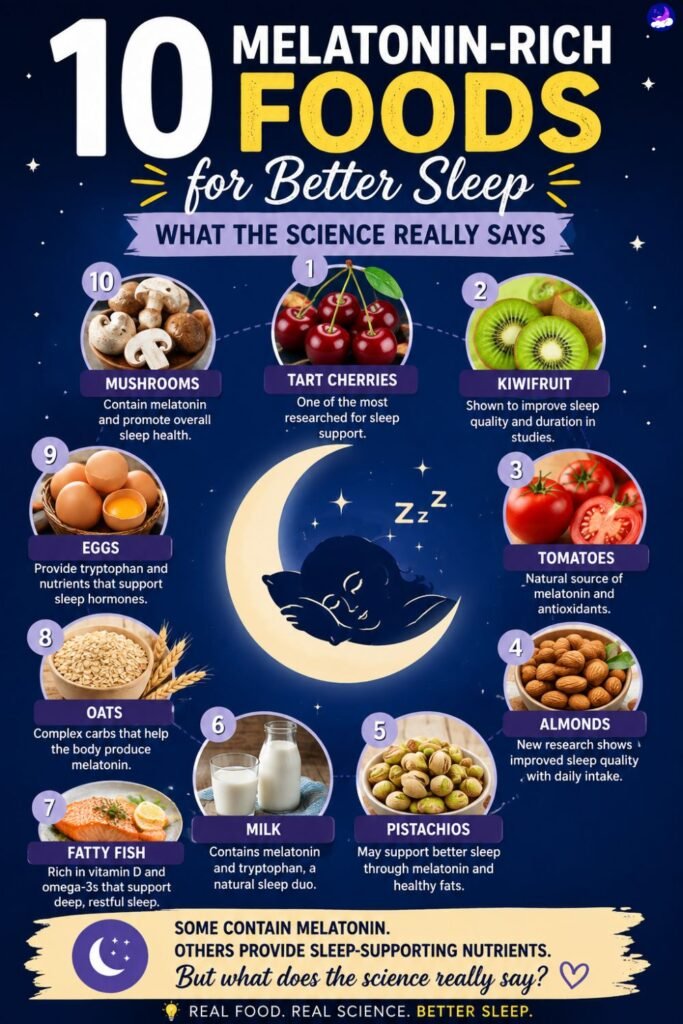
1. Tart Cherries
If you want to start with one of the best-studied melatonin-rich foods, tart cherries are a logical choice.
Tart cherries contain naturally occurring melatonin as well as plant compounds such as anthocyanins and other polyphenols.
Researchers have studied tart cherry consumption in relation to several sleep outcomes, including:
- Sleep duration
- Sleep efficiency
- Sleep onset
- Melatonin levels
- Subjective sleep quality
A 2025 systematic review identified seven interventional studies examining tart cherry consumption and sleep. Three studies reported improvements in sleep indicators, while three reported increases in melatonin levels.
That sounds encouraging.
But the researchers also found considerable differences in the studies, including the amount of tart cherry consumed, duration of treatment and characteristics of participants.
They therefore concluded that the available evidence remains limited and heterogeneous.
Take-Home Message
Tart cherries are one of the better-studied melatonin-rich foods, with promising evidence for some sleep outcomes—but they are not a proven treatment for insomnia.
2. Kiwifruit
Kiwifruit is an interesting addition because it has been studied directly for sleep quality, rather than simply being identified as a food containing melatonin.
The 2026 scoping review identified kiwifruit among the melatonin-containing foods that have been investigated in human intervention studies. These studies suggest possible improvements in sleep-related outcomes, although the overall evidence remains heterogeneous.
Kiwifruit also provides:
- Vitamin C
- Fiber
- Folate
- Potassium
- Various antioxidant compounds
This is important because the potential sleep effects of a whole food cannot necessarily be attributed to melatonin alone.
Researchers are still trying to understand whether the effects of foods such as kiwifruit are related to melatonin, other nutrients, antioxidant compounds, serotonin-related pathways, or a combination of factors.
Should You Eat Kiwifruit Before Bed?
There is no universally established bedtime dose or timing.
If you enjoy kiwifruit and tolerate it well, it can be part of a healthy diet. But it should not be treated as a guaranteed sleep remedy.
Take-Home Message
Kiwifruit has promising sleep research, but we still do not know whether its effects are mainly related to melatonin or other nutrients and compounds.
3. Tomatoes
Tomatoes may seem like an unusual addition to a list of melatonin-rich foods, but they deserve attention.
The 2026 scoping review identified tomatoes among the foods for which human research has examined possible effects on sleep.
Tomatoes also contain several biologically active compounds, including:
- Lycopene
- Vitamin C
- Carotenoids
- Other polyphenolic compounds
Again, this highlights a recurring theme in nutrition research.
A whole food does not contain just one active ingredient.
If tomatoes are associated with a sleep-related benefit in a particular study, we cannot automatically assume that melatonin alone caused the effect.
The Practical Takeaway
Tomatoes are an easy food to include in a balanced diet through salads, cooked meals, soups or other preparations.
But don’t eat tomatoes because you expect them to act like a melatonin tablet.
Think of them as a nutritious food with emerging sleep research.
Take-Home Message
Tomatoes contain melatonin and have emerging human research, but there is not yet enough evidence to call them a proven sleep aid.
4. Almonds
Almonds deserve a place on this list for two reasons.
First, almonds contain naturally occurring melatonin and several nutrients relevant to normal health.
Second, we now have new human clinical research examining almonds and sleep.
A 2026 randomized controlled trial included 175 adults aged 21–55 with poor sleep quality. Participants consumed almonds or an isocaloric control snack for five months.
The almond group showed greater improvements in several subjective sleep outcomes, including subjective sleep efficiency and sleep latency.
However, most objective sleep measures assessed using polysomnography did not show significant between-group differences.
The study also examined melatonin levels, making the findings particularly interesting. However, more research is needed before we can conclude that almonds directly improve sleep through melatonin.
Almonds also provide:
- Magnesium
- Vitamin E
- Healthy fats
- Protein
- Fiber
What Should We Conclude?
Regular almond consumption may support perceived sleep quality, but we cannot yet say that almonds treat insomnia.
This is a good example of why SCS should distinguish between promising research and established evidence.
Take-Home Message
Recent research suggests almonds may improve some measures of perceived sleep quality, but more research is needed before drawing strong conclusions.
5. Pistachios
Pistachios are often described online as one of the most melatonin-rich foods.
There is some scientific basis for the interest.
Researchers have detected measurable melatonin in pistachios, but reported concentrations can vary considerably depending on the sample and testing method.
This variability is one reason it is difficult to provide one definitive number for the melatonin content of every pistachio.
Pistachios also provide:
- Protein
- Healthy fats
- Magnesium
- Fiber
- Various micronutrients
However, there is a major difference between knowing that pistachios contain melatonin and proving that eating pistachios improves sleep.
The direct human evidence is much more limited.
So Should You Eat Pistachios for Sleep?
They can certainly be part of a healthy diet.
A small serving of unsalted pistachios may also make a sensible snack if you tolerate them well.
But don’t think of pistachios as a natural equivalent of a melatonin supplement.
Take-Home Message
Pistachios contain measurable melatonin, but evidence that eating them directly improves sleep is still limited.
6. Milk
Milk has an interesting relationship with melatonin and sleep.
Researchers have detected melatonin in milk, and its concentration can vary depending on factors such as the time at which the milk was produced.
Milk also contains tryptophan, an amino acid involved in the biochemical pathway that eventually contributes to melatonin production.
It provides other nutrients as well, including:
- Protein
- Calcium
- Vitamin B12
- Riboflavin
This may help explain why milk has traditionally been associated with bedtime routines.
But there is an important distinction.
The fact that milk contains melatonin and tryptophan does not mean that drinking a glass of milk before bed will reliably increase your melatonin enough to improve sleep.
The human evidence remains limited.
What About Warm Milk?
Warm milk may be comforting for some people and can become part of a relaxing bedtime routine.
That behavioral effect should not be confused with a proven pharmacological effect of milk on sleep.
If you enjoy milk and tolerate dairy well, there is nothing wrong with including it in a balanced diet.
Take-Home Message
Milk contains melatonin and tryptophan, but evidence that drinking milk directly improves sleep remains limited.
7. Fatty Fish
Fatty fish such as salmon are sometimes included in lists of foods containing melatonin.
But their potential relationship with sleep is broader than melatonin alone.
Fatty fish provide:
- Omega-3 fatty acids
- Vitamin D
- High-quality protein
- Vitamin B12
- Other nutrients
These nutrients are important for overall health, and researchers have explored relationships between nutrition, inflammation, brain function and sleep.
However, we should not make a simple claim such as:
“Salmon increases melatonin and therefore improves sleep.”
The available evidence does not justify that conclusion.
Fatty fish are valuable foods regardless of their melatonin content, and including them as part of a balanced diet can support overall nutritional health.
If they also contribute to healthy sleep through several biological pathways, that is an interesting area for further research.
Take-Home Message
Fatty fish provide melatonin along with omega-3 fatty acids and vitamin D, but their direct effect on sleep has not been firmly established.
8. Oats and Whole Grains
Whole grains such as oats are another interesting source of dietary melatonin.
Oats also provide:
- Complex carbohydrates
- Fiber
- Magnesium
- Several vitamins and minerals
There has been research into whether carbohydrate-containing meals may influence sleep through pathways involving insulin and the availability of tryptophan to the brain.
But this does not mean that eating a bowl of oatmeal before bed will automatically make you fall asleep faster.
The relationship between carbohydrates and sleep is more complicated than that.
Oats can be an excellent part of a balanced diet, but we should not turn them into a “natural sleeping pill.”
A Practical Approach
If you enjoy oatmeal, you can include it as breakfast, lunch or part of an evening meal depending on your overall diet and personal preference.
There is no strong evidence establishing a universal “oatmeal bedtime dose.”
Take-Home Message
Oats provide melatonin and several sleep-relevant nutrients, but there is not enough evidence to recommend them as a specific sleep treatment.
9. Eggs
Eggs are another food in which researchers have detected measurable melatonin.
They also contain:
- High-quality protein
- Tryptophan
- Vitamin B12
- Choline
- Other micronutrients
Tryptophan is particularly interesting because it is involved in the pathway that contributes to serotonin and melatonin production.
However, this biochemical pathway should not be confused with clinical evidence.
Eating an egg does not mean that your body will suddenly produce large amounts of melatonin.
There is currently not enough evidence to recommend eggs as a treatment for insomnia.
Instead, think of eggs as a nutrient-rich food that happens to contain measurable melatonin and other compounds relevant to sleep biology.
Take-Home Message
Eggs contain measurable melatonin and tryptophan, but their direct effect on sleep has not been established.
10. Mushrooms
Mushrooms complete our list because several types of mushrooms have been found to contain melatonin.
The amount can vary substantially between species and growing conditions.
Mushrooms also contain a variety of nutrients and bioactive compounds, making them interesting from a nutritional perspective.
But, once again, there is an important distinction between:
“Mushrooms contain melatonin.”
and:
“Eating mushrooms improves sleep.”
The first has laboratory support.
The second requires more human research.
At present, there is not enough evidence to recommend a specific mushroom, portion or bedtime schedule for improving sleep.
Still, mushrooms can be a useful part of a varied diet.
Take-Home Message
Some mushrooms contain melatonin, but human research showing that eating mushrooms improves sleep is still limited.
Melatonin-Rich Foods at a Glance
| Food | Melatonin / Sleep Connection | Key Nutrients or Compounds | Take-Home Message |
|---|---|---|---|
| Tart cherries | Naturally contain melatonin; studied in human sleep research | Anthocyanins, polyphenols | One of the better-studied options, but evidence is still limited. |
| Kiwifruit | Studied for sleep outcomes | Vitamin C, fiber, potassium | Promising, but more research is needed. |
| Tomatoes | Contain melatonin; emerging sleep research | Lycopene, carotenoids, vitamin C | Interesting research, but not a proven sleep aid. |
| Almonds | Contain melatonin; recent human trial | Magnesium, vitamin E, healthy fats | Encouraging early evidence, especially for perceived sleep quality. |
| Pistachios | Measurable dietary melatonin reported | Protein, healthy fats, magnesium | Melatonin-rich, but direct sleep evidence is limited. |
| Milk | Contains melatonin and tryptophan | Protein, calcium, B12 | May fit a bedtime routine, but sleep benefits aren’t firmly established. |
| Fatty fish | Some fish contain measurable melatonin | Omega-3s, vitamin D, protein | Nutritionally valuable, but direct sleep evidence is limited. |
| Oats | Cereals contain measurable melatonin | Fiber, complex carbohydrates, magnesium | A healthy whole grain, but not a proven sleep treatment. |
| Eggs | Measurable melatonin reported | Protein, tryptophan, B12, choline | Nutrient-rich, but direct sleep benefits remain uncertain. |
| Mushrooms | Some varieties contain melatonin | Bioactive compounds | Interesting melatonin source, but human sleep research is limited. |
Important: Melatonin concentrations in foods can vary substantially depending on variety, growing conditions, processing, storage and laboratory methods. A higher measured melatonin concentration also does not automatically mean a greater sleep benefit.
Which Foods Have the Best Human Evidence?
This is an important question because a list of foods containing melatonin can easily become misleading.
Some foods have been studied only in laboratories.
Others have been tested in humans.
And a much smaller number have been examined in controlled sleep studies.
The current evidence suggests that tart cherries, kiwifruit and tomatoes are among the more interesting foods for further research, while almonds have recently gained attention because of a randomized controlled trial.
Tart cherries have some of the more established research among the foods discussed here. The 2025 systematic review found seven interventional studies, although the researchers emphasized that differences in study design and populations prevent strong conclusions.
Almonds are also interesting because the 2026 trial moved beyond laboratory analysis and examined both subjective sleep quality and objective sleep measures.
The other foods are better described as promising nutritional candidates or foods containing melatonin, rather than proven sleep interventions.
This distinction is one of the most important things to remember when reading about natural sleep aids.
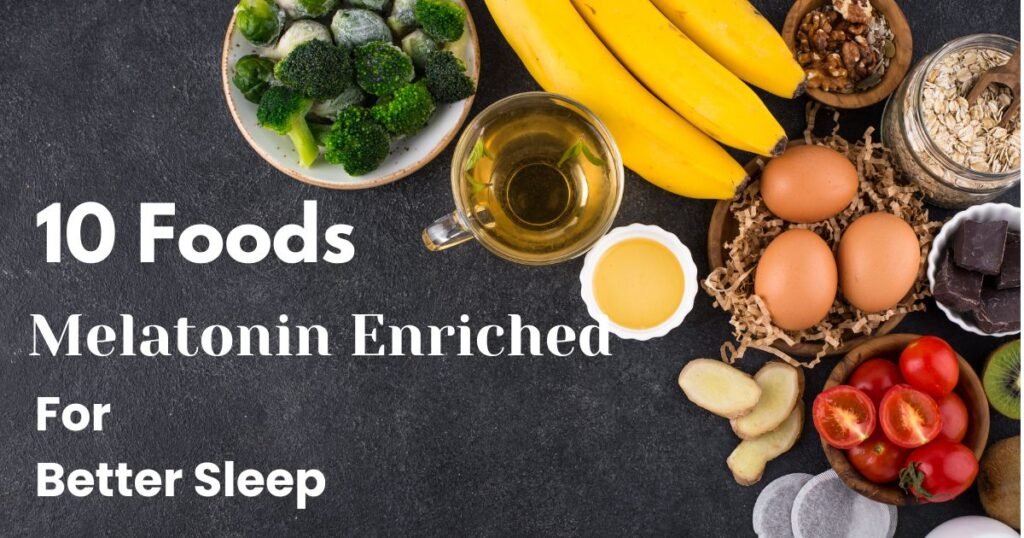
Melatonin-Rich Foods vs. Melatonin Supplements
A common mistake is assuming that eating a food containing melatonin is basically the same as taking a melatonin supplement.
It isn’t.
Melatonin From Food
When you eat a melatonin-rich food, you consume melatonin alongside:
- Protein
- Carbohydrates
- Fats
- Vitamins
- Minerals
- Fiber
- Antioxidants
- Other plant or animal compounds
The amount of melatonin can also vary substantially.
Melatonin Supplements
A supplement is designed to provide a concentrated amount of melatonin.
This creates a very different exposure.
Food measurements may be reported in nanograms per gram, whereas melatonin supplements are commonly labeled in milligrams.
One milligram equals one million nanograms.
This does not mean a supplement is automatically better.
It simply means that dietary melatonin and supplemental melatonin should not be treated as equivalent.
If you want to understand how supplemental melatonin works, including dosage, timing, side effects and interactions, that is a separate question from whether foods containing melatonin can support sleep.
Also Read: Melatonin For Jetlag | Melatonin For Shift workers
Does More Melatonin in a Food Mean Better Sleep?
No—not necessarily.
This may be the most important scientific lesson in the entire topic.
Imagine that laboratory testing finds more melatonin in Food A than Food B.
It would be tempting to conclude:
Food A must be better for sleep.
But we cannot make that conclusion from melatonin content alone.
The potential effect of a food depends on:
- How much food is consumed
- How much melatonin it contains
- How much is absorbed
- When it is consumed
- Other nutrients in the food
- Individual metabolism
- Circadian timing
- The person’s sleep pattern
- Existing medical or sleep conditions
This is one reason the 2026 scoping review found considerable variation between studies involving food dose, timing, duration, participants and sleep measurement methods.
So when you see a headline claiming:
“This food has the most melatonin!”
don’t automatically interpret that as:
“This food is the best for sleep.”
Those are two very different claims.
What About Tryptophan, Magnesium and Other Sleep Nutrients?
Melatonin is only one piece of the nutrition-and-sleep puzzle.
Several foods on this list also provide nutrients involved in normal nervous-system function and sleep-related biological pathways.
Tryptophan
Tryptophan is an essential amino acid found in foods such as:
- Eggs
- Milk
- Fish
- Nuts
- Seeds
- Other protein-rich foods
The body can use tryptophan to produce serotonin, which is involved in the biochemical pathway leading to melatonin.
However, eating tryptophan does not automatically produce a large increase in melatonin.
The pathway is regulated by multiple biological steps.
Magnesium
Magnesium is another nutrient commonly associated with sleep.
Foods such as almonds, pistachios and whole grains provide magnesium.
Magnesium participates in many processes involving the nervous system, muscles and energy metabolism.
But eating a magnesium-rich food is not equivalent to taking a magnesium supplement, and research on magnesium supplementation should not automatically be used as evidence that a particular food treats insomnia.
Omega-3 Fatty Acids and Vitamin D
Fatty fish provide omega-3 fatty acids and vitamin D, which are important nutrients for overall health.
Researchers have investigated their relationships with sleep, but this should not be turned into a simple claim that eating salmon before bed will improve sleep.
The bigger lesson is that a healthy dietary pattern provides many nutrients that support normal biological function.
When Should You Eat Melatonin-Rich Foods?
There is no single scientifically established bedtime for all melatonin-rich foods.
Some studies have tested foods in the evening, while others have examined regular consumption over weeks or months.
The 2026 scoping review specifically noted differences in the timing of food consumption across studies.
So be cautious with claims such as:
“Eat this food exactly 30 minutes before bed.”
There is rarely enough evidence to make such a universal recommendation.
Instead, focus on your overall evening eating pattern.
You may find it useful to:
- Avoid very large meals immediately before bed if they cause discomfort.
- Limit caffeine later in the day.
- Choose foods you digest comfortably.
- Keep evening snacks moderate.
- Avoid using food as a substitute for a consistent sleep schedule.
- Pay attention to how your own body responds.
A small serving of fruit, yogurt, milk, oats or nuts may work well for some people.
Others may sleep better without eating close to bedtime.
There is no single perfect bedtime food for everyone.
Also Read: Melatonin for Older Adults | Melatonin for Pregnant Women | Melatonin for Kids.
Can Melatonin-Rich Foods Replace Melatonin Supplements?
Usually, this is not the best question to ask.
Food and supplements serve different purposes.
If someone has a specific reason to consider melatonin, such as a circadian rhythm problem or jet lag, the evidence surrounding a measured melatonin supplement is different from the evidence surrounding dietary melatonin.
On the other hand, if your goal is to improve your overall diet and support healthy sleep, adding nutritious foods makes sense.
The two approaches should not be treated as interchangeable.
Think of it this way:
Melatonin-rich foods
→ part of a balanced diet
Melatonin supplements
→ concentrated melatonin used for specific purposes
Neither is a magic solution for every sleep problem.
How to Build a Sleep-Friendly Evening Diet
Instead of searching for one food that will “make you sleep,” think about the entire evening.
A balanced evening meal could include:
Protein
Fish, eggs, dairy, beans or another protein source.
Whole-Food Carbohydrates
Oats, whole grains, vegetables or fruit.
Healthy Fats
Nuts, seeds or fatty fish.
Plant Foods
Fruits and vegetables containing fiber, vitamins, minerals and plant compounds.
If you are hungry later, a small snack may be more comfortable than a very large meal.
For example:
Oatmeal + a small portion of almonds + fruit
or
Yogurt + fruit + a few nuts
or
Salmon + vegetables + whole grains
These aren’t “sleep prescriptions.”
They are simply examples of how foods associated with sleep research can fit into a balanced dietary pattern.
What the Research Still Cannot Tell Us
The research on melatonin-rich foods and sleep is growing, but important questions remain.
How much dietary melatonin reaches the bloodstream?
Some studies show changes in melatonin-related markers after consuming certain foods, but absorption and bioavailability can vary.
Does Food-Derived Melatonin Change the Body Clock?
That remains much less certain than the established role of the body’s own melatonin system.
Which Food Works Best?
There are not enough head-to-head clinical trials comparing different melatonin-rich foods.
What Is the Ideal Amount?
There is no established dietary melatonin dose for improving sleep.
Who Benefits Most?
A food may affect a person with poor sleep differently from someone who already sleeps well.
Are the Effects Caused by Melatonin Alone?
Probably not always.
A food contains many compounds at the same time. A sleep-related effect could involve melatonin, antioxidants, tryptophan, magnesium, polyphenols, fatty acids or several compounds working together.
This is why researchers continue to study whole foods rather than simply assuming that their melatonin content explains everything.
Are Melatonin-Rich Foods Safe?
The foods discussed in this article are ordinary foods that can generally be part of a balanced diet for people who tolerate them.
But individual dietary needs vary.
For example:
- People with food allergies need to avoid trigger foods.
- People with diabetes may need to consider carbohydrate portions.
- People with kidney disease may need individualized dietary advice.
- People taking certain medicines may have dietary restrictions.
- Some people experience reflux or digestive discomfort after eating close to bedtime.
And there is an important distinction between food safety and supplement safety.
The fact that a food naturally contains melatonin does not mean that taking a concentrated melatonin supplement is automatically appropriate for everyone.
If you have persistent insomnia, excessive daytime sleepiness, loud snoring, breathing pauses during sleep or another ongoing sleep problem, changing your diet may not address the underlying cause.
Diet Is Only One Part of Better Sleep
It is tempting to look for a single food for better sleep.
But sleep is influenced by many factors.
These include:
- Circadian rhythm
- Light exposure
- Sleep schedule
- Stress
- Physical activity
- Caffeine
- Alcohol
- Bedroom environment
- Medical conditions
- Medications
- Diet
- Individual biology
Food can support a healthy lifestyle, but it cannot compensate for every other factor.
A handful of almonds or a serving of tart cherries can be a nutritious part of your diet.
But if you are sleeping poorly because of an untreated sleep disorder, changing your evening snack is unlikely to solve the underlying problem.
This is why melatonin-rich foods should be viewed as one part of sleep health, not as a replacement for evidence-based treatment.
Frequently Asked Questions
Which food contains the most melatonin?
There is no single universally accepted answer. Melatonin measurements vary between foods, varieties, growing conditions and laboratory methods. More importantly, a higher melatonin concentration does not automatically mean a greater sleep benefit.
What Are the Best Melatonin-Rich Foods for Sleep?
Tart cherries currently have some of the better human evidence among the foods discussed here. Kiwifruit and tomatoes are also being investigated, while recent research on almonds is encouraging. However, the overall evidence remains limited and heterogeneous.
Do Melatonin-Rich Foods Really Work?
Some foods may improve certain sleep measures, but the evidence varies considerably. The strongest evidence is not strong enough to say that all foods containing melatonin reliably improve sleep.
Can I Get Enough Melatonin From Food?
Foods can provide naturally occurring melatonin, but the amounts are generally much smaller and more variable than those provided by melatonin supplements. Food and supplements should therefore not be considered equivalent.
Should I Eat Melatonin-Rich Foods Before Bed?
You can include them in your evening diet if they suit you, but there is no universal bedtime rule. Your overall diet, meal size, digestion and sleep schedule are more important than following a rigid timing rule.
Are Melatonin-Rich Foods Better Than Melatonin Supplements?
They are different. Melatonin-rich foods provide melatonin alongside other nutrients, while supplements provide a concentrated dose. Which approach is appropriate depends on the individual’s reason for using melatonin.
Also Read: Melatonin and Weird Dreams | Melatonin Myths and Facts | Benefits of Melatonin beyond sleep.
The Bottom Line
Melatonin-rich foods are an interesting part of sleep nutrition, but they are not magic sleep remedies.
Foods such as tart cherries, kiwifruit, tomatoes, almonds, pistachios, milk, fatty fish, oats, eggs and mushrooms contain melatonin or other nutrients connected with sleep biology. But the strength of evidence varies considerably.
Among these foods, tart cherries currently have some of the stronger human evidence, while research on kiwifruit, tomatoes and almonds is also interesting. A 2026 scoping review found potential benefits from several melatonin-containing foods but emphasized that the evidence remains heterogeneous and that many foods have received little direct clinical research.
The most important distinction is this:
A food containing melatonin is not automatically a food proven to improve sleep.
The amount of melatonin in a food can vary, and any effect may involve many other nutrients and biological pathways.
So rather than searching for one “best” melatonin-rich food, focus on building a balanced, nutritious diet that supports overall sleep health.
Tart cherries, fruit, vegetables, whole grains, nuts, fish, eggs and dairy can all have a place in that diet depending on your individual nutritional needs.
And if you have persistent sleep problems, don’t rely on food alone. The right approach depends on why you are not sleeping well in the first place.
References
- Desai SR, Pinto L, Halbe A, Vaidya RA, Udipi SA, Kalita S. Effects of almond consumption on sleep quality in adults: a randomized controlled trial. Frontiers in Nutrition. 2026;13:1892442. Read the full study
- Barforoush F, Ebrahimi S, Karimian Abdar M, Khademi S, Morshedzadeh N. The Effect of Tart Cherry on Sleep Quality and Sleep Disorders: A Systematic Review. Food Science & Nutrition. 2025;13(9):e70923. Read the systematic review
- Nisar T, Fuller A, Gyawali P, Bird S. Effectiveness of Melatonin-Containing Foods on Promoting Sleep: A Scoping Review. Food Science & Nutrition. 2026;14(5):e71823. Read the 2026 scoping review
- Meng X, Li Y, Li S, Zhou Y, Gan R-Y, Xu D-P, Li H-B. Dietary Sources and Bioactivities of Melatonin. Nutrients. 2017;9(4):367. Read the full review
- Influence of Dietary Sources of Melatonin on Sleep Quality: A Review. Journal of Food Science. 2020. Read the review on PubMed
- Melatonin-rich foods in our diet: food for thought or wishful thinking? 2020. Read the review on PubMed
- Plant-derived melatonin from food: a gift of nature. 2021. Read the review on PubMed