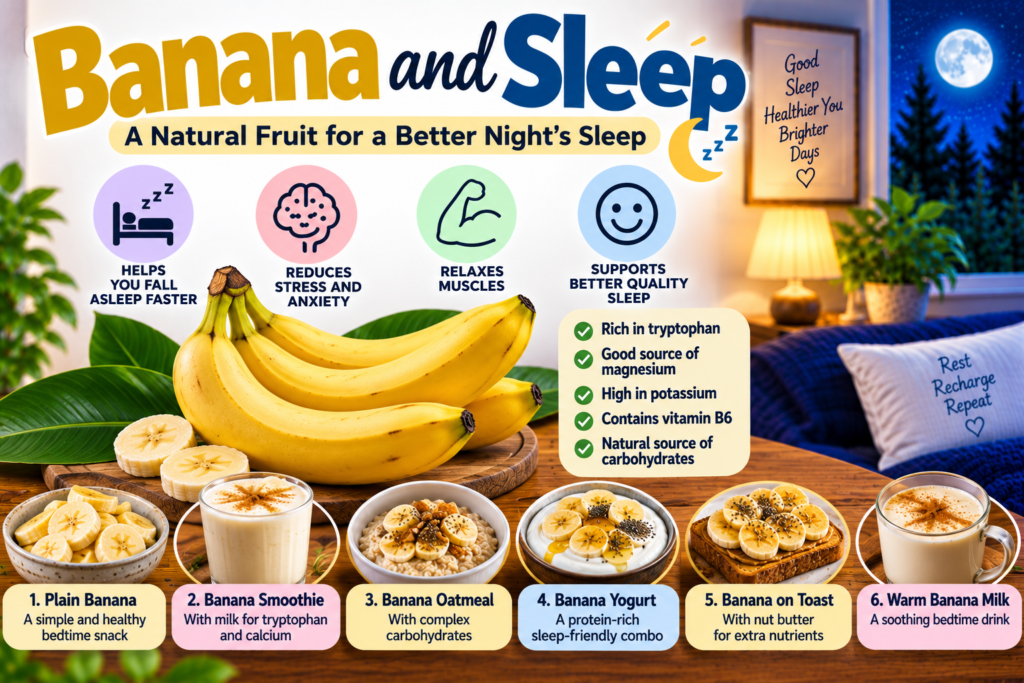
Banana and sleep are often discussed together because bananas contain magnesium, potassium, vitamin B6, and carbohydrates that support normal body functions.
Some research has investigated whether eating a banana at bedtime may improve sleep quality, but the evidence remains limited.
A small clinical study reported improved subjective sleep quality among participants who ate bananas before bed, although it did not establish that bananas reliably increase sleep duration or treat insomnia.
Table of Contents
In this guide, we explore what the research says, the possible benefits of eating a banana at night, and how to include it in a healthy evening diet.
Bananas are affordable, widely available, and easy to eat without any preparation. But does eating one before bed actually help you fall asleep faster or sleep more soundly?
The answer is not as straightforward as many online articles suggest. Let’s look at the evidence and separate what we know from what still needs research.
Can Eating a Banana Help You Sleep Better?
Bananas may be a useful evening snack, particularly if hunger makes it difficult to settle down at bedtime. They provide carbohydrates, fibre, potassium, magnesium, and vitamin B6.
However, a nutritious food is not automatically a sleep-promoting food.
Here is what we know:
- Bananas provide essential nutrients that support normal nerve function, muscle function, and metabolism.
- A banana can satisfy evening hunger, which may help if you find it uncomfortable to go to bed hungry.
- A small clinical study has investigated bananas at bedtime in people with insomnia, with some encouraging findings.
- Strong evidence is still missing. We do not yet know whether eating bananas regularly improves sleep in most people.
The practical answer is that you can enjoy a banana before bed if it suits your diet, but you should not expect it to work like a sleeping pill.
What Did Researchers Discover About Banana and Sleep?
One reason banana and sleep has become a popular topic is a small clinical study published in 2024. Unlike many nutrition articles that rely entirely on theories about individual nutrients, this study directly examined bedtime banana consumption in people with insomnia.
One Small Study Found a Possible Benefit—But Is It Enough?
Researchers investigated the effects of eating a banana or drinking milk at bedtime in people with primary insomnia.
The study included 21 participants, divided into three groups:
- A banana group that ate one portion of banana at bedtime.
- A milk group that drank 200 mL of whole milk at bedtime.
- A control group that did not add a non-routine bedtime food.
The intervention lasted six weeks. Researchers assessed sleep using the Pittsburgh Sleep Quality Index (PSQI) and polysomnography, which records several aspects of sleep.
The findings were interesting:
- Subjective sleep quality improved in both the banana and milk groups, based on changes in PSQI scores.
- Total sleep time increased significantly in the milk group compared with its baseline measurement.
- The study did not establish that bananas reliably increased total sleep time.
There are important limitations to keep in mind.
First, only 21 people completed the study, leaving just seven participants in each group. Such small groups make it difficult to draw conclusions that apply to the wider population.
Second, the improvement in sleep questionnaire scores does not prove that bananas can treat insomnia. Larger trials are needed to confirm whether the effect is real, clinically meaningful, and reproducible.
The study provides an interesting reason to investigate bananas and sleep quality, but it is not enough to recommend bananas as an established sleep treatment.
What Does This Mean for You?
At present, the evidence does not show that everyone who eats a banana before bed will sleep better.
It is reasonable to include bananas in a balanced diet, but the decision should be based on your preferences, hunger, and nutritional needs—not the expectation that the fruit will cure insomnia.
Researchers still need larger, well-controlled studies to determine:
- Whether bananas consistently improve sleep quality.
- Whether they help people fall asleep faster.
- Whether any benefits continue over time.
- Whether people with insomnia respond differently from healthy sleepers.
Until more evidence becomes available, banana is best viewed as a nutritious food, not a proven natural sleep aid.
4 Things in Bananas That Make Them a Useful Evening Snack
Bananas contain several nutrients that have attracted attention in sleep research. Understanding what these nutrients do can help explain why bananas are a healthy food, while also showing why their benefits should not be overstated.
1. Magnesium: Does It Help You Relax Before Bed?
Magnesium is an essential mineral involved in hundreds of processes in the body, including normal nerve and muscle function.
One medium banana provides roughly 30–35 mg of magnesium, although the amount varies with size.
Magnesium is often discussed in connection with sleep because it participates in processes involving the nervous system. Inadequate magnesium intake can also affect health.
However, there is an important distinction:
- Your body needs enough magnesium to function normally.
- Eating magnesium-containing foods contributes to your daily intake.
- Eating a banana does not guarantee better sleep.
A banana is not among the richest dietary sources of magnesium. If you want to increase your intake, consider including a variety of foods such as lentils, beans, nuts, seeds, whole grains, and leafy green vegetables.
There is not enough evidence to conclude that the magnesium in a banana directly improves sleep in people who already meet their nutritional needs.
2. Potassium: Important for Muscles and Nerves
Bananas are well known for their potassium content. One medium banana provides approximately 400–450 mg, depending on its size.
Potassium helps maintain:
- Normal muscle contraction.
- Nerve signalling.
- Fluid balance.
- Normal heart function.
These roles are essential for overall health. However, potassium is not a sleeping agent, and there is no strong evidence that eating extra potassium through bananas makes people fall asleep faster or increases deep sleep.
The benefit is more straightforward: bananas provide potassium as part of a varied diet.
Important: People with kidney disease or those taking certain medicines that can raise potassium levels may need individualized dietary advice. They should not deliberately increase potassium intake to improve sleep without consulting their healthcare professional.
3. Vitamin B6: What Does It Have to Do With Sleep?
Bananas provide vitamin B6, which helps the body process nutrients and supports normal nervous system function.
Vitamin B6 also participates in the production of neurotransmitters, including serotonin. Serotonin is involved in several biological pathways related to mood and sleep regulation.
This connection has encouraged interest in whether vitamin B6-rich foods could help with sleep.
But having a role in the body’s sleep-related processes does not mean that eating more vitamin B6 will automatically improve sleep.
- Vitamin B6 is necessary for normal body function.
- Getting enough helps prevent deficiency.
- There is no strong evidence that the modest amount in a banana improves sleep on its own.
Avoid taking high-dose vitamin B6 supplements as a sleep remedy without medical advice. Excessive intake over time can cause nerve damage.
4. Carbohydrates: Can a Banana Help if You’re Hungry at Night?
A medium banana provides approximately 25–30 g of carbohydrates, along with fibre and naturally occurring sugars.
For some people, the most useful benefit of a banana before bed may be simple: it provides something to eat when hunger strikes in the evening.
A banana can be a practical option if:
- You feel hungry shortly before bedtime.
- You want a quick snack rather than a heavy meal.
- You prefer fruit to sweets or highly processed snacks.
- You need something convenient after an evening walk or workout.
However, carbohydrates do not automatically make everyone sleepy. Eating a banana is not a guaranteed way to fall asleep faster.
The realistic benefit may be satisfying hunger and providing nutrients, rather than directly changing the body’s sleep mechanisms.
Is a Banana a Good Late-Night Snack?
For most people who tolerate bananas well, eating a banana before bed is a reasonable option. Whether you need a snack at all depends on your appetite and overall eating pattern.
A banana may suit you if:
- You regularly feel hungry after dinner.
- You want something simple and convenient.
- You prefer fruit to biscuits, sweets, or other highly processed snacks.
- A small snack helps you feel comfortable before sleeping.
On the other hand, if you have eaten enough and are not hungry, there is no need to add a banana to your routine just for a possible sleep benefit.
How Many Bananas Should You Eat Before Sleeping?
There is no scientifically established number of bananas for better sleep.
For many adults, one small or medium banana is a practical snack portion. This is a general portion suggestion, not a proven sleep-promoting dose.
Keep these points in mind:
- One small banana: May be enough to satisfy mild hunger.
- One medium banana: A convenient snack for many people.
- More than one banana: May be unnecessary if you are not hungry or are managing your overall carbohydrate intake.
Your needs depend on your appetite, activity level, overall diet, and health conditions. Eating more bananas does not necessarily mean you will sleep better.
When Is the Best Time to Eat a Banana for Sleep?
There is no proven best time to eat a banana for better sleep.
You can eat one:
- With dinner: If it fits comfortably into your meal.
- As an evening snack: If you become hungry a few hours after dinner.
- Closer to bedtime: If a small snack suits you and does not cause digestive discomfort.
You do not have to eat a banana exactly 30 minutes or one hour before sleeping. Research has not established a precise timing rule for bananas.
If eating close to bedtime makes you feel uncomfortably full or worsens reflux, try having your snack earlier.
The aim is to find a routine that suits your body, rather than following an unproven bedtime rule.
Simple Ways to Include Bananas in Your Evening Diet
You do not need a special recipe to enjoy bananas. If you like eating one in the evening, keep it simple and choose an option that suits your appetite.
Here are four easy ideas:
- Banana with warm milk: Enjoy a small banana alongside a cup of warm milk if you tolerate dairy. This provides a combination of carbohydrates and protein, but the combination has not been established as a sleep treatment.
- Banana with plain curd: Combine sliced banana with unsweetened curd or yogurt for a convenient snack.
- Banana with oats: Add sliced banana to a small bowl of cooked oats when you want something more filling.
- Banana with a few nuts: Pair a banana with a small portion of almonds or walnuts for additional nutrients and healthy fats.
A practical tip: Choose a portion that satisfies your hunger without leaving you uncomfortably full. You do not need to add sugar, honey, or special ingredients to make a banana a suitable evening snack.
These combinations can contribute to a balanced diet, but there is no strong evidence that any particular banana recipe improves sleep.
Can Everyone Eat Bananas Before Bed?
Bananas are suitable for most people, but individual dietary needs differ.
People Managing Diabetes
Bananas contain carbohydrates that can affect blood glucose levels.
If you have diabetes:
- Consider the size and ripeness of the banana.
- Include it within your overall meal or snack plan.
- Choose a portion that suits your individual carbohydrate needs.
- Follow the dietary advice given by your healthcare professional.
You do not necessarily need to avoid bananas, but portion size and your overall diet matter.
People With Kidney Disease or Potassium Restrictions
Bananas contain potassium. Some people with chronic kidney disease or certain medication-related risks may need to limit potassium intake.
If you have been advised to follow a low-potassium diet, check with your clinician or dietitian before making bananas a regular bedtime snack.
People With Sensitive Digestion
If eating a banana close to bedtime makes you feel bloated or uncomfortable, try a smaller portion or eat it earlier.
There is no need to force yourself to eat a particular food for a possible sleep benefit.
People With Banana Allergy
Banana allergy is uncommon but can occur. Symptoms may include itching or swelling of the mouth, hives, or other allergic symptoms.
Stop eating bananas if you suspect an allergy and seek medical advice. Severe breathing difficulty or throat swelling requires emergency care.
6 Simple Habits for Better Sleep
A healthy diet is important, but good sleep depends on several habits working together. No single food can compensate for a persistently irregular schedule or an untreated sleep disorder.
Try these practical steps:
- Keep a regular sleep schedule. Go to bed and wake up at roughly the same time each day.
- Get daylight during the day. Natural light, particularly earlier in the day, helps regulate your body clock.
- Limit caffeine later in the day. Coffee, tea, energy drinks, and other sources of caffeine may interfere with sleep.
- Avoid heavy meals immediately before lying down. Large meals close to bedtime can cause discomfort or worsen reflux.
- Make your bedroom comfortable. Keep it dark, quiet, and comfortably cool.
- Seek help for persistent sleep problems. Regular difficulty falling asleep, repeated awakenings, or excessive daytime sleepiness may need professional assessment.
For chronic insomnia, cognitive behavioural therapy for insomnia (CBT-I) is a recommended first-line treatment. A banana or another food should not replace appropriate assessment and treatment.
Frequently Asked Questions About Banana and Sleep
1. Is it good to eat a banana before bed?
For most people, yes, if they enjoy bananas and tolerate them well. A banana can be a convenient snack when hunger is keeping them awake. However, there is not enough evidence to say that eating one reliably improves sleep.
2. How many bananas should I eat before sleeping?
There is no proven sleep-specific dose. One small or medium banana is a practical snack portion for many adults, but the right amount depends on your appetite and health needs.
3. Does a banana help you fall asleep faster?
There is not enough high-quality evidence to establish that bananas help people fall asleep faster. A small 2024 study investigated bedtime banana consumption in people with insomnia, but larger controlled trials are needed.
4. Is a banana better than milk for sleep?
There is no strong evidence that a banana is better than milk, or vice versa, for improving sleep. In the small 2024 study, subjective sleep quality improved in both groups, while the significant increase in total sleep time was reported in the milk group. Choose the food that suits your preferences, nutritional needs, and digestion.
5. Can bananas cure insomnia?
No. Bananas have not been proven to cure insomnia. If sleep problems persist and affect your daily functioning, seek appropriate assessment and evidence-based treatment.
Banana and Sleep: Take-Home Message
Banana and sleep: Bananas provide magnesium, potassium, vitamin B6, and carbohydrates, making them a nutritious snack for many people.
One small clinical study found an improvement in subjective sleep quality among participants who ate bananas at bedtime, but the evidence is not strong enough to recommend bananas as an insomnia treatment.
Enjoy a banana if you are hungry, and prioritize consistent sleep habits for better rest.
Also Read: Nutrients for Sleep, Magnesium-Rich Foods for Sleep, Tryptophan and Sleep
References
- Keser MG, Yuksel A, Ekmekci AH, Vatansev H. Bedtime banana and milk intake on sleep and biochemical parameters. Asia Pacific Journal of Clinical Nutrition. 2024;33(4):481–489. Read the study on PubMed.
- Harvard T.H. Chan School of Public Health. Bananas: nutrition and health information. Read the overview.
- National Institutes of Health, Office of Dietary Supplements. Potassium: Fact Sheet for Health Professionals. Read the fact sheet.