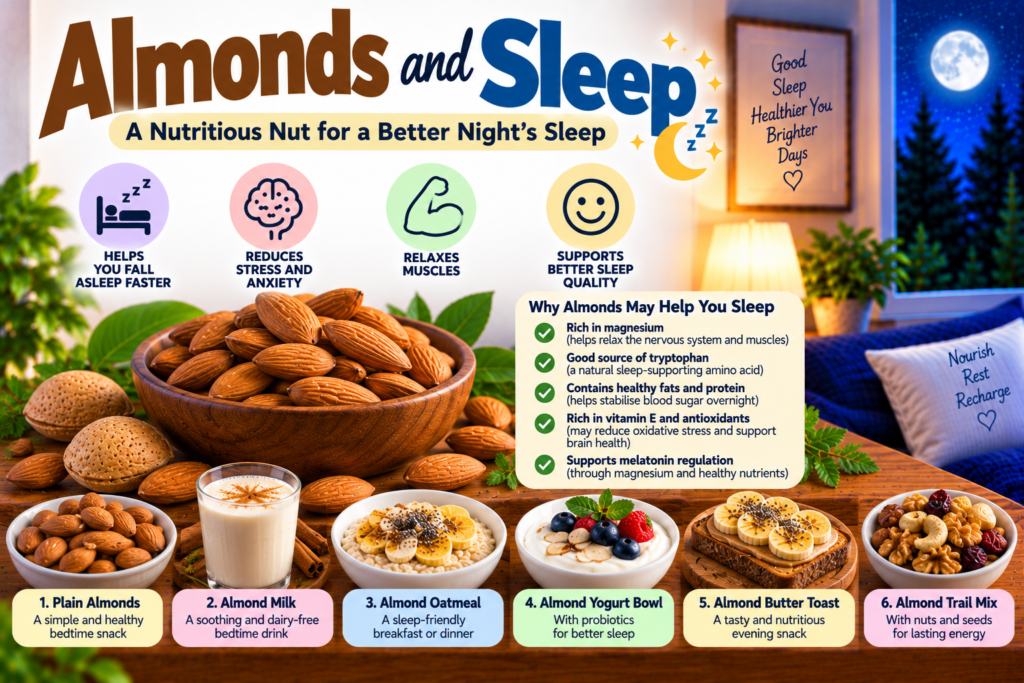
Almonds and sleep have attracted growing interest because almonds contain magnesium, tryptophan, protein, and other nutrients involved in normal body functions.
A 2026 clinical trial found that adults who ate almonds regularly for five months reported improvements in several measures of sleep quality.
However, most objective sleep measurements did not show significant differences between groups. Almonds are a nutritious snack and may have sleep-related benefits, but they are not a proven treatment for insomnia.
Table of Contents
Can Eating Almonds Really Help You Sleep Better?
You may have heard that eating a few almonds before bed can help you sleep. The idea sounds reasonable because almonds contain nutrients involved in normal nervous system function and sleep-related biological processes.
But there is an important difference between a food containing sleep-related nutrients and that food actually improving sleep.
Researchers have begun investigating this question directly. Early findings are encouraging, particularly a recent controlled trial involving adults with poor sleep quality. Yet the evidence is still developing, and we do not know whether almonds consistently help people fall asleep faster, stay asleep longer, or experience better-quality sleep.
If you enjoy almonds, they can be part of a balanced diet. You do not need to eat them at bedtime, however, and there is no reason to expect them to work like a sleeping pill.
What Does Research Say About Almonds and Sleep?
Two human studies are particularly relevant: an earlier study involving medical students and a more recent randomised controlled trial involving adults in India.
A Five-Month Study Found Improvements in Self-Reported Sleep
A randomised controlled trial published in Frontiers in Nutrition in 2026 examined whether regular almond consumption could improve sleep in adults with poor sleep quality.
The researchers initially randomised 175 adults aged 21–55 years to receive either almonds or a calorie-matched snack. The intervention lasted five months, and the final analysis included participants who completed the study and met the analysis requirements.
The almond group consumed 60 grams of raw almonds daily, approximately 50 whole almonds. Participants were instructed to divide the almonds into two portions, one for a mid-morning snack and another for an evening snack. The comparison group received savoury snacks with similar energy and protein content.
The researchers found improvements in several self-reported sleep measures in the almond group compared with the control group. These included:
- Overall sleep quality, measured using the Pittsburgh Sleep Quality Index.
- Perceived sleep efficiency, or how much of their time in bed participants felt they spent sleeping.
- Reported time to fall asleep, also known as sleep latency.
However, the findings were not equally strong across all measurements. Most sleep parameters measured objectively using polysomnography—a test that records brain activity and other physiological signals during sleep—did not differ significantly between the groups.
The researchers also found higher melatonin concentrations at the end of the study in the almond group, but this result was borderline statistically significant. It does not establish that melatonin caused the reported improvements.
The study is an important development because it used a control group and assessed both subjective and objective sleep outcomes. Nevertheless, it has limitations. Participants knew which snack they were eating, the intervention was relatively intensive, and the study received support from the Almond Board of California.
So, Regular almond consumption may improve how some people perceive their sleep.
But the findings do not prove that eating almonds immediately before bed will help you fall asleep or treat insomnia.
Read the study: Effects of Almond Consumption on Sleep Quality in Adults: A Randomized Controlled Trial.
What Did an Earlier Study of Medical Students Find?
A 2019 study investigated almond consumption among medical students living in university dormitories in Tehran, Iran.
The researchers gave ten sweet almonds daily to 442 students for two weeks. They assessed insomnia symptoms before and after the intervention using the Insomnia Severity Index.
The proportion of students classified as having insomnia decreased from 77.6% before the intervention to 69.2% afterward.
At first glance, this appears encouraging. However, the study used a before-and-after design without a separate control group. That makes it difficult to determine whether the improvement was caused by almonds or by other factors, such as changes in stress, routine, expectations, or normal variation in sleep.
The participants were also medical students living in dormitories, so the results may not apply to everyone.
This study provides an early clue worth investigating, but it cannot establish that almonds treat insomnia.
Read the study: Investigating the Prevalence of Sleep Disorder and the Impact of Sweet Almond on the Quality of Sleep in Students of Tehran, Iran.
What Can We Conclude From the Research?
The research on almonds and sleep quality is promising, but it is not yet conclusive.
The newer randomised trial offers stronger evidence than the earlier study because it compared almonds with another snack. However, improvements were clearer in self-reported sleep measures than in most objective measurements.
We also need further trials to determine whether the findings can be reproduced in other populations, whether smaller servings have similar effects, and whether the timing of almond consumption makes any difference.
For now, almonds are best considered a nutritious food that may offer sleep-related benefits—not an established treatment for poor sleep or insomnia.
Almonds and Sleep: Take-Home Message
Regular almond consumption may improve perceived sleep quality, but the evidence is still developing. Enjoy almonds for their nutritional value rather than relying on them as a sleep remedy.
Also Read:
Can Magnesium and Tryptophan in Almonds Affect Sleep?
Almonds contain several nutrients that make them a useful part of a balanced diet. Two that attract particular interest in sleep research are magnesium and tryptophan.
Magnesium: An Essential Mineral for Normal Body Function
Almonds are a useful source of magnesium, a mineral involved in hundreds of processes in the body. It supports normal nerve and muscle function, energy production, and many other physiological activities.
Magnesium is also involved in processes related to the nervous system, which has led researchers to investigate possible links between magnesium intake and sleep.
However, getting enough magnesium is not the same as taking extra magnesium to improve sleep. If someone has an inadequate intake, improving their diet can help meet nutritional needs. That does not mean that consuming more magnesium will necessarily improve sleep in someone who already gets enough.
Almonds can contribute to your daily magnesium intake, but there is not enough evidence to recommend them as a proven magnesium-based sleep aid.
Also Read:
Tryptophan: An Amino Acid Involved in Sleep Biology
Almonds contain tryptophan, an essential amino acid that the body uses to make proteins. Tryptophan also contributes to the production of serotonin, which can be converted into melatonin.
Melatonin is a hormone that helps regulate the body’s sleep-wake timing. Its production normally rises in the evening as part of the body’s circadian rhythm.
This provides a possible biological reason to study almonds and sleep. However, eating a food containing tryptophan does not automatically mean that enough reaches the relevant pathways to improve sleep.
The amount of tryptophan in almonds alone cannot tell us whether eating them will increase melatonin production enough to make a noticeable difference. The body’s response depends on several physiological processes, including how nutrients are absorbed and used.
In other words, tryptophan makes the connection biologically plausible, but it does not prove that almonds will make you sleepy.
Also Read:
What About Vitamin E and Healthy Fats?
Almonds also provide vitamin E and predominantly unsaturated fats. Vitamin E helps protect cells from oxidative damage, while unsaturated fats are part of a balanced dietary pattern.
These are useful nutritional qualities, but there is not enough evidence to conclude that vitamin E or the healthy fats in almonds directly improve sleep.
Almonds are worth including in a varied diet for their overall nutritional value. Their potential sleep benefits remain a separate question that requires more research.
How Many Almonds Should You Eat, and When?
There is no scientifically established number of almonds that guarantees better sleep.
The 2026 trial used 60 grams of almonds daily—approximately 50 whole almonds—divided between a mid-morning snack and an evening snack for five months. This was a research intervention, not a recommended bedtime dose.
For everyday eating, a small handful of around 20–30 grams can be a practical snack for many adults.
The exact number of almonds varies with their size. This portion is general dietary guidance, not a proven amount for improving sleep.
A few points are worth remembering:
- You do not need to eat almonds immediately before bed. The newer trial studied regular consumption across the day, not a bedtime-only dose.
- More is not necessarily better. Almonds are energy-dense, so large servings can add substantial calories to your diet.
- Choose a time that suits your routine. If almonds feel comfortable as an evening snack, that is reasonable. If you experience digestive discomfort, eat them earlier.
- You do not need to force a bedtime snack. If you are not hungry, there is no need to eat almonds simply because they are sometimes described as a sleep-friendly food.
If you enjoy almonds, use them as one component of a balanced diet rather than following a strict almond routine.
Simple Ways to Include Almonds in Your Diet
You do not need special recipes to enjoy almonds. A few easy options are enough:
- Eat a small handful of plain almonds as a snack.
- Add chopped almonds to oats or plain yoghurt.
- Combine almonds with fruit for a simple snack.
- Use ground almonds in meals where they suit the dish.
- Choose unsalted almonds more often if you are trying to limit sodium.
Raw and dry-roasted almonds can both fit into a balanced diet. Check packaged products for added salt, sugar, or other ingredients if these matter for your health needs.
There is no need to buy special almond products marketed for sleep. Ordinary almonds provide the nutrients discussed in this article.
Who Should Be Careful About Eating Almonds?
Almonds are suitable for many people, but they are not appropriate for everyone.
People With a Nut Allergy
Almonds are tree nuts and can cause serious allergic reactions. Anyone with a diagnosed almond allergy should avoid them and follow their healthcare professional’s advice.
Do not try almonds as a sleep remedy if you have a known allergy.
People Watching Their Calorie Intake
Almonds provide useful nutrients, but they are also energy-dense. Large servings can add substantial calories to the diet.
You do not need to avoid almonds if you are managing your weight. Instead, consider portion size and how they fit into your overall eating pattern. Replacing a less nutritious snack with a modest portion of almonds may be more useful than simply adding extra food.
People With Digestive Sensitivity
Some people experience bloating or digestive discomfort after eating nuts, particularly in larger amounts. If almonds cause symptoms, try a smaller portion or choose another snack that you tolerate well.
People Following a Medically Prescribed Diet
Some people with advanced kidney disease or other medical conditions need individualised advice about minerals, potassium, phosphorus, protein, or overall energy intake.
If you have been prescribed a specific diet, follow the guidance of your healthcare professional or dietitian.
Almonds are optional. You can maintain a nutritious diet and support healthy sleep without eating them.
Everyday Habits That Matter More for Sleep
Almonds may be a useful food choice, but good sleep depends on more than a single snack. These everyday habits are more important than trying to find one food that guarantees a good night’s rest.
- Keep a regular sleep schedule. Try to go to bed and wake up at roughly the same time every day.
- Allow enough time for sleep. Most adults need at least seven hours of sleep regularly, although individual needs vary.
- Get natural daylight during the day. Daylight exposure helps support the body’s circadian rhythm.
- Reduce bright light and stimulating activities before bed. Give yourself time to wind down.
- Limit caffeine late in the day. Caffeine can interfere with sleep, particularly in people who are sensitive to it.
- Make your bedroom comfortable. A quiet, dark, and comfortably cool room may help you sleep.
A balanced diet can support general health, but it cannot compensate for an irregular schedule, insufficient sleep opportunity, or an untreated sleep disorder.
If you regularly struggle to fall asleep, wake frequently during the night, or feel excessively sleepy during the day, consider seeking medical advice. Persistent insomnia may require evidence-based treatment rather than dietary changes alone.
Frequently Asked Questions About Almonds and Sleep
1. Do almonds help you sleep better?
Almonds may improve perceived sleep quality when consumed regularly, according to a 2026 randomised controlled trial. However, most objective sleep measurements did not show significant differences between the almond and control groups. More research is needed before almonds can be recommended as a reliable sleep aid.
2. How many almonds should I eat before bed?
There is no proven bedtime dose. A small handful may be a reasonable snack if you enjoy almonds and tolerate them well. The 60-gram daily amount used in the 2026 trial was divided into two snacks over five months; it should not be interpreted as a bedtime recommendation.
3. Are almonds rich in magnesium?
Yes. Almonds provide magnesium, which supports normal nerve and muscle function and many other processes in the body. However, getting magnesium from food does not guarantee improved sleep, especially if your usual intake is already adequate.
4. Is it better to eat almonds at night or in the morning?
There is no strong evidence that almonds improve sleep more when eaten at night rather than in the morning. The recent trial studied regular daily consumption, including a mid-morning and an evening snack. Choose a time that fits your appetite and routine.
5. Can almonds cure insomnia?
No. Almonds have not been established as a treatment or cure for insomnia. They can be part of a balanced diet, but persistent sleep difficulties may require medical assessment and evidence-based treatment.
Almonds and Sleep: The Final Take-Home Message
Almonds and sleep is a promising area of nutrition research. Almonds provide magnesium, tryptophan, vitamin E, protein, and unsaturated fats, making them a nutritious food to include in a balanced diet.
A 2026 randomised controlled trial found improvements in several self-reported sleep measures among adults who consumed almonds regularly for five months. However, most objective sleep measurements did not show significant differences between groups. The findings are encouraging, but they do not prove that almonds reliably improve sleep for everyone.
If you enjoy almonds, a modest portion can be a sensible snack. You do not need to eat them immediately before bed, follow a special almond routine, or consume a large quantity to sleep well.
Enjoy almonds for their nutritional value, but do not rely on them as a treatment for insomnia. A consistent sleep schedule, a comfortable sleep environment, and appropriate medical care when needed remain essential.
Also Read:
References
- Desai SR, Pinto L, Halbe A, Vaidya RA, Udipi SA, Kalita S. Effects of almond consumption on sleep quality in adults: a randomized controlled trial. Frontiers in Nutrition. 2026;13:1892442. Read the full study.
- Ghafarzadeh J, Sadeghniiat-Haghighi K, Sadeghpour O, Akbarpour S, Amini-Behbahani F. Investigating the prevalence of sleep disorder and the impact of sweet almond on the quality of sleep in students of Tehran, Iran. Iranian Journal of Public Health. 2019;48(6):1149–1154. Read the full study.
- National Institutes of Health, Office of Dietary Supplements. Magnesium: Fact Sheet for Health Professionals. Read the fact sheet.
- National Institutes of Health, Office of Dietary Supplements. Vitamin E: Fact Sheet for Health Professionals. Read the fact sheet.
- U.S. Food and Drug Administration. Food Allergies: What You Need to Know. Read the guidance.