Oats and sleep are often linked because oats provide complex carbohydrates, fibre, magnesium, and other nutrients that support overall health.
Research suggests that dietary patterns and carbohydrate intake may be related to some aspects of sleep, but there is not enough direct evidence to establish oats as a food that improves sleep.
Oats can still be a nutritious choice for breakfast, dinner, or an evening snack. In this guide, you will learn what oats offer, whether eating oats before bed makes sense, and how to include them in a balanced diet.
Oats are affordable, versatile, and easy to prepare. You can enjoy them as porridge, overnight oats, or a savoury dish with vegetables. But does a bowl of oats at night help you fall asleep faster or sleep more soundly?
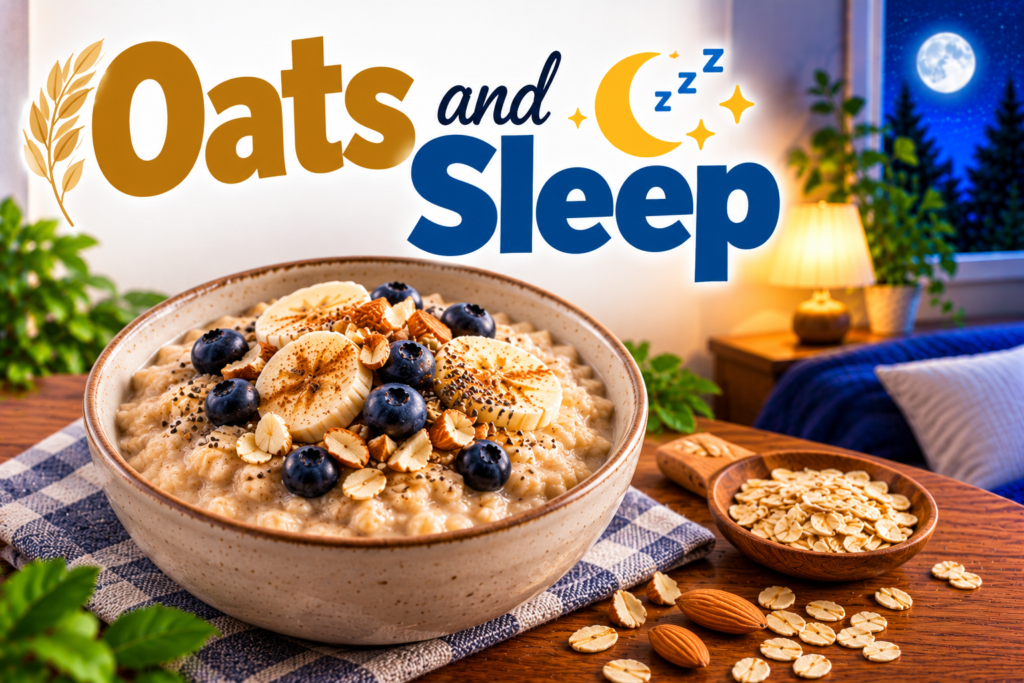
Let’s look at what the research actually tells us.
Table of Contents
Can Eating Oats at Night Actually Improve Sleep?
Oats can be part of a healthy diet, but they are not a proven sleep aid. The interest in oats and sleep comes mainly from research on carbohydrates, dietary fibre, and overall eating habits rather than from strong clinical trials testing oats themselves.
Here is what we know so far:
- Oats provide complex carbohydrates that supply energy and can make a meal satisfying.
- They contain fibre, including beta-glucan, which supports digestive health and helps make oats a nutritious everyday food.
- They contribute magnesium and other nutrients needed for normal body functions.
- A bowl of oats may help satisfy evening hunger, which can be useful if going to bed hungry makes you uncomfortable.
- Direct evidence is limited: Researchers have not established that eating oats before bed reliably improves sleep quality or treats insomnia.
The practical answer is straightforward: if you enjoy oats and they suit your digestion, there is no general reason to avoid them in the evening. However, you do not need to eat them at night specifically to improve sleep.
What Does Research Say About Oats and Sleep?
Can Carbohydrates Help You Sleep Better?
Researchers have investigated whether the amount and type of carbohydrate in a person’s diet affect sleep. Some studies have reported changes in particular sleep measures, but the results are mixed.
A 2021 systematic review and meta-analysis examined 11 articles covering 27 nutrition trials. It found that carbohydrate intake could influence certain aspects of sleep architecture, including deep sleep and REM sleep. However, the findings varied according to the amount and type of carbohydrate consumed, and the authors called for further research.
A separate systematic review published in 2022 examined 19 studies of macronutrient intake and sleep. It found that longer-term dietary interventions could affect some sleep outcomes, but the results were not uniformly positive. The authors also noted methodological limitations in the available studies.
Neither review proves that oats improve sleep. These studies investigated broader dietary interventions, not simply eating a bowl of oats before bedtime.
What can we take from this research?
- The relationship between carbohydrates and sleep is complex.
- The overall diet may matter more than one individual food.
- The effects of changing carbohydrate intake are not necessarily the same for everyone.
- There is not enough evidence to recommend oats as a treatment for sleep difficulties.
Research references: Systematic review and meta-analysis of carbohydrates and sleep and Systematic review of macronutrient intake and sleep.
Can a Healthy Diet Make a Difference to Sleep?
Research suggests that healthy dietary habits and better sleep often go together.
A 2021 systematic review examined 29 studies on diet and sleep quality. In general, healthier eating patterns were associated with better sleep quality, while higher intakes of processed foods and foods rich in free sugars were associated with poorer sleep features.
However, many of these studies were observational. This means they identified relationships between eating habits and sleep but could not prove that particular foods caused better sleep.
People who eat healthier diets may also have more regular routines, different activity levels, or other habits that influence sleep.
The sensible takeaway is to focus on your overall eating pattern rather than expecting one food to solve sleep problems. Oats can be a useful part of that pattern, especially when they replace a less nutritious meal or snack.
Research reference: Association between diet and sleep quality: A systematic review.
What Makes Oats a Good Food Choice?
Oats are worth including in a balanced diet for several reasons. Their nutritional value is well established, even though their direct effect on sleep remains uncertain.
1. Magnesium: A Mineral Your Body Needs
Magnesium is involved in hundreds of processes in the body, including normal nerve function, muscle function, and energy metabolism.
A typical 40 g serving of dry oats provides roughly 50–60 mg of magnesium, although the amount varies by product.
Magnesium is often discussed in relation to sleep because it participates in processes involving the nervous system. But there is an important distinction between getting enough magnesium and taking extra magnesium to improve sleep.
- Your body needs magnesium to function normally.
- Oats can contribute to your daily magnesium intake.
- Other sources include beans, lentils, nuts, seeds, and leafy green vegetables.
- Eating oats does not guarantee better sleep, and the magnesium in a bowl of oats has not been established as a direct sleep treatment.
If your diet is low in magnesium, eating a variety of magnesium-containing foods is more useful than relying on oats alone.
2. Complex Carbohydrates: A Satisfying Meal
Oats provide carbohydrates that supply energy. Their fibre content also makes them a satisfying food, particularly when combined with milk, yogurt, nuts, or seeds.
Oats may be useful if:
- You want a filling breakfast.
- You need a simple meal after a busy day.
- You feel hungry in the evening and prefer a proper snack to sweets.
- You want an alternative to highly processed breakfast cereals.
However, carbohydrates do not automatically make you sleepy. The effects of a meal depend on its composition, portion size, timing, and your individual response.
Oats are best viewed as a nutritious source of carbohydrates, not a food that switches on sleep.
3. Fibre: Supporting Digestion and Fullness
Oats contain dietary fibre, including beta-glucan, a type of soluble fibre.
Fibre helps support digestive health and can make meals more satisfying. Beta-glucan also contributes to the cholesterol-lowering benefits associated with oats when consumed in adequate amounts as part of a suitable diet.
These are useful reasons to include oats in your diet, but there is no strong evidence that oat fibre itself improves sleep.
If you are not used to eating much fibre, increase your intake gradually. A sudden increase can cause gas or bloating, which may be particularly uncomfortable if you eat a large bowl shortly before going to bed.
4. Protein and Other Nutrients
Oats provide some plant-based protein, iron, phosphorus, and other nutrients. They generally offer more protein than many refined cereal products, although the exact amount depends on the serving and product.
You can make an oat-based meal more substantial by adding:
- Milk or plain yogurt.
- A small portion of nuts or seeds.
- Peanut butter, if you tolerate it.
- Fruit such as banana or berries.
These additions change the meal’s nutritional composition and can make it more satisfying. However, no single nutrient in oats has been established as the reason someone might sleep better after eating them.
Do Oats Contain Melatonin?
Melatonin is a hormone that helps regulate the body’s sleep–wake timing. Naturally occurring melatonin has been studied in a variety of foods, including some grains.
However, the presence of melatonin in a food does not prove that eating it improves human sleep. The amount can vary, and the effects of food-derived melatonin cannot be assumed to match those of a studied supplement.
There is not enough clinical evidence to recommend oats as a way to increase melatonin or treat insomnia.
If you enjoy oats, their fibre and overall nutritional value are better-established reasons to eat them than the expectation that they will increase melatonin and make you sleepy.
Should You Eat Oats Before Bed?
Eating oats before bed can be reasonable for some people, but there is no proven bedtime dose or timing that guarantees better sleep.
Whether oats are a suitable evening meal depends on your appetite, digestion, portion size, and usual eating habits.
You might consider oats in the evening if:
- You are genuinely hungry after dinner.
- You want a simple, home-prepared meal.
- You prefer oats to a heavily processed snack.
- A modest bowl of porridge feels comfortable before bed.
On the other hand, a large bowl of oats with several toppings may feel too filling if you eat it immediately before lying down.
You do not need to eat oats at night to benefit from their nutritional value. Breakfast, lunch, or an earlier evening meal can also be suitable times.
How Much Oats Should You Eat at Night?
There is no scientifically established portion of oats for better sleep.
As a practical food portion, many adults use around 30–40 g of dry oats to prepare one serving of porridge. This is a general serving suggestion, not a sleep-treatment dose.
Keep these points in mind:
- Start with a comfortable portion: You do not need a large bowl to enjoy oats.
- Consider the toppings: Sugar, syrup, dried fruit, nuts, and nut butters can change the meal’s calorie and carbohydrate content.
- Adjust to your appetite: A snack and a full meal do not need to be the same size.
- Notice how you feel: If oats make you bloated or overly full at night, try eating them earlier.
Eating a larger portion does not mean you will sleep better.
What Is the Best Time to Eat Oats?
There is no established best time to eat oats for sleep.
You can include oats at different times of the day, depending on what suits your routine.
- At breakfast: Oats provide carbohydrates and fibre to start the day.
- As an afternoon meal or snack: They can help satisfy hunger between meals.
- At dinner: Savoury oats with vegetables or a modest bowl of porridge can be part of a balanced meal.
- In the evening: A small serving may be suitable if you are hungry and tolerate it well.
If eating close to bedtime causes discomfort, leave more time between your meal and lying down. People with reflux may find that avoiding large meals shortly before bed is particularly helpful.
There is no need to follow a strict rule such as eating oats exactly one hour before sleeping.
Simple Ways to Include Oats in Your Daily Diet
You do not need complicated recipes to enjoy oats. A few simple combinations can make them easier to include in your routine.
- Oats with milk: Prepare porridge with milk or a suitable fortified alternative.
- Oats with banana: Add sliced banana for natural sweetness and additional nutrients.
- Oats with nuts and seeds: Use a small portion of almonds, walnuts, chia seeds, or flaxseeds.
- Savoury oats: Cook oats with vegetables and mild seasonings for an easy Indian-style meal.
- Overnight oats: Soak oats in milk or yogurt in the refrigerator and add fruit before eating.
Choose plain oats where practical and adjust sweeteners to your needs. Flavoured instant products can contain added sugar, so check the nutrition label if you are trying to limit it.
These are convenient ways to eat oats, not special recipes proven to improve sleep. Choose the version that fits your taste, digestion, and overall diet.
Who Should Be Careful About Eating Oats?
Oats suit many people, but a few considerations are worth keeping in mind.
People Managing Diabetes
Oats contain carbohydrates and can affect blood glucose levels. Their fibre content can be useful in a balanced eating plan, but the overall meal matters.
If you have diabetes:
- Pay attention to serving size.
- Prefer plain oats over products with substantial added sugar.
- Consider the effect of milk, fruit, sweeteners, and other toppings.
- Follow your healthcare professional’s dietary advice.
You do not necessarily need to avoid oats, but portion size and the full meal should fit your individual needs.
People With Coeliac Disease
Oats are naturally gluten-free, but they can become contaminated with wheat, barley, or rye during growing, transport, or processing.
People with coeliac disease should choose oats specifically labelled gluten-free and follow their clinician’s advice. Some people with coeliac disease may also react to avenin, a protein found in oats.
People With Sensitive Digestion
Increasing fibre intake too quickly can cause gas, bloating, or abdominal discomfort in some people.
If oats cause symptoms:
- Try a smaller serving.
- Increase fibre gradually.
- Drink enough fluids.
- Consider eating oats earlier in the day.
There is no need to force yourself to eat oats before bed for a possible sleep benefit.
6 Simple Habits That Matter for Better Sleep
A healthy diet can contribute to general wellbeing, but better sleep depends on more than one food.
Try these practical habits:
- Keep a regular sleep schedule: Go to bed and wake up at roughly the same time every day.
- Get daylight during the day: Natural light, particularly in the morning, helps regulate your body clock.
- Limit caffeine later in the day: Coffee, tea, energy drinks, and other sources of caffeine can interfere with sleep.
- Avoid heavy meals immediately before lying down: Large meals can cause discomfort or worsen reflux.
- Make your bedroom comfortable: Keep it dark, quiet, and comfortably cool.
- Seek help for persistent sleep problems: Regular difficulty falling asleep, repeated awakenings, or excessive daytime sleepiness may require professional assessment.
For chronic insomnia, cognitive behavioural therapy for insomnia (CBT-I) is a recommended first-line treatment. Eating oats or other individual foods should not replace appropriate assessment and treatment.
Frequently Asked Questions About Oats and Sleep
1. Are oats good for sleep?
Oats can be part of a balanced diet, but there is not enough direct evidence to conclude that eating oats reliably improves sleep. Their nutritional benefits are well established; their sleep-specific benefits remain uncertain.
2. Is it good to eat oats before bed?
You can eat oats before bed if you enjoy them and they do not cause digestive discomfort. A modest serving may suit someone who is hungry in the evening, but there is no proven bedtime benefit.
3. Do oats contain melatonin?
Oats have been discussed as a potential food source of naturally occurring melatonin, but the amount can vary. There is insufficient evidence that eating oats produces a meaningful improvement in human sleep.
4. How much oats should I eat before sleeping?
There is no proven sleep-specific dose. Around 30–40 g of dry oats is a common serving for porridge, but the right amount depends on your appetite, dietary needs, and how close you are to bedtime.
5. Can oats cure insomnia?
No. Oats have not been proven to cure or treat insomnia. If sleep difficulties persist and affect your daily functioning, seek appropriate assessment and evidence-based treatment.
Oats and Sleep: Take-Home Message
Oats and sleep: Oats provide complex carbohydrates, fibre, magnesium, and other nutrients that make them a nutritious addition to a balanced diet.
However, there is not enough direct human evidence to recommend oats as a sleep aid. Enjoy them at a time that suits your appetite and digestion, and focus on consistent sleep habits for better rest.
Also Read:
References
- Andreou E, et al. A systematic review, meta-analysis and meta-regression on the effects of carbohydrates on sleep. Nutrients. 2021;13(4):1283. Read the full study.
- Du C, Almotawa J, Feldpausch CE, et al. Effects of macronutrient intake on sleep duration and quality: A systematic review. Nutrition & Dietetics. 2022;79(1):59–75. Read on PubMed.
- Godos J, Grosso G, Castellano S, Galvano F, Caraci F, Ferri R. Association between diet and sleep quality: A systematic review. Sleep Medicine Reviews. 2021;57:101430. Read on PubMed.
- St-Onge MP, Mikic A, Pietrolungo CE. Effects of diet on sleep quality. Advances in Nutrition. 2016;7(5):938–949. Read the full article.