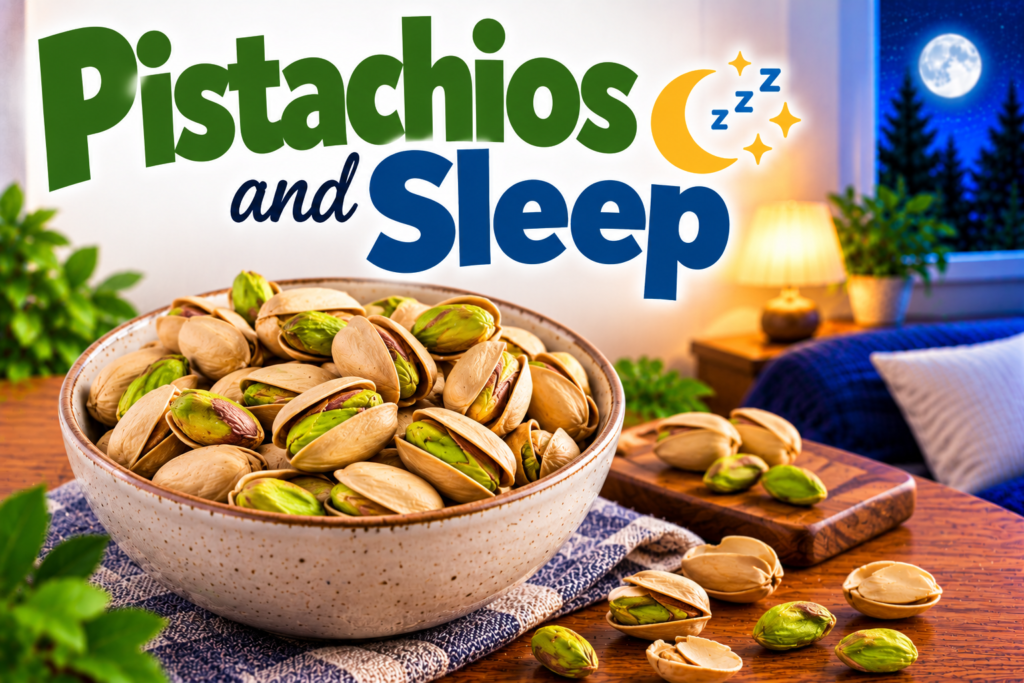
Pistachios and sleep have attracted attention because pistachios contain naturally occurring melatonin, along with magnesium, vitamin B6, fibre, and other nutrients involved in normal body functions.
A recent scientific review suggests that these nutrients make pistachios worth investigating as a food that may support sleep health.
However, there is not yet strong clinical evidence that eating ordinary pistachios improves sleep in humans. Pistachios can be a nutritious snack, but they should not be considered a proven natural sleep aid.
Table of Contents
Can Eating Pistachios Really Help You Sleep Better?
You may have heard that eating pistachios in the evening can help you sleep because they contain melatonin. The idea sounds promising, but there is an important difference between finding a sleep-related compound in a food and showing that eating the food improves sleep.
Researchers have measured melatonin in pistachios and investigated how pistachio extracts interact with melatonin receptors in laboratory experiments. More recently, scientists have reviewed the nutrients and bioactive compounds in pistachios to understand how they might relate to sleep health.
These findings give researchers good reasons to investigate pistachios further. They do not yet establish that eating a handful of pistachios will help you fall asleep faster, stay asleep longer, or wake up feeling more refreshed.
The most accurate answer is that pistachios have promising nutritional characteristics, but their direct effect on human sleep remains uncertain.
If you enjoy pistachios, there is no need to avoid them. They can be part of a balanced diet, whether you eat them in the morning, during the afternoon, or as an evening snack.
Do Pistachios Contain Melatonin?
Yes. Scientific studies have detected melatonin in pistachio kernels.
Melatonin is a hormone that helps regulate the body’s sleep-wake timing. Its production normally increases in the evening as part of the body’s circadian rhythm, helping signal that it is time for sleep.
Melatonin is also present in certain foods, including some nuts, fruits, vegetables, and animal-derived foods. This has led researchers to explore whether dietary melatonin can influence the body’s melatonin levels or sleep-related processes.
How Much Melatonin Do Pistachios Contain?
A 2014 study examined kernels from four varieties of pistachio and confirmed the presence of melatonin using laboratory analytical methods.
Other research has reported relatively high melatonin concentrations in pistachios compared with several other nuts. However, the measured amounts vary between studies. Pistachio variety, growing conditions, sample preparation, extraction methods, and analytical techniques can all influence the results.
For that reason, there is no single melatonin value that can be confidently applied to every pistachio or every serving.
You may encounter claims that a particular handful of pistachios provides a precise dose of melatonin. Such figures should be treated cautiously unless they are supported by reliable measurements of the specific food and serving being discussed.
Read the research: Determination of Melatonin in Kernels of Four Different Pistacia Varieties.
Does Melatonin in Pistachios Mean They Can Help You Sleep?
Not necessarily.
The body regulates melatonin through a complex system involving the brain, the circadian clock, and exposure to light and darkness. The effect of melatonin consumed through food may depend on the amount present, how it is absorbed, and other physiological factors.
Even if a food contains measurable melatonin, researchers still need to establish whether eating it changes melatonin levels in a meaningful way and whether that change improves sleep.
Pistachios contain melatonin, but their ability to improve human sleep has not yet been established.
Also Read:
What Does Research Say About Pistachios and Sleep?
The evidence includes laboratory research, studies measuring the melatonin content of pistachios, and scientific reviews. These sources help explain why pistachios are attracting interest, but they do not all answer the same question.
What Have Laboratory Studies Discovered?
A 2023 study investigated extracts from Pistacia vera, the plant that produces edible pistachios, to understand how they interact with human melatonin receptors.
The researchers tested pistachio extracts in laboratory cell-based systems. The extract showed activity in experiments involving the MT1 and MT2 melatonin receptors, and the researchers identified melatonin among the compounds present.
This finding is scientifically interesting because these receptors are involved in the body’s response to melatonin.
However, the researchers were studying an extract in a laboratory—not asking people to eat ordinary pistachios and measuring their sleep.
Extracts can differ from the food itself, and results from laboratory experiments cannot automatically be applied to human digestion, absorption, or sleep. The study therefore provides a possible explanation for further research, not proof that pistachios are a sleep aid.
Read the study: Pistacia vera Extract Potentiates the Effect of Melatonin on Human Melatonin MT1 and MT2 Receptors.
What Does the Latest Scientific Review Say?
A narrative review published online in September 2026 examined the nutrients and bioactive compounds in pistachios that might be relevant to sleep health.
The authors discussed several components, including:
- Melatonin, which is involved in regulating sleep-wake timing.
- Vitamin B6, which participates in normal nervous system function and biochemical pathways involved in neurotransmitter production.
- Magnesium, an essential mineral involved in nerve and muscle function.
- Dietary fibre and polyphenols, which are being investigated for their possible roles in gut health, metabolism, and other physiological processes.
The review concluded that pistachios have a nutritional profile worth investigating as a potential whole-food approach to supporting sleep. However, the authors also emphasised the need for human trials to assess the direct effects of pistachio consumption on sleep outcomes.
That distinction is important. A narrative review can bring together biological mechanisms and existing research, but it cannot substitute for a well-designed clinical trial demonstrating that eating pistachios improves sleep.
Read the review: Exploring the Role of Pistachio Nutrients and Bioactive Components in Sleep Health: A Narrative Review.
Is a Human Trial Testing Pistachios for Sleep?
Yes. A registered randomised controlled trial is investigating the effects of pistachio consumption in adults aged 45–64 who have poor sleep quality.
The study compares pistachios with calorie-matched control foods. Participants in the pistachio group are assigned two 28-gram servings per day—one in the morning and another three to six hours before bedtime—for four weeks. The study plans to assess self-reported sleep quality, objective sleep measures, and overnight melatonin production.
The trial is listed as recruiting, and results are not yet available. Its planned completion date is in 2027, so it is too early to know whether pistachios will improve the measured sleep outcomes.
The study is particularly useful because it is designed to test the whole food in people rather than relying only on laboratory findings.
Read the trial record: Impact of Pistachio Consumption on Sleep — ClinicalTrials.gov.
What Can We Conclude From the Research?
The current evidence supports three conclusions:
- Pistachios contain melatonin. This has been demonstrated through laboratory analysis.
- Pistachios contain nutrients that are relevant to normal body functions. Researchers are investigating whether these nutrients and other compounds could influence sleep-related processes.
- A direct sleep benefit in humans remains unproven. The available laboratory findings and reviews do not establish that eating pistachios improves sleep quality, duration, or insomnia symptoms.
The ongoing clinical trial may help answer some of these questions. Until its results are available and further research confirms the findings, pistachios should be viewed as a nutritious food rather than an established sleep treatment.
Pistachios and Sleep: Take-Home Message
Pistachios contain melatonin and other nutrients worth studying, but eating them has not yet been proven to improve sleep in humans.
Also Read:
Can Magnesium and Vitamin B6 in Pistachios Support Sleep?
Pistachios provide several nutrients that are important for normal health. Two that attract particular interest in sleep research are magnesium and vitamin B6.
Their presence makes pistachios nutritionally valuable, but it does not automatically mean that eating them will improve sleep. The distinction is worth keeping in mind as we look at what these nutrients do.
Magnesium: Important for Normal Nerve Function
Pistachios provide magnesium, an essential mineral involved in normal nerve and muscle function, energy production, and many other processes in the body.
Magnesium has attracted interest in sleep research because it participates in physiological processes related to nervous system function. Researchers have investigated whether magnesium intake and magnesium status are associated with sleep quality.
However, getting enough magnesium is not the same as taking extra magnesium to improve sleep. People whose diets provide inadequate amounts may benefit from improving their intake, but that does not mean that additional magnesium will necessarily improve sleep in everyone.
Pistachios can contribute to your daily magnesium intake. There is not enough evidence, however, to recommend them specifically as a magnesium-based sleep remedy.
Also Read:
Vitamin B6: Involved in Neurotransmitter Production
Pistachios contain vitamin B6, a nutrient involved in protein metabolism, normal nervous system function, and the production of several neurotransmitters.
Vitamin B6 participates in biochemical pathways involved in serotonin production. Serotonin has several functions in the body and can be converted into melatonin.
This is one reason vitamin B6 is sometimes discussed in relation to sleep. However, it does not establish that eating pistachios increases melatonin production enough to improve sleep.
Nor is there good evidence that people who already meet their vitamin B6 requirements will sleep better simply by consuming more of it.
Pistachios can help provide vitamin B6 as part of a balanced diet, but their direct effect on sleep remains uncertain.
What About Fibre, Protein, and Healthy Fats?
Pistachios also provide plant protein, dietary fibre, and predominantly unsaturated fats. These nutrients contribute to a balanced diet and make pistachios a satisfying snack.
Researchers are exploring how dietary patterns, gut health, and metabolic processes relate to sleep. However, there is not enough evidence to conclude that the protein, fibre, or fats in pistachios directly improve sleep.
Their established nutritional value is a good reason to include them in a varied diet. Any specific sleep benefit still needs to be demonstrated.
How Many Pistachios Should You Eat, and When?
There is no scientifically established number of pistachios that guarantees better sleep.
A standard serving is about 28 grams, or one ounce. Depending on the size and whether the shells are included in the count, this is approximately 45–50 kernels.
For many adults, this can be a practical snack portion. However, it is general dietary guidance, not a proven sleep-improving dose.
The ongoing clinical trial uses 56 grams of pistachios per day, divided into two servings over four weeks. This is part of the research protocol, not a recommendation that everyone should eat that amount.
A few practical points are worth remembering:
- You do not need to eat pistachios immediately before bed. The ongoing trial is testing regular consumption, including a morning serving and an evening serving several hours before bedtime.
- More is not necessarily better. Pistachios are energy-dense, so large servings can add considerable calories to your daily intake.
- Choose a comfortable portion. If eating nuts close to bedtime makes you feel too full or causes digestive discomfort, have them earlier.
- A bedtime snack is optional. If you are not hungry, there is no need to eat pistachios simply because they contain melatonin.
There is no established timing rule or serving size that guarantees a sleep benefit. If you enjoy pistachios, choose an amount and time that fit your usual diet and routine.
Simple Ways to Include Pistachios in Your Diet
You do not need special recipes to enjoy pistachios. A few straightforward options are enough:
- Eat a small portion of plain pistachios as a snack.
- Add chopped pistachios to oats or plain yoghurt.
- Combine pistachios with fruit for a simple snack.
- Sprinkle chopped pistachios over a meal for extra texture.
- Choose unsalted pistachios more often if you need to limit sodium.
Pistachios can be eaten raw or roasted, depending on your preference. Check packaged products for added salt, sugar, or other ingredients when these matter for your health needs.
There is no need to purchase special pistachio products marketed for sleep. Ordinary pistachios are sufficient as a food choice.
Who Should Be Careful About Eating Pistachios?
Pistachios are suitable for many people, but there are some important exceptions.
People With a Nut Allergy
Pistachios are tree nuts and can cause serious allergic reactions. Anyone with a diagnosed pistachio allergy should avoid them and follow their healthcare professional’s advice.
Do not try pistachios as a sleep remedy if you have a known allergy.
People Managing Their Calorie Intake
Pistachios provide useful nutrients, but they are also energy-dense. Large portions can add substantial calories to your daily intake.
You do not need to avoid pistachios if you are managing your weight. Consider portion size and how they fit into your overall eating pattern. Replacing a less nutritious snack with a modest portion may be more useful than simply adding extra food.
People Watching Their Sodium Intake
Salted pistachios can contain considerable sodium, depending on how they are processed. If you have been advised to limit sodium, unsalted varieties may be a better option.
People Following a Medically Prescribed Diet
Some people with advanced kidney disease or other medical conditions need individualised advice about potassium, phosphorus, protein, or overall dietary intake.
If you have a prescribed diet, follow the recommendations of your healthcare professional or dietitian.
Pistachios are optional. You can maintain a balanced diet and support healthy sleep without eating them.
Everyday Habits That Matter More for Sleep
It is tempting to look for one food that can solve sleep problems. However, healthy sleep depends on several factors, including your daily routine, environment, health, and sleep schedule.
These everyday habits are more important than relying on a particular snack:
- Keep a consistent sleep schedule. Try to go to bed and wake up at roughly the same time each day.
- Allow enough time for sleep. Most adults need at least seven hours of sleep regularly, although individual needs vary.
- Get natural daylight during the day. Daylight exposure helps support the body’s circadian rhythm.
- Reduce bright light and stimulating activities before bed. Give yourself time to wind down.
- Limit caffeine late in the day. Caffeine can interfere with sleep, particularly in people who are sensitive to it.
- Make your bedroom comfortable. A quiet, dark, and comfortably cool room may help.
A balanced diet supports general health, but it cannot compensate for an irregular sleep schedule, insufficient sleep opportunity, or an untreated sleep disorder.
If you regularly struggle to fall asleep, wake repeatedly during the night, or feel excessively sleepy during the day, consider seeking medical advice. Persistent insomnia may require evidence-based treatment rather than dietary changes alone.
Frequently Asked Questions About Pistachios and Sleep
1. Do pistachios help you sleep better?
Pistachios contain melatonin and nutrients involved in normal body functions. However, there is not yet strong clinical evidence that eating ordinary pistachios improves sleep in humans. They can be part of a balanced diet, but they are not a proven sleep aid.
2. Are pistachios high in melatonin?
Pistachios contain naturally occurring melatonin, and some laboratory studies have reported relatively high levels compared with other nuts. However, measured concentrations vary considerably between studies. The amount in a typical serving is not a reliable measure of its effect on human sleep.
3. How many pistachios should I eat before bed?
There is no proven bedtime dose. A serving of about 28 grams can be a reasonable snack if you enjoy pistachios and tolerate them well. This is a general serving suggestion, not a scientifically established dose for improving sleep.
4. Is it better to eat pistachios at night or in the morning?
There is no strong evidence that pistachios improve sleep more when eaten at night rather than in the morning. Choose a time that fits your appetite and routine rather than following an unproven timing rule.
5. Can pistachios increase melatonin naturally?
Pistachios contain melatonin, but it has not been established that eating them increases the body’s melatonin levels enough to improve sleep. Human intervention studies are needed to determine whether a meaningful benefit occurs.
6. Can pistachios treat insomnia?
No. Pistachios have not been established as a treatment for insomnia. If sleep difficulties persist or affect your daily functioning, seek appropriate medical advice rather than relying on a particular food.
Pistachios and Sleep: The Final Take-Home Message
Pistachios and sleep is an interesting area of nutrition research, mainly because pistachios contain naturally occurring melatonin alongside magnesium, vitamin B6, fibre, protein, and other compounds.
Laboratory studies have confirmed the presence of melatonin in pistachios, and a 2026 scientific review explains why their nutrient profile deserves further investigation. However, the review also highlights the need for human trials. The ongoing controlled trial of whole pistachios has not yet reported results.
If you enjoy pistachios, a modest portion can be a nutritious snack. You do not need to eat them immediately before bed, follow a special pistachio routine, or consume large quantities to sleep well.
Enjoy pistachios for their nutritional value, but do not rely on them as a treatment for insomnia.
A consistent sleep schedule, a comfortable sleep environment, and appropriate medical care when needed remain essential.
Also Read:
References
- Oladi E, Mohamadi M, Shamspur T, Mostafavi A. Spectrofluorimetric determination of melatonin in kernels of four different Pistacia varieties after ultrasound-assisted solid-liquid extraction. Spectrochimica Acta Part A: Molecular and Biomolecular Spectroscopy. 2014;132:326–329. Read the study on PubMed.
- Labani N, Gbahou F, Noblet M, et al. Pistacia vera extract potentiates the effect of melatonin on human melatonin MT1 and MT2 receptors with functional selectivity. Pharmaceutics. 2023;15(7):1845. Read the full study.
- Mixon A, Pérez-Jiménez J, St-Onge MP. Exploring the role of pistachio nutrients and bioactive components in sleep health: a narrative review. Nutrition Research Reviews. 2026;39. Read the review.
- National Institutes of Health, Office of Dietary Supplements. Magnesium: Fact Sheet for Health Professionals. Read the fact sheet.
- National Institutes of Health, Office of Dietary Supplements. Vitamin B6: Fact Sheet for Health Professionals. Read the fact sheet.