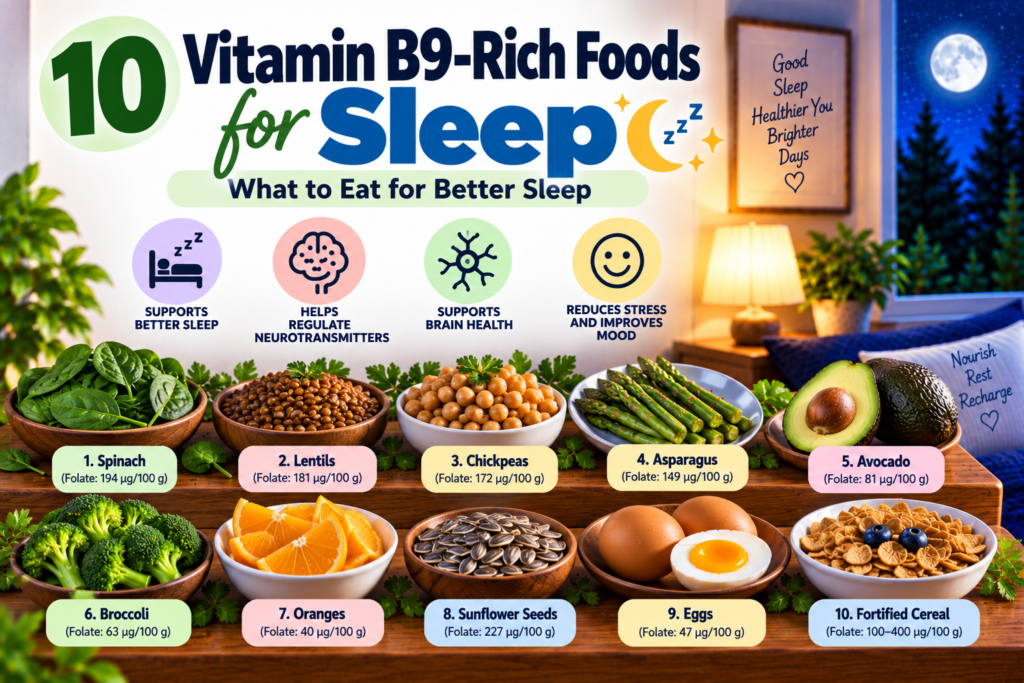
Vitamin B9 rich foods for sleep include lentils (dal), chickpeas (chana), leafy green vegetables, beans, peas, peanuts, broccoli, asparagus, oranges, and eggs.
These foods provide folate, a vitamin B that supports normal cell function and helps the body produce DNA and certain compounds involved in nervous-system function.
However, research has not established that eating more folate directly improves sleep or treats insomnia. The best approach is to include folate-rich foods in a balanced diet rather than relying on any single food as a sleep remedy.
Table of Contents
Why Is Vitamin B9 Important for Sleep?
Vitamin B9, commonly known as folate, is a water-soluble B vitamin essential for several processes in the body. It supports DNA synthesis, cell division, red blood cell formation, and the metabolism of certain amino acids.
Folate also participates in biochemical pathways involved in producing and regulating neurotransmitters. These chemical messengers help nerve cells communicate and play roles in mood, alertness, and other brain functions.
Because sleep depends on several interconnected biological systems, researchers have investigated whether folate status is associated with sleep quality and difficulty falling asleep.
That does not mean folate acts as a sleeping pill. It means that maintaining adequate nutrition is one part of supporting normal bodily function, including the processes that influence sleep.
Folate and Sleep: Take-Home Message
Folate is essential for normal brain and body function, but getting more vitamin B9 than you need has not been shown to produce better sleep.
What Does Research Say About Folate and Sleep?
The relationship between folate and sleep is interesting, but the available evidence is not strong enough to recommend folate supplements or particular foods as a treatment for sleep problems.
Two observational studies help explain what researchers have found.
1. Folate and Sleep a nonlinear association
A study published in 2025 analysed data from approximately 20,200 US adults participating in the National Health and Nutrition Examination Survey (NHANES).
The researchers found a U-shaped association between folate measures and sleep disturbances. Both lower and higher folate intake were associated with greater odds of reported sleep disturbances compared with an intermediate intake group. Higher red blood cell folate levels were also associated with sleep disturbances in some analyses.
These results do not mean that folate-rich foods cause sleep problems. The study was observational, so it could identify associations but could not establish cause and effect. Other factors, including overall diet, health conditions, supplement use, and lifestyle, may influence the results.
Also Read:
2. Association of Vitamin B9 with difficulty falling asleep
Another study examined data from 8,926 US adults. It reported that higher serum total folic acid concentrations were associated with lower odds of severe difficulty falling asleep after statistical adjustments for several potential confounders.
However, the study used data collected in 2005–2008 and was also cross-sectional. It cannot establish whether higher folic acid levels improved sleep, whether sleep-related factors influenced nutrition, or whether other variables explained the association.
What should you conclude from these studies?
The findings suggest that folate status and sleep may be related, but they do not prove that eating more folate improves sleep. They also do not establish a particular folate dose for insomnia.
For now, the sensible advice is to meet your nutritional requirements through a varied diet, address any confirmed deficiency with appropriate medical guidance, and avoid treating vitamin B9 as a substitute for established approaches to sleep problems.
10 Vitamin B9-Rich Foods to Include in Your Diet
Folate occurs naturally in legumes, leafy greens, vegetables, fruits, nuts, and several other foods. You do not need expensive ingredients or special sleep supplements to include it in your meals.
The following options are practical for many Indian households. Their exact folate content varies with the variety, serving size, storage, and cooking method.
1. Lentils and Dal
Dal is one of the easiest ways to add folate to an everyday Indian diet. Lentils provide folate alongside plant protein, fibre, and other nutrients.
You can rotate among masoor dal, moong dal, and other lentil varieties rather than depending on just one type. Serve dal with rice or roti and a vegetable dish for a balanced meal.
How to eat it: Include dal at lunch or dinner according to your appetite and usual eating pattern. Pair it with leafy greens or another vegetable to increase the variety of nutrients in the meal.
2. Chickpeas (Chana)
Chickpeas are a useful source of folate, plant protein, and fibre. They can be incorporated into meals in several ways, making them particularly practical for people who prefer vegetarian foods.
Try kala chana curry, boiled chana chaat, or chickpeas added to a mixed vegetable salad. Cooking dried chickpeas thoroughly after soaking can make them easier to use in everyday meals.
How to eat them: Prepare chana as part of lunch, dinner, or an afternoon meal. If a large serving causes bloating or discomfort, start with a smaller portion.
3. Spinach and Other Leafy Greens
Dark green leafy vegetables are among the recognised dietary sources of folate. Spinach is a useful example, but you can also include mustard greens, amaranth leaves, and other locally available greens.
These vegetables contribute a range of nutrients beyond folate. Their nutritional value makes them worthwhile additions to a balanced diet, even though their direct effect on sleep has not been established.
How to eat them: Prepare palak dal, lightly cooked spinach, saag, or mixed leafy greens. Wash vegetables thoroughly and avoid prolonged cooking in excessive water when practical, as folate is water-soluble and can be lost during cooking.
4. Black-Eyed Peas (Lobia)
Black-eyed peas, also called lobia or cowpeas, provide folate and plant protein. They are a useful alternative to lentils and chickpeas when you want more variety in your meals.
The US National Institutes of Health Office of Dietary Supplements lists half a cup of boiled black-eyed peas as providing approximately 105 micrograms of dietary folate equivalents (DFE). This figure is a reference value, not a guarantee for every preparation or serving.
How to eat them: Make lobia curry, add cooked beans to a salad, or serve them with rice or roti.
5. Green Peas
Green peas supply folate, fibre, and other nutrients. They are easy to add to familiar dishes and can help increase vegetable variety without requiring a separate recipe.
Frozen peas are also convenient. Their nutritional contribution depends on the amount eaten and how they are prepared.
How to eat them: Add peas to vegetable pulao, mixed vegetable curry, poha, or a simple side dish. They work well alongside dal and other vegetables.
6. Peanuts
Peanuts provide folate, unsaturated fats, and plant protein. They are convenient as a snack or as an ingredient in meals, although portion size matters because they are energy-dense.
Dry-roasted peanuts are a recognised source of folate. The NIH lists approximately 27 micrograms DFE per ounce of dry-roasted peanuts.
How to eat them: Have a modest handful as a snack, or add crushed peanuts to poha, salads, or vegetable dishes. Choose unsalted varieties more often if you are limiting sodium.
7. Asparagus
Asparagus is a good source of folate, although it may be less commonly eaten than dal or leafy greens in many Indian households.
The NIH lists approximately 89 micrograms DFE in four boiled asparagus spears. This illustrates its contribution to folate intake, but it is not necessary to buy asparagus specifically to improve sleep.
How to eat it: Steam, boil, or lightly sauté asparagus and serve it as a side dish. If it is expensive or difficult to find locally, use more affordable leafy greens and legumes instead.
8. Broccoli
Broccoli provides folate along with fibre and vitamin C. It can contribute to a varied vegetable intake, although no evidence shows that broccoli itself improves sleep.
The NIH lists approximately 52 micrograms DFE in half a cup of cooked broccoli.
How to eat it: Steam or lightly cook broccoli, add it to mixed vegetables, or include it in a simple stir-fry. Avoid cooking it for unnecessarily long periods in large amounts of water.
9. Oranges and Other Fruits
Oranges provide folate as well as vitamin C. Other fruits also contribute small amounts of folate and can form part of a balanced eating pattern.
The NIH lists approximately 29 micrograms DFE in one small orange. Fruit is valuable for overall nutrition, but there is no convincing evidence that eating an orange at bedtime will make you fall asleep faster.
How to eat them: Enjoy whole fruit during the day or as part of a light snack. Choose fruit according to your preferences and health needs rather than expecting a specific fruit to act as a sleep aid.
10. Eggs
Eggs contain folate along with protein, vitamin B12, and other nutrients. They are a convenient option for people who eat eggs, but they are not a major folate source compared with some legumes and leafy vegetables.
The NIH lists approximately 22 micrograms DFE in one large hard-boiled egg.
How to eat them: Include boiled eggs, an omelette, or eggs with vegetables as part of a balanced meal. If you follow a vegetarian diet that excludes eggs, lentils, beans, greens, and other plant foods can help supply folate.
Folate Content of Selected Foods
The following values provide a quick comparison using the NIH Office of Dietary Supplements’ food table. These are reference values for the specified portions, not precise estimates for every Indian recipe.
| Food | Reference serving | Folate (mcg DFE) |
|---|---|---|
| Spinach, boiled | ½ cup | 131 |
| Black-eyed peas, boiled | ½ cup | 105 |
| Asparagus, boiled | 4 spears | 89 |
| Broccoli, cooked | ½ cup | 52 |
| Green peas, cooked | ½ cup | 47 |
| Orange, fresh | 1 small | 29 |
| Peanuts, dry-roasted | 1 ounce | 27 |
| Egg, hard-boiled | 1 large | 22 |
Source: NIH Office of Dietary Supplements — Folate Fact Sheet. Values can differ by food variety, portion, preparation, and database.
For an Indian diet, a practical starting point is to rotate dal, chana, lobia, leafy greens, peas, and peanuts through the week. You do not need to eat all ten foods every day.
How Much Vitamin B9 Do You Need Daily?
The recommended dietary allowance depends on age and life stage. The US National Institutes of Health lists the following amounts:
| Life stage | Recommended daily intake |
|---|---|
| Adults aged 19 years and older | 400 mcg DFE |
| Pregnancy | 600 mcg DFE |
| Breastfeeding | 500 mcg DFE |
DFE stands for dietary folate equivalents. This measurement accounts for differences in how the body absorbs naturally occurring food folate and folic acid from fortified foods or supplements.
These are US reference values; nutritional recommendations can vary by country and clinical circumstance. Individual needs may also differ when a deficiency or a medical condition is present.
Do you need a folate supplement for sleep?
Not necessarily. Most people should first aim to obtain adequate nutrients through a varied diet. A folate supplement may be appropriate in certain circumstances, such as a diagnosed deficiency or pregnancy planning, but the decision should be based on the relevant clinical guidance—not on an assumption that the supplement will improve sleep.
People who could become pregnant should follow local medical guidance about folic acid for preventing neural tube defects. That is a separate and well-established reason for folic acid use, not a sleep treatment.
Folate vs Folic Acid: What Is the Difference?
The terms are related but are not identical.
- Folate refers to vitamin B9 in its naturally occurring forms, found in foods such as leafy greens, legumes, and fruits.
- Folic acid is a form of vitamin B9 used in most supplements and in fortified foods.
- DFE is a unit used to compare folate intake while accounting for differences in absorption.
Eating folate-rich foods is a sensible way to support overall nutrition. However, taking high doses of folic acid is not a shortcut to better sleep.
Can Too Much Vitamin B9 Be Harmful?
Folate naturally present in food has not been shown to cause the same concerns as excessive intake of synthetic folic acid. The US adult upper intake level is 1,000 micrograms per day of folic acid from supplements and fortified foods; this limit does not apply to naturally occurring food folate or to medically supervised treatment.
High doses of folic acid can correct the anaemia associated with vitamin B12 deficiency without preventing its neurological damage, potentially delaying recognition of the deficiency. This is one reason to avoid taking high-dose supplements without appropriate guidance.
Speak with a healthcare professional before using folate supplements if you have a known deficiency, take medicines that may interact with folate, or are considering high doses.
Other Habits That May Help You Sleep Better
Folate-rich foods can be part of a healthy diet, but sleep is influenced by much more than one nutrient. If you are trying to improve your sleep, consider these practical steps:
- Keep a consistent sleep schedule. Going to bed and getting up at similar times can help support your body clock.
- Get regular daylight exposure. Daylight, particularly earlier in the day, helps regulate the sleep–wake cycle.
- Limit caffeine late in the day. Coffee, tea, energy drinks, and other caffeinated products can interfere with sleep in susceptible people.
- Make your bedroom comfortable. A quiet, dark, and comfortably cool environment can make sleep easier.
- Avoid heavy meals close to bedtime if they cause discomfort. Leave enough time for digestion according to your meal size and personal tolerance.
- Seek help for persistent sleep problems. Ongoing difficulty falling asleep, frequent waking, loud snoring, or excessive daytime sleepiness may require medical assessment.
If you have persistent insomnia, dietary changes alone may not be enough. Evidence-based treatments, including cognitive behavioural therapy for insomnia (CBT-I), may be appropriate.
Frequently Asked Questions
1. Which vitamin B9 foods are best for sleep?
Lentils, chickpeas, leafy greens, black-eyed peas, green peas, and peanuts are useful folate-containing foods. They support normal nutrition, but no particular food has been proven to treat insomnia.
2. Does folate help you fall asleep faster?
There is not enough evidence to conclude that increasing folate intake makes people fall asleep faster. Some observational studies have found associations between folate status and sleep disturbances, but they cannot prove that folate causes better or worse sleep.
3. Is it better to eat folate-rich foods at night?
There is no established bedtime or special timing for folate intake. Include folate-containing foods in meals that suit your usual routine and digestion.
4. Can I take folic acid tablets to improve sleep?
Folic acid is not an established treatment for insomnia. Supplements may be needed for specific medical or nutritional reasons, but taking extra folic acid solely to improve sleep is not supported by current evidence.
5. Are folate and vitamin B12 related?
Yes. Folate and vitamin B12 both participate in important cellular processes, including DNA synthesis and red blood cell formation. A high intake of folic acid can mask some signs of vitamin B12 deficiency, so persistent symptoms or suspected deficiency should be assessed rather than self-treated with high-dose supplements.
6. Can folate-rich foods replace sleep medication?
No. Foods containing folate can support a balanced diet, but they should not replace prescribed treatment or evidence-based care for a diagnosed sleep disorder. Discuss changes to sleep medication with the prescribing clinician.
Vitamin B9 Foods for Sleep: Take-Home Message
Include dal, chana, lobia, leafy greens, peas, peanuts, and other folate-containing foods in a varied diet. They help you meet your nutritional needs, but vitamin B9 is not a proven sleep remedy. Focus on overall sleep habits and seek medical advice for persistent sleep problems.
Also Read: Vitamins for Sleep, Vitamin B9 and Sleep
References
- National Institutes of Health, Office of Dietary Supplements. Folate: Fact Sheet for Health Professionals.
https://ods.od.nih.gov/factsheets/Folate-HealthProfessional/ - National Institutes of Health, Office of Dietary Supplements. Folate: Fact Sheet for Consumers.
https://ods.od.nih.gov/factsheets/Folate-Consumer/ - Association of different folate statuses with sleep disturbances in adults in the US: Data from NHANES 2007–2016. Sleep Medicine, 2025.
https://pubmed.ncbi.nlm.nih.gov/40011128/ - An H, Xue Q, Zhang J. The association between serum total folic acid concentration and severe difficulty falling asleep in US adults: NHANES 2005–2008. Frontiers in Neurology. 2023;14:1225403.
https://pmc.ncbi.nlm.nih.gov/articles/PMC10551128/