
Do Walnuts Help You Sleep? When you’re trying to sleep better, it is natural to look at what you eat during the day. Some foods have been studied for their possible connection with sleep, and walnuts are one of the more interesting examples.
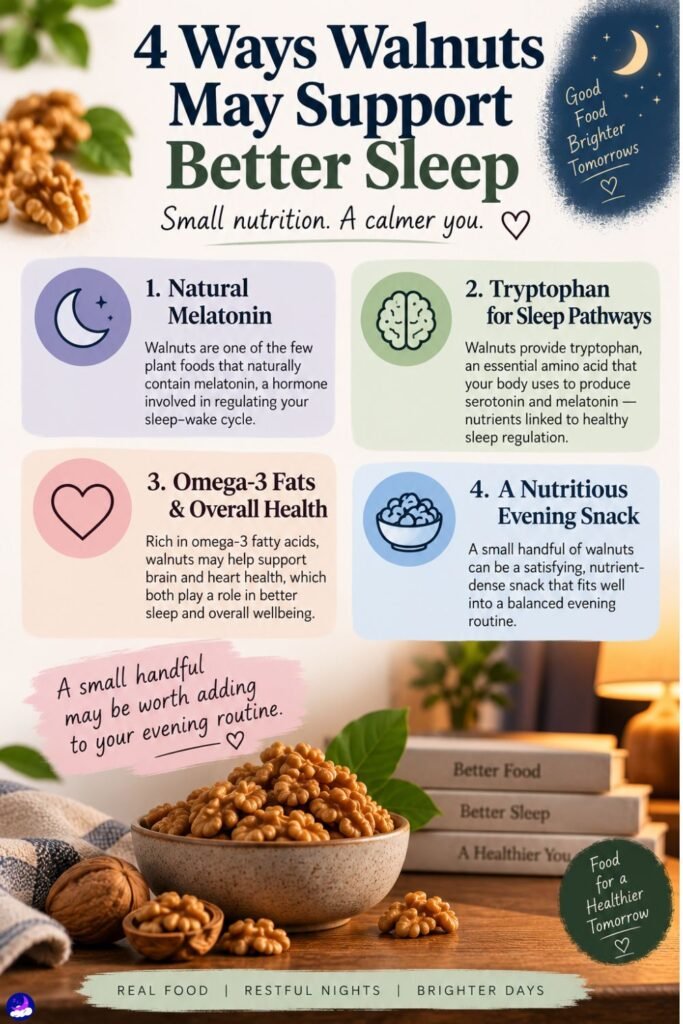
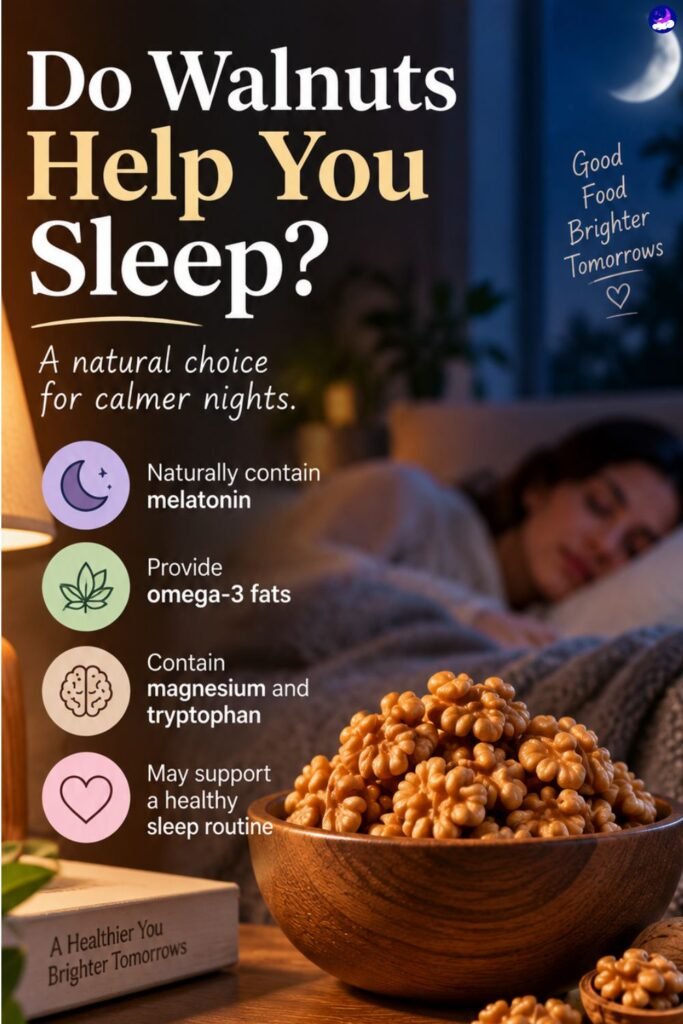
Walnuts contain several nutrients and naturally occurring compounds that may be relevant to sleep, including melatonin, tryptophan, magnesium and the omega-3 fatty acid alpha-linolenic acid (ALA).
Table of Contents
But there is an important question behind all of this: Do walnuts actually help you sleep?
Walnuts may support certain aspects of sleep, but the evidence is still developing.
Until recently, much of the interest in walnuts and sleep came from their nutritional profile. A 2025 randomized crossover trial gave us more direct human evidence.
In that study, young adults who ate 40 grams of walnuts with dinner each day for eight weeks experienced improvements in several sleep-related measures, including sleep latency, overall sleep quality and daytime sleepiness. The researchers also found higher evening levels of a urinary melatonin metabolite.
That is encouraging, but it does not mean walnuts are a treatment for insomnia.
Let’s take a closer look at what we know—and what we still don’t.
A better way to think about walnuts is as a nutritious food that may have sleep-supportive properties, rather than as a natural sleeping pill.
Why Are Walnuts Linked to Sleep?
Walnuts have an interesting nutritional combination.
They contain:
- Melatonin, a hormone involved in regulating the body’s sleep-wake cycle
- Tryptophan, an essential amino acid used to make serotonin and, eventually, melatonin
- Alpha-linolenic acid (ALA), a plant-based omega-3 fatty acid
- Magnesium, which plays important roles in normal nerve and muscle function
- Protein, fibre and unsaturated fats
That doesn’t mean each of these nutrients automatically improves sleep.
The body doesn’t work like a simple list of ingredients. Eating a food that contains a sleep-related nutrient does not necessarily mean that the nutrient will produce a noticeable sleep effect.
What makes walnuts particularly interesting is the combination of these compounds and the fact that researchers have now begun testing their effect directly in humans.
| Nutrient in Walnuts | How It Supports Sleep |
|---|---|
| Melatonin | Helps regulate the body’s internal clock (circadian rhythm) |
| Magnesium | Calms the nervous system and relaxes muscles |
| Tryptophan | Boosts serotonin and melatonin, the “feel good” and “sleep” chemicals |
| Omega-3 fatty acids | Reduces brain inflammation, supports emotional balance |
| Protein and fiber | Stabilizes blood sugar and prevents nighttime hunger |
Do Walnuts Contain Melatonin?
Yes. Walnuts naturally contain melatonin.
Melatonin is a hormone produced mainly by the pineal gland. As evening approaches, melatonin levels normally rise, helping the body prepare for sleep and keeping the sleep-wake cycle on track.
Because walnuts contain melatonin, they have sometimes been promoted as a natural food for better sleep. That description needs a little caution, though.
The melatonin naturally present in a food should not be treated as equivalent to taking a melatonin supplement. Digestion, absorption and metabolism all affect what happens after you eat a food.
The recent research is interesting for another reason. In the 2025 trial, researchers measured 6-sulfatoxymelatonin, a major urinary metabolite used as a marker of melatonin activity. Evening levels increased during the walnut intervention.
So there is more here than simply saying, “walnuts contain melatonin.” There is some human evidence suggesting that regular walnut consumption may influence melatonin-related activity.
Also Read: Foods that contain Melatonin.
What Does Research Say About Walnuts and Sleep?
The strongest evidence currently comes from a 2025 randomized crossover trial involving 76 young adults.
Participants ate 40 grams of walnuts with dinner every day for eight weeks during the walnut intervention. After a washout period, they went through the comparison condition. Researchers then looked at several measures related to sleep.
The results were encouraging.
| Sleep-related measure | Finding during walnut consumption |
|---|---|
| Evening urinary 6-sulfatoxymelatonin | Increased |
| Sleep latency | Decreased |
| Overall sleep quality | Improved |
| Daytime sleepiness | Decreased |
These results are useful because the researchers were not simply asking whether people who eat nuts tend to sleep better. They were actually testing walnut consumption and measuring changes in sleep-related outcomes.
Still, there is a reason to be careful about the conclusion.
The study was relatively small and focused on young adults. Participants also knew what they were eating, so it is difficult to completely separate the effect of the walnuts from other influences. And one study, even a randomized one, is not enough to establish a universal effect.
So, for now, the evidence is promising rather than definitive.
Walnuts and Sleep: What We Know vs. What We Don’t
Nutrition headlines often make preliminary findings sound much more certain than they really are. With walnuts, the distinction is worth making.
| What we know | What we don’t yet know |
|---|---|
| Walnuts naturally contain melatonin | Exactly how much walnut-derived melatonin contributes to sleep |
| Walnuts contain tryptophan and ALA | Whether these nutrients directly cause better sleep after eating walnuts |
| A clinical trial found improvements in several sleep measures | Whether the same benefits occur in older adults or people with insomnia |
| Walnut consumption increased an evening melatonin metabolite in the trial | Whether walnuts work better than other nuts |
| Walnuts can be part of a healthy diet | Whether walnuts can treat a sleep disorder |
This is why it is reasonable to be interested in walnuts and sleep without making bigger claims than the evidence allows.
How Might Walnuts Affect Sleep?
Researchers have several ideas about why walnuts might influence sleep. Some are more convincing than others, and none should be presented as a proven explanation yet.
Melatonin
Melatonin is probably the most obvious candidate.
Walnuts naturally contain melatonin, and the 2025 study found higher evening urinary 6-sulfatoxymelatonin during walnut consumption.
That finding suggests walnuts may influence melatonin-related processes, although researchers still need to work out exactly how this happens.
Tryptophan
Walnuts also contain tryptophan.
Your body uses tryptophan to make serotonin, which is involved in many functions, and serotonin can be used in the pathway that produces melatonin.
It would be misleading, though, to turn this into a simple chain of:
walnuts → tryptophan → serotonin → sleep
The process is considerably more complicated. How much tryptophan is available to the brain depends on several metabolic and dietary factors.
So tryptophan is a possible piece of the puzzle, not proof that walnuts directly increase sleep-promoting chemicals.
ALA and Omega-3 Fats
Walnuts are one of the better plant sources of alpha-linolenic acid (ALA), an essential omega-3 fatty acid.
Omega-3 fats have been investigated for their possible relationship with sleep and brain health. That has led to suggestions that the ALA in walnuts might contribute to their potential sleep effects.
The evidence isn’t strong enough to make that claim, however.
In particular, the body converts ALA to longer-chain omega-3 fats such as DHA only to a limited extent. So the commonly repeated explanation that walnuts work through a straightforward ALA → DHA → serotonin → better sleep pathway is far too simplistic.
Magnesium
Walnuts also provide magnesium.
Magnesium is involved in normal nerve and muscle function, and researchers have studied magnesium status in relation to sleep.
But this doesn’t mean the magnesium in walnuts is enough to treat sleep problems. It is more sensible to consider magnesium as one part of the walnut’s overall nutritional profile.
Can Walnuts Help You Fall Asleep Faster?
There is some encouraging evidence here.
The 2025 trial found that participants had a reduction in sleep latency, meaning they took less time to fall asleep during the walnut intervention.
That doesn’t mean a few walnuts will suddenly make you sleepy at night.
How quickly you fall asleep can be affected by many everyday factors, including:
- Caffeine late in the day
- Stress or anxiety
- Bright light exposure
- Evening screen use
- An inconsistent sleep schedule
- Physical activity
- Bedroom temperature and comfort
- Certain medicines
- Medical or sleep conditions
Walnuts may be one small part of a healthy routine. They aren’t likely to overcome several hours of poor sleep habits.
Should You Eat Walnuts Before Bed?
You can, provided you tolerate them well. But there is no strong evidence that walnuts have to be eaten immediately before bedtime.
The recent clinical trial used walnuts with dinner, rather than as a snack immediately before participants went to sleep.
That’s an important detail because advice such as “eat walnuts 30 minutes before bed” sounds more scientifically established than it actually is.
If you enjoy walnuts in the evening, having them with dinner or as part of a small evening snack is perfectly reasonable.
There is no need to watch the clock for the “perfect” walnut timing.
Your overall evening routine is likely to matter much more.
How Many Walnuts Should You Eat at Night?
There is currently no officially established walnut dose for improving sleep.
The 2025 trial used 40 grams of walnuts per day, eaten with dinner.
That is roughly a small handful, although the exact number of walnut halves depends on their size.
It is important not to turn the study dose into a universal recommendation. The researchers used 40 grams to test a specific intervention; they did not establish 40 grams as the amount everyone needs for good sleep.
Walnuts are also calorie-dense, so eating large quantities is unnecessary.
A moderate portion of plain, unsalted walnuts can fit easily into a balanced diet.
Are Walnuts Better Than Other Nuts for Sleep?
It would be tempting to call walnuts the best nut for sleep, but we don’t have enough evidence to say that.
Almonds, pistachios, cashews and other nuts also provide nutrients that are important for a healthy diet and may have relevance to sleep.
Walnuts stand out because they contain melatonin and are a rich plant source of ALA. They also happen to be one of the nuts that has now been directly studied in a randomized trial for sleep.
That makes them interesting—not necessarily superior.
Until researchers directly compare different nuts under similar conditions, it is better to avoid declaring one the winner.
What Is the Best Way to Eat Walnuts?
You don’t need a special recipe to include walnuts in your diet.
They can be added to:
- Oatmeal
- Plain yoghurt
- Fruit and yoghurt bowls
- Salads
- Whole-grain breakfast dishes
- Homemade trail mix
- Vegetable or grain bowls
For everyday eating, plain or unsalted walnuts are a sensible choice. Sugar-coated or heavily salted walnut snacks are a different story and may not fit as well into an overall healthy eating pattern.
If you’re eating walnuts in the evening, keep the portion moderate. A very large, heavy snack close to bedtime may simply leave some people feeling too full or uncomfortable.
Who Should Be Careful With Walnuts?
Walnuts are a healthy food for many people, but they are also tree nuts and can cause serious allergic reactions.
Anyone with a known walnut or tree-nut allergy should avoid them rather than trying them as a sleep remedy.
Portion size is another consideration. Walnuts contain plenty of healthy fats, but they are also energy-dense. Eating more isn’t necessarily better.
And if walnuts cause you digestive discomfort, eating them close to bedtime probably isn’t a good idea.
Can Walnuts Cure Insomnia?
No.
This is where it is important not to let an interesting nutrition finding turn into a medical claim.
The available research suggests that walnuts may support certain aspects of sleep. It does not show that walnuts can cure chronic insomnia.
Insomnia can have many different causes, including stress, anxiety, depression, chronic pain, medication effects and other medical or sleep conditions.
If you regularly have difficulty falling asleep, staying asleep or waking too early despite having enough opportunity to sleep, adding walnuts to your diet should not replace proper evaluation or evidence-based treatment.
Walnuts can be part of a healthy lifestyle. They are not a substitute for treatment when a sleep disorder is present.
Frequently Asked Questions About Walnuts and Sleep
Do walnuts make you sleepy?
Not in the way a sedative or sleeping medicine does. However, early research suggests that regular walnut consumption may improve some sleep-related measures, including sleep latency and overall sleep quality.
Can I eat walnuts before bed?
Yes, if you tolerate them well. But there is no good evidence that they have to be eaten immediately before bed. The recent clinical trial used walnuts with dinner.
How many walnuts should I eat at night?
There is no established sleep-specific amount. A recent study used 40 grams of walnuts daily with dinner, but that should not be interpreted as a universal prescription
Do walnuts contain melatonin?
Yes. Walnuts naturally contain melatonin. Research has also found an increase in evening urinary 6-sulfatoxymelatonin during regular walnut consumption.
Are walnuts good for sleep quality?
They may be. A 2025 randomized crossover trial found an improvement in overall sleep quality after eight weeks of daily walnut consumption in young adults.
Are walnuts a treatment for insomnia?
No. They can be part of a healthy diet, but walnuts have not been established as a treatment or cure for insomnia.
The Bottom Line
So, do walnuts help you sleep?
The fairest answer right now is possibly—and the evidence is becoming more interesting.
Walnuts contain melatonin, tryptophan, ALA, magnesium, healthy fats and other nutrients. More importantly, a 2025 randomized crossover trial found that eating 40 grams of walnuts daily with dinner for eight weeks was associated with higher evening urinary 6-sulfatoxymelatonin, shorter sleep latency, better overall sleep quality and less daytime sleepiness in young adults.
Those findings are encouraging, but they are not the final word.
We still need larger studies involving different age groups and people with actual sleep disorders. We also need to understand which components of walnuts may be responsible for the observed effects and whether walnuts offer any advantage over other nutritious foods.
For now, there is nothing wrong with giving walnuts a place in a healthy diet if you enjoy them.
They may be a sleep-friendly food, but they are not a sleeping pill.
And if your sleep is consistently poor, improving your overall sleep habits—and addressing any underlying problem—is likely to matter much more than adding one particular food to your evening routine.
References
- Zerón-Rugerio MF, Ibarra-Picón A, Diez-Hernández M, et al. Daily walnut consumption increases 6-sulfatoxymelatonin urinary levels and can improve sleep quality: a randomized crossover trial. Food & Function. 2025;16:7023–7035.
This is the key study behind the article’s main claim about walnuts and sleep. It studied 76 young adults who consumed 40 g of walnuts daily with dinner for eight weeks.
Read the study on PubMed - Nisar T, Fuller A, Gyawali P, Bird S. Effectiveness of Melatonin-Containing Foods on Promoting Sleep: A Scoping Review. Food Science & Nutrition. 2026;14(5):e71823.
A recent review examining research on foods containing naturally occurring melatonin and their potential relationship with sleep. It also highlights the limitations and differences between existing studies.
Read the 2026 review on PubMed - Tindall A, Kissell MC. The Role of Peanuts and Tree Nuts in Improving Diet and Sleep Quality: A Pilot Study and Literature Review. Nutrients. 2026;18(4):579.
Useful for the broader discussion of nuts, diet quality and sleep. The authors identified only a small number of randomized trials examining nut intake and sleep, with results varying according to nut type, dose, timing and participants.
Read the review on PubMed - Pereira N, Naufel MF, Ribeiro EB, Tufik S, Hachul H. Influence of Dietary Sources of Melatonin on Sleep Quality: A Review. Journal of Food Science. 2020;85(1):5–13.
Provides useful background on dietary melatonin and its potential relationship with sleep, while also noting limitations in the available trials.
Read the review on PubMed - Muñoz-Jurado A, Escribano BM. Presence of melatonin in foods of daily consumption: The benefit of this hormone for health. Food Chemistry. 2024;458:140172.
Useful for the discussion of melatonin naturally occurring in foods and why the amount of melatonin in a food does not automatically tell us what effect eating that food will have on health or sleep.
Read the review on PubMed