
Can vitamin B12 help you sleep better? The short answer is: possibly if you are deficient, but there is not enough evidence that B12 supplements improve sleep when your B12 level is already adequate.
Vitamin B12 is essential for the nervous system, healthy red blood cells and DNA synthesis.
Researchers have also studied its effects on melatonin and the body clock, but clinical studies have not established vitamin B12 as a treatment for insomnia or other common sleep problems.
Table of Contents
The relationship between vitamin B12 and sleep is interesting, but the evidence is still limited.
Vitamin B12 and Sleep: What Does the Research Show?
Some observational studies have found associations between B12 levels and sleep quality or insomnia symptoms. However, these studies cannot tell us whether low B12 causes poor sleep or whether another factor is responsible.
More importantly, studies that actually gave people vitamin B12 have generally not shown a consistent improvement in sleep.
| Question | What the evidence shows |
|---|---|
| Is B12 important for normal brain and nerve function? | Yes |
| Can B12 deficiency cause fatigue and neurological problems? | Yes |
| Is low B12 associated with some sleep problems? | Possibly |
| Does B12 supplementation improve sleep in healthy adults? | Not demonstrated |
| Can B12 influence melatonin or circadian biology? | Possibly |
| Does B12 treat insomnia? | No established evidence |
| Does B12 treat delayed sleep phase syndrome? | Not supported by controlled research |
| Is high-dose B12 recommended as a sleep supplement? | No |
What happened in healthy adults?
One small 2022 study looked directly at whether B12 supplementation changes sleep.
Fourteen healthy adults with normal B12 levels took 3,000 micrograms of cyanocobalamin daily for two weeks. Their blood B12 levels increased substantially, but researchers found no change in sleep latency, total sleep time, wake after sleep onset or sleep efficiency.
The study was small and short, so it cannot rule out every possible effect of B12 on sleep. Still, it does not support taking high-dose B12 simply to sleep better.
What about people with delayed sleep phase syndrome?
Vitamin B12 has also been investigated as a possible treatment for circadian rhythm problems.
In a double-blind study of 50 people with delayed sleep phase syndrome, participants received either 3 mg of methylcobalamin daily or placebo for four weeks.
The researchers found no significant difference between the groups in daytime drowsiness, mood or night-time sleep. The study concluded that methylcobalamin was not an effective treatment for delayed sleep phase syndrome.
What about infants?
A randomized, double-blind trial involving 600 infants at risk of B12 deficiency also examined sleep.
One year of B12 supplementation did not improve nighttime sleep duration, total sleep duration or wake after sleep onset. There was a small reduction in sleep-onset latency, but overall the findings did not support B12 supplementation as a way to improve sleep.
Of course, results in infants cannot be directly applied to adults. The study is useful because it adds another controlled trial to a relatively small evidence base.
Vitamin B12 and Sleep: Take-Home Message
B12 is essential for the nervous system, but current research does not show that B12 supplements reliably improve sleep when B12 status is already adequate.
Also Read:
How Could Vitamin B12 Affect Sleep?
There are several possible biological connections between B12 and sleep, but they should not be confused with proof that B12 supplementation improves sleep.
Vitamin B12 and the nervous system
Vitamin B12 is required for the development, myelination and normal function of the central nervous system. It is also involved in DNA synthesis and healthy red blood cell formation.
A significant B12 deficiency can cause neurological symptoms such as numbness and tingling, as well as fatigue and anemia.
Because normal sleep depends on healthy brain and nervous-system function, a deficiency could potentially affect sleep indirectly.
But there is an important distinction:
Correcting a deficiency is not the same as taking extra B12 to improve sleep.
Vitamin B12, melatonin and the body clock
B12 has attracted attention because of research into melatonin and circadian rhythms.
In a small crossover study, nine healthy people received 3 mg of methylcobalamin daily for four weeks. B12 altered the timing and amount of circulating melatonin, but it did not change the timing of sleep.
Another study found that B12 affected melatonin-related measures and activity patterns, with some effects differing according to the form of B12 used.
These findings are interesting, but they do not establish that B12 produces better sleep.
In fact, they illustrate an important principle:
Changing a biological marker does not necessarily mean improving the outcome that matters to the person.
For sleep, that outcome might be falling asleep more easily, staying asleep, getting adequate sleep or feeling refreshed the next day.
How Could Vitamin B12 Affect Sleep?: Take-Home Message
B12 may interact with melatonin and circadian biology, but these laboratory and small human findings have not translated into a proven sleep treatment.
Also Read:
Can Vitamin B12 Deficiency Affect Sleep?
This may be a more clinically relevant question than whether extra B12 acts as a sleep aid.
Vitamin B12 deficiency can cause:
- Fatigue
- Weakness
- Megaloblastic anemia
- Numbness or tingling
- Neurological changes
- Cognitive problems
- Glossitis
- Palpitations
- Pale skin
Neurological symptoms can occur even without anemia, which is one reason significant B12 deficiency should not be ignored.
These symptoms can make a person feel unwell and may interfere with normal daytime functioning and sleep.
However, B12 deficiency should not automatically be blamed for insomnia.
A person can have poor sleep with completely normal B12 levels, and having low B12 does not prove that B12 is the cause of their sleep problem.
What do observational studies show?
A 2023 cross-sectional study of 512 adults attending primary healthcare services found that lower B12 levels were associated with insomnia symptoms after adjustment for several factors. However, the study did not find a significant association between B12 levels and poor overall sleep quality.
Another study in people with type 2 diabetes found an association between higher, rather than lower, B12 levels and insomnia. This illustrates why individual observational studies should not be interpreted as proof that either low or high B12 causes insomnia.
A systematic review of micronutrients and sleep similarly concluded that evidence linking micronutrient status with sleep was still limited and that more research was needed to establish clinical relevance.
So far, the research tells us that B12 and sleep may be related, but it does not establish a simple cause-and-effect relationship.
Who Is More Likely to Have Low Vitamin B12?
Not everyone with poor sleep needs a B12 test. But some people have a higher risk of B12 inadequacy or deficiency.
| Group | Why B12 status may be lower |
|---|---|
| People following a vegan diet | Little or no natural dietary B12 |
| Older adults | Absorption of food-bound B12 can become less efficient |
| People with pernicious anemia | Lack of intrinsic factor impairs absorption |
| People with gastrointestinal disorders | Absorption may be impaired |
| People who have had some gastrointestinal surgeries | Reduced absorption |
| Long-term metformin users | May reduce B12 absorption or status |
| Long-term acid-suppressing medication users | May interfere with absorption of food-bound B12 |
Vitamin B12 deficiency can develop even when dietary intake appears adequate if absorption is impaired.
People who avoid animal foods
Vitamin B12 occurs naturally mainly in animal-derived foods.
People following a vegan diet therefore need a reliable source of B12 from fortified foods or supplements.
This is important for general health, whether or not the person has sleep problems.
How Is Vitamin B12 Deficiency Diagnosed?
A blood test is commonly used to assess vitamin B12 status.
Serum or plasma B12 values below approximately 200–250 pg/mL are generally considered subnormal, although the appropriate interpretation depends on the laboratory and clinical situation.
A borderline B12 result may require additional testing.
Methylmalonic acid (MMA) is a particularly useful marker because it rises when B12-dependent metabolism is impaired. However, MMA can also increase with reduced kidney function, so it should be interpreted in context. Homocysteine can also rise when B12 status is low, but it is less specific.
The important point is that:
A B12 blood result should be interpreted alongside symptoms, diet, medications and other clinical findings rather than treated as an isolated number.
How Much Vitamin B12 Do You Need?
The recommended amount of B12 is small.
| Life stage | Recommended amount |
|---|---|
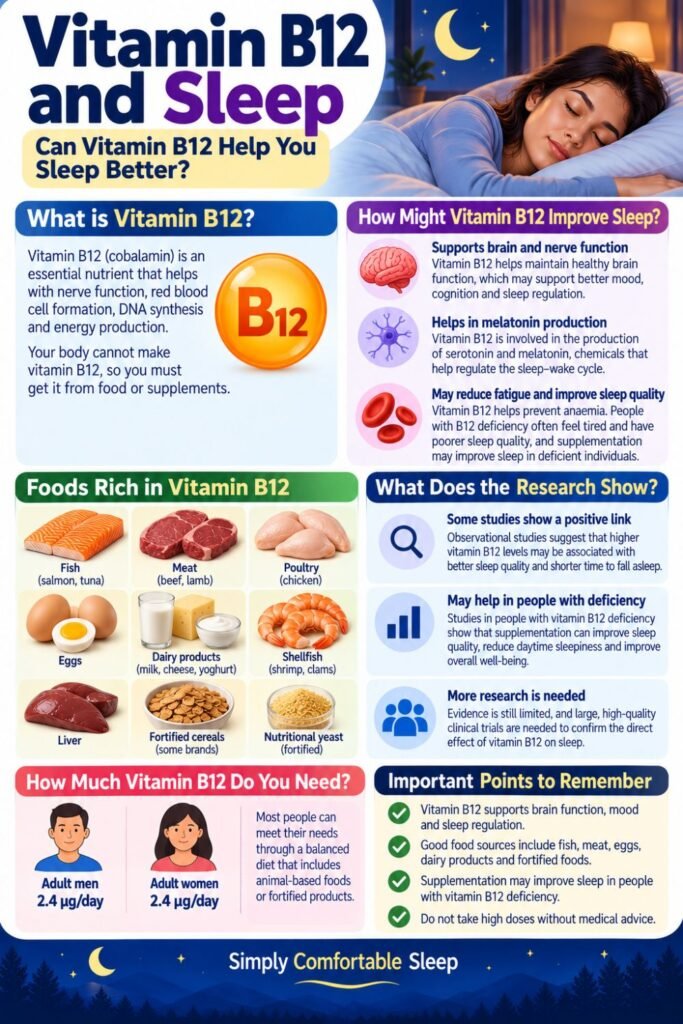
| Adults 19+ | 2.4 mcg/day |
| Pregnancy | 2.6 mcg/day |
| Breastfeeding | 2.8 mcg/day |
| Teens 14–18 | 2.4 mcg/day |
These amounts are designed to meet normal nutritional requirements. They are not doses established to improve sleep.
You may notice that B12 supplements often contain 500 or 1,000 mcg—or even more.
That does not mean your body needs that much every day for normal health or sleep. Large doses are sometimes used because only a small proportion of very high oral doses is absorbed, and higher doses may be appropriate when treating deficiency.
Can You Get Enough Vitamin B12 From Food?
For people who eat animal foods, B12 is available from a variety of everyday foods.
Good sources include:
- Fish
- Meat
- Poultry
- Eggs
- Milk and dairy products
- Shellfish
- Beef liver
- Fortified breakfast cereals
- Fortified nutritional yeast
Plant foods do not naturally provide reliable B12 unless they have been fortified.
For most people, the goal should be to meet nutritional needs through an appropriate diet, using fortified foods or supplements when necessary.
There is no special “B12 sleep food” that has been shown to improve sleep.
Should You Take Vitamin B12 Before Bed?
There is no established benefit to taking vitamin B12 at bedtime.
Some studies have investigated B12 and circadian rhythms, but they do not show that taking B12 at night produces better sleep. One small study found changes in melatonin rhythms without a corresponding change in sleep timing.
If you are taking B12 to correct a deficiency, follow the schedule recommended by your healthcare professional.
If your B12 status is normal, there is currently no good reason to add B12 at bedtime specifically as a sleep aid.
Is High-Dose Vitamin B12 Better for Sleep?
No evidence shows that high-dose B12 produces better sleep.
This is worth emphasizing because B12 supplements can contain doses hundreds of times higher than the daily requirement.
The U.S. National Institutes of Health has not established a tolerable upper intake level for vitamin B12 because it has a low potential for toxicity and is generally considered safe even at high doses.
But safe does not mean beneficial.
High-dose B12 can be medically appropriate when treating deficiency, especially when absorption is impaired. It is very different from taking high-dose B12 simply because you hope it will improve sleep.
The 2022 study in healthy adults is a useful example: participants took 3,000 mcg/day for two weeks, their blood B12 increased substantially, but their measured sleep did not change.
Vitamin B12 and Sleep: Take-Home Message
More B12 is not automatically better for sleep. High doses may be useful for treating deficiency, but they are not established sleep-improvement doses.
Also Read:
When Poor Sleep Probably Isn’t a Vitamin B12 Problem
If your B12 level is adequate and you have no particular reason to suspect deficiency, taking B12 simply because you sleep poorly is unlikely to address the main cause.
Common reasons for poor sleep include:
- Chronic insomnia
- Sleep apnea
- Restless legs syndrome
- Circadian rhythm disorders
- Irregular sleep schedules
- Excessive caffeine
- Alcohol
- Stress
- Chronic pain
- Medication effects
- An uncomfortable sleep environment
For chronic insomnia, cognitive behavioral therapy for insomnia (CBT-I) has much stronger evidence than vitamin supplementation.
This is why persistent sleep problems deserve a proper sleep assessment rather than a long list of supplements.
So, Does Vitamin B12 Help You Sleep?
Vitamin B12 is essential for the brain, nervous system and blood formation, but it is not an established sleep supplement.
If you are deficient, correcting the deficiency is important and may improve symptoms such as fatigue and neurological problems. However, if your B12 status is already adequate, current evidence does not show that taking extra B12 will reliably help you sleep better.
Research into B12, melatonin and circadian rhythms remains interesting, but these findings have not translated into a proven treatment for insomnia or delayed sleep phase syndrome.
Final Take-Home Message
B12 deficiency deserves attention, but high-dose B12 for better sleep does not have strong evidence behind it. Get enough B12 for good health, and look beyond supplements when sleep problems persist.
Also Read:
Frequently Asked Questions
Does vitamin B12 help you sleep?
There is not enough evidence to say that B12 supplements reliably improve sleep. B12 is essential for normal nervous-system function, but controlled studies have not demonstrated a consistent sleep benefit.
Can B12 deficiency affect sleep?
Possibly. B12 deficiency can cause fatigue and neurological problems that may interfere with normal functioning and sleep. However, B12 deficiency has not been established as a common cause of insomnia.
Does vitamin B12 increase melatonin?
Small human studies suggest that B12 can alter melatonin rhythms, but these changes have not been shown to consistently produce better sleep.
Should I take B12 at night?
There is no established benefit to taking B12 at bedtime. If you are taking it to treat a deficiency, follow the recommended treatment schedule.
Can vitamin B12 treat insomnia?
No. Vitamin B12 is not an established treatment for chronic insomnia.
How much B12 do adults need?
Adults generally need 2.4 mcg per day. The recommendation increases to 2.6 mcg during pregnancy and 2.8 mcg during breastfeeding.
What foods are high in vitamin B12?
Fish, shellfish, meat, poultry, eggs and dairy products are good sources. Fortified cereals and fortified nutritional yeast can provide B12 for people who consume little or no animal food.
Should I test my B12 if I have poor sleep?
Testing may be reasonable if you have additional reasons to suspect deficiency, such as a vegan diet, gastrointestinal disease, long-term metformin or acid-suppressing medication use, unexplained fatigue, anemia or neurological symptoms. Poor sleep alone does not automatically mean that B12 testing is necessary.
References
- National Institutes of Health, Office of Dietary Supplements. Vitamin B12 – Health Professional Fact Sheet. Updated July 2, 2025. NIH ODS – Vitamin B12, Health Professional Fact Sheet
- Channer-Wallen T, Dawson P, Thomas-Brown PG, Gossell-Williams M. Lack of association between serum vitamin B12 and nocturnal sleep parameters following cyanocobalamin supplementation in healthy adults. Heliyon. 2022;8(2):e08831. PMID: 35146159. PubMed – PMID 35146159
- Okawa M, Takahashi K, Egashira K, et al. Vitamin B12 treatment for delayed sleep phase syndrome: a multi-center double-blind study. Psychiatry Clin Neurosci. 1997;51(5):275-279. PMID: 9413873. PubMed – PMID 9413873
- Honma S, Kohsaka M, Fukuda N, Morita N, Honma K. Effects of vitamin B12 on plasma melatonin rhythm in humans: increased light sensitivity phase-advances the circadian clock? Experientia. 1992;48:716-720. PMID: 1516676. PubMed – PMID 1516676
- Hysing M, et al. The effect of vitamin B12-supplementation on actigraphy measured sleep pattern: a randomized controlled trial. Clin Nutr. 2022;41(2):307-312. PMID: 34999324. PubMed – PMID 34999324
- Ji X, Grandner MA, Liu J. The relationship between micronutrient status and sleep patterns: a systematic review. Public Health Nutr. 2017;20(4):687-701. PMID: 27702409. PubMed – PMID 27702409
- Bouloukaki I, et al. Association of Vitamin B12 Levels with Sleep Quality, Insomnia, and Sleepiness in Adult Primary Healthcare Users in Greece. Healthcare. 2023;11(23). PMID: 38063594. PubMed – PMID 38063594
- Xiong S, et al. The independent association between vitamin B12 and insomnia in Chinese patients with type 2 diabetes mellitus: a cross-sectional study. Nutr Diabetes. 2022. PMID: 35039481. PubMed – PMID 35039481