Iron and sleep are connected in several ways, particularly through restless legs syndrome (RLS). Low iron can affect sleep when inadequate iron status contributes to RLS, fatigue or other problems that disturb nighttime rest. However, iron is not a general sleep aid, and taking an iron supplement without a specific need is not recommended.
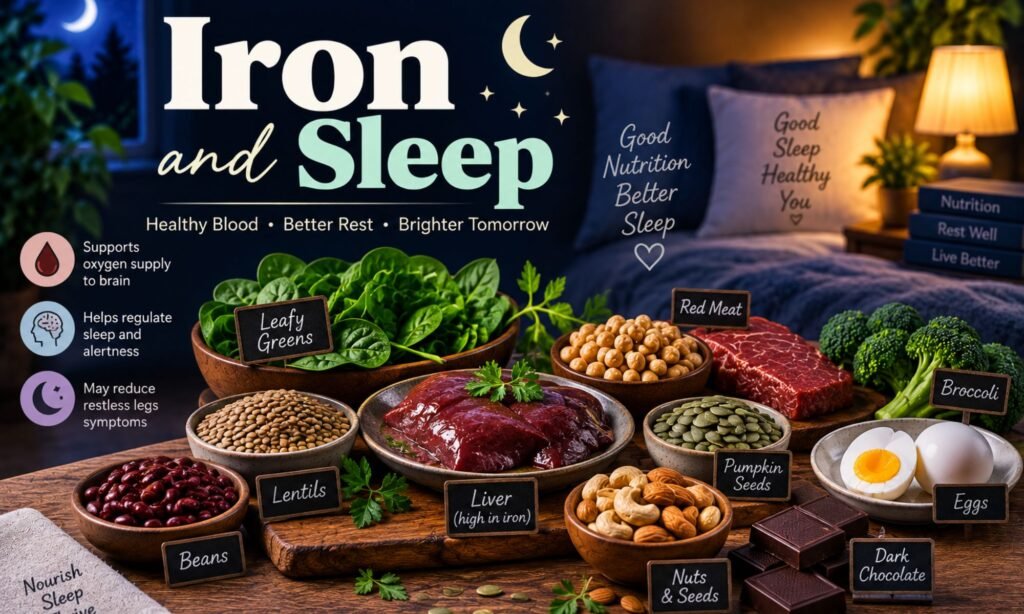
Table of Contents
Sleep is influenced by much more than what happens at bedtime. Your body depends on iron, magnesium, vitamins, amino acids and other nutrients to support the nervous system, energy metabolism and many processes involved in normal sleep.
Iron is particularly interesting because its relationship with sleep is more specific than simply saying that “iron helps you sleep.” Research has examined iron deficiency in connection with restless legs syndrome, periodic limb movements, sleep-disordered breathing and broader sleep disturbances. However, the strongest body of evidence involves RLS. A scoping review of 93 studies found that 74 focused on restless legs syndrome.
This makes iron an important nutrient to understand if sleep is being disrupted by unusual nighttime sensations, an urge to move the legs or persistent restless movement.
At the same time, poor sleep does not automatically mean low iron. Someone with ordinary insomnia but adequate iron status should not assume that taking iron will solve the problem.
The more useful question is:
Could inadequate iron status be contributing to the particular sleep problem?
What Does Iron Have to Do With Sleep?
Iron is an essential mineral involved in oxygen transport, energy production, cellular function and neurological processes.
Most people associate iron with hemoglobin, the protein in red blood cells that carries oxygen from the lungs to tissues. Iron is also part of myoglobin, which helps supply oxygen to muscles, and it is required for several enzymes and metabolic processes. The brain also has its own tightly regulated iron metabolism.
That neurological role is particularly relevant to restless legs syndrome.
Researchers believe that brain iron availability and dopamine-related pathways may be involved in RLS. Iron deficiency does not explain every case of RLS, but altered brain iron metabolism appears to be an important part of the condition.
RLS can interfere with sleep because symptoms tend to appear or become worse during rest and in the evening or at night.
A person may feel an uncomfortable urge to move the legs just when they are trying to settle down. Moving the legs can provide temporary relief, but the sensations may return when the person becomes still again.
Iron deficiency has also been investigated in relation to other sleep conditions. The evidence is less consistent than it is for RLS, but studies have examined associations with periodic limb movements, sleep-disordered breathing and general sleep disturbances.
Iron and Sleep: Take-Home Message
Iron status supports normal neurological function, but its sleep connection is particularly important when restless legs symptoms are present.
Also Read:
Iron Deficiency vs. Iron-Deficiency Anemia
Iron deficiency and iron-deficiency anemia are related, but they are not the same thing.
Iron deficiency can begin with depletion of the body’s iron stores. If the deficiency progresses, the body may not have enough iron to produce hemoglobin normally, eventually resulting in iron-deficiency anemia.
This distinction matters because someone can have depleted iron stores before obvious anemia develops. The NIH notes that iron deficiency progresses from depletion of iron stores to impaired red-blood-cell production and, eventually, iron-deficiency anemia.
Common measurements used to evaluate iron status include:
| Test | What it helps assess |
|---|---|
| Ferritin | Stored iron |
| Serum iron | Iron circulating in the blood |
| Transferrin | Protein that transports iron |
| Transferrin saturation | Proportion of transferrin carrying iron |
| Hemoglobin | Helps identify anemia |
Ferritin is particularly useful because it reflects iron stores. However, it can also increase during inflammation or infection, which can make interpretation more complicated. Healthcare professionals may therefore use several measurements together rather than relying on one result.
This becomes especially important with RLS because the iron thresholds used in sleep medicine are not necessarily the same as the thresholds used for diagnosing ordinary iron deficiency in the general population.
Iron Deficiency and Sleep: Take-Home Message
Low iron stores can occur before iron-deficiency anemia, so hemoglobin alone does not tell the whole story.
Also Read:
Iron Deficiency and Restless Legs Syndrome
This is the most important sleep-related connection in this article.
Restless legs syndrome, or RLS, is a neurological condition involving an urge to move the legs, often accompanied by uncomfortable sensations.
The symptoms typically:
- Become worse when resting
- Improve temporarily with movement
- Become more noticeable during the evening or night
- Can make it difficult to fall asleep
- May repeatedly disturb sleep after a person finally falls asleep
For someone with RLS, the problem is not simply an inability to relax.
The neurological sensations themselves can make remaining still difficult.
Iron appears to be involved in RLS through complex mechanisms involving brain iron and dopamine-related pathways. Current research suggests that low iron availability in certain parts of the brain may occur even when systemic iron measurements do not show severe deficiency.
This helps explain why iron status receives particular attention in people with RLS.
The 2025 American Academy of Sleep Medicine guideline recommends that people with clinically significant RLS have serum iron studies, including ferritin and transferrin saturation, checked regularly.
That does not mean every person with RLS is iron deficient. It means that iron status is important enough to be part of the clinical evaluation.
Iron and Restless Legs: Take-Home Message
Restless legs syndrome is the sleep condition most strongly associated with iron status.
Also Read:
Can Low Iron Cause Restless Legs?
The relationship between low iron and RLS is well established enough to influence clinical practice, but it is better to describe it as an important association and potential contributor rather than saying that low iron causes every case.
The 2020 scoping review found that most of the research on iron deficiency and sleep focused on RLS. Among the RLS association studies it reviewed, many found statistically supported relationships between iron deficiency and RLS. Iron treatment was also beneficial in most of the RLS treatment studies included in the review.
More recent reviews continue to describe brain iron deficiency and altered iron metabolism as important parts of RLS biology.
However, RLS has multiple possible contributing factors. Genetics, medications, kidney disease, pregnancy and other conditions can all be relevant.
So the correct interpretation is:
Low iron can be an important contributor to RLS, but low iron is not the only possible explanation for RLS.
That distinction matters because it prevents people from assuming that an iron supplement is appropriate whenever their legs feel restless at night.
Low Iron and Restless Legs: Take-Home Message
Low iron can contribute to RLS, but restless legs can have multiple causes.
Also Read:
Ferritin and Sleep: Why It Matters
If you have read about iron and restless legs, you have probably come across ferritin.
Ferritin is a protein that stores iron, and a ferritin blood test is commonly used to estimate the body’s iron stores.
For general nutritional assessment, ferritin is one useful measure of iron status. But RLS requires a slightly different perspective.
The 2025 AASM guideline recommends that adults with clinically significant RLS have ferritin and transferrin saturation assessed regularly. Its consensus-based iron-treatment thresholds suggest considering iron supplementation when ferritin is 75 ng/mL or lower or transferrin saturation is below 20%. For adults with RLS and ferritin between 75 and 100 ng/mL, the guideline recommends considering IV rather than oral iron.
For children with RLS, the guideline uses a lower ferritin threshold of below 50 ng/mL for considering iron treatment.
These are RLS-specific clinical thresholds.
They should not be interpreted as:
“Anyone with ferritin below 75 needs an iron supplement.”
That would be an incorrect use of the guideline.
Ferritin can also be affected by inflammation, which is another reason it should be interpreted alongside other iron measurements and the person’s clinical situation. Reviews of existing guidelines have found substantial variation in ferritin cutoffs and inconsistent approaches to accounting for inflammation.
Ferritin and Sleep: Take-Home Message
Ferritin and transferrin saturation provide important information about iron status, particularly when RLS is being evaluated.
Also Read:
Can Iron Supplements Improve Sleep?
Iron supplements should not be used as general-purpose sleep aids.
However, they can improve sleep-related symptoms when iron deficiency or inadequate iron status is contributing to RLS.
A 2025 systematic review and meta-analysis included 12 randomized controlled trials involving 511 people with RLS. Iron treatment improved RLS severity, quality of life and a sleep-related visual analogue score. The researchers also found more overall adverse events with iron treatment, although serious adverse events and treatment discontinuation did not differ significantly between groups.
An earlier meta-analysis of randomized trials also found that iron treatment improved RLS symptom scores compared with control treatment.
This gives us an important distinction:
Treating an iron-related problem can improve sleep.
That is very different from:
Taking iron simply because you want to sleep better.
The AASM guideline supports oral ferrous sulfate in appropriately selected adults with RLS and appropriate iron status, while also providing guidance for IV iron in specific circumstances.
Iron Supplements and Sleep: Take-Home Message
Iron supplementation may improve sleep when iron-related RLS is involved, but it is not a general sleep treatment.
Also Read:
Can Low Iron Make You Tired Even Without Poor Sleep?
Yes, but fatigue is not specific to iron deficiency.
Iron is required for oxygen transport and energy metabolism, so inadequate iron can eventually contribute to tiredness, weakness and reduced physical capacity. Iron-deficiency anemia is particularly likely to cause noticeable fatigue because hemoglobin production is impaired.
But feeling tired does not automatically mean you have low iron.
Poor sleep itself can cause daytime fatigue. So can stress, inadequate calorie intake, thyroid problems, infections, medications and many other conditions.
This is why it is useful to separate three questions:
Am I tired?
Am I sleeping poorly?
Am I actually iron deficient?
They can occur together, but one does not prove the others.
If fatigue is persistent or unexplained, testing and medical evaluation are more useful than starting an iron supplement based on symptoms alone.
Low Iron and Fatigue: Take-Home Message
Fatigue can occur with iron deficiency, but tiredness alone does not prove that iron is the problem.
Also Read:
Iron-Rich Foods for Better Iron Status
Food is an important way to maintain adequate iron intake.
However, I would not call these “sleep foods.”
Eating an iron-rich meal does not act like a sleeping pill. The benefit is more fundamental: adequate dietary iron helps maintain normal iron status, which supports normal health and neurological function.
| Food | Iron type | Other useful nutrients |
|---|---|---|
| Oysters | Heme | Zinc, B12, protein |
| Lean red meat | Heme | B12, protein |
| Chicken and turkey | Heme + non-heme | Protein, B vitamins |
| Lentils | Non-heme | Folate, magnesium, protein |
| Beans | Non-heme | Fiber, magnesium |
| Tofu | Non-heme | Protein |
| Spinach | Non-heme | Folate, magnesium |
| Pumpkin seeds | Non-heme | Magnesium, zinc |
| Fortified cereals | Non-heme | Varies by product |
Heme iron is found in meat, seafood and poultry and is generally more bioavailable.
Non-heme iron is found in plant foods and fortified foods. Its absorption is more strongly influenced by the rest of the meal.
For people eating mostly or entirely plant-based diets, this distinction matters because the body absorbs non-heme iron less efficiently. The NIH notes that vegetarian iron requirements are approximately 1.8 times higher than those for people who consume meat, because of differences in iron bioavailability.
That does not mean plant-based diets cannot provide enough iron. Beans, lentils, tofu, seeds and fortified foods can all contribute substantially.
Iron-Rich Foods and Sleep: Take-Home Message
Iron-rich foods help support adequate iron intake, but their sleep benefit comes through overall iron status, not an immediate sedative effect.
Also Read:
How to Absorb More Iron From Food
The amount of iron in a food is only part of the story. Absorption also matters.
Vitamin C can improve the absorption of non-heme iron, which makes combinations such as these useful:
- Lentils with tomatoes
- Beans with bell peppers
- Spinach with citrus
- Tofu with broccoli or peppers
- Fortified cereal with strawberries
Some compounds can reduce non-heme iron absorption, including phytates found in many plant foods and certain polyphenols found in tea and coffee. Calcium can also affect iron absorption in some circumstances.
This does not mean you need to avoid tea, coffee, beans or calcium-rich foods.
The overall diet matters more than obsessing over a single meal.
If someone is already iron deficient, however, meal timing and food combinations may become more relevant as part of a broader plan.
Iron Absorption: Take-Home Message
Pairing non-heme iron with vitamin C can improve iron absorption from many plant foods.
Also Read:
How Much Iron Do You Need Each Day?
Iron requirements vary according to age, sex and life stage.
According to the NIH Office of Dietary Supplements, the recommended dietary allowance for most adult men aged 19–50 is 8 mg per day, while women aged 19–50 generally need 18 mg per day. Pregnancy increases the recommendation to 27 mg per day. For adults aged 51 and older, the recommendation is 8 mg per day.
| Life stage | Recommended iron intake/day |
|---|---|
| Adult men 19–50 | 8 mg |
| Adult women 19–50 | 18 mg |
| Pregnant adults | 27 mg |
| Breastfeeding adults | 9 mg |
| Adults 51+ | 8 mg |
People following vegetarian diets have higher recommended intakes because non-heme iron is less bioavailable.
These are general dietary recommendations, not treatment doses.
Someone being treated for iron deficiency or RLS may receive an amount and formulation determined by their healthcare professional. The two should not be confused.
Daily Iron Needs: Take-Home Message
Daily iron needs vary by life stage and diet, and they are different from therapeutic iron doses.
Also Read:
Who Is More Likely to Have Low Iron?
Iron deficiency can develop because of inadequate intake, increased requirements, blood loss, reduced absorption or a combination of factors.
People at greater risk can include:
- People who menstruate
- Pregnant people
- Infants and children
- Teenagers
- Frequent blood donors
- People with diets low in iron
- People with gastrointestinal conditions affecting absorption
- People experiencing ongoing blood loss
Menstruation is an important source of iron loss, while pregnancy substantially increases iron requirements. The NIH also identifies infants, young children, adolescent girls, pregnant women and premenopausal women among groups at greater risk of inadequate iron intake.
Having one of these risk factors does not mean that a person is iron deficient.
It simply means that iron status may deserve attention if symptoms or circumstances suggest a possible problem.
Low Iron Risk: Take-Home Message
Some people have a higher risk of iron deficiency, but risk factors alone do not establish a deficiency.
Also Read:
Signs of Iron Deficiency
Iron deficiency can cause symptoms, but many are nonspecific.
Possible symptoms include:
- Fatigue
- Weakness
- Reduced exercise tolerance
- Difficulty concentrating
- Headaches
- Pale skin
- Shortness of breath when anemia develops
- Restless legs in some people
The symptoms can vary according to how severe and how long-lasting the deficiency is.
Importantly, feeling tired is not enough to diagnose iron deficiency.
Someone may be exhausted because of chronic sleep deprivation, insomnia, stress or another medical problem. Similarly, someone with poor sleep does not automatically need iron.
Blood tests and clinical evaluation are more useful than trying to diagnose low iron from symptoms alone.
Iron Deficiency Symptoms: Take-Home Message
Symptoms can raise suspicion, but testing is needed to identify iron deficiency.
Also Read:
Iron-Deficiency Anemia and Sleep
Iron-deficiency anemia develops when iron deficiency becomes severe enough to interfere with normal hemoglobin production.
Because hemoglobin carries oxygen, anemia can contribute to fatigue, weakness and reduced physical capacity.
Research also suggests that anemia may be associated with sleep disturbances.
A 2026 narrative review found that iron-deficiency anemia was associated with poorer sleep quality, shorter sleep duration, longer sleep-onset latency and lower sleep efficiency across the studies it reviewed. The review also found that RLS occurred more often among people with iron-deficiency anemia. However, the researchers noted substantial differences between studies in how anemia and sleep were defined and measured.
This means anemia may be relevant to sleep, but it should not automatically be blamed for every sleep problem.
More importantly, if iron-deficiency anemia is diagnosed, the underlying cause of the iron deficiency needs attention.
Possible causes include inadequate dietary intake, increased requirements, impaired absorption and blood loss.
Iron-Deficiency Anemia and Sleep: Take-Home Message
Iron-deficiency anemia can be associated with sleep disturbances, but finding the underlying cause is essential.
Also Read:
Iron, Children and Sleep
Iron status can be particularly important during childhood because children are growing rapidly and have changing nutritional requirements.
Research has examined iron deficiency in children with RLS, periodic limb movements and restless sleep. The evidence is not as extensive as it is in adults, but the relationship is clinically relevant.
The 2025 AASM guideline recommends that children with RLS and appropriate clinical findings may receive iron treatment when ferritin is below 50 ng/mL, using oral or IV iron under appropriate medical care.
This should not be interpreted as a recommendation for parents to give children iron whenever they sleep poorly.
Too much iron can be harmful, and childhood sleep problems have many possible causes.
If a child has persistent restless sleep, unusual nighttime leg movements or symptoms suggestive of RLS, pediatric evaluation is more appropriate than self-treatment.
Iron and Children’s Sleep: Take-Home Message
Suspected iron-related sleep problems in children should be professionally evaluated rather than treated with iron without guidance.
Also Read:
Iron, Pregnancy and Sleep
Pregnancy is another situation where iron and sleep can intersect.
Iron requirements increase substantially during pregnancy, while restless legs syndrome is also common during pregnancy.
This makes iron status worth considering when a pregnant person develops new nighttime leg discomfort or a strong urge to move the legs.
However, pregnancy changes nutritional requirements and the safety considerations for medications and supplements. An iron supplement should therefore be based on appropriate assessment rather than used simply because sleep has become difficult.
The AASM guideline specifically includes pregnancy among the situations in which RLS management requires attention to the safety of treatment choices.
Iron and Pregnancy Sleep: Take-Home Message
During pregnancy, iron needs increase, but supplementation should be guided by appropriate assessment.
Also Read:
Should You Take Iron for Better Sleep?
For most people, not simply because they are sleeping poorly.
Iron supplementation makes sense when there is a specific nutritional or clinical reason.
That might include:
- Confirmed iron deficiency
- Iron-deficiency anemia
- Appropriate iron findings in RLS
- Increased nutritional requirements
- A healthcare professional’s recommendation
Taking iron unnecessarily is not harmless.
Common side effects of oral iron include constipation, nausea and abdominal discomfort. Higher doses can increase gastrointestinal side effects, and excessive iron intake can be dangerous. The NIH notes that supplemental iron at high doses can cause gastrointestinal problems and that iron toxicity can be serious.
There is also no evidence that taking more iron than your body needs will make a nutritionally adequate person sleep better.
A better question is:
Could inadequate iron status be contributing to my sleep problem?
If that possibility exists, the next step is assessment rather than automatically taking a supplement.
Iron Supplements for Sleep: Take-Home Message
Iron supplements should have a specific nutritional or clinical reason, not simply a goal of better sleep.
Also Read:
When Poor Sleep Isn’t an Iron Problem
Not every sleep problem is related to nutrition.
Persistent sleep difficulties may be caused by:
- Chronic insomnia
- Sleep apnea
- Restless legs syndrome
- Circadian rhythm disorders
- Stress or anxiety
- Pain
- Medications
- Caffeine or alcohol
- An uncomfortable sleep environment
- Irregular sleep schedules
Even when someone has RLS, iron deficiency is not necessarily the only contributing factor.
Likewise, a person with insomnia but no symptoms suggesting RLS and no evidence of inadequate iron status should not assume iron is the missing piece.
If sleep problems are persistent, severe or affecting daytime functioning, finding the underlying cause is more useful than repeatedly adding supplements.
Nutrition can support healthy sleep, but it should not become an explanation for every sleep problem.
When Sleep Isn’t an Iron Problem: Take-Home Message
Iron matters for some sleep problems, but persistent poor sleep may have a different underlying cause.
Also Read:
Frequently Asked Questions
Can low iron affect sleep?
Yes. Low iron status can be associated with sleep problems, with the strongest evidence involving restless legs syndrome. Iron deficiency has also been studied in relation to other sleep disturbances, although the evidence is less consistent.
Can low iron cause restless legs at night?
Low iron can contribute to RLS, although it is not the only possible cause. Because of the connection between iron status and RLS, current sleep-medicine guidance recommends checking iron studies in people with clinically significant RLS.
Does iron deficiency cause insomnia?
Iron deficiency may contribute to sleep disruption, particularly when RLS or anemia is involved. However, insomnia has many possible causes, so iron deficiency should not automatically be assumed to be responsible.
What ferritin level is associated with restless legs?
For adults with clinically significant RLS, the 2025 AASM guideline recommends considering iron supplementation when ferritin is 75 ng/mL or lower or transferrin saturation is below 20%. These are RLS-specific clinical thresholds, not general instructions for everyone.
Can iron supplements help you sleep better?
They may help when iron-related RLS is contributing to sleep problems. A 2025 meta-analysis found that iron treatment improved RLS severity, quality of life and a sleep-related measure.
What foods are high in iron?
Good sources include lean meat, seafood, poultry, lentils, beans, tofu, spinach, seeds and iron-fortified cereals. Animal foods provide heme iron, while plant foods and fortified foods provide non-heme iron.
Does vitamin C help absorb iron?
Yes. Vitamin C can improve the absorption of non-heme iron, which is found mainly in plant foods and fortified foods.
Can you take iron every night for sleep?
Not simply for sleep. Whether iron should be taken, in what form and at what dose depends on your iron status and the reason for treatment. Unnecessary supplementation can cause side effects and excessive iron can be harmful.
Can children have low iron and sleep problems?
Yes. Iron status has been studied in children with RLS and other restless-sleep patterns. Because excessive iron can be dangerous in children, suspected iron-related sleep problems should be evaluated professionally.
Should you take iron if you have trouble sleeping?
Not automatically. If you have symptoms such as restless legs, nighttime leg discomfort, heavy menstrual bleeding or other risk factors for iron deficiency, discussing iron assessment with a healthcare professional may be appropriate.
The Bottom Line
Iron is essential for oxygen transport, energy production and normal neurological function, but its relationship with sleep is more specific than simply saying that iron “helps you sleep.”
The strongest connection is with restless legs syndrome. Low iron status may contribute to RLS, and RLS can make it difficult to fall asleep or remain asleep. This is why current sleep-medicine guidance recommends checking ferritin and transferrin saturation in people with clinically significant RLS.
Iron deficiency and iron-deficiency anemia may also be associated with broader sleep disturbances, although the evidence is less specific.
For most people, the goal should be adequate iron—not excess iron.
A varied diet can provide iron through foods such as meat, seafood, legumes, tofu, seeds and fortified foods. Vitamin C can help improve the absorption of non-heme iron from plant foods.
When inadequate iron is suspected or confirmed, the important step is to identify why iron is low and address the underlying problem.
And if you simply have trouble sleeping without symptoms suggesting RLS or evidence of inadequate iron status, an iron supplement is unlikely to be the answer.
Iron and Sleep: Take-Home Message
Adequate iron supports healthy function, but iron supplements should be used for a specific nutritional or clinical need, not as a general sleep aid.
Also Read:
References
- Leung W, Singh I, McWilliams S, Stockler S, Ipsiroglu OS. Iron deficiency and sleep: A scoping review. Sleep Medicine Reviews. 2020. PubMed
- Winkelman JW, Berkowski JA, DelRosso LM, et al. Treatment of restless legs syndrome and periodic limb movement disorder: An American Academy of Sleep Medicine clinical practice guideline. Journal of Clinical Sleep Medicine. 2025. PubMed
- Mahmoud A, Salamah HM, Alshaker H, et al. Efficacy and safety of iron supplements for restless leg syndrome: A systematic review and meta-analysis. 2025. PubMed
- Avni T, Reich S, Lev N, Gafter-Gvili A. Iron supplementation for restless legs syndrome: A systematic review and meta-analysis. 2019. PubMed
- McWilliams S, et al. Iron Deficiency and Sleep/Wake Behaviors: A Scoping Review of Clinical Practice Guidelines. Nutrients. 2024. PubMed
- Anemia and Sleep Disturbances: Mechanisms, Evidence and Clinical Implications. 2026. PubMed
- National Institutes of Health, Office of Dietary Supplements. Iron — Health Professional Fact Sheet. NIH Office of Dietary Supplements