Vitamin A is essential for vision, immunity, growth, reproduction and normal cell function, but whether vitamin A can directly improve sleep is still unclear.
Research suggests that vitamin A-derived retinoic acid is involved in biological pathways related to sleep and circadian regulation, including brain activity during sleep.
Table of Contents
However, most of this evidence comes from experimental and animal research, and there is no established evidence that vitamin A supplements improve sleep in otherwise healthy people.
For now, the sensible approach is to meet your vitamin A needs through a balanced diet rather than taking extra vitamin A as a sleep aid.
What Does the Science Say About Vitamin A and Sleep?
The relationship between vitamin A and sleep is interesting, but the evidence is very different from the evidence for some other nutrients.
Researchers have found that vitamin A-derived compounds can influence pathways involved in brain function, circadian rhythms and sleep-related electrical activity. However, this does not mean that taking a vitamin A supplement will necessarily make you sleep longer or better.
| Type of evidence | What researchers have found | What it tells us |
|---|---|---|
| Molecular research | Retinoic acid affects gene signaling through retinoid receptors | Provides a possible biological mechanism |
| Animal studies | Retinoid signaling affects sleep-related EEG activity | Suggests a role in sleep regulation |
| Vitamin A deficiency studies in animals | Deficiency can reduce sleep-related delta EEG power | Suggests adequate vitamin A may be important for normal sleep physiology |
| Human observational research | Emerging associations between vitamin A status and sleep have been reported in specific populations | Association does not prove causation |
| Human supplementation trials | No established evidence that vitamin A supplementation treats insomnia | Vitamin A is not an established sleep treatment |
The important point is that the biological evidence is more interesting than the clinical evidence.
A 2008 review concluded that retinoid signaling may be involved in the homeostatic component of sleep EEG, while a 2022 review noted that evidence connecting vitamin A deficiency with biological-rhythm disorders remains limited and is based largely on animal studies.
Vitamin A and Sleep: Take-Home Message
Vitamin A-related signaling appears to influence sleep biology, but clinical evidence for vitamin A supplementation is still lacking.
Also Read:
How Vitamin A May Influence Sleep
Retinoic Acid and Brain Activity
Vitamin A is the parent compound for a family of compounds called retinoids.
One important vitamin A derivative is retinoic acid, which can influence gene expression by activating nuclear retinoid receptors.
Researchers have found that this signaling system is involved in the brain and may influence biological rhythms and sleep.
A 2005 study in mice found that the gene encoding retinoic acid receptor beta (RARβ) influenced the contribution of delta oscillations to the sleep EEG. Delta oscillations are a major feature of slow-wave sleep and are associated with the depth and homeostatic regulation of sleep.
This was an important finding because it provided a possible molecular connection between vitamin A signaling and sleep physiology.
But there is an important limitation:
The study was conducted in mice.
It does not show that taking vitamin A supplements increases deep sleep in humans.
Vitamin A Deficiency and Sleep EEG
Another animal study examined what happened when mice were fed a vitamin-A-deficient diet.
After four weeks, the vitamin-A-deficient mice showed a significant reduction in delta power during non-REM sleep. The researchers suggested that the changes could be related to altered dopaminergic function.
This adds to the evidence that vitamin A-related pathways may have a role in normal sleep regulation.
However, it is still experimental evidence.
We cannot assume that a person with poor sleep has vitamin A deficiency, nor can we assume that giving extra vitamin A to a person with adequate vitamin A status will increase slow-wave sleep.
Vitamin A and the Circadian Clock
Vitamin A may also have a connection with the body’s circadian system.
Retinoic acid can interact with retinoid receptors involved in gene regulation, and experimental research suggests that retinoid signaling can influence biological rhythms in the brain.
A review of the available literature found that retinoic acid may influence circadian pathways, including pathways involving the suprachiasmatic nucleus, the brain’s main circadian clock. However, the review emphasized that evidence specifically linking vitamin A deficiency to biological-rhythm disorders remains limited and that most relevant studies have been conducted in animals.
This gives us a plausible mechanism, but not yet a proven nutritional treatment.
Vitamin A, the Pineal Gland and Melatonin
The connection becomes even more interesting when we look at the pineal gland, which produces melatonin at night.
Researchers have found the machinery required for retinoic acid signaling in both human and mouse pineal glands. Experimental research has also demonstrated interaction between retinoic acid signaling and melatonin.
However, the findings do not mean:
More vitamin A → more melatonin → better sleep.
The relationship appears to be more complicated.
In the experimental study, melatonin actually suppressed some retinoic-acid-induced gene transcription. The researchers described this as possible cross-talk between retinoic acid and melatonin systems, rather than showing that vitamin A supplementation increases melatonin.
Vitamin A and Melatonin: Take-Home Message
Vitamin A-related retinoic acid signaling interacts with the pineal and melatonin systems.
But vitamin A is not an established way to increase melatonin or improve sleep.
Also Read:
Could Vitamin A Deficiency Affect Sleep?
This is an important question, but the evidence needs to be interpreted carefully.
Vitamin A deficiency is medically important because vitamin A has essential roles in vision, immunity, cellular differentiation and normal development. Severe deficiency can produce significant health problems.
Animal research suggests that deficiency can also affect sleep-related brain activity.
But we currently cannot say that vitamin A deficiency is a common cause of insomnia in humans.
A 2022 review of vitamin A deficiency and biological rhythms concluded that evidence remains limited and that most of the relevant research has been conducted in animals.
So the scientifically appropriate conclusion is:
Vitamin A deficiency may affect biological pathways involved in sleep.
But human evidence is insufficient to establish that vitamin A deficiency causes insomnia or other common sleep disorders.
What Human Research Tells Us
There is some emerging human research, but it has important limitations.
A 2026 observational study involving 361 children with autism spectrum disorder found that children with lower vitamin A levels had more severe sleep problems. The researchers also examined retinoic acid receptor beta and clock-related genes and found associations involving vitamin A status and these biological pathways.
This is interesting because it provides a possible connection between vitamin A status, sleep and circadian biology.
However, the study was observational and involved a specific pediatric population.
It cannot establish that:
- vitamin A deficiency caused the sleep problems,
- vitamin A supplements would improve sleep, or
- the findings apply to healthy adults.
There is also an important caution when reviewing older literature: a 2021 study that reported an association between vitamin A deficiency and sleep disturbances in children with autism was subsequently retracted. It therefore should not be used as supporting evidence.
This is exactly why checking the publication status of individual studies matters when building an evidence-based nutrition article.
What We Still Don’t Know About Vitamin A and Sleep
Despite the interesting mechanisms, several important questions remain unanswered.
There is currently no established evidence showing that vitamin A supplementation:
- Treats insomnia
- Increases total sleep time in healthy adults
- Reliably improves sleep quality
- Increases deep sleep in humans
- Increases melatonin enough to improve sleep
- Prevents common sleep disorders
- Has a specific therapeutic dose for sleep
A 2026 narrative review of nutritional modulators of sleep describes vitamin and nutrient pathways that may influence sleep through neurobiological and circadian mechanisms, but this broader literature does not establish vitamin A supplementation as a proven treatment for insomnia.
This distinction is important:
A nutrient can be necessary for normal physiology without being a useful sleep supplement when taken in extra amounts.
Vitamin A and Sleep: What the Evidence Really Means
Vitamin A appears to participate in sleep biology, but we do not yet have good clinical evidence that taking extra vitamin A improves sleep.
Also Read:
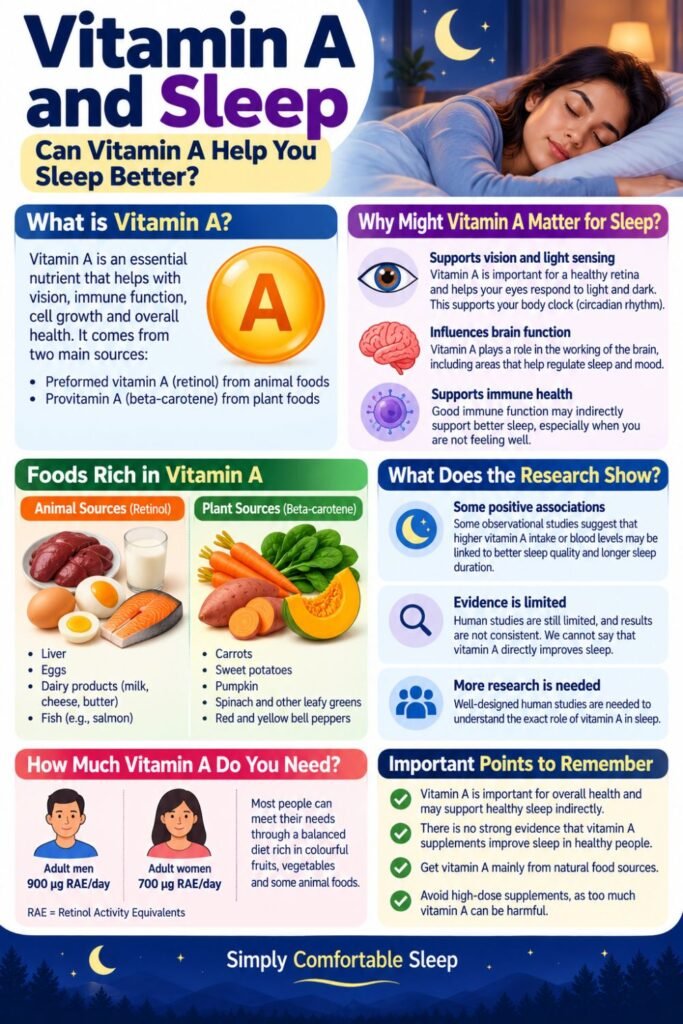
What Is Vitamin A?
Vitamin A is a fat-soluble vitamin involved in several important functions throughout the body.
It is particularly important for:
- Normal vision
- Immune function
- Growth and development
- Reproduction
- Cell growth and differentiation
- Normal functioning of organs and tissues
The human diet provides vitamin A in two main forms:
Preformed vitamin A comes mainly from animal foods and includes retinol and retinyl esters.
Provitamin A carotenoids come mainly from plant foods. Beta-carotene is the best-known example, and the body can convert it into vitamin A.
Vitamin A-Rich Foods
You do not need to take a vitamin A supplement simply because you want to support normal sleep biology.
A varied diet can provide vitamin A.
| Food | Main source of vitamin A |
|---|---|
| Liver | Preformed vitamin A |
| Eggs | Preformed vitamin A |
| Milk and dairy products | Preformed vitamin A |
| Fish | Preformed vitamin A |
| Carrots | Beta-carotene |
| Sweet potatoes | Beta-carotene |
| Pumpkin | Beta-carotene |
| Spinach and leafy greens | Provitamin A carotenoids |
| Mango | Provitamin A carotenoids |
| Papaya | Provitamin A carotenoids |
| Tomato products | Provitamin A carotenoids |
Animal foods provide preformed vitamin A, while many colourful fruits and vegetables provide carotenoids that can be converted to vitamin A.
Preformed Vitamin A
Important sources include:
- Liver
- Fish
- Eggs
- Milk
- Dairy products
Liver deserves special mention because it can contain very high concentrations of preformed vitamin A. Eating it in very large amounts can contribute substantially to vitamin A intake.
Provitamin A Carotenoids
Plant foods provide carotenoids such as beta-carotene.
Good sources include:
- Carrots
- Sweet potatoes
- Pumpkin
- Spinach
- Other dark green vegetables
- Mango
- Papaya
- Orange and yellow vegetables
These foods are useful components of a healthy diet and provide much more than vitamin A alone.
How Much Vitamin A Do You Need?
Vitamin A requirements vary with age, sex and life stage.
For adults, the NIH Office of Dietary Supplements lists the following recommended dietary allowances:
| Group | Recommended intake |
|---|---|
| Adult men | 900 mcg RAE/day |
| Adult women | 700 mcg RAE/day |
| Pregnancy | 770 mcg RAE/day |
| Breastfeeding | 1,300 mcg RAE/day |
RAE means retinol activity equivalents and takes into account differences in the biological activity of retinol and provitamin A carotenoids.
These values are designed to meet nutritional requirements.
There is no separate recommended vitamin A dose for better sleep.
Do Carrots Before Bed Help You Sleep?
Carrots are a nutritious source of beta-carotene, which the body can convert to vitamin A.
But there is currently no good evidence that eating carrots before bed directly improves sleep.
The same applies to other vitamin-A-rich foods.
Their value comes from helping provide a nutritionally adequate diet—not from acting as a natural sleeping pill.
So if you enjoy carrots at dinner, there is no reason to avoid them. But there is also no need to eat them specifically at bedtime for sleep.
Should You Take Vitamin A Supplements for Sleep?
For most people, there is no established reason to take vitamin A supplements specifically for sleep.
Vitamin A is fat-soluble, meaning the body can store it, particularly in the liver. Excessive intake of preformed vitamin A can therefore accumulate and cause toxicity.
The adult tolerable upper intake level for preformed vitamin A is 3,000 mcg RAE per day. This upper limit applies to preformed vitamin A from food and supplements; it does not apply in the same way to beta-carotene and other provitamin A carotenoids.
What Can Happen With Too Much Vitamin A?
Very high acute doses can cause symptoms such as:
- Severe headache
- Nausea
- Dizziness
- Blurred vision
- Muscle aches
- Problems with coordination
Long-term excessive intake can cause:
- Dry skin
- Muscle and joint pain
- Fatigue
- Abnormal liver function
- Other toxic effects
Because of these risks, more vitamin A is not necessarily better.
Vitamin A Supplements and Sleep: Take-Home Message
Meet your vitamin A needs, but do not use high-dose vitamin A as a sleep aid.
Also Read:
Vitamin A and Pregnancy
Vitamin A remains an essential nutrient during pregnancy, but this is also a situation where excessive intake of preformed vitamin A deserves particular caution.
High intakes of preformed vitamin A can cause congenital abnormalities. The adult upper limit for preformed vitamin A is 3,000 mcg RAE per day, and the NIH advises people who are or might become pregnant to avoid high-dose vitamin A supplements.
This does not mean vitamin A should be avoided during pregnancy.
The goal is to obtain an appropriate amount without excessive supplementation.
Anyone who is pregnant or planning pregnancy should discuss vitamin A-containing supplements with a healthcare professional.
Can Vitamin A Be Harmful in High Doses?
Yes.
This is one reason vitamin A should be treated differently from the idea of simply “adding more nutrients for better sleep.”
Preformed vitamin A can accumulate in the body. Chronic excessive intake can cause toxicity, while very high doses can cause acute toxicity.
Beta-carotene behaves differently. High intake can cause carotenodermia, a harmless yellow-orange discoloration of the skin that resolves after reducing intake. However, high-dose beta-carotene supplements are not recommended for the general population, and high-dose supplementation has been associated with increased lung-cancer risk in smokers and people exposed to asbestos.
This is another reason to favour food sources over high-dose supplements when possible.
Correcting Deficiency Is Different From Taking Extra
This distinction is important when discussing vitamins and sleep.
If someone has a genuine nutritional deficiency, correcting that deficiency is important for normal health.
But that does not mean taking amounts far above nutritional requirements will produce additional benefits.
For vitamin A:
Adequate intake → necessary for normal physiology.
Deficiency → may cause health problems and requires correction.
Extra vitamin A beyond requirements → not proven to improve sleep and may cause harm.
This principle applies to many nutrients, but it is especially important for fat-soluble vitamins such as vitamin A.
Vitamin A and Sleep Apnea
There is currently no strong evidence that vitamin A supplementation is an established treatment for obstructive sleep apnea (OSA).
Sleep apnea involves repeated episodes of upper-airway obstruction or reduced breathing during sleep and requires appropriate evaluation and management.
Vitamin A may be involved in biological pathways related to inflammation, cell function and circadian biology, but that does not make vitamin A a treatment for sleep apnea.
If someone has loud habitual snoring, witnessed pauses in breathing, gasping during sleep or significant daytime sleepiness, the appropriate step is evaluation for a possible sleep disorder—not self-treatment with vitamin A.
When Poor Sleep Probably Isn’t a Vitamin A Problem
If you regularly have difficulty sleeping, vitamin A deficiency should not be the first explanation you assume.
Common causes of poor sleep include:
- Chronic insomnia
- Obstructive sleep apnea
- Restless legs syndrome
- Irregular sleep schedules
- Excessive caffeine
- Alcohol
- Stress
- Anxiety
- Evening light exposure
- Shift work
- Medication effects
- Chronic pain
- Other medical conditions
Persistent sleep problems deserve attention to the underlying cause.
A vitamin supplement is unlikely to solve a sleep disorder when the real problem is untreated sleep apnea, an irregular circadian rhythm, medication effects or another medical condition.
Poor Sleep and Vitamin A: Take-Home Message
If you regularly struggle with sleep, do not assume vitamin A is the missing piece. Look for the underlying cause of the sleep problem.
Also Read:
Vitamin A vs Vitamin A Supplements
| Situation | Practical approach |
|---|---|
| Adequate vitamin A from food | Maintain a balanced diet |
| Suspected vitamin A deficiency | Seek appropriate medical assessment |
| Poor sleep with adequate nutrition | Look for other causes |
| Considering vitamin A for insomnia | There is no established sleep dose |
| High-dose vitamin A supplementation | Avoid unless medically indicated |
| Pregnancy | Take particular care with preformed vitamin A supplements |
The goal is nutritional adequacy, not megadosing.
So, Can Vitamin A Help You Sleep Better?
The most accurate answer is:
Vitamin A may be involved in the biology of sleep, but it has not been established as a sleep treatment.
Research has uncovered several interesting connections. Vitamin A-derived retinoic acid can influence retinoid receptors and brain signaling. Experimental studies in mice suggest that this pathway affects sleep-related delta oscillations. Vitamin A deficiency in mice has also been associated with reduced delta power during non-REM sleep.
Retinoic acid signaling is also present in the pineal gland and interacts with melatonin-related biology, although the relationship is complex and does not show that vitamin A supplementation increases melatonin.
Human evidence is much less developed. The 2026 study in children with autism spectrum disorder found associations between vitamin A status, sleep problems and clock-related genes, but it was observational and does not demonstrate that supplementation improves sleep.
So the practical message is simple:
Get enough vitamin A. Don’t assume that more is better.
Eat a varied diet containing vegetables, fruits, leafy greens, eggs, dairy, fish and other nutritious foods. If vitamin A deficiency is suspected, address it appropriately with medical guidance.
But if your vitamin A intake is already adequate, there is currently no good reason to take extra vitamin A simply because you want to sleep better.
Final Take-Home Message
Vitamin A has a fascinating role in sleep and circadian biology, but current evidence does not show that vitamin A supplements improve sleep in healthy people. Aim for adequate vitamin A from a balanced diet rather than high-dose supplementation.
Also Read:
Frequently Asked Questions
Does vitamin A help you sleep?
Vitamin A-derived retinoic acid appears to participate in biological pathways involved in sleep regulation, but there is not enough human evidence to recommend vitamin A supplements for improving sleep.
Can vitamin A deficiency cause insomnia?
There is currently insufficient evidence to say that vitamin A deficiency directly causes insomnia in humans. Animal studies suggest that vitamin A deficiency can alter sleep-related EEG activity, but these findings cannot be directly applied to humans.
Does vitamin A increase melatonin?
Not in any established clinical sense. Retinoic acid signaling and melatonin interact in experimental studies of the pineal gland, but there is no good evidence that taking vitamin A supplements increases melatonin enough to improve sleep.
Are carrots good for sleep?
Carrots are nutritious and provide beta-carotene, which the body can convert to vitamin A. However, there is no good evidence that eating carrots specifically before bed improves sleep.
What foods are high in vitamin A?
Preformed vitamin A is found in foods such as liver, fish, eggs and dairy products. Provitamin A carotenoids are found in foods such as carrots, sweet potatoes, pumpkin, spinach, mango and papaya.
Should I take vitamin A supplements for insomnia?
There is no established vitamin A dose for treating insomnia. Taking high doses without a medical indication is not advisable because excessive preformed vitamin A can cause toxicity.
How much vitamin A do adults need?
Adult men generally need 900 mcg RAE per day, while adult women need 700 mcg RAE per day. Requirements increase during pregnancy and breastfeeding.
Can too much vitamin A be harmful?
Yes. Excessive preformed vitamin A can cause acute or chronic toxicity, including headache, nausea, dizziness, fatigue, liver abnormalities and other problems. The adult upper limit for preformed vitamin A is 3,000 mcg RAE per day.
Is vitamin A safe during pregnancy?
Vitamin A is essential during pregnancy, but excessive preformed vitamin A can cause congenital abnormalities. Pregnant women should avoid unnecessary high-dose vitamin A supplements and discuss supplementation with their healthcare professional.
Can vitamin A treat sleep apnea?
There is currently no established evidence that vitamin A supplementation treats obstructive sleep apnea. Suspected sleep apnea requires appropriate clinical evaluation and treatment.
References
- National Institutes of Health, Office of Dietary Supplements. Vitamin A and Carotenoids – Health Professional Fact Sheet.
NIH ODS – Vitamin A and Carotenoids - Sei H. Vitamin A and sleep regulation. J Med Invest. 2008;55(1-2):1-8. PMID: 18319539.
PubMed – PMID 18319539 - Maret S, Franken P, Dauvilliers Y, Ghyselinck NB, Chambon P, Tafti M. Retinoic acid signaling affects cortical synchrony during sleep. Science. 2005;310(5745):111-113. PMID: 16210540.
PubMed – PMID 16210540 - Kitaoka Y, Hattori A, Chikahisa S, Miyamoto K, Nakaya Y, Sei H. Vitamin A deficiency induces a decrease in EEG delta power during sleep in mice. Brain Res. 2007;1150:121-130. PMID: 17400199.
PubMed – PMID 17400199 - Li Y, et al. Impacts of vitamin A deficiency on biological rhythms: Insights from the literature. Front Nutr. 2022. PMID: 36466383.
PubMed – PMID 36466383 - Ashton A, Clark J, Fedo J, Sementilli A, Fragoso YD, McCaffery P. Retinoic Acid Signalling in the Pineal Gland Is Conserved across Mammalian Species and Its Transcriptional Activity Is Inhibited by Melatonin. Cells. 2023;12(2):286. PMID: 36672220.
PubMed – PMID 36672220 - Xiang X, Chen H, Yuan B, et al. Vitamin A status is associated with sleep, clock genes, and symptoms in children with autism spectrum disorder. Front Psychiatry. 2026;17:1805599. PMID: 42023298.
PubMed – PMID 42023298 - Khosropanah A, Hosseini SA, Keshavarz A. Nutritional modulators of sleep: A narrative review of vitamins, minerals, amino acids, and their neurobiological and chronoepigenetic mechanisms. Chronobiol Int. 2026;43(7):951-964. PMID: 41992896.
PubMed – PMID 41992896