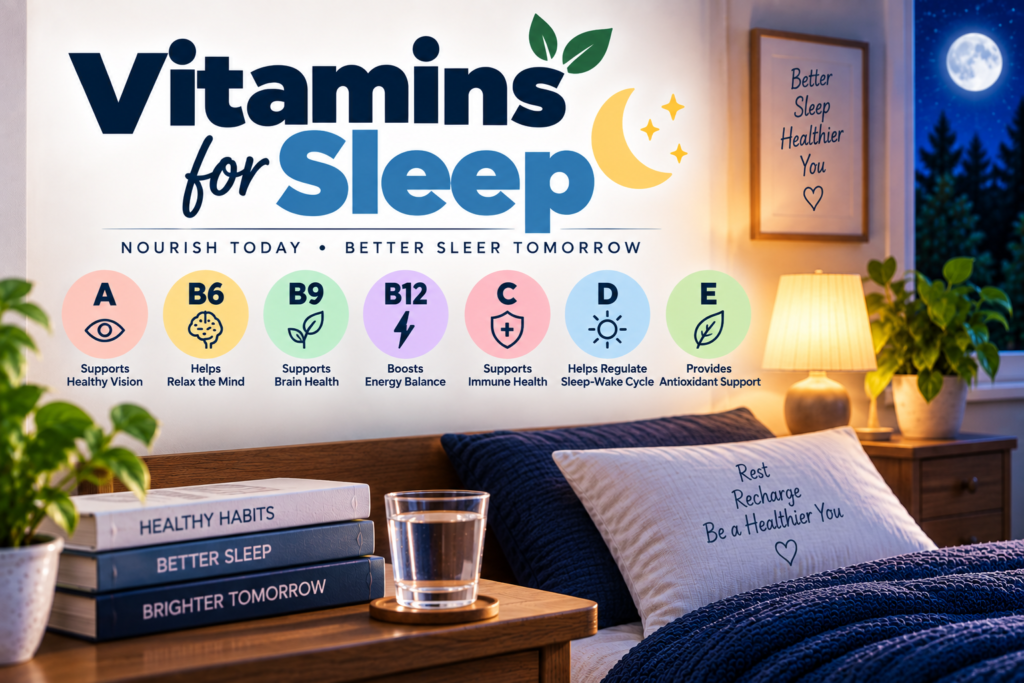
Vitamins for sleep does it help? Yes. Some vitamins support biological processes involved in sleep, but no vitamin is a universal sleep aid. Vitamin D and several B vitamins have attracted the most interest in sleep research, while evidence for other vitamins is more limited.
Meeting your nutritional needs—and correcting deficiencies when they occur—is more important than taking extra vitamins simply because they are marketed for sleep.
Table of Contents
Sleep is influenced by much more than your bedtime routine. Your body relies on vitamins, minerals, amino acids and other nutrients to support the nervous system, brain function, energy metabolism and circadian processes involved in healthy sleep.
That is why researchers have looked at the relationship between vitamin status and sleep. Some studies have found associations between inadequate vitamin levels and sleep problems, while supplementation trials have produced more mixed results. A recent 2026 review also highlights possible roles for B vitamins and vitamin D in neurotransmitter and circadian pathways, while emphasizing that larger controlled trials are still needed.
The distinction between vitamin adequacy and supplementation is important throughout this topic. Having enough of a vitamin is necessary for normal physiology. Taking more than you need does not automatically translate into better sleep.
7 Vitamins for Sleep
Here are seven vitamins worth understanding when looking at the connection between nutrition and sleep.
| Vitamin | Why researchers are interested | Evidence so far |
|---|---|---|
| Vitamin D | Circadian biology, brain function and sleep quality | Promising but mixed |
| Vitamin B6 | Neurotransmitter metabolism | Limited |
| Vitamin B12 | Nervous-system and circadian function | Limited and mixed |
| Folate (B9) | Methylation and neurological function | Limited |
| Vitamin C | Antioxidant and cellular function | Limited direct evidence |
| Vitamin E | Antioxidant and cellular function | Limited direct evidence |
| Vitamin A | Vision, immune and cellular function | Very limited direct sleep evidence |
This is not a ranking of the best vitamins for sleep.
Some of these vitamins have strong evidence for their importance to overall health, but that is different from proving that taking a supplement will improve sleep.
Research on micronutrients has identified possible relationships between vitamin status and sleep, but the evidence remains much stronger for some nutrients than others.
Vitamin D for Sleep
Vitamin D is probably the vitamin that has received the most attention in sleep research.
Vitamin D receptors and the enzymes involved in vitamin D metabolism are found in areas of the brain involved in sleep regulation. Researchers have proposed several possible connections between vitamin D and sleep, including effects on circadian regulation, brain function and inflammatory pathways.
Observational research has also found relationships between lower vitamin D status and sleep problems. A meta-analysis found that people with lower vitamin D levels were more likely to have sleep disorders and poor sleep quality. However, an association does not prove that low vitamin D is causing the sleep problem.
Supplementation studies provide a more interesting picture.
A 2022 systematic review and meta-analysis included 19 studies, including 13 randomized controlled trials. The researchers found that vitamin D supplementation significantly improved scores on the Pittsburgh Sleep Quality Index compared with placebo, with moderate certainty of evidence. However, findings for sleep-related impairment, sleep disorders, sleepiness and restless legs syndrome were not consistent.
Another systematic review and meta-analysis of five studies also found a statistically significant improvement in sleep quality with vitamin D supplementation, although the studies showed substantial variation.
So, is vitamin D a sleep supplement?
Not exactly.
The evidence is promising, but it does not show that everyone with poor sleep will benefit from taking vitamin D. A person’s baseline vitamin D status, dose, duration and underlying reason for poor sleep may all matter.
Vitamin D is also somewhat different from many other vitamins because the body can produce it after exposure to sunlight. Dietary sources include fatty fish, egg yolks and fortified foods.
The practical goal is therefore to maintain adequate vitamin D status, rather than assuming that a higher dose will produce better sleep.
Vitamin D for Sleep: Take-Home Message
Vitamin D may be relevant to sleep quality, particularly when levels are inadequate, but supplementation is not a guaranteed sleep solution.
Also Read:
Vitamin B6 for Sleep
Vitamin B6 is involved in numerous biochemical reactions, including the metabolism of amino acids and neurotransmitters.
It is particularly interesting in sleep research because B6 participates in pathways involved in neurotransmitter production, including pathways connected with tryptophan metabolism.
This creates a biological connection between:
Tryptophan → serotonin pathways → melatonin and sleep regulation
But this biochemical connection does not mean that taking extra B6 will necessarily increase melatonin or improve sleep.
Human research is still limited. One randomized, double-blind study involving 100 participants found that a high dose of vitamin B6 increased the amount of dream content participants recalled, but did not significantly affect other sleep-related variables.
That is a useful example of why we need to separate an interesting biological effect from a proven sleep benefit.
Vitamin B6 can be obtained from foods including poultry, fish, potatoes, chickpeas, bananas and fortified cereals.
Vitamin B6 for Sleep: Take-Home Message
Vitamin B6 supports neurotransmitter metabolism, but evidence for using B6 supplements to improve sleep is limited.
Also Read:
Vitamin B12 for Sleep
Vitamin B12 is essential for normal neurological function, red blood cell formation and DNA synthesis.
Its relationship with sleep is particularly interesting because B12 has been investigated in connection with circadian rhythms and melatonin.
Some experimental research has shown that vitamin B12 can influence aspects of the human melatonin rhythm and circadian timing. In one controlled study, B12 shifted the timing of the melatonin rhythm but did not change sleep timing.
Other research has explored B12 supplementation in people with sleep-wake rhythm disorders, but these studies are small and do not establish B12 as a general treatment for sleep problems.
More recent research has also failed to show a clear sleep benefit from B12 supplementation in healthy adults with normal B12 levels.
This is an important distinction.
B12 is essential for neurological health, but that does not make B12 supplementation a proven treatment for sleep problems.
Good sources include:
- Fish
- Meat
- Eggs
- Dairy products
- Fortified foods
People following strict vegan diets may need particular attention to reliable B12 sources because naturally occurring B12 is found mainly in animal-derived foods.
Vitamin B12 for Sleep: Take-Home Message
Vitamin B12 is important for normal neurological function, but its direct role in improving sleep remains uncertain.
Also Read:
Folate for Sleep
Folate, also known as vitamin B9, is important for DNA synthesis, cell division and normal neurological function.
It also participates in one-carbon metabolism and methylation, biochemical processes that influence many functions throughout the body.
Researchers have become increasingly interested in the relationship between folate, B12 and neurological pathways involved in sleep and circadian regulation. A recent review highlighted the possible role of folate and B12 in methylation processes involving circadian genes, while also emphasizing the need for larger controlled studies.
Food sources of folate include:
- Leafy green vegetables
- Beans and lentils
- Asparagus
- Avocado
- Citrus fruits
- Fortified grains and cereals
Folate is another example where adequate intake matters for health, but that does not mean taking additional folate will necessarily improve sleep.
Folate for Sleep: Take-Home Message
Folate supports normal neurological function, but evidence for a direct sleep benefit remains limited.
Also Read:
Vitamin C for Sleep
Vitamin C is best known for its role in immune function, collagen production and antioxidant protection.
It is also involved in numerous biochemical processes throughout the body.
Because oxidative stress and inflammation have been studied in relation to sleep, researchers have explored whether antioxidant nutrients such as vitamin C might be relevant.
However, the direct human evidence connecting vitamin C supplementation with better sleep is limited.
That distinction is important. Vitamin C is clearly an essential nutrient. It does not follow that taking additional vitamin C will improve sleep in someone who already gets enough.
Good food sources include:
- Citrus fruits
- Guava
- Kiwi
- Bell peppers
- Tomatoes
- Broccoli
- Strawberries
For most people, a varied diet can provide plenty of vitamin C.
Vitamin C for Sleep: Take-Home Message
Vitamin C supports overall health, but there is currently limited evidence that supplementation directly improves sleep.
Also Read: [Vitamin C and Sleep]
Vitamin E for Sleep
Vitamin E is a group of fat-soluble compounds with important antioxidant functions.
It helps protect cells from oxidative damage and supports normal immune function and other physiological processes.
Oxidative stress has been investigated in relation to sleep, which provides one reason vitamin E has attracted research interest. However, evidence directly showing that vitamin E supplementation improves sleep remains limited.
Food sources include:
- Almonds
- Sunflower seeds
- Hazelnuts
- Peanuts
- Avocado
- Vegetable oils
- Some green vegetables
This is another vitamin where the nutritional message is stronger than the sleep-specific evidence.
You need vitamin E for normal health. That does not mean that more vitamin E will produce better sleep.
Vitamin E for Sleep: Take-Home Message
Vitamin E supports cellular health, but its direct role in sleep remains unclear.
Also Read:
Vitamin A for Sleep
Vitamin A is essential for vision, immune function, reproduction and normal cell growth and development.
It is found in two main dietary forms: preformed vitamin A from animal foods and provitamin A carotenoids from plant foods.
Vitamin A also interacts with biological pathways involved in cell differentiation and nervous-system function, which makes it biologically interesting when considering sleep.
However, direct evidence that vitamin A supplementation improves sleep is very limited.
This is therefore not a vitamin I would describe as a sleep aid.
Instead, the focus should be on getting enough vitamin A through foods such as:
- Eggs
- Dairy products
- Liver
- Carrots
- Sweet potatoes
- Pumpkin
- Dark leafy vegetables
As with other fat-soluble vitamins, unnecessary high-dose supplementation is not a good strategy.
Vitamin A for Sleep: Take-Home Message
Vitamin A is essential for health, but evidence for a direct sleep benefit is very limited.
Also Read:
Can Vitamin Deficiency Affect Sleep?
This is one of the most important questions to ask before considering a vitamin supplement.
There is a major difference between:
Having a vitamin deficiency
and
Taking extra vitamins when your nutritional needs are already being met.
A deficiency can interfere with normal physiological processes and may contribute indirectly to fatigue, neurological symptoms or other problems that affect sleep.
Vitamin D provides one example. Lower vitamin D status has been associated with a greater risk of sleep problems, although the association does not prove that deficiency is the sole cause.
B vitamins provide another example because they participate in neurological and metabolic pathways.
But correcting a deficiency is different from taking high doses of vitamins simply because they are associated with sleep.
The first question should be: “Am I getting enough?”
Only after that does the question of supplementation become relevant.
Vitamin Deficiency and Sleep: Take-Home Message
Correcting a deficiency may be more important than taking extra vitamins for sleep.
Also Read:
Can Vitamins Help You Sleep Better?
The answer depends heavily on which vitamin you are talking about.
The current evidence can be summarized like this:
| Vitamin | What the research suggests | Evidence so far |
|---|---|---|
| Vitamin D | May improve subjective sleep quality in some people | Promising, mixed |
| Vitamin B6 | Involved in neurotransmitter pathways; limited sleep benefit evidence | Limited |
| Vitamin B12 | May influence circadian and melatonin pathways | Limited |
| Folate | Involved in neurological and methylation pathways | Limited |
| Vitamin C | Important antioxidant; little direct sleep evidence | Very limited |
| Vitamin E | Antioxidant and cellular functions | Very limited |
| Vitamin A | Essential for health; little direct sleep evidence | Very limited |
A vitamin can have strong evidence for its essential role in human health while having weak evidence for improving sleep when taken as a supplement.
Vitamin D currently has the most interesting intervention evidence among the vitamins discussed here. A systematic review of 19 studies found improved sleep-quality scores with supplementation, while findings for sleep quantity and specific sleep disorders were less consistent.
A second meta-analysis also found an improvement in sleep quality with vitamin D supplementation, although the researchers noted substantial variation between studies.
Vitamin Evidence and Sleep: Take-Home Message
Vitamin D currently has some of the more promising evidence, but no vitamin should be treated as a universal sleep treatment.
Also Read:
Food Sources of Sleep-Supporting Vitamins
Food is often the simplest way to meet vitamin requirements.
Instead of looking for one “sleep vitamin,” think about eating a variety of foods that provide several nutrients at once.
| Food | Important vitamins |
|---|---|
| Eggs | B12, B6, A |
| Fatty fish | D, B12 |
| Leafy greens | Folate, C, A |
| Citrus fruits | C, folate |
| Dairy foods | B12, A and D when fortified |
| Nuts and seeds | E, some B vitamins |
| Beans and lentils | Folate, B vitamins |
| Fortified cereals | Varies by product |
| Sweet potatoes | Provitamin A |
| Guava and peppers | Vitamin C |
The advantage of food is that it provides vitamins alongside protein, minerals, fiber, healthy fats and other compounds.
For example, eggs provide B12 and B6 alongside protein. Leafy greens provide folate and vitamin C along with minerals and fiber.
That does not make any of these foods a guaranteed sleep treatment. They simply contribute to a diet that helps meet your nutritional needs.
Food and Vitamins for Sleep: Take-Home Message
A varied diet is usually a better foundation for meeting vitamin needs than relying on a single sleep supplement.
Also Read:
Should You Take Vitamins for Sleep?
Not automatically.
The most reasonable reason to take a vitamin supplement is usually a specific nutritional need, rather than the hope that a higher dose will produce better sleep.
Supplementation may make sense when there is:
- A confirmed deficiency
- Inadequate dietary intake
- A restrictive diet
- A condition affecting nutrient absorption
- Increased nutritional requirements
- A healthcare professional’s recommendation
It is less convincing when someone is already meeting their nutritional needs and simply adds several supplements because they have been marketed for sleep.
There is also a practical problem with combining products.
A multivitamin, vitamin D supplement, B-complex product and separate “sleep formula” may contain overlapping ingredients. That can make it difficult to know how much you are actually taking.
The goal should therefore be adequacy, not excess.
Vitamin Supplements and Sleep: Take-Home Message
Supplementation makes the most sense when there is a specific nutritional need.
Also Read:
Can You Take Vitamins Together?
Many vitamins are naturally consumed together in food, and multivitamin products are designed around this principle.
The bigger question is how much you are getting overall and whether you actually need additional supplementation.
For example, someone might take a multivitamin containing vitamin D and B vitamins while also taking separate vitamin D, B-complex and “sleep support” products. The ingredients can overlap.
Some vitamins also have upper intake limits, and high-dose supplements may interact with medications or cause side effects.
Fat-soluble vitamins such as A, D and E deserve particular attention because they can accumulate in the body more readily than water-soluble vitamins.
For people with a known deficiency or medical condition, supplementation is best discussed with a healthcare professional who can consider the appropriate dose and duration.
Taking Vitamins Together: Take-Home Message
More supplements can mean more overlap, so check your total intake before adding another product.
Also Read:
Vitamins, Melatonin and Sleep
Vitamins and melatonin intersect in several areas of sleep biology, but the relationship is more complicated than many supplement claims suggest.
Vitamin B6 is involved in pathways related to neurotransmitter metabolism, while tryptophan is involved in the pathway toward serotonin and melatonin.
This gives us a simplified biological connection:
Tryptophan → serotonin → melatonin
Vitamin D has also been investigated in relation to circadian regulation and melatonin, while recent reviews continue to explore these mechanisms.
But this does not mean that taking vitamin B6 or vitamin D will automatically increase melatonin enough to improve sleep.
Melatonin production is regulated by the body’s circadian system and light exposure, not by a single nutrient.
This distinction is important because it prevents a common mistake: treating every nutrient involved in a biological pathway as if it were a direct sleep aid.
Vitamins and Melatonin: Take-Home Message
Vitamins support sleep-related pathways, but they do not simply switch on melatonin.
Also Read: [Melatonin Guide] | [Circadian Rhythm and Melatonin] | [Natural Melatonin Production]
How Vitamins Work With Other Nutrients
Sleep biology does not depend on isolated nutrients.
Your body uses many nutrients together in interconnected biochemical pathways.
For example, tryptophan and vitamin B6 are connected through neurotransmitter metabolism. Folate and vitamin B12 work together in several metabolic processes. Magnesium also participates in numerous enzyme reactions involved in cellular function.
This does not mean that combining these nutrients into a supplement “stack” will necessarily improve sleep.
It simply means that nutritional status is best understood as a network rather than a collection of isolated ingredients.
This is one reason a varied diet can be more meaningful than focusing on one nutrient at a time.
Nutrients Working Together: Take-Home Message
Sleep nutrition is about overall nutritional adequacy, not creating the perfect vitamin combination.
Also Read:
When Poor Sleep Isn’t a Vitamin Problem
Not every sleep problem is caused by poor nutrition.
Persistent sleep difficulties may be related to:
- Chronic insomnia
- Sleep apnea
- Restless legs syndrome
- Circadian rhythm disorders
- Stress or anxiety
- Medications
- Pain
- An uncomfortable sleep environment
- Irregular sleep schedules
For example, someone with sleep apnea may repeatedly wake because breathing is disrupted. Taking vitamin D or B vitamins will not correct the underlying airway problem.
Similarly, someone with a circadian rhythm disorder may need help adjusting their timing of sleep and light exposure rather than taking another vitamin.
If sleep problems are persistent, severe or affecting daytime functioning, looking for the underlying cause is more useful than repeatedly adding supplements.
For chronic insomnia, evidence-based behavioral treatment such as cognitive behavioral therapy for insomnia (CBT-I) has stronger support than relying on nutritional supplements alone.
Nutrition can support healthy sleep, but it should not become an explanation for every sleep problem.
When Sleep Isn’t a Vitamin Problem: Take-Home Message
Vitamins support health, but persistent sleep problems may need a different solution.
Also Read:
Frequently Asked Questions
What vitamins are best for sleep?
There is no single best vitamin for everyone. Vitamin D has some of the more promising research, while B vitamins have biological connections with neurological and circadian processes. Evidence for vitamins C, E and A as direct sleep aids is much more limited.
Can vitamin deficiency cause poor sleep?
Some vitamin deficiencies can affect normal neurological and physiological function and may contribute to problems that interfere with sleep. However, poor sleep by itself does not prove that a vitamin deficiency is present.
Does vitamin D help you sleep?
Vitamin D supplementation has improved sleep-quality measures in several studies and meta-analyses, but results are not completely consistent. Its benefits may depend on a person’s baseline vitamin D status and other factors.
Can vitamin B6 increase melatonin?
Vitamin B6 participates in biochemical pathways related to neurotransmitter metabolism, but that does not mean taking extra B6 will reliably increase melatonin or improve sleep. Human evidence for B6 supplementation as a sleep intervention remains limited.
Does vitamin B12 affect sleep?
Vitamin B12 is important for normal neurological function and has been studied in relation to circadian rhythms and melatonin. However, evidence that B12 supplementation directly improves sleep is limited and mixed.
Can you get enough sleep-supporting vitamins from food?
Yes. A varied diet containing vegetables, fruits, legumes, whole grains, eggs, dairy, fish, nuts and seeds can provide many of the vitamins involved in normal physiological function.
Should you take vitamins at night for better sleep?
Not necessarily. There is no general rule that vitamins work better when taken at bedtime. Timing depends on the specific vitamin, supplement formulation, diet and individual circumstances.
Can taking too many vitamins affect sleep?
Potentially. Excessive supplementation can cause side effects, and some high-dose products may cause symptoms that interfere with wellbeing or sleep. Fat-soluble vitamins such as A and D are particularly important to use appropriately because they can accumulate in the body.
Are multivitamins good for sleep?
A multivitamin can help fill nutritional gaps in some people, but it should not be considered a proven sleep treatment. If your diet already provides adequate vitamins, taking more does not necessarily improve sleep.
Can vitamins replace melatonin?
No. Vitamins and melatonin have different roles. Melatonin is a hormone involved in sleep-wake timing, while vitamins support numerous metabolic and physiological processes. They should not be treated as interchangeable sleep aids.
The Bottom Line
Vitamins are essential for normal health, and some have interesting connections with sleep quality, neurotransmitter function and circadian biology.
Among the vitamins studied, vitamin D currently has some of the more promising evidence for improving subjective sleep quality, although research is not completely consistent. Vitamin B6, B12 and folate are also biologically interesting because of their roles in neurological and metabolic pathways.
For vitamins C, E and A, the evidence for a direct sleep benefit is much more limited.
The most important point is not to turn every vitamin into a sleep supplement.
A varied diet that provides adequate vitamins, minerals, protein, healthy fats and other nutrients is the foundation. If a genuine deficiency exists, correcting it may be much more meaningful than simply taking higher doses.
And when sleep problems continue despite good nutrition, the answer may have little to do with vitamins at all.
Vitamins for Sleep: Take-Home Message
Meeting your vitamin needs supports healthy sleep, but no single vitamin is a guaranteed sleep solution.
Also Read: [Nutrients for Sleep: What the Science Shows] | [Food and Nutrition Cornerstone] | [Natural Sleep Aids]
References
- Abboud M. Vitamin D Supplementation and Sleep: A Systematic Review and Meta-Analysis of Intervention Studies. Nutrients. 2022. PubMed
- Mirzaei-Azandaryani Z, Abdolalipour S, Mirghafourvand M. The Effect of Vitamin D on Sleep Quality: A Systematic Review and Meta-Analysis. Nutrition and Health. 2022. PubMed
- Gao Q, et al. A Meta-Analysis: Does Vitamin D Play a Promising Role in Sleep Disorders? 2020. PubMed
- Denholm J Adventure-Hearts, Madden NA, Delfabbro P. Effects of Vitamin B6 (Pyridoxine) and a B Complex Preparation on Dreaming and Sleep. Perceptual and Motor Skills. 2018. PubMed
- Effects of Vitamin B12 on Plasma Melatonin Rhythm in Humans. PubMed
- The Effect of Vitamin B12-Supplementation on Actigraphy-Measured Sleep Pattern: A Randomized Control Trial. 2022. PubMed
- Nutritional Modulators of Sleep: A Narrative Review of Vitamins, Minerals, Amino Acids, and Their Neurobiological and Chronoepigenetic Mechanisms. Chronobiology International. 2026. PubMed